View in other NatureServe Network Field Guides
NatureServe
Montana
Utah
Wyoming
Idaho
Wisconsin
British Columbia
South Carolina
Yukon
California
New York
Pale Snaketail - Ophiogomphus severus
General Description
A wide ranging western snaketail with a lightly marked thorax (Paulson 2009). Found in sandy to rocky streams and rivers throughout the state. Overlaps in the western part of the state with the Sinuous Sanketail, but can usually be found in smaller streams than this other species.
Species Range
Montana Range
Range Descriptions
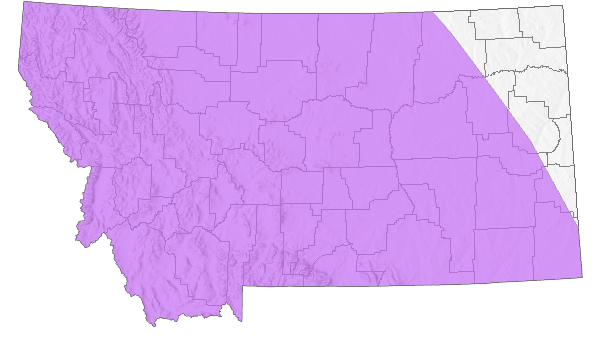
 Native
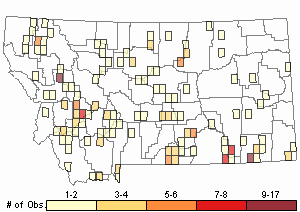
Observations in Montana Natural Heritage Program Database
Number of Observations: 310
(Click on the following maps and charts to see full sized version)
Map Help and Descriptions
Relative Density
Recency
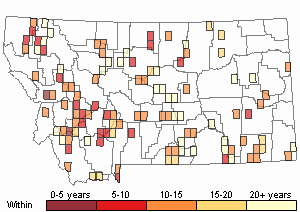
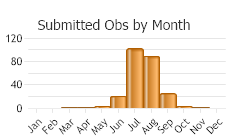
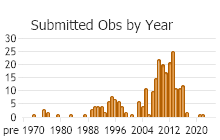
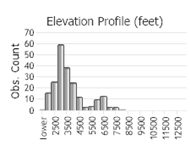 (Observations spanning multiple months or years are excluded from time charts)
Habitat
The habitat of the Pale Snaketail is usually sandy and rocky rivers and streams with moderate current in forested and open landscapes, as well as large sandy lakes in the northern part of their range (Dunkle 2000, Paulson 2009).
National Vegetation Classification System Groups Associated with this Species
Wetland and Riparian
Riparian and Wetland Forest
Riparian Shrubland
Food Habits
Larvae feed on a wide variety of aquatic insects, such as mosquito larvae, other aquatic fly larvae, mayfly larvae, and freshwater shrimp. They will also eat very small fish and tadpoles.
Adult- The dragonfly will eat almost any soft-bodied flying insect including mosquitoes, flies, small moths, mayflies, and flying ants or termites.
Reproductive Characteristics
In cooler temperatures, male Pale Snaketails patrol long reaches up and down shorelines usually near the head of riffles. However later in the day, they tend to perch in the shade more often than patrol. Copulation is lengthy and completed at rest. Female oviposit by repeated forays from rock or riffle perches out into water making making a single tap, then returning to their perch site (Dunkle 2000, Paulson 2009).
Stewardship Responsibility
References
- Literature Cited AboveLegend:
 View Online Publication
- Dunkle, S.W. 2000. Dragonflies through binoculars: A field guide to dragonflies of North America. New York, NY. Oxford University Press. 266 pp.
- Paulson, D.R. 2009. Dragonflies and Damselflies of the West. Princeton University Press, Princeton. 535 pp.
- Additional ReferencesLegend: View Online Publication
Do you know of a citation we're missing? Heaton, J.R. 1966. The benthos and drift fauna of a riffle in the Madison River, Yellowstone National Park. Ph.D. Dissertation. Bozeman, Montana: Montana State University. 59 p.
- Koelsch, Patrick Karl. 1975. Species diversity of stream insects as a measure of ecological stress for Post Creek, Lake County, Montana. M.S. Thesis. University of Montana. Missoula, MT.
- Sater, S. 2022. The insects of Sevenmile Creek, a pictorial guide to their diversity and ecology. Undergraduate Thesis. Helena, MT: Carroll College. 242 p.
- Web Search Engines for Articles on "Pale Snaketail"
- Additional Sources of Information Related to "Insects"