View in other NatureServe Network Field Guides
NatureServe
Montana
Utah
Wyoming
Idaho
Wisconsin
British Columbia
South Carolina
Yukon
California
New York
Sinuous Snaketail - Ophiogomphus occidentis
State Rank Reason (see State Rank above)
The sinuous snaketail is currently ranked S2S4 as a "potential species of concern" in Montana because it is potentially at risk of extirpation in the state due to limited and/or declining numbers, range and/or habitat, even though it may be abundant in some areas. Recent collections are expanding our knowledge and its known distribution in the state (Kohler, pers. comm.)
General Description
A more restrictive range western snaketail with distinctive anterior striped thorax (Paulson 2009). Found in slow flowing sandy to rocky streams and rivers throughout the western part of the state. Overlaps in the western part of the state with the Pale Snaketail, but can usually be found in larger streams than this species.
Diagnostic Characteristics
distinctive wavy striped thorax will distinguish this species from other snaketails(Paulson 2009), nymphs are inseperable.
Species Range
Montana Range
Range Descriptions
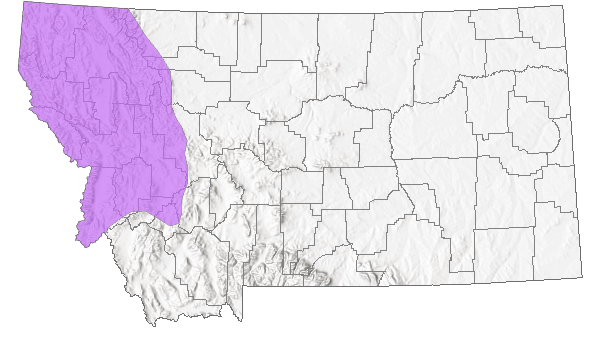
 Native
Range Comments
This species is widespread in western North America and has been reported in the following states: California (SNR), Montana (S2S4), Nevada (SNR), Oregon (SNR), Utah (SH), Washington (S5) and in
Canada's British Columbia (S4). It has not been reported in Idaho, but is most likely present , just not documented yet.
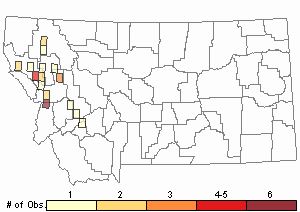
Observations in Montana Natural Heritage Program Database
Number of Observations: 33
(Click on the following maps and charts to see full sized version)
Map Help and Descriptions
Relative Density
Recency
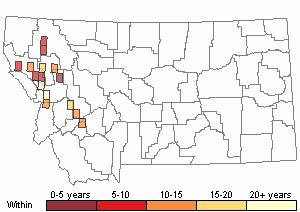
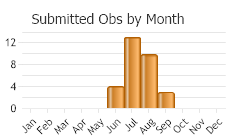
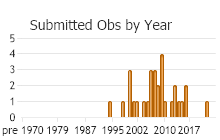
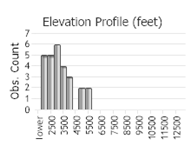 (Observations spanning multiple months or years are excluded from time charts)
Habitat
The Sinuous Snaketail prefers slow-flowing, sandy and gravelly, large streams and rivers usually in mountainous areas at lower elevations. They have also been encountered at lakes with rock or gravel bottoms in the northern part of their range, although it is unknown if they do indeed breed at these locations (Dunkle 2000, Paulson 2009).
National Vegetation Classification System Groups Associated with this Species
Wetland and Riparian
Riparian and Wetland Forest
Riparian Shrubland
Food Habits
Larvae feed on a wide variety of aquatic insects, such as mosquito larvae, other aquatic fly larvae, mayfly larvae, and freshwater shrimp. They will also eat very small fish and tadpoles.
Adult- The dragonfly will eat almost any soft-bodied flying insect including mosquitoes, flies, small moths, mayflies, and flying ants or termites.
Reproductive Characteristics
Both male and female Sinuous Snaketails tend to stay away from breeding sites early in the day, preferring to perch in nearby forested or shrubby flats instead. Males make long patrols through habitat searching for females and then often fly away from the water. Copulation occurs away from water, at rest and often high in trees. Females oviposit in rapid flight by tapping the water and splashing into water (Dunkle 2000, Paulson 2009).
Stewardship Responsibility
References
- Additional ReferencesLegend:
 View Online Publication
Do you know of a citation we're missing?- Dunkle, S.W. 2000. Dragonflies through binoculars: A field guide to dragonflies of North America. New York, NY. Oxford University Press. 266 pp.
- Paulson, D.R. 2009. Dragonflies and Damselflies of the West. Princeton University Press, Princeton. 535 pp.
- Web Search Engines for Articles on "Sinuous Snaketail"
- Additional Sources of Information Related to "Insects"