View in other NatureServe Network Field Guides
NatureServe
Montana
Utah
Wyoming
Idaho
Wisconsin
British Columbia
South Carolina
Yukon
California
New York
Gray Comma - Polygonia progne
General Description
[From Ferris and Brown 1981; Scott 1986; Opler and Wright 1999; Glassberg 2001; Guppy and Shepard 2001] Forewing 2.3-2.6 cm. Upperside bright orange-brown with a wide dark border; winter form (from 2nd flight) has a border covering only about 1/4 of the wing, both enclosing a few small yellow spots; underside charcoal gray and heavily striated, outer portion of forewing whitish with 3-4 light chevrons in a dark border, silver mark in center of hindwing is small, slender, L-shaped, tapered at both ends.
Shropshire and Tallamy (2025) provide a list, with synonymies, of 13,055 described native, exotic, and occasional straying Lepidoptera species of North America, north of Mexico; known but undescribed taxa, taxa with unresolved taxonomy, and excluded species are also included. The
main manuscript includes links to supplementary materials, including a reference list for Lepidoptera of North America north of Mexico, and a filterable spreadsheet with information on taxonomy, synonymy, size ranges of species, distribution by state, province, and country with references, and host-plant Family and Genus associations with references.
Phenology
One flight, mainly June and July north of southern Canada; two flights, late June to early July then August to early September elsewhere (Scott 1986; Glassberg 2001; Guppy and Shepard 2001).
Diagnostic Characteristics
Determined by a combination of upper hindwing black border wide with small yellow spots, underwing surfaces charcoal gray and heavily striated, silver-white "comma" on the under hindwing tapered at both ends.
Species Range
Montana Range
Range Descriptions
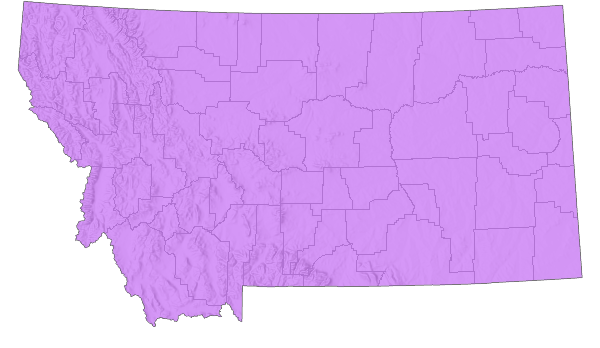
 Native
Range Comments
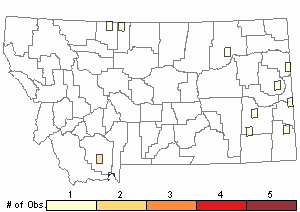
From central and northeastern British Columbia and southeastern Yukon Territory east through boreal Canada and the northern US to Maine and the Maritimes, south to the central US east of the Rocky Mountains (Scott 1996; Glassberg 2001; Guppy and Shepard 2001). In Montana, reported from at least 11 counties east of the mountains (Stanford and Opler 1993; FLMNH Lepidopterists' Society database; MNHP). Rare to uncommon (Glassberg 2001).
Shropshire and Tallamy (2025) provide a link to a supplemental filterable spreadsheet with information on distribution by state, province, and country with references for all Lepidoptera species of North America, north of Mexico.
Observations in Montana Natural Heritage Program Database
Number of Observations: 13
(Click on the following maps and charts to see full sized version)
Map Help and Descriptions
Relative Density
Recency
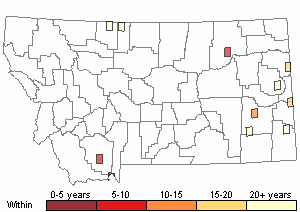
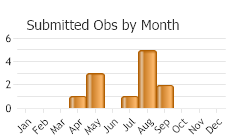
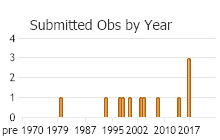
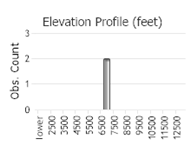 (Observations spanning multiple months or years are excluded from time charts)
Migration
Non-migratory.
Habitat
Deciduous woodlands, riparian woodlands, forest openings, aspen parkland (Opler and Wright 1999; Glassberg 2001; Guppy and Shepard 2001). Habitat in Montana not described.
Shropshire and Tallamy (2025) provide a link to a supplemental filterable spreadsheet with information on host-plant Family and Genus associations with references for all Lepidoptera species of North America, north of Mexico.
National Vegetation Classification System Groups Associated with this Species
Forest and Woodland
Deciduous Forest and Woodland
Low Elevation - Xeric Forest and Woodland
Montane - Subalpine Forest and Woodland
Shrubland
Foothills - Montane Shrubland
Sparse and Barren
Sparse and Barren
Wetland and Riparian
Riparian and Wetland Forest
Riparian Shrubland
Food Habits
Larval food plants primarily species of Ribes, also Betula, Rhododendron, rarely Ulmus. Adults feed on tree sap, rotten fruit, mud, rarely flower nectar (Ferris and Brown 1981; Scott 1984, 1986, 1992; Guppy and Shepard 2001).
Reproductive Characteristics
Females lay eggs singly mostly on the undersides of host plant leaves. Larvae rest on undersides of leaves or on stems; do not build nests. Develop through five larval instars prior to pupation; diapause (overwinter) as adults (Scott 1986). Males perch on small trees at edges of clearings to await passage of females.
Stewardship Responsibility
References
- Literature Cited AboveLegend:
 View Online Publication
 Ferris, C.D. and F.M. Brown (eds). 1981. Butterflies of the Rocky Mountains. Univ. of Oklahoma Press. Norman. 442 pp.
- Glassberg, J. 2001. Butterflies through Binoculars: A Field Guide to the Butterflies of Western North America. Oxford University Press.
- Guppy, C.S. and J.H. Shepard. 2001. Butterflies of British Columbia: including western Alberta, southern Yukon, the Alaska Panhandle, Washington, northern Oregon, northern Idaho, northwestern Montana. UBC Press (Vancouver, BC) and Royal British Columbia Museum (Victoria, BC). 414 pp.
- Opler, P.A. and A.B. Wright. 1999. A field guide to western butterflies. Second edition. Peterson Field Guides. Houghton Mifflin Company, Boston, Massachusetts. 540 pp.
- Scott, J.A. 1984. A review of Polygonia progne (oreas) and P. gracilis (zephyrus) (Nymphalidae), including a new subspecies from the southern Rocky Mountains. Journal of Research on the Lepidoptera. 23(3): 197-210.
- Scott, J.A. 1986. The butterflies of North America: a natural history and field guide. Stanford University Press, Stanford, California.
- Scott, J.A. 1992. Hostplant records for butterflies and skippers (mostly from Colorado) 1959-1992, with new life histories and notes on oviposition, immatures, and ecology. Papilio new series #6. 185 p.
- Stanford, R.E. and P.A. Opler. 1993. Atlas of western USA butterflies: including adjacent parts of Canada and Mexico. Unpubl. Report. Denver and Fort Collins, Colorado 275 pp.
- Additional ReferencesLegend: View Online Publication
Do you know of a citation we're missing?- Allen, T.J., J.P. Brock, and J. Glassberg. 2005. Caterpillars in the field and garden: a field guide to the butterfly caterpillars of North America. Oxford University Press.
- Brock, J.P. and K. Kaufman. 2003. Kaufman Field Guide to Butterflies of North America. Houghton Mifflin Company, New York, NY 284 pp.
- Forister, M.L., E.M. Grames, C.A. Halsch, K.J. Burls, C.F. Carroll, K.L. Bell, J.P. Jahner, et al. 2023. Assessing risk for butterflies in the context of climate change, demographic uncertainty, and heterogeneous data sources. Ecological Monographs 93(3):e1584. https://doi.org/10.1002/ecm.1584
- Layberry, R.A., P.W. Hall, and J.D. LaFontaine. 1998. The Butterflies of Canada. University of Toronto Press. 280 pp. + color plates.
- Shropshire, K.J. and D.W. Tallamy. 2025. Lepidoptera of North America, north of Mexico: an annotated list containing geographic ranges and host-plant records. Zookeys.1261:101-113.
- Web Search Engines for Articles on "Gray Comma"
- Additional Sources of Information Related to "Insects"