View in other NatureServe Network Field Guides
NatureServe
Montana
Utah
Wyoming
Idaho
Wisconsin
British Columbia
South Carolina
Yukon
California
New York
Prairie Shrew - Sorex haydeni
Other Names:
Hayden's Shrew
State Rank Reason (see State Rank above)
Species is rarely observed and faces threats from degradation of prairie habitats
General Description
Also known as the prairie shrew, Hayden’s shrew is small (total length about 8 cm) and brown across the back, blending to lighter brown on the sides and a whitish belly. Its tail is short relative to other species, and has a tuft of hair at its tip, brownish when viewed from below. (Foresman 2012)
Diagnostic Characteristics
Easily confused with the masked shrew (Sorex cinereus), though careful observation of the habitat where an individual is found may help distinguish the two. Positive identification requires detailed analysis of the skull. (Foresman 2012)
Species Range
Montana Range
Range Descriptions
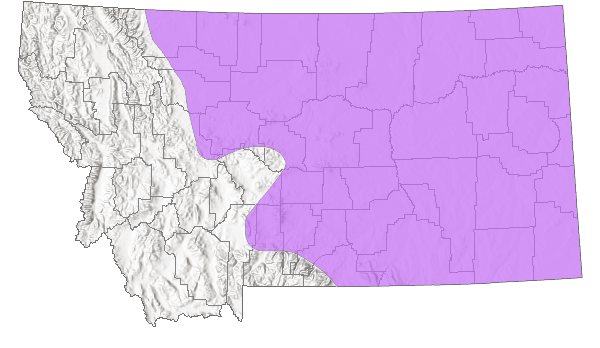
 Native
Western Hemisphere Range
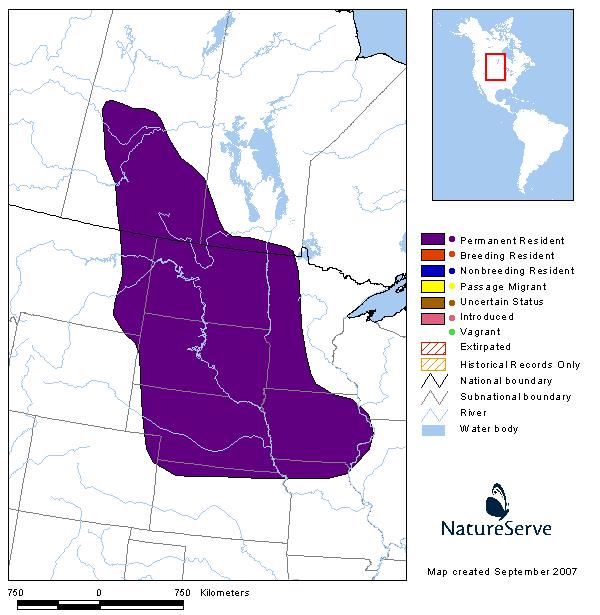
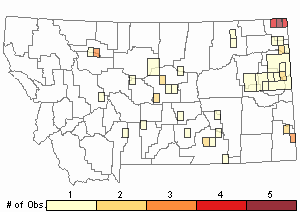
Observations in Montana Natural Heritage Program Database
Number of Observations: 58
(Click on the following maps and charts to see full sized version)
Map Help and Descriptions
Relative Density
Recency
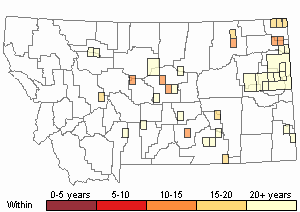

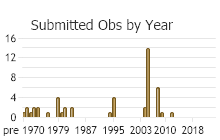
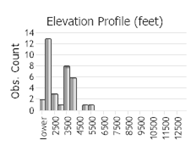 (Observations spanning multiple months or years are excluded from time charts)
Migration
Non-migratory.
Habitat
At the northern limits of its range in Canada, prefers drier, grassier habitats than does S. cinereus; in areas where the two species coexist, habitat segregation may occur (Foresman 2012).
National Vegetation Classification System Groups Associated with this Species
Forest and Woodland
Deciduous Forest and Woodland
Low Elevation - Xeric Forest and Woodland
Shrubland
Foothills - Montane Shrubland
Sagebrush Shrubland
Grassland
Lowland - Prairie Grassland
Sparse and Barren
Sparse and Barren
Wetland and Riparian
Alkaline - Saline Wetlands
Peatland
Riparian and Wetland Forest
Riparian Shrubland
Wet Meadow and Marsh
Recently Disturbed or Modified
Introduced Vegetation
Human Land Use
Agriculture
Developed
Food Habits
Diet comprised of a wide range of insects, earthworms, and small vertebrates.
Ecology
May construct short tunnels and runways. Sight and smell apparently well developed but may also use echolocation.
Reproductive Characteristics
Breeding likely occurs from late March through July or August. Gestation is about 20 days, and 1-2 litters of 3-6 young are produced yearly. (Foresman 2012)
Management
Only in recent decades has Hayden's shrew been recognized as its own species; as a result, specific ecological information is lacking and further investigation merited.
Stewardship Responsibility
References
- Literature Cited AboveLegend:
 View Online Publication
 Carraway, L.N. 1995. A key to recent Soricidae of the western United States and Canada based primarily on dentaries. Occasional Papers of the Natural History Museum, University of Kansas (175):1-49.
- Additional ReferencesLegend: View Online Publication
Do you know of a citation we're missing?
- Web Search Engines for Articles on "Prairie Shrew"
- Additional Sources of Information Related to "Mammals"