View in other NatureServe Network Field Guides
NatureServe
Montana
Utah
Wyoming
Idaho
Wisconsin
British Columbia
South Carolina
Yukon
California
New York
Lapland Longspur - Calcarius lapponicus
General Description
Sexually dimorphic in breeding (Alternate) plumage; sexes similar in winter (Basic) plumage. In breeding plumage, both sexes have upperparts blackish streaked with buff and rufous nape and greater-coverts. Underparts whitish with black streaking on flanks, and dark tail with outermost feather white. In the male, nape is bright rufous orange; crown, lores, ear-coverts, chin, throat, and upper breast black, forming a distinctive facial mask. Females relatively nondescript without black facial mask and with remaining colors duller. Center of chin and throat white. In winter, both sexes and all ages are much like summer females, but tend to be browner and paler.
For a comprehensive review of the conservation status, habitat use, and ecology of this and other Montana bird species, please see
Marks et al. 2016, Birds of Montana.Species Range
Montana Range
Range Descriptions
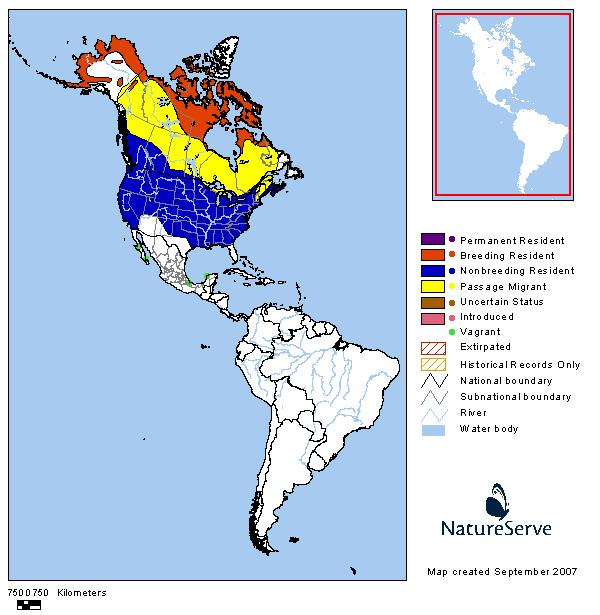
 Western Hemisphere Range
 eBird Occurrence Map
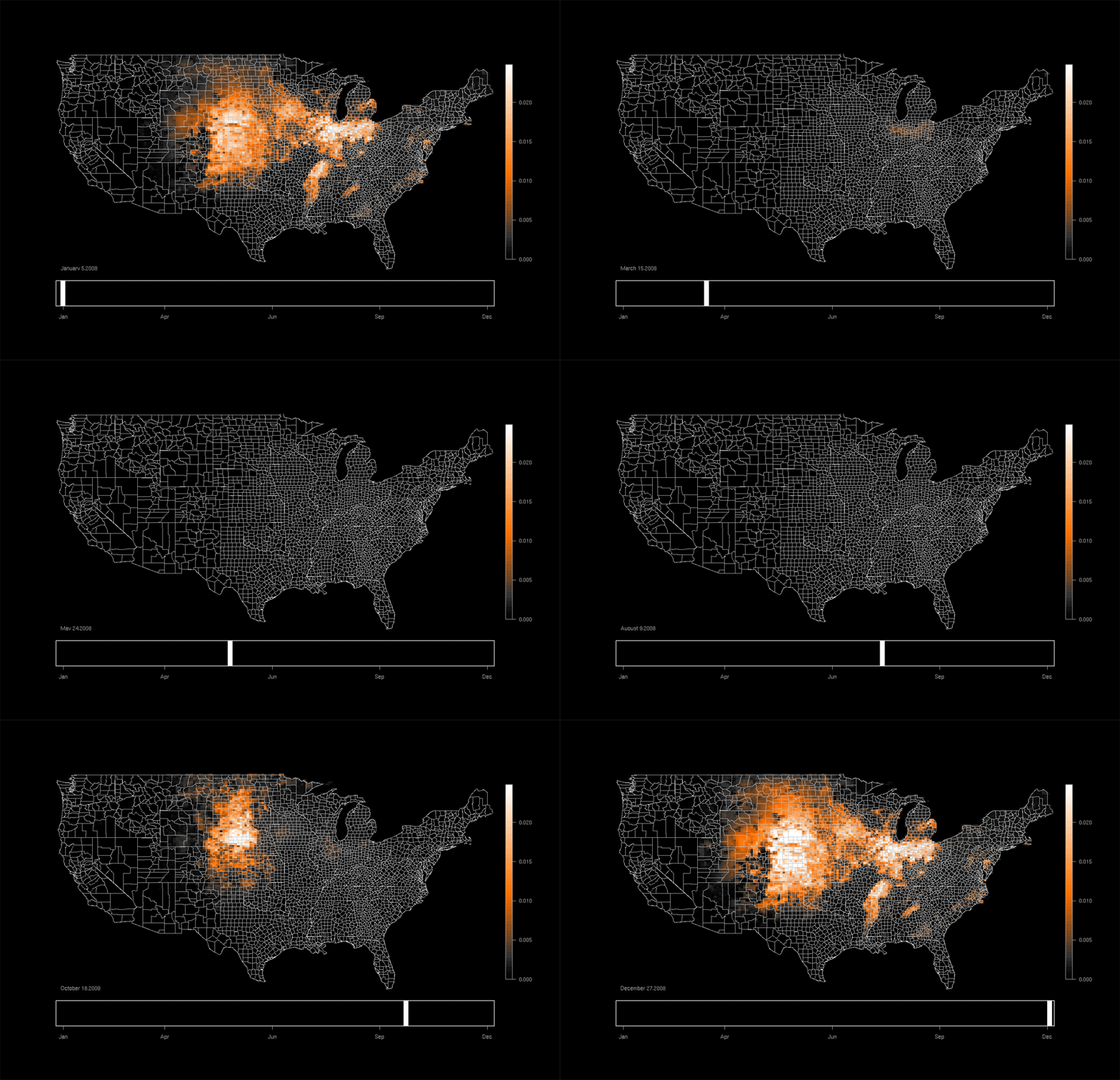
Click the map for more info.
Courtesy of

and

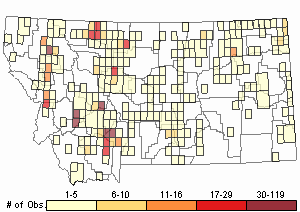
Observations in Montana Natural Heritage Program Database
Number of Observations: 1338
(Click on the following maps and charts to see full sized version)
Map Help and Descriptions
Relative Density
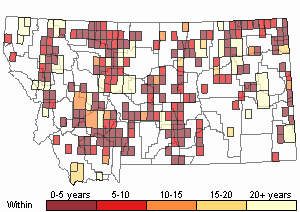
Recency
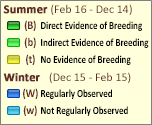
SUMMER (Feb 16 - Dec 14)
Direct Evidence of Breeding
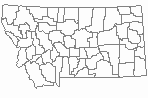
Indirect Evidence of Breeding
No Evidence of Breeding
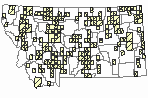
WINTER (Dec 15 - Feb 15)
Regularly Observed
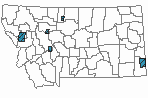
Not Regularly Observed
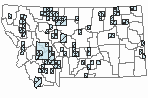

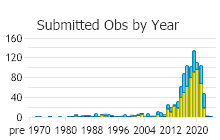
 (Observations spanning multiple months or years are excluded from time charts)
Migration
In the Bozeman area, normal migration periods are October 20 to December 15 and March 1 to April 15, with a peak on March 20.
Habitat
Species found in open areas, such as fields, pastures, and tundra. Species found on ground; rarely perches.
National Vegetation Classification System Groups Associated with this Species
Forest and Woodland
Deciduous Forest and Woodland
Low Elevation - Xeric Forest and Woodland
Montane - Subalpine Forest and Woodland
Shrubland
Sagebrush Shrubland
Grassland
Lowland - Prairie Grassland
Montane - Subalpine Grassland
Wetland and Riparian
Alkaline - Saline Wetlands
Peatland
Riparian and Wetland Forest
Wet Meadow and Marsh
Recently Disturbed or Modified
Insect-Killed Forest
Introduced Vegetation
Human Land Use
Agriculture
Developed
Food Habits
Diet consists of seeds, grasses and invertebrates.
Reproductive Characteristics
Single brooded species with four to six eggs per brood. Incubation period 12 to 13 days. Young able to fly eight to ten days after hatch.
Stewardship Responsibility
References
- Literature Cited AboveLegend:
 View Online Publication
- Marks, J.S., P. Hendricks, and D. Casey. 2016. Birds of Montana. Arrington, VA. Buteo Books. 659 pages.
- Additional ReferencesLegend: View Online Publication
Do you know of a citation we're missing?- American Ornithologists’ Union [AOU]. 1998. Check-list of North American birds, 7th edition. American Ornithologists’ Union, Washington, D.C. 829 p.
- Bird Conservancy of the Rockies. 2017. Pocket Guide to Northern Prairie Birds. Brighton, CO: Bird Conservancy of the Rockies. 98 p.
- Cameron, E. S. 1907. The birds of Custer and Dawson counties, Montana. Auk 24(3):389-406.
- Ehrlich, P., D. Dobkin, and D. Wheye. 1988. The birder’s handbook: a field guide to the natural history of North American birds. Simon and Schuster Inc. New York. 785 pp.
 Farrand, J. 1983. Audubon Society Master Guide to Birding, No. 2 Gulls to Dippers. Alfred A. Knopf, Inc. New York. New York, pp 176-178.
- Gniadek, S. 1983. Southwest Glendive Wildlife Baseline Inventory. Miles City, Mont: Bureau of Land Management, Miles City District Office. 56 pp with appendices.
- Hays, R., R.L. Eng, and C.V. Davis (preparers). 1984. A list of Montana birds. Helena, MT: MT Dept. of Fish, Wildlife & Parks.
- Hoffmann, R.S., R.L. Hand, and P.L. Wright. 1959. Recent bird records from western Montana. The Condor 61(2):147-151.
- Hussell, D. J., and R. M. Montgomerie. 2002. Lapland Longspur (Calcarius lapponicus). In The birds of North America, No. 656 (A. Poole and F. Gill, Eds.). Academy of Natural Sciences of Philadelphia and American Ornithologists’ Union.
- Johnsgard, P.A. 1992. Birds of the Rocky Mountains with particular reference to national parks in the northern Rocky Mountain region. Lincoln: University of Nebraska Press. xi + 504 pp.
- Joslin, Gayle, and Heidi B. Youmans. 1999. Effects of recreation on Rocky Mountain wildlife: a review for Montana. [Montana]: Montana Chapter of the Wildlife Society.
- Lenard, S., J. Carlson, J. Ellis, C. Jones, and C. Tilly. 2003. P. D. Skaar's Montana bird distribution, 6th edition. Montana Audubon, Helena, MT. 144 pp.
- Montana Bird Distribution Committee. 2012. P.D. Skaar's Montana bird distribution. 7th Edition. Montana Audubon, Helena, Montana. 208 pp. + foldout map.
- Oechsli, L.M. 2000. Ex-urban development in the Rocky Mountain West: consequences for native vegetation, wildlife diversity, and land-use planning in Big Sky, Montana. M.Sc. Thesis. Montana State University, Bozeman. 73 p.
- Rising, J.D. 1996. A guide to the identification and natural history of the sparrows of the United States and Canada. Academic Press, Inc., San Diego, CA. 365 pp.
- Sater, S. 2022. The insects of Sevenmile Creek, a pictorial guide to their diversity and ecology. Undergraduate Thesis. Helena, MT: Carroll College. 242 p.
- Saunders, A.A. 1914. The birds of Teton and northern Lewis & Clark counties, Montana. Condor 16:124-144.
- Sibley, D. 2014. The Sibley guide to birds. Alfred A. Knopf, New York, NY. 598 pp.
- Skaar, P. D., D. L. Flath, and L. S. Thompson. 1985. Montana bird distribution. Montana Academy of Sciences Monograph 3(44): ii-69.
- Skaar, P.D. 1969. Birds of the Bozeman latilong: a compilation of data concerning the birds which occur between 45 and 46 N. latitude and 111 and 112 W. longitude, with current lists for Idaho, Montana, Wyoming, impinging Montana counties and Yellowstone National Park. Bozeman, MT. 132 p.
- Taylor, D.M. and C.H. Trost. 1987. The status of historically rare of unrecorded birds in Idaho. Unpublished manuscript. 68 p.
- Thompson, L.S. 1981. Circle West wildlife monitoring study: Third annual report. Technical report No. 8. Montana Department of Natural Resources and Conservation. Helena, Montana.
- U.S. Forest Service. 1991. Forest and rangeland birds of the United States: Natural history and habitat use. U.S. Department of Agriculture, Forest Service Agricultural Handbook 688. 625 pages.
- Watts, C.R. and L.C. Eichhorn. 1981. Changes in the birds of central Montana. Proceedings of the Montana Academy of Sciences 40:31-40.
- Web Search Engines for Articles on "Lapland Longspur"
- Additional Sources of Information Related to "Birds"