View in other NatureServe Network Field Guides
NatureServe
Montana
Utah
Wyoming
Idaho
Wisconsin
British Columbia
South Carolina
Yukon
California
New York
Greater White-fronted Goose - Anser albifrons
General Description
Easily recognized as only gray-brown goose with pinkish bill and orange feet; paler chest and black patches on lower breast and belly.
For a comprehensive review of the conservation status, habitat use, and ecology of this and other Montana bird species, please see
Marks et al. 2016, Birds of Montana.Species Range
Montana Range
Range Descriptions
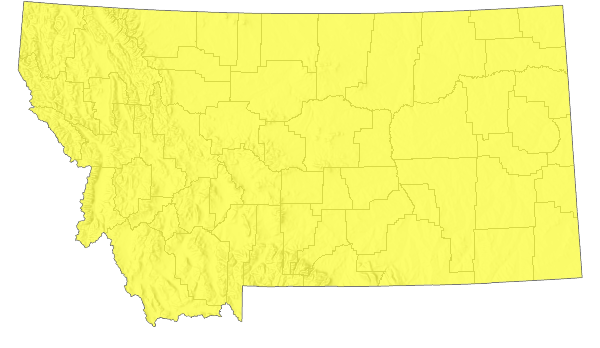
 Migratory
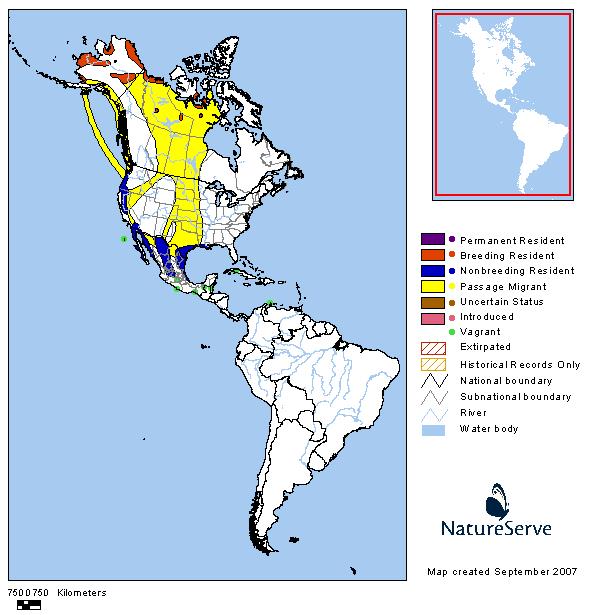
Western Hemisphere Range
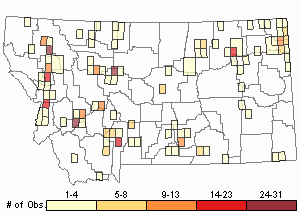
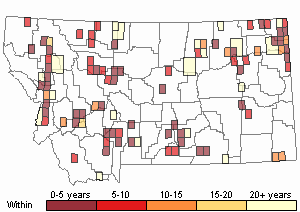
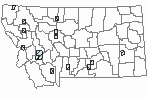
Observations in Montana Natural Heritage Program Database
Number of Observations: 484
(Click on the following maps and charts to see full sized version)
Map Help and Descriptions
Relative Density
Recency
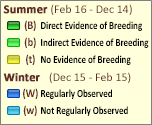
SUMMER (Feb 16 - Dec 14)
Direct Evidence of Breeding
Indirect Evidence of Breeding
No Evidence of Breeding
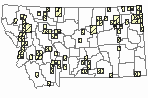
WINTER (Dec 15 - Feb 15)
Regularly Observed
Not Regularly Observed

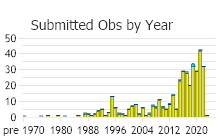
 (Observations spanning multiple months or years are excluded from time charts)
Migration
The main migration routes are to the east and west of Montana.
Habitat
Nests generally located in moderate to dense cover of grasses and sedges or dwarf shrubs.
National Vegetation Classification System Groups Associated with this Species
Wetland and Riparian
Alkaline - Saline Wetlands
Peatland
Riparian and Wetland Forest
Wet Meadow and Marsh
Human Land Use
Agriculture
Developed
Food Habits
Diet consists of both aquatic and terrestrial plant matter, seeds, grains, and grasses.
Reproductive Characteristics
Single brooded species with five to six eggs per brood. Incubation period 23 to 25 days. Young able to fly 45 days after hatch.
Stewardship Responsibility
References
- Literature Cited AboveLegend:
 View Online Publication
- Marks, J.S., P. Hendricks, and D. Casey. 2016. Birds of Montana. Arrington, VA. Buteo Books. 659 pages.
- Additional ReferencesLegend: View Online Publication
Do you know of a citation we're missing?- American Ornithologists’ Union [AOU]. 1998. Check-list of North American birds, 7th edition. American Ornithologists’ Union, Washington, D.C. 829 p.
- Ehrlich, P., D. Dobkin, and D. Wheye. 1988. The birder’s handbook: a field guide to the natural history of North American birds. Simon and Schuster Inc. New York. 785 pp.
 Ely, C.R. and A.X. Dzubin. 1994. Greater White-fronted Goose (Anser albifrons). Species Account Number 131. The Birds of North America Online (A. Poole, Ed.). Ithaca, NY: Cornell Laboratory of Ornithology; Retrieved 3/25/2008 from The Birds of North America Online database
- Hays, R., R.L. Eng, and C.V. Davis (preparers). 1984. A list of Montana birds. Helena, MT: MT Dept. of Fish, Wildlife & Parks.
- Hildebrand, B. D. 1979. Habitat requirements of molting Canada Geese at Lima Reservoir, Montana. M.Sc. Thesis. Bozeman, MT: Montana State University. 79 p.
- Hoffmann, R.S., R.L. Hand, and P.L. Wright. 1959. Recent bird records from western Montana. The Condor 61(2):147-151.
- Johnsgard, P.A. 1975. Waterfowl of North America. Bloomington, IN: Indiana University Press. 575 p.
- Johnsgard, P.A. 1992. Birds of the Rocky Mountains with particular reference to national parks in the northern Rocky Mountain region. Lincoln: University of Nebraska Press. xi + 504 pp.
- Joslin, Gayle, and Heidi B. Youmans. 1999. Effects of recreation on Rocky Mountain wildlife: a review for Montana. [Montana]: Montana Chapter of the Wildlife Society.
- Krapu, G.L., K.J. Reinecke, D.G. Jorde and S.G. Simpson. 1995. Spring-staging ecology of midcontinent Greater White-fronted Geese. J. Wildl. Manage. 59(4): 736-746.
- Lenard, S., J. Carlson, J. Ellis, C. Jones, and C. Tilly. 2003. P. D. Skaar's Montana bird distribution, 6th edition. Montana Audubon, Helena, MT. 144 pp.
- Montana Bird Distribution Committee. 2012. P.D. Skaar's Montana bird distribution. 7th Edition. Montana Audubon, Helena, Montana. 208 pp. + foldout map.
- Oechsli, L.M. 2000. Ex-urban development in the Rocky Mountain West: consequences for native vegetation, wildlife diversity, and land-use planning in Big Sky, Montana. M.Sc. Thesis. Montana State University, Bozeman. 73 p.
- Palmer, R.S. 1962. Handbook of North American birds. Volume 1. Loons through flamingos. Yale University Press, New Haven. 567 pp.
- Rhodes, O.E., Jr., L.M. Smith and M.H. Smith. 1991. Conservation and genetic resources in waterfowl. Trans. N. Amer. Wildl. & Nat. Res. Conf. 56:462-472.
- Sibley, D. 2014. The Sibley guide to birds. Alfred A. Knopf, New York, NY. 598 pp.
- Skaar, P. D., D. L. Flath, and L. S. Thompson. 1985. Montana bird distribution. Montana Academy of Sciences Monograph 3(44): ii-69.
- Skaar, P.D. 1969. Birds of the Bozeman latilong: a compilation of data concerning the birds which occur between 45 and 46 N. latitude and 111 and 112 W. longitude, with current lists for Idaho, Montana, Wyoming, impinging Montana counties and Yellowstone National Park. Bozeman, MT. 132 p.
- U.S. Forest Service. 1991. Forest and rangeland birds of the United States: Natural history and habitat use. U.S. Department of Agriculture, Forest Service Agricultural Handbook 688. 625 pages.
- Watts, C.R. and L.C. Eichhorn. 1981. Changes in the birds of central Montana. Proceedings of the Montana Academy of Sciences 40:31-40.
- Web Search Engines for Articles on "Greater White-fronted Goose"
- Additional Sources of Information Related to "Birds"