View in other NatureServe Network Field Guides
NatureServe
Montana
Utah
Wyoming
Idaho
Wisconsin
British Columbia
South Carolina
Yukon
California
New York
Sparrow's-egg Lady's-slipper - Cypripedium passerinum
State Rank Reason (see State Rank above)
Sparrow's-egg lady's-slipper is known from over a dozen moderate to large-sized populations, a few dozen small occurrences and one historical location. Several of the occurrences are either in designated wilderness areas or in Glacier National Park. The main threat to populations appears to be from potential hydrologic changes.
- Details on Status Ranking and Review
Population Size
Score2 - Small: Generally 2,000-10,000 individuals.
Range Extent
Score1 - Peripheral, Disjunct or Sporadic Distribution in MT: Widespread species that is peripheral, disjunct or sporadically distributed within MT such that it occurs in <5% of the state (<7,500 sq. miles or the combined area of Beaverhead and Ravalli Counties) or is restricted to 4-5 sub-basins.
Area of Occupancy
Score1 - Moderate: Generally occurring in 11-25 Subwatersheds (6th Code HUC’s).
Environmental Specificity
Score1-2 - Moderate to High.
Trends
Score0-2 - Stable to Moderate Declines:
CommentTrend data are largely unavailable. Habitat generally appears to be stable and it does not appear likely that severe declines have occurred, though it is possible that minor or moderate declines have occurred or may be occuring across the species' range in Montana.
Threats
Score1-2 - Medium to High.
CommentThough impacts may be occurring or likely at some locations, the magnitude or immediacy of threats to the species or its habitat do not appear to be severe.
Intrinsic Vulnerability
Score2 - High Vulnerability: Very specific biological attributes, unusual life history characteristics or limited reproductive potential makes the species highly susceptible to extirpation from stochastic events or other adverse impacts to its habitat and very slow to recover.
Raw Conservation Status Score
Score
8 to 12 total points scored out of a possible 19.
General Description
Sparrow's-egg Lady's-slipper is a perennial with leafy stems reaching up to 35 cm high and arising from slender, creeping rhizomes. The 3-5 broadly lance-shaped leaves reach up to 15 cm long and clasp the stem; the herbage is covered with long, soft hairs and is usually somewhat sticky. The one or two flowers are subtended by a leafy bract which is longer than the inflorescence. The sepals are green and 10-16 mm long, and the upper is longer than the lower two. The petals are white; the lower is pouch-like with purple spots on the inside, and the other two resemble the sepals but are shorter. The erect capsule is ovoid and bears thousands of tiny seeds.
Phenology
Flowering in late June-early August.
Diagnostic Characteristics
This species can be distinguished from our other white lady's slipper (C. montanum) by the sepals that are shorter than the slipper-like petal and not wavy or twisted.
Species Range
Montana Range
Range Descriptions
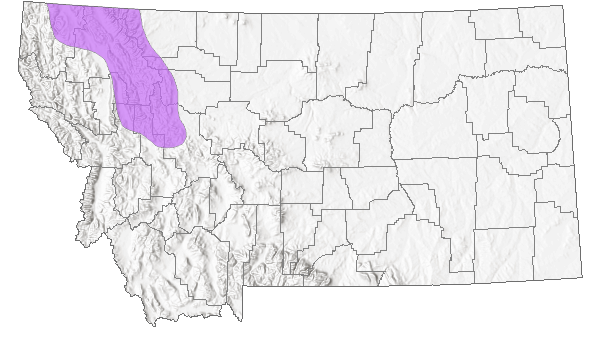
 Native
Range Comments
AK and Yukon to Hudson Bay and Quebec, south to southeastern BC, northern MT, and to the region of Lake Superior. Peripheral.
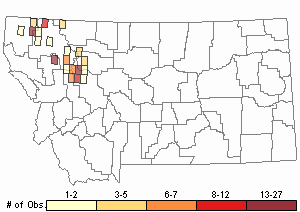
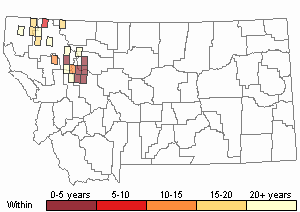
Observations in Montana Natural Heritage Program Database
Number of Observations: 158
(Click on the following maps and charts to see full sized version)
Map Help and Descriptions
Relative Density
Recency
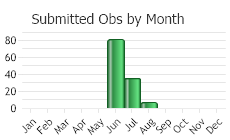
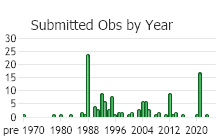
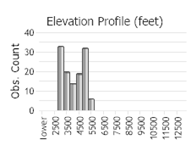 (Observations spanning multiple months or years are excluded from time charts)
Habitat
Mossy, moist, or seepy places in coniferous forests, often on calcareous substrates.
National Vegetation Classification System Groups Associated with this Species
Forest and Woodland
Montane - Subalpine Forest and Woodland
Wetland and Riparian
Peatland
Riparian and Wetland Forest
Stewardship Responsibility
Threats or Limiting Factors
STATE THREAT SCORE REASON
Reported threats to Montana's populations of Sparrow’s-egg Lady’s-slipper refer to development and activity related to recreation (MTNHP Threat Assessment 2021). Several populations occur along the trails of Glacier National Park (GNP) where visitation has increased substantially in recent years. Trail maintenance, especially proposed trail-widening, and trampling by hikers poses minor risk to GNP populations. Threat of non-native plant spread is a concern as exposure increases with visitation.
References
- Literature Cited AboveLegend:
 View Online Publication
 MTNHP Threat Assessment. 2021. State Threat Score Assignment and Assessment of Reported Threats from 2006 to 2021 for State-listed Vascular Plants. Botany Program, Montana Natural Heritage Program, Helena, Montana.
- Additional ReferencesLegend: View Online Publication
Do you know of a citation we're missing?- Arditti, J., J.D. Michaud and P.L. Healey. 1979. Morphometry of orchid seeds. I. Paphiopedilum and native California and related species of Cypripedium. American Journal of Botany 66(10):1128-1137.
- Catling, P. M. 1983. Autogamy in eastern Canadian Orchidaceae: a review of current knowledge and some new observations. Naturaliste Canada 110:37-53.
- Hoitsma, T. 1992. Sensitive Plant Survey, Fortine Ranger District, Kootenai National Forest. [Unpublished Report] 65 pp. plus appendices.
- Horn, G. 1980. Report on inventory of threatened or endangered, rare, or sensitive plants-Headwaters Resource Area, Butte District, Bureau of Land Management, Montana. Unpublished report. 54 pp.
- Keddy, C.J., Keddy, P.A. and R.J. Planck. 1983. An ecological study of Cypripedium passerinum Rich. (sparrow's egg lady-slipper, Orchidaceae) on the north shore of Lake Superior. Canadian Field-Naturalist 97(3):268-274.
- Lesica, P., M.T. Lavin, and P.F. Stickney. 2012. Manual of Montana Vascular Plants. Fort Worth, TX: BRIT Press. viii + 771 p.
- Lesica, P., M.T. Lavin, and P.F. Stickney. 2022. Manual of Montana Vascular Plants, Second Edition. Fort Worth, TX: BRIT Press. viii + 779 p.
- Linden, B. 1980. Aseptic germination of seeds of northern terrestrial orchids. Ann. Bot. Fennici 17:174-182.
- Shelly, J.S. 1988. Status review of Cypripedium passerinum, U.S. Forest Service, Region 1, Flathead and Lewis & Clark National Forests. Unpublished report. Montana Natural Heritage Program, Helena, MT 52 pp.
- St-Arnaud, M. and D. Barabe. 1989. Comparative analysis of the flower vascularization of some Cypripedium species (Orchidaceae). Lindleyana 4(3):146-153.
- Vanderhorst, J.P. 1996. Status report on sensitive lady's slipper orchids (Cypripedium calceolus var. parviflorum and Cypripedium passerinum) on the Kootenai National Forest. Unpublished report to the Kootenai National Forest. Montana Natural Heritage Program, Helena, MT 27 pp. plus appendices.
- Web Search Engines for Articles on "Sparrow's-egg Lady's-slipper"