View in other NatureServe Network Field Guides
NatureServe
Montana
Utah
Wyoming
Idaho
Wisconsin
British Columbia
South Carolina
Yukon
California
New York
Round-leaved Orchis - Amerorchis rotundifolia
Other Names:
Orchis rotundifolia
State Rank Reason (see State Rank above)
Amerorchis rotundifolia is a relatively rare orchid, restricted to fens and wetlands in northwest and north-central Montana, on both sides of the Continental Divide. The species' habitat is largely intact and stable, giving credence for a more or less stable population trend. Population counts are imprecise, but data suggests there could be over 10,000 plants. Reported threats at various occurrences include the presence of invasive plant species, livestock grazing, and people picking flowers; however, none of these threats are widespread or significant in impact. In addition, shifts in climate may negatively impact Amerorchis rotundifolia over the next decade or longer, particularly from the effects of increased temperatures and/or increased frequency and severity of droughts. However, impacts from a shifting climate remain unknown.
Surveys that bring forth current information on population counts, habitat quality, and assess for threats at known occurrences is needed. Monitoring at a subset of sites to assess short- and long-term population trends is greatly needed.
General Description
Round-leaved Orchis is a glabrous, rhizomatous perennial with a single sub-basal leaf and a stem 10-20 cm tall. Leaf is elliptic to orbicular with a rounded tip, and is up to 10 cm long. The few to several flowers terminate the stem in a narrow inflorescence. There are 3 white to pale pink sepals. The upper is hood-shaped, 6-10 mm long, and slightly larger than the lateral ones; the 2 upper petals are narrowly lance-shaped. The large, lower petal (lip) is up to 9 mm long, white, spotted with purple, and deeply 3-lobed with a pair of lateral lobes and a notched lower one. The capsule is elliptic and contains thousands of tiny seeds.
Phenology
Flowering in late June-early July.
Diagnostic Characteristics
This species is easy to recognize by the single leaf and distinctive flower. Calypso bulbosa also has a single leaf but the pink flowers are solitary and much larger.
Species Range
Montana Range
Range Descriptions
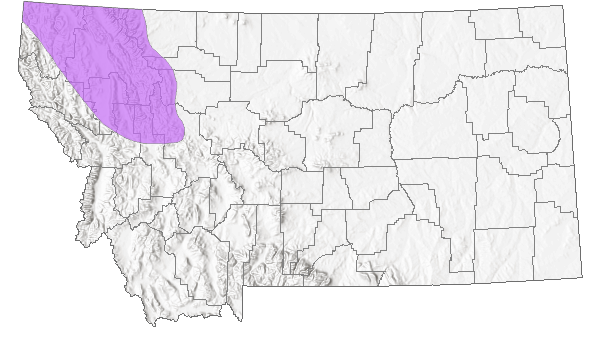
 Native
Range Comments
AK to Greenland south to WY, MI, NY (Lesica et al. 2012. Manual of Montana Vascular Plants. BRIT Press. Fort Worth, TX).
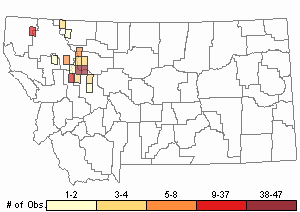
Observations in Montana Natural Heritage Program Database
Number of Observations: 215
(Click on the following maps and charts to see full sized version)
Map Help and Descriptions
Relative Density
Recency
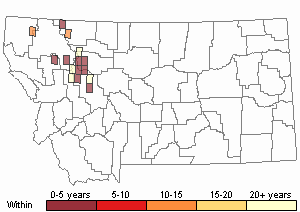

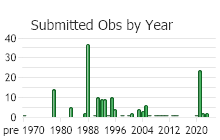
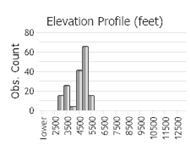 (Observations spanning multiple months or years are excluded from time charts)
Habitat
Spruce forest around seeps or along streams, often in soil derived from limestone.
National Vegetation Classification System Groups Associated with this Species
Wetland and Riparian
Peatland
Riparian and Wetland Forest
Riparian Shrubland
Stewardship Responsibility
Threats or Limiting Factors
STATE THREAT SCORE REASON
Reported threats to Montana’s populations of Round-leaved Orchis are attributed to noxious weeds, livestock use, and recreational use (MTNHP Threat Assessment 2021). Several populations are found in the vicinity of noxious weed populations, within grazing allotments, and along hiking trails. Impacts from individual threats are relatively minor. However, co-occurring threats are ongoing in the vicinity of several populations, and these are known to inflict stronger impacts. Potential threats from people collecting Round-leaved Orchis are acknowledged, but the severity of impacts related to collection activity is not known.
References
- Literature Cited AboveLegend:
 View Online Publication
- Lesica, P., M.T. Lavin, and P.F. Stickney. 2012. Manual of Montana Vascular Plants. Fort Worth, TX: BRIT Press. viii + 771 p.
 MTNHP Threat Assessment. 2021. State Threat Score Assignment and Assessment of Reported Threats from 2006 to 2021 for State-listed Vascular Plants. Botany Program, Montana Natural Heritage Program, Helena, Montana.
- Additional ReferencesLegend: View Online Publication
Do you know of a citation we're missing?- Chadde, Steve. Sensitive Plant Survey, Pinkham Analysis Area, Kootenai National Forest. Unpublished Report, 26 Pp. Plus Appendices.
- Fertig, W. and G. Jones. 1992. Plant communities and rare plant species of the Swamp Lake Botanical Area, Clark's Fork Ranger District, Shoshone National Forest. Unpublished report to the Shoshone National Forest. Challenge Cost Share Agreement No. CSA-2-91-14-0001. Wyoming Natural Diversity Database. 113+ pp.
- Handley, J. and B. Heidel. 2005. Amerorchis rotundifolia (Banks ex Pursh) Hultén (roundleaf orchid): a technical conservation assessment. USDA Forest Service, Rocky Mountain Region, Species Conservation Project. 37 p.
- Hoitsma, T. 1992. Sensitive Plant Survey, Fortine Ranger District, Kootenai National Forest. [Unpublished Report] 65 pp. plus appendices.
- Lesica, P., M.T. Lavin, and P.F. Stickney. 2022. Manual of Montana Vascular Plants, Second Edition. Fort Worth, TX: BRIT Press. viii + 779 p.
- Shelly, J.S. 1988. Status review of Orchis [Amerorchis] rotundifolia, U.S. Forest Service, Region 1, Flathead and Lewis & Clark National Forests, Montana. Unpublished report. Montana Natural Heritage Program, Helena, MT 59 pp.
- Web Search Engines for Articles on "Round-leaved Orchis"