View in other NatureServe Network Field Guides
NatureServe
Montana
Utah
Wyoming
Idaho
Wisconsin
British Columbia
South Carolina
Yukon
California
New York
State Rank Reason (see State Rank above)
DRAFT: Requesting feedback on the 2026 revised rank, factors, and State Rank Reason outlined below and in the Conservation Status Rank Report.
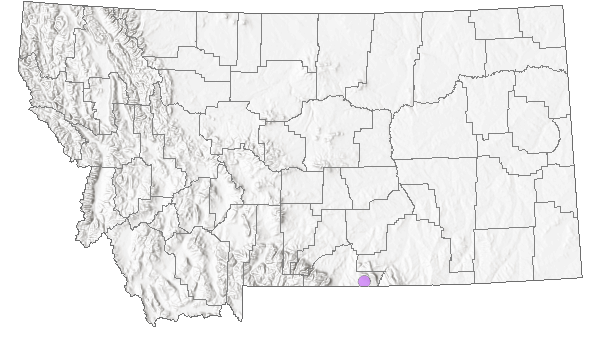
Nama densum is extremely rare in the state, being known from only one collection from 1991 in Carbon County at its northern range extent. The population size and extent are unknown, but it is apparently small.
A survey of the previous collection site is needed to attempt to relocate and document the current status of the population. Documentation of the size, extent, habitat and potential threats is needed. Additional surveys of potentially suitable habitat in the vicinity of the known population are needed.
General Description
Nama is a small annual with several prostrate, branched stems that are up to 10 cm long and radiating from the central taproot. The alternate leaves are narrowly oblong and up to 4 cm long. The foliage is covered with short hair. Flowers are solitary in the axils of the crowded upper leaves. The white to pale, lavendar corollas have a 2-5 mm long tube and 5 rounded lobes. The 5 stamens are inside the tube. The 5-lobed calyx is covered with stiff, long hairs. Globose capsules contain numerous seeds.
Our plants are variety parviflorum (Greenm.) C.L. Hitchc.
Phenology
Flowers are produced in early June.
Diagnostic Characteristics
Species of Phlox have opposite leaves. Nemophila and Ellisia are also prostrate annuals, but they have divided leaves.
Species Range
Montana Range
Range Descriptions
 Native
Range Comments
WA to MT south to CA, NV, UT, CO. Known from Carbon County (Lesica et al. 2012. Manual of Montana Vascular Plants. BRIT Press. Fort Worth, TX).
Observations in Montana Natural Heritage Program Database
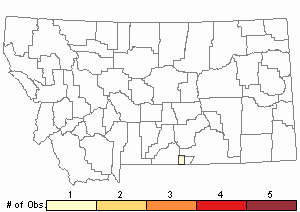
Number of Observations: 1
(Click on the following maps and charts to see full sized version)
Map Help and Descriptions
Relative Density
Recency
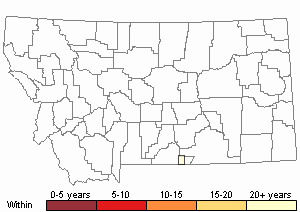
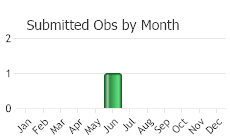
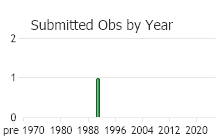
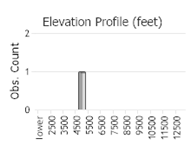 (Observations spanning multiple months or years are excluded from time charts)
Habitat
Nama grows very locally along the southern base of the Pryor Mountains in sandy soil weathered from outcrops of calcareous sandstone and dominated by Artemisia tridentata and Stipa comata (Lesica and Achuff 1992). Other associates include Chrysothamnus viscidiflorus, Phacelia ivesiana, Gilia inconspicua, Gilia leptomeria, and Streptanthelia longirostris.
National Vegetation Classification System Groups Associated with this Species
Forest and Woodland
Low Elevation - Xeric Forest and Woodland
Montane - Subalpine Forest and Woodland
Shrubland
Sagebrush Shrubland
Sparse and Barren
Sparse and Barren
Ecology
Nama is an annual, suggesting that population sizes may vary greatly between years and may respond positively to moderate levels of disturbance. No plants could be found at the site of its discovery two years later, however seeds of annual species may remain dormant in drought years.
Cronquist et al. (1984) consider N. densum as a small-flowered, autogamous close relative of the larger-flowered, presumably outcrossing, N. aretioides. This suggests that pollinators are not needed for seed set.
Management
The single known Montana population of Nama densum is subject to cattle grazing. However, this low annual is probably favored by moderate levels of disturbance that create open ground for seedling establishment and decrease competition from larger perennial species. This population also lies near primitive roads used for vehicular travel.
Stewardship Responsibility
Threats or Limiting Factors
STATE THREAT SCORE REASON
Reported threats to Montana's populations of Nama are currently assigned as unknown (MTNHP Threat Assessment 2021). The only known population is located where it is potentially exposed to recreation activities, but severity of impacts is not known. Information on threats to the Nama population is needed.
References
- Literature Cited AboveLegend:
 View Online Publication
- Lesica, P., M.T. Lavin, and P.F. Stickney. 2012. Manual of Montana Vascular Plants. Fort Worth, TX: BRIT Press. viii + 771 p.
 MTNHP Threat Assessment. 2021. State Threat Score Assignment and Assessment of Reported Threats from 2006 to 2021 for State-listed Vascular Plants. Botany Program, Montana Natural Heritage Program, Helena, Montana.
- Additional ReferencesLegend: View Online Publication
Do you know of a citation we're missing?- Cronquist, A., A.H. Holmgren, N.H. Holmgren, J.L. Reveal, and P.K. Holmgren. 1984. Intermountain Flora: Vascular Plants of the Intermountain West, U.S.A. Vol. 4, Subclass Asteridae (except Asteraceae). Bronx, NY: New York Botanical Garden. 573 pp.
- Lesica, P. and P. F. Stickney. 1994. Noteworthy collections: Montana. Madrono 41:228-231.
- Lesica, P. and P.L. Achuff. 1992. Distribution of vascular plant species of special concern and limited distribution in the Pryor Mountain desert, Carbon County, Montana. Unpublished report to the Bureau of Land Management. Montana Natural Heritage Program, Helena, MT. 105 pp.
- Lesica, P., M.T. Lavin, and P.F. Stickney. 2022. Manual of Montana Vascular Plants, Second Edition. Fort Worth, TX: BRIT Press. viii + 779 p.
- Quire, R.L. 2013. The sagebrush steppe of Montana and southeastern Idaho shows evidence of high native plant diversity, stability, and resistance to the detrimental effects of nonnative plant species. M.Sc. Thesis. Bozeman, MT: Montana State University. 124 p.
- Web Search Engines for Articles on "Nama"