View in other NatureServe Network Field Guides
NatureServe
Montana
Utah
Wyoming
Idaho
Wisconsin
British Columbia
South Carolina
Yukon
California
New York
English Sundew - Drosera anglica
State Rank Reason (see State Rank above)
Known from over two dozen populations in the state, most of these are moderate to large-sized, healthy populations. Most occurrences are on federally managed lands with several of these in designated wilderness areas, research natural areas or Glacier National Park which help to protect the occurrences from many potential threats. However, one population is vulnerable to ski area expansion and activity, and the species may be negatively impacted by fire as observations at one location appear to indicate. Plants are also sensitive to and negatively impacted by trampling of peat mats on which the species grow.
- Details on Status Ranking and Review
Population Size
Score1 - Moderate: Generally 10,000-100,000 individuals.
Range Extent
Score0 - Widespread species within Montana (occurs in 5% or more of the state or generally occurring in 6 or more sub-basins.) as well as outside of Montana.
Area of Occupancy
Score1 - Moderate: Generally occurring in 11-25 Subwatersheds (6th Code HUC’s).
Environmental Specificity
Score2 - High: Species is restricted to a highly specialized and limited habitat and is typically dependent upon unaltered, high-quality habitat (C Values of 8-10).
Trends
ScoreNA - Rank factor not assessed.
Threats
Score1 - Medium: 11-30% of the populations are being negatively impacted or are likely to be impacted by one or more activities or agents, which are expected to result in decreased populations and/or habitat quality and/or quantity.
Intrinsic Vulnerability
Score1-2 - Moderate to High Vulnerability.
Raw Conservation Status Score
Score
6 to 7 total points scored out of a possible 16 (Rarity factors and threats only).
General Description
PLANTS: Perennial herbs with basal leaves and an unbranched leafless stem that is 8-25 cm high. Plants arise from a central rootcrown. Source: Lesica et al. 2012.
LEAVES: The leaves are ascending to prostrate, all basal and borne on petioles 2-6 cm long. They have narrowly oblong blades that are 1-3 cm long and 3-5 mm wide and covered on the upper surfaces with reddish-purple, stalked glands that trap insects. Source: Lesica et al. 2012.
INFLORECENCE: A 1-sided, nodding, 2 to 7 flowered, raceme-like cyme. Flowers are perfect and have 5 white petals. Source: Lesica et al. 2012.
The specific epithet anglica translates from Latin directly to its common name “English.” The species was first described on record in England in 1778 and the specimen can now be found in the herbarium of the Linnean Society of London (Wolf et al. 2006). Drosera is derived from the Greek drosos meaning “dewdrops” referring to the dewdrop-like glands on the leaves (Giblin et al. [eds.] 2018).
Phenology
Flowering late June-July, fruiting July-August.
Diagnostic Characteristics
Montana has 3 native species of
Drosera. All species are insectivorous, perennial herbs that trap prey in on their sticky, gland-tipped leaf hairs. The inflorescences of all species are 1-sided, nodding, raceme-like cymes that consist of regular, white flowers. A hand lens or microscope is required to measure the seeds.
Note that small, young basal rosettes are not particularly reliable or helpful for species identification (Rice 2019).
English Sundew -
Drosera anglica, native, SOC
*Size: Mature plants are 8-25 cm tall.
*Leaves: Blades are narrowly oblong, ascending, and 10-25 mm long with a 2-6 cm long petiole.
*Capsules: 3-6 mm long.
*Seeds: Pointed at the tip and 1-1.5 mm long.
*Flowers: Mature flowers have petals that are 4-8 mm long, a calyx that is 4-5 mm long, and 4 to 5 styles.
*Anthers: Yellow.
Roundleaf Sundew -
Drosera rotundifolia, native, potential SOC
*Size: Mature plants are 3-20 cm tall.
*Leaves: Blades are orbicular, spreading, and 4-12 mm long with a 1-3 cm long petiole.
*Capsules: 3-5 mm long.
*Seeds: Elongate and flat at the tip and about 1.5 mm long.
*Flowers: Mature flowers have petals that are about 6 mm long, a calyx that is just shorter, and usually 3 styles.
*Anthers: White.
Slenderleaf Sundew -
Drosera linearis, native, SOC
*Size: Mature plants up to 15 cm tall.
*Leaves: Blades are linear, ascending, and 2-5 cm long.
*Capsules: 4-5 mm long.
*Seeds: Round at the tip and less than 1 mm long.
*Flowers: Mature flowers have petals that are 4-8 mm long, a calyx that is 4-5 mm long, and 4 to 5 styles.
*Anthers: Bright orange.
Species Range
Montana Range
Range Descriptions
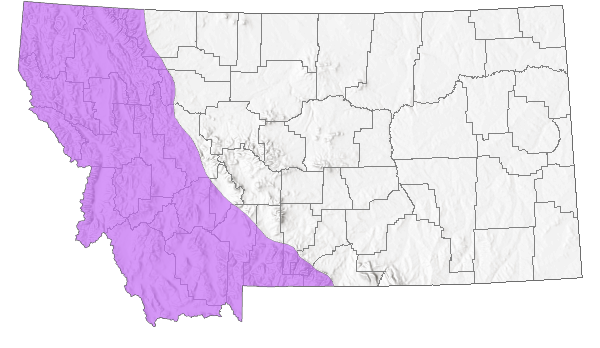
 Native
Range Comments
Circumboreal. South to California, Montana, and Saskatchewan (Lesica et al. 2012).
Observations in Montana Natural Heritage Program Database
Number of Observations: 147
(Click on the following maps and charts to see full sized version)
Map Help and Descriptions
Relative Density
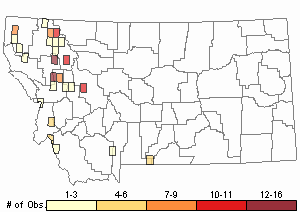
Recency
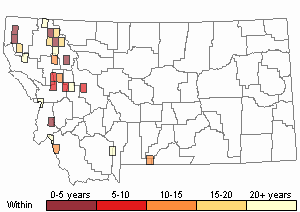
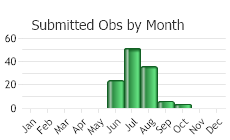
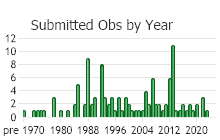
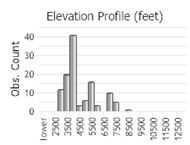 (Observations spanning multiple months or years are excluded from time charts)
Habitat
English Sundew grow with Spaghnum moss in wet, organic soils of fens in the montane zone (Lesica et al. 2012). Plants may also occur in grass or sedge dominated seeps (Rice 2019).
National Vegetation Classification System Groups Associated with this Species
Wetland and Riparian
Peatland
Food Habits
Drosera anglica traps and digests primarily insects from the Dipteran and Coleopteran orders as well as many other arthropods (Wolf et al. 2006).
Ecology
HYBRIDIZATION
Drosera anglica is most likely originated as a sterile hybrid of D. linearis x D. rotundifolia (Wood 1955; Hoyo et al. 2015). The species later became fertile possibly due to a natural chromosome doubling event (Rice 2019). Where their ranges overlap, D. anglica and D. rotundifolia may also hybridize to form the resulting hybrid Drosera x obovata (Wood 1955).
ASSOCIATED SPECIES
English Sundew typically grows on floating mats covered with Sphagnum mosses. It is also closely associated with many Carex species including C. limosa and C. lasiocarpa and herbaceous dicots such as Menyanthes trifoliata. Other rare species found only in Sphagnum fens can typically be found in association with Drosera anglica as well. Source: Wolf et al. 2006.
PLANT COMPETITION
Because of its smaller stature, Drosera anglica is often overtaken by Sphagnum mosses and outcompeted for sunlight. Consequently, access to sunlight is a significant limiting factor in the distribution of English Sundew (Wolf et al. 2006).
Competition with other carnivorous plants and ants for prey is also limiting for English Sundew (Thum 1986; Gibson 1991). Ants have been observed stealing prey insects off the leaves of Drosera species (Thum 1989).
PREY CAPTURE
Prey insects are initially lured to plants by their brilliant red gland stalks (Wolf et al. 2006). This pigmentation may vary due to environmental effects such as sun exposure and inundation (Rice 2019). After landing or climbing onto the leaves, prey get stuck to the longer, trapping glands on the margins of the leaves which hold them in place while the shorter glands secrete digestive enzymes (Lloyd 1942). A bending of the leaf petiole to fold the leaf over itself also assists in keeping prey in place once entrapment has occurred (Darwin 1897).
Reproductive Characteristics
All three species of Drosera can reproduce both sexually and vegetatively (Hoyo et al. 2015; Murza et al. 2003). Sexual reproduction is almost exclusively accomplished through self-pollination leading to most offspring being genetically identical to parent plants whether they reproduce sexually or vegetatively (Wolf et al. 2006).
English Sundew reproduces vegetatively by producing new raments that sprout from the plants (Hoyo et al. 2015). This occurs when leaf buds separate and form plantlets or when axillary buds form beneath rosettes and then detach when the connecting stem decays (Wolf et al. 2006). Both methods result in a new, clonal individual.
FRUITS AND SEEDS
Fruits are many-seeded capsules that are 3-6 mm long (Lesica et al. 2012). Seeds are 1-1.5 mm long, longitudinally striate and not flattened at the tips (Giblin et al. [eds.] 2018). Upon closer inspection the striations consist of tiny window-shaped indentations arranged in rows (Rice 2019).
FLOWERS
Each flower has a 5-lobed calyx that is 5-6 mm long and 5 separate, oblong, white petals that are longer than the calyx. There are 5 stamens and 4-5 styles, which are divided more than half their length (Lesica et al. 2012). The flowers of English Sundew are self-pollinating and therefore, almost never found open (Wolf et al. 2006).
LIFE CYCLE [Wolf et al. 2006]
English Sundew has four main life stages including seed, seedling, mature plant and vegetative propagule. During this time, it may also go through 2 dormant life stages including seed bank and overwintering buds. First year seedlings do not reproduce.
Management
The most effective way to preserve populations of Drosera anglica is to ensure that the water regimes of its primary habitat remain unaltered (Wolf et al. 2006). Better informed management decisions of D. anglica populations can be made by taking inventory of watersheds where colonized fens are present. Activities such as logging, groundwater pumping, grazing, and recreation should be closely monitored for their effects on nutrient levels.
Stewardship Responsibility
Threats or Limiting Factors
In areas across its range hydrologic alterations to the fens has been identified as a primary threat (Wolf et al. 2006). Drosera species require very specific ground water conditions for plants to maintain their ideal nutrient levels. Being adapted to nutrient poor environments makes them extremely sensitive to nutrient level increases. When this is disrupted in any way, proper ecosystem functioning may be inhibited.
STATE THREAT SCORE REASON
Reported threats to Montana's populations of English Sundew include populations located where recreation-related disruption or non-native species competition has negative impacts. One population is located near the base area of a ski resort, and future expansion of existing facilities are likely. Some populations occur in the vicinity of expanding non-native plant populations that have potential to out-compete small-statured English Sundew for light and soil nutrients. Trampling by recreationalists is expected where English Sundew populations are frequently visited by people (MTNHP Threat Assessment 2021).
References
- Literature Cited AboveLegend:
 View Online Publication
- Lesica, P., M.T. Lavin, and P.F. Stickney. 2012. Manual of Montana Vascular Plants. Fort Worth, TX: BRIT Press. viii + 771 p.
 MTNHP Threat Assessment. 2021. State Threat Score Assignment and Assessment of Reported Threats from 2006 to 2021 for State-listed Vascular Plants. Botany Program, Montana Natural Heritage Program, Helena, Montana.
- Additional ReferencesLegend: View Online Publication
Do you know of a citation we're missing?- Lesica, P. 1994. The distribution of plant community diversity associated with glacial wetlands in the Ovando Valley, Montana. [Unpublished report.] The Nature Conservancy, Montana Field Office, Helena. 26 pp.
- Lesica, P., M.T. Lavin, and P.F. Stickney. 2022. Manual of Montana Vascular Plants, Second Edition. Fort Worth, TX: BRIT Press. viii + 779 p.
- Rice, Barry A. 2019. The Genus Drosera L. (Droseraceae) in the western USA. March 21. Phytologia 101(1).
- Web Search Engines for Articles on "English Sundew"