View in other NatureServe Network Field Guides
NatureServe
Montana
Utah
Wyoming
Idaho
Wisconsin
British Columbia
South Carolina
Yukon
California
New York
James Stitchwort - Stellaria jamesiana
Other Names:
Pseudostellaria jamesiana
Native Species
Global Rank:
G5
State Rank:
S3S4
(see State Rank Reason below)
C-value:
Agency Status
USFWS:
USFS:
BLM:
State Rank Reason (see State Rank above)
Pseudostellaria jamesiana occurs on the eastern edge of its range in Beaverhead County, Montana. Most observations are from 1991 to 2019, possibly indicating that it has been overlooked in our history of botanical exploration. Reported observations in Madison County need to be verified. Pseudostellaria jamesiana grows in meadows and open coniferous forests where understory is sparse. Potential activities from forestry and quarrying may occur in vicinity of some locations, but its response to disturbance is not known. Monitoring and surveying that brings forth information on locations, population sizes, habitat, responses to disturbance, and threats are needed to assess it status in Montana.
- Details on Status Ranking and Review
Range Extent
ScoreD - 1,000-5,000 sq km (~400-2,000 sq mi)
Comment4,120 square kilometers
Area of Occupancy
ScoreD - 6-25 4-km2 grid cells
CommentPlant occurs in 8 of the 30,590 4x4 square-kilometer grid cells that cover Montana.
Number of Populations
ScoreB - 6 - 20
Comment9 observations
Environmental Specificity
ScoreC - Moderate. Generalist or community with some key requirements scarce
Threats
ScoreD - Low
General Description
James Stitchwort is a rhizomatous, perennial herb with weak stems that can easily be detached from the rhizomes; the stems are erect or ascending, 1.5-5 dm tall, and 4-angled with swollen nodes. The upper stem, inflorescence, and often the leaves have small, glandular-tipped hairs, while the lower stems are usually hairless. The leaves are opposite, stalkless, lance-shaped with long tapering, pointed tips, and 2-15 cm long by 1.5-20 mm wide. There are few to many flowers borne on diffuse branches arising from leaf axils and at the top of the plant. The flowers have five pointed sepals which are 3.5-6 mm long, green with pale, membranous margins, and covered with glandular hairs. Each flower also has 5 bilobed, white petals that are about twice as long as the sepals, usually 10 stamens, and a single pistil with usually 3 style branches. The mature fruit is shorter than the sepals and opens by 3 valves.
Phenology
Collected in flower in July.
Diagnostic Characteristics
S. JAMESIANA is distinguished from other Montana STELLARIA by its 3-valved capsule (others are 6-valved), and by the combination of its densely glandular hairy inflorescence and its leaves which are greater than 4 times as long as they are wide. Differences in the reproductive structure are great enough that this species has been assigned its own genus (PSEUDOSTELLARIA), and it will not key out in many floras using the character of a 3-valved capsule.
Species Range
Montana Range
Range Descriptions

 Native
Range Comments
Idaho and Wyoming to Texas, New Mexico, and California.
Observations in Montana Natural Heritage Program Database
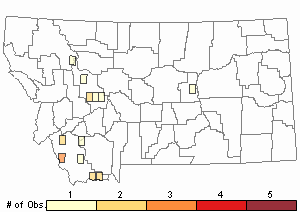
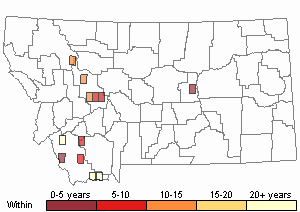
Number of Observations: 10
(Click on the following maps and charts to see full sized version)
Map Help and Descriptions
Relative Density
Recency
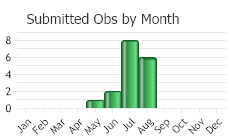
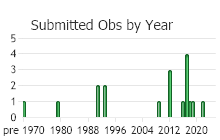
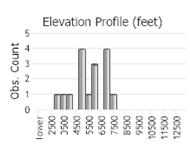 (Observations spanning multiple months or years are excluded from time charts)
Habitat
Woodland slopes in foothill or montane zones.
National Vegetation Classification System Groups Associated with this Species
Forest and Woodland
Deciduous Forest and Woodland
Montane - Subalpine Forest and Woodland
Stewardship Responsibility
References
- Additional ReferencesLegend:
 View Online Publication
Do you know of a citation we're missing?- Culver, D.R. 1993. Sensitive plant species inventory in the Centennial Valley, Beaverhead County, Montana. Unpublished report to the Butte District, Bureau of Land Management. Montana Natural Heritage Program, Helena, 42 pp. plus appendices.
 Culver, D.R. 1994. Floristic analysis of the Centennial Region, Montana. M.Sc. Thesis. Montana State University, Bozeman. 199 pp.
- Heidel, B. L. 1996. Noteworthy collections - Montana. Madrono 43(3):436-440.
- Lesica, P., M.T. Lavin, and P.F. Stickney. 2012. Manual of Montana Vascular Plants. Fort Worth, TX: BRIT Press. viii + 771 p.
- Lesica, P., M.T. Lavin, and P.F. Stickney. 2022. Manual of Montana Vascular Plants, Second Edition. Fort Worth, TX: BRIT Press. viii + 779 p.
- Web Search Engines for Articles on "James Stitchwort"