View in other NatureServe Network Field Guides
NatureServe
Montana
Utah
Wyoming
Idaho
Wisconsin
British Columbia
South Carolina
Yukon
California
New York
Woolly Prince's plume - Stanleya tomentosa
State Rank Reason (see State Rank above)
DRAFT: Requesting feedback on the 2026 revised rank, factors, and State Rank Reason outlined below and in the Conservation Status Rank Report.
Stanleya tomentosa is a regional endemic of Carbon County, MT and north-central Wyoming. Population levels are imprecisely known, though number at least several thousand plants and the statewide population may be over 10,000 plants. Trends are unknown, though the species' habitat is largely intact and in good condition. No significant threats to the species are known, though climate change could negatively it.
Additional data are needed to be able to further clarify the species' status rank. Surveys of potentially suitable habitat may document additional locations. Monitoring of a subset of populations is needed to be able to determine potential trends.
General Description
Perennial (monocarpic?) from a simple or few-branched caudex covered in old leaf bases. Stems erect, simple, 40–120 cm. Leaves basal and cauline; basal leaves petiolate, 10–30 cm long, oblanceolate, pinnately lobed, the terminal lobe largest; stem leaves similar below, becoming entire above. Vestiture of dense long, simple hairs at least below. Petals pale yellow, 10–15 mm long, glabrous. Fruit slightly curved, 3–8 cm long, constricted between the seeds; the stipe 15–25 mm long; pedicels spreading, 10–15 mm long (
Lesica et al. 2012. Manual of Montana Vascular Plants. BRIT Press. Fort Worth, TX).
Species Range
Montana Range
Range Descriptions
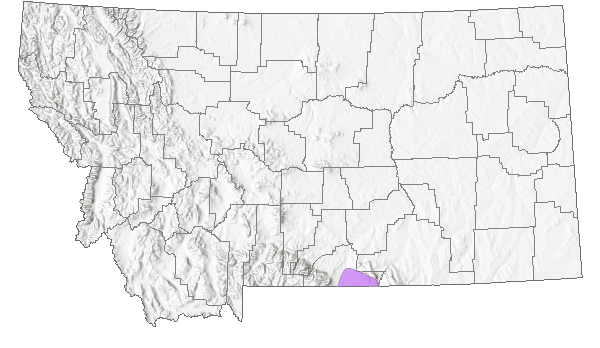
 Native
Range Comments
Regional endemic; in Wyoming known from the Big Horn Basin and the foothills of the Absaroka, Big Horn, Bridger, and Owl Creek mountains in Big Horn, Fremont, Hot Springs, and Park counties.
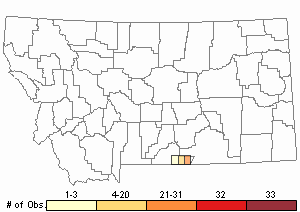
Observations in Montana Natural Heritage Program Database
Number of Observations: 75
(Click on the following maps and charts to see full sized version)
Map Help and Descriptions
Relative Density
Recency
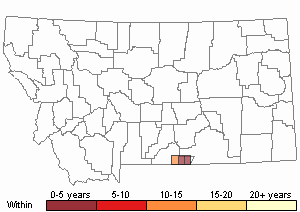

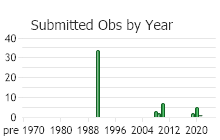
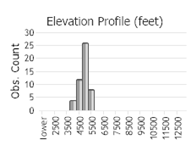 (Observations spanning multiple months or years are excluded from time charts)
Habitat
Open, gravelly soil of slopes and flats in sagebrush grassland, desert shrubland, and juniper woodland in the valley and foothill zones.
Stewardship Responsibility
References
- Literature Cited AboveLegend:
 View Online Publication
- Lesica, P., M.T. Lavin, and P.F. Stickney. 2012. Manual of Montana Vascular Plants. Fort Worth, TX: BRIT Press. viii + 771 p.
- Additional ReferencesLegend: View Online Publication
Do you know of a citation we're missing?- Lesica, P. and P.L. Achuff. 1992. Distribution of vascular plant species of special concern and limited distribution in the Pryor Mountain desert, Carbon County, Montana. Unpublished report to the Bureau of Land Management. Montana Natural Heritage Program, Helena, MT. 105 pp.
- Lesica, P., M.T. Lavin, and P.F. Stickney. 2022. Manual of Montana Vascular Plants, Second Edition. Fort Worth, TX: BRIT Press. viii + 779 p.
- Rollins, R. C. 1993. The Cruciferae of Continental North America: systematics of the mustard family from the Arctic to Panama. Stanford University Press, Stanford, California. 976 pp.
- Web Search Engines for Articles on "Woolly Prince's plume"