View in other NatureServe Network Field Guides
NatureServe
Montana
Utah
Wyoming
Idaho
Wisconsin
British Columbia
South Carolina
Yukon
California
New York
Subarctic Darner - Aeshna subarctica
State Rank Reason (see State Rank above)
This dragonfly is currently listed as an "S1S2" Species of Concern in MT due to extremely limited and/or rapidly declining population numbers, range and/or habitat, making it vulnerable to extirpation in the state.
General Description
The Subarctic Darner is circumboreal in its distribution, but is a fairly uncommonly occurring member of the family Aeshnidae found in isolated mountainous regions of Montana and is a species of concern. Darners are among the largest and fastest-flying North American dragonflies. Preferred breeding habitat of the Subarctic Darner is in swamps, fens, and bog ponds with a clear vegetative edge of abundant sphagnum and other mosses (Dunkle 2000, Paulson 2009). Similar to the Sedge Darner with black face line present, but lateral thoracic stripes are bent forward and have 2 narrow yellow spots present between the stripes.
Diagnostic Characteristics
Appearance is similar to the Sedge Darner with black face line present, but lateral thoracic stripes are bent forward and have 2 narrow yellow spots present between the stripes.
Species Range
Montana Range
Range Descriptions
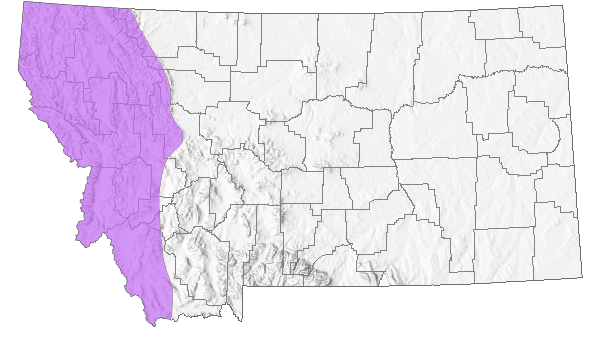
 Native
Range Comments
The Subarctic Darner is circumboreal in it's distribution, occurring throughout central and northern Europe, Eurasia and Japan (Dunkle 2000, Paulson 2009). In Montana, this species is currently known only from Mud Lake near Skalkaho Pass, Granite County, though it probably occurs in other boreal areas of western Montana (Miller and Gustafson 1996).
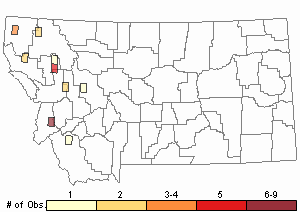
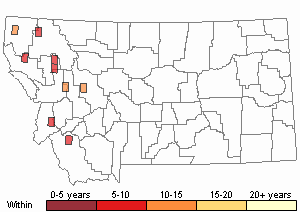
Observations in Montana Natural Heritage Program Database
Number of Observations: 27
(Click on the following maps and charts to see full sized version)
Map Help and Descriptions
Relative Density
Recency
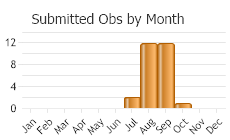
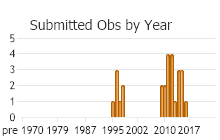
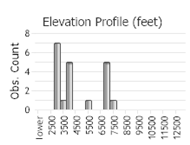 (Observations spanning multiple months or years are excluded from time charts)
Habitat
The Subartic Darner breeds in swamps, fens, and bog ponds with a clear vegetative edge of abundant sphagnum and other mosses (Dunkle 2000, Paulson 2009).
National Vegetation Classification System Groups Associated with this Species
Wetland and Riparian
Alkaline - Saline Wetlands
Alpine Riparian and Wetland
Peatland
Wet Meadow and Marsh
Food Habits
Larvae feed on a wide variety of aquatic insects, such as mosquito larvae, other aquatic fly larvae, mayfly larvae, and freshwater shrimp. They will also eat very small fish and tadpoles. The adult dragonfly will eat almost any soft-bodied flying insect including mosquitoes, flies, small moths, mayflies, and flying ants or termites.
Reproductive Characteristics
Male Subarctic Darners are only territorial at low population densities and do not patrol regular routes. They fly over open water and floating sphagnum mats, hover for a period then continue on to another floating mat. Females oviposit in mosses and sedges at the waterline at the edge of open water (Dunkle 2000, Paulson 2009).
Stewardship Responsibility
References
- Literature Cited AboveLegend:
 View Online Publication
 Miller, K.B. and D.L. Gustafson. 1996. Distribution records of the Odonata of Montana. Bulletin of American Odonatology 3(4):75-88.
- Additional ReferencesLegend: View Online Publication
Do you know of a citation we're missing?- Dunkle, S.W. 2000. Dragonflies through binoculars: A field guide to dragonflies of North America. New York, NY. Oxford University Press. 266 pp.
- Paulson, D.R. 2009. Dragonflies and Damselflies of the West. Princeton University Press, Princeton. 535 pp.
- Paulson, D.R. and S.W. Dunkle. 2009. A checklist of North American Odonata including English name, etymology, type locality, and distribution. Originally published as Occasional Paper No. 56. Slater Museum of Natural History, University of Puget Sound, June 1999; completely revised March 2009.
- Web Search Engines for Articles on "Subarctic Darner"
- Additional Sources of Information Related to "Insects"