View in other NatureServe Network Field Guides
NatureServe
Montana
Utah
Wyoming
Idaho
Wisconsin
British Columbia
South Carolina
Yukon
California
New York
Prairie Rattlesnake - Crotalus viridis
Native Species
Global Rank:
G5
State Rank:
S4
(see State Rank Reason below)
Agency Status
USFWS:
USFS:
BLM:
FWP SWAP:
SGCN
State Rank Reason (see State Rank above)
Species is relatively common within suitable habitat and widely distributed across portions of the state.
General Description
Adults have a triangular head, blunt nose, narrow neck, and stout body; they range in length from 15 to 60 inches. The background color above varies from pale green to brown; a series of brown or black blotches edged with a dark and then a light line extends the length of the body. The blotches often merge into rings on the tail. There are also blotches on the sides. The belly is pale yellow to white and lacks blotches. All rattlesnakes have a heat-sensing pit located between the nostril and the eye. The fangs are hollow and hinged, allowing them to be folded back against the roof of the mouth. The tail ends in a rattle that helps warn potential predators of the snake's presence.
Diagnostic Characteristics
No other snake in Montana has rattles (see Gophersnake and Western Hog-nosed Snake).
Species Range
Montana Range
Range Descriptions
 Native
Global Range

Estimated global breeding range area is: 2,173,408 km
2 (Approximately 16% in Montana)
See information about
 iNaturalist Geomodels
Observations in Montana Natural Heritage Program Database
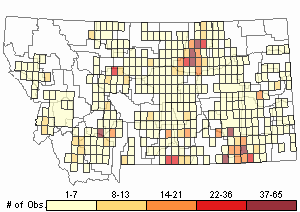
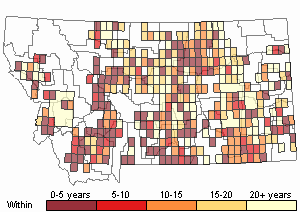
Number of Observations: 2012
(Click on the following maps and charts to see full sized version)
Relative Density
Recency
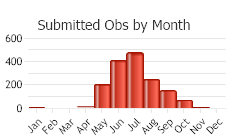
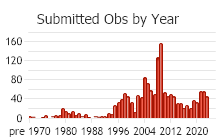
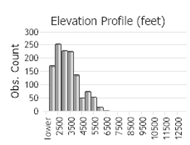 (Observations spanning multiple months or years are excluded from time charts)
Migration
Non-migratory.
Habitat
Prairie Rattlesnakes favor open and arid country but are also found in ponderosa pine stands and mixed grass-coniferous forests. They are more likely to be encountered on south-facing slopes and in areas with rock outcrops. Prairie Rattlesnakes den communally, but range up to 7 miles from the dens during the summer. Females give birth to 4 to 21 young in late summer; the young are marked similarly to adults, but colors are brighter. Prairie Rattlesnakes prey on a variety of animals, including mice, ground squirrels, and rabbits. Gravid females may aggregate at basking sites (rookeries) (Gannon and Secoy 1985). May be most common near broken country and breaks. Land use changes from range to irrigated farmland may adversely affect population (Pendlebury 1977).
National Vegetation Classification System Groups Associated with this Species
Forest and Woodland
Deciduous Forest and Woodland
Low Elevation - Xeric Forest and Woodland
Montane - Subalpine Forest and Woodland
Shrubland
Arid - Saline Shrubland
Foothills - Montane Shrubland
Sagebrush Shrubland
Grassland
Lowland - Prairie Grassland
Montane - Subalpine Grassland
Sparse and Barren
Sparse and Barren
Wetland and Riparian
Alkaline - Saline Wetlands
Riparian and Wetland Forest
Riparian Shrubland
Recently Disturbed or Modified
Introduced Vegetation
Recently Burned
Human Land Use
Agriculture
Developed
Food Habits
Two of three collected in north-central MT had eaten Peromyscus maniculatus (Mosimann and Rabb 1952). In southern Saskatchewan, 4 collected with prey: 2 P. maniculatus; 1 Richardson's Ground Squirrel, 1 passerine (Gannon and Secoy 1984).
Ecology
In southwest Saskatchewan, one hibernaculum contained an estimated 150 adults, plus juvenile and young-of-year in same den. Overwinter weight loss greater for northern populations than for southern popualtions; overwinter mortality of young-of-year may be significant for northern populations (Gannon and Secoy 1984).
Reproductive Characteristics
Female probably has 2-year reproductive cycle (Gannon and Secoy 1984). Mate late July to early September (Klauber 1972). Sperm presumed to stay viable overwinter. Parturition late August to September. Average young is 9 to 10 in southern Saskatchewan (Gannon and Secoy 1984).
Stewardship Responsibility
References
- Literature Cited AboveLegend:
 View Online Publication
- Gannon, V.P.J. and D.M. Secoy. 1984. Growth and reproductive rates of a northern population of the prairie rattlesnake, Crotalus v. viridis. Journal of Herpetology 18(1): 13-19.
 Gannon, V.P.J. and D.M. Secoy. 1985. Seasonal and daily activity patterns in a Canadian population of the prairie rattlesnake, Crotalus viridis viridis. Canadian Journal of Zoology 63(1): 86-91.
- Klauber, L.M. 1972. Rattlesnakes: their habits, life histories, and influence on mankind. Second edition. Two volumes. University California Press, Berkeley.
- Mosimann, J.E. and G.B. Rabb. 1952. The herpetology of Tiber Reservoir Area, Montana. Copeia(1): 23-27.
- Pendlebury, G.B. 1977. Distribution and abundance of the prairie rattlesnake, Crotalus viridis viridis, in Canada. Canadian Field Naturalist 91(2): 122-129.
- Additional ReferencesLegend: View Online Publication
Do you know of a citation we're missing?- [DCC] Decker Coal Company. 1998. 1997 Consolidated annual progress report. Decker Coal Company West, North and East Pits. Decker, MT.
- [EI] Econ Incorporated. 1984. Terrestrial wildlife inventory for the Lame Jones and Ismay coal lease tracts. Econ Incorporated. Helena, MT.
- [OEA] Olson Elliot and Associates Research. 1985. 1983-1984 Wildlife monitoring report for the CX Ranch project. Olson Elliot and Associates Research. Helena, MT.
- [PRESI] Powder River Eagle Studies Incorporated. 1998a. Big Sky Mine 1997 wildlife monitoring studies. Powder River Eagle Studies Incorporated. Gillete, WY.
- [PRESI] Powder River Eagle Studies Incorporated. 1998b. Spring Creek Mine 1997 wildlife monitoring studies. Powder River Eagle Studies Incorporated. Gillete, WY.
- [VTNWI] VTN Wyoming Incorporated. No Date. Second year's analysis of terrestrial wildlife on proposed mine access and railroad routes in southern Montana and northern Wyoming, March 1979 - February 1980. VTN Wyoming Incorporated. Sheridan, WY. 62 p.
- [WESCO] Western Ecological Services Company. 1983a. Wildlife inventory of the Knowlton known recoverable coal resource area, Montana. Western Ecological Services Company, Novato, CA. 107 p.
- [WESCO] Western Ecological Services Company. 1983b. Wildlife inventory of the Southwest Circle known recoverable coal resource area, Montana. Western Ecological Services Company, Novato, CA. 131 p.
- [WESTECH] Western Technology and Engineering Incorporated. 1982. Wildlife Reconnaissance, Cypress International Yellowstone Mine. Western Technology and Engineering, Inc., Helena, Mt.
- [WESTECH] Western Technology and Engineering Incorporated. 1993. Diamond Hill Project Wildlife Baseline Survey. Western Technology and Engineering, Inc., Helena, Mt.
- [WESTECH] Western Technology and Engineering Incorporated. 1998. Wildlife Monitoring Absaloka Mine Area 1997. Western Technology and Engineering, Inc., Helena, Mt.
- Adame, B.L., J.G. Soto, D.J. Secraw, J.C. Perez, J.L. Glenn and R.C. Straight. 1990. Regional variation of biochemical characteristics and antigenicity in Great Basin rattlesnake (Crotalus viridis lutosus) venom. Comparative Biochemistry and Physiology B 97(1): 95-102.
- Aird, S.D. 1984. Crotalus viridis viridis (prairie rattlesnake). Coloration. Herpetological Review 15(1): 18-19.
- Aird, S.D. 1985. A quantitative assessment of variation in venom constituents within and between three nominal rattlesnake subspecies. Toxicon 23: 1000-1004.
- Aird, S.D. and I.I. Kaiser. 1985. Comparative studies on three rattlesnake toxins. Toxicon 23(3): 361-374.
- Aird, S.D. and M.E. Aird. 1990. Rain collecting behaviour in a Great Basin rattlesnake (Crotalus viridis lutosus). Bulletin of the Chicago Herpetological Society 25(12): 217.
- Aird, S.D., C.S. Seebart, and I.I. Kaiser. 1988. Preliminary fractionation and characterization of the venom of the Great Basin rattlesnake (Crotalus viridis lutosus). Herpetologica 44(1): 71-85.
- Aird, S.D., I.I. Kaiser, R.V. Lewis, and W.G. Kruggel. 1985. Rattlesnake presynaptic neurotoxins: primary structure and evolutionary origin of the acidic subunit. Biochemistry 24: 7054-7058.
- Aird, S.D., W.G. Kruggel and I.I. Kaiser. 1991. Multiple myotoxin sequences from the venom of a single prairie rattlesnake (Crotalus viridis viridis). Toxicon 29(2): 265-268.
- Aldridge, R.D. 1975. Environmental control of spermatogenesis in the rattlesnake Crotalus viridis. Copeia 1975(3): 493-496.
- Aldridge, R.D. 1979a. Female reproductive cycles of the snakes Arizona elegans and Crotalus viridis. Herpetologica 35(3): 256-261.
- Aldridge, R.D. 1979b. Seasonal spermatogenesis in sympatric Crotalus viridis and Arizona elegans in New Mexico. Journal of Herpetology 13(2): 187-192.
- Aldridge, R.D. 1981. Mobility, density, habitats and sex ratios in snakes. Transactions of the Missouri Academy of Science 15: 247.
- Aldridge, R.D. 1993. Male reproductive anatomy and seasonal occurrence of mating and combat behavior of the rattlesnake Crotalus v. viridis. Journal of Herpetology 27: 481-484.
- Aldridge, R.D. 2002. The link between mating season and male reproductive anatomy in the rattlesnakes Crotalus viridis oreganus and Crotalus viridis helleri. Journal of Herpetology 36(2): 295-300.
- Allen, J. A. 1874. Notes on the natural history of portions of Dakota and Montana Territories, being the substance of a report to the Secretary of War on the collections made by the North Pacific Railroad Expedition of 1873. Proceedings of the Boston Society of Natural History. pp. 68-70.
- Alving, W.R. and K.V. Kardong. 1996. The role of the vomeronasal organ in rattlesnake (Crotalus viridis oreganus) predatory behavior. Brain Behavior and Evolution 48(3): 165-172.
- Anaya, M., E.D. Rael, C.S. Lieb, J.C. Perez, and R.J. Salo. 1992. Antibody detection of venom protein variation within a population of the rattlesnake Crotalus viridis viridis. Journal of Herpetology 26(4): 473-482.
- Anderson, J.R. 1901. Rattlesnakes and scorpions. Ottawa Naturalist 15: 162-163.
- Armstrong, B. L., and J. B. Murphy. 1979. The natural history of Mexican rattlesnakes. University of Kansas Museum Natural History Special Publication. No. 5. vii + 88 pp.
- Ashton, K.G. 1999. Shedding aggregations of Crotalus viridis concolor. Herpetological Review 30: 211-213.
- Ashton, K.G. 2001. Body size variation among mainland populations of the western rattlesnake (Crotalis viridis). Evolution 55: 2523-2533.
- Ashton, K.G. 2002. Headfirst ingestion of prey by rattlesnakes: Are tactile cues used? Journal of Herpetology 36(3):500-502.
- Ashton, K.G. and A. de Queiroz. 2001. Molecular systematics of the western rattlesnake, Crotalus viridis (Viperidae), with comments on the utility of the D-loop in phylogenetic studies of snakes. Molecular and Phylogenetic Evolution 21: 176-189.
- Ashton, K.G. and T. M. Patton. 2001. Movement and reproductive biology of female midget faded rattlesnakes, Crotalus viridis concolor, in Wyoming. Copeia 2001:229-234.
- Audubon, M.R. (ed.). 1960. Audubon and his journals. Volume 2. Dover Publications Incorporated. New York, NY.
- Bailey, V. and M.R. Terman. 1986. Noteworthy achievement in longevity in Crotalus viridis. Northern Ohio Association of Herpetological Notes 13(11): 18.
- Bailey, V., M.R. Terman, and R. Wall. 1989. Noteworthy longevity in Crotalus viridus viridus (rafinesque). Transactions of the Kansaas Academy of Science 92(1-4): 116-117.
- Bajwa, S. S., F. S. Markland, and F.E. Russell. 1981. Fibrinolytic and fibrinogen clotting enzymes present in the venoms of western diamondback rattlesnake, Crotalus atrox, eastern diamondback rattlesnake, Crotalus adamanteus, and southern pacific rattlesnake, Crotalus viridishelleri. Toxicon 19(1): 53-59.
- Bar, O.D., J.B. Sullivan, E Black, and F.E. Russell. 1984. Neutralization of Crotalidae venom induced platelet aggregation by affinity chromatography isolated immunoglobulin G to Crotalus viridis helleri venom. Journal of Toxicology Clinical Toxicology 22(1): 1-10.
- Bauerle, B., D.L. Spencer, and W. Wheeler. 1975. The use of snakes as pollution indicator species. Copeia 1975: 366-368.
- Baxter, G.T. and M.D. Stone. 1985. Amphibians and reptiles of Wyoming. Second edition. Wyoming Game and Fish Department. Cheyenne, WY. 137 p.
- Benson, K.R. 1978. Herpetology of the Lewis and Clark expedition 1804-1806. Herpetological Review 9(3): 87-91.
- Bergeron, D. 1978. Terrestrial Wildlife Survey Coal creek Mine Area, Montana. Unpublished report for Coal Creek Mining Co., Ashland, Montana.
- Bieber, A.L., R.H. McParland, and R.R. Becker. 1987. Amino acid sequences of myotoxins from Crotalus viridis concolor venom. Toxicon 25(6): 677-680.
- Black, J.H. 1981. Oklahoma rattlesnake hunts --1981. Bulletin of the Oklahoma Herpetological Society 6: 39-43.
- BLM. 1982b. Moorhead baseline inventory - wildlife. Bureau of Land Management, Miles City District Office. Miles City, MT. 29 pp.
- Blood, D.A. 1993. Western Rattlesnake. British Columbia Ministry of Environment, Lands and Parks, Victoria.
- Bober, M.A. and C.L. Ownby. 1988. Rapid decline in blood antimyotoxin levels in the presence of myotoxin a from prairie rattlesnake (Crotalus viridis viridis venom). Journal of Toxicology Clinical Toxicology 26(5-6): 303-312.
- Bogert, C.M. 1941. Sensory cues used by rattlesnakes in their recognition of ophidian enemies. Annals of the New York Academy of Sciences 41: 329-343.
- Books, D. 1994. A narrow fellow in the grass. Montana Outdoors 25(5): 7-11.
- Boundy, J. 1992. Crotalus viridis viridis (prairie rattlesnake). Herpetological Review 23(4): 124.
- Boundy, J. 2001. Herpetofaunal surveys in the Clark Fork Valley region, Montana. Herpetological Natural History 8: 15-26.
- Bramblett, R.G., and A.V. Zale. 2002. Montana Prairie Riparian Native Species Report. Montana Cooperative Fishery Research Unit, Montana State University - Bozeman.
- Breidenbach, C.H. 1990. Thermal cues influence strikes in pitless vipers. Journal of Herpetology 24(4): 448-450.
- Brown, D.G. 1990. Observation of a prairie rattlesnake (Crotalus viridis viridis) consuming neonatal cottontail rabbits (Sylvilagus nuttalli), with defense of the young cottontails by adult conspecifics. Bulletin of the Chicago Herpetological Society 25(2): 24-26.
- Brown, D.G. and D. Duvall. 1990. Movements of prairie rattlesnakes in Wyoming in two successive years. Journal of the Colorado-Wyoming Academy of Science 22(1): 5.
- Brown, D.G. and D. Duvall. 1993. Habitat associations of prairie rattlesnakes (Crotalus viridis) in Wyoming. Herpetological Natural History 1(1): 5-12.
- Brown, E. 1950. Rattlesnake kills rabbit. Yellowstone Nature Notes 24(4): 47-48.
- Brunson, R.B. 1955. Check list of the amphibians and reptiles of Montana. Proceedings of the Montana Academy of Sciences 15: 27-29.
- Bullock, R.E. 1971. Cannibalism in captive rattlesnakes. Great Basin Naturalist 31(2): 49-50.
- Bureau of Indian Affairs, Department of the Interior. 1981. Draft Environmental Impact Statement. Unpublished report for the Crow/Shell Coal Lease, Crow Indian Reservation, Montana.
- Burroughs, R. D. 1961. Natural history of the Lewis and Clark expedition. Michigan State University Press, East Lansing. 340 p.
- Butts, T.W. 1997. Mountain Inc. wildlife monitoring Bull Mountains Mine No. 1, 1996. Western Technology and Engineering. Helena, MT.
- Cage, Y. 2004. Combat in the Prairie rattlesnake. Sonoran Herpetologist 17(11):107-108.
- Campbell, J. A. and E. D. Brodie, Jr., (editors). 1992. Biology of the pit vipers. Selva, Tyler, Texas.
- Chadwick, L.E. and H. Rahn. 1954. Temperature dependence of rattling frequency in the rattlesnake, Crotalus v. viridis. Science 119: 442-443.
- Charland, M.B. 1987. An examination of factors influencing first-year recruitment in the northern Pacific rattlesnake, Crotalus viridis oreganus, in British Columbia. Unpubl. M.S. Thesis, University of Victoria, British Columbia, Canada.
- Charland, M.B. 1989. Size and winter survivorship in neonatal western rattlesnakes (Crotalus viridis). Canadian Journal of Zoology 67(7): 1620-1625.
- Charland, M.B. and P.T. Gregory. 1989. Feeding rate and weight gain in postpartum rattlesnakes: do animals that eat more always grow more? Copeia 1989(1): 211-214.
- Charland, M.B. and P.T. Gregory. 1990. The influence of female reproductive status on thermoregulation in a viviparous snake, Crotalus viridis. Copeia 1990(4): 1089-1098.
- Charland, M.B., K.J. Nelson, and P.T. Gregory. 1993. Status of the northern Pacific rattlesnake in British Columbia. B.C. Ministry of Environment, Wildlife Branch, Working Wildlife Report No. WR-54. 18 p.
- Chiszar, D. and C.W. Radcliffe. 1977. Absence of prey-chemical preferences in newborn rattlesnakes (Crotalus cerastes, C. enyo, and C. viridis). Behavioral Biology 21 (1): 146-150.
- Chiszar, D. and C.W. Radcliffe. 1980. Striking and the induction of chemosensory searching in rattlesnakes: effects of handling and transportation to test cages. Journal of the Colorado-Wyoming Academy of Science 12(1): 5-6.
- Chiszar, D. and H.M. Smith. 1993d. Crotalus viridis viridis (prairie rattlesnake). Herpetological Review 24(4): 156.
- Chiszar, D. and H.M. Smith. 1994. Serpentes: Crotalus viridis viridis (Prairie rattlesnake): Record rattle-string. Herpetological Review 25(3): 123.
- Chiszar, D. and K.M. Scudder. 1980. Chemosensory searching by rattlesnakes during predatory episodes. In: Muller-Schwarze, D. and R.M. Silverstein (eds.), Chemical Signals: Vertebrates and Aquatic Invertebrates. Plenum Press, New York. Pp. 125-139.
- Chiszar, D., C. Byall, and H.M. Smith. 1996. Presence of cover influences response to prey by prairie rattlesnakes (Crotalus viridis). Psychological Record 46(4): 591-594.
- Chiszar, D., C. Harvey, D. Dickman, and J. Colton. 1985. Thermal cues and striking behavior in viperid snakes. Journal of the Colorado-Wyoming Academy of Science 17(1): 35.
- Chiszar, D., C. Radcliffe, and F. Feiler. 1986. Trailing behavior in banded rock rattlesnakes (Crotalus lepidus klauberi) and prairie rattlesnakes (C. viridis viridis). Journal of Comparative Psychology 100(4): 368-371.
- Chiszar, D., C.W. Radcliffe, and H.M. Smith. 1980. Ambushing and foraging behavior in rattlesnakes: a behavioral polymorphism. Journal of the Colorado-Wyoming Academy of Science 12(1): 5.
- Chiszar, D., C.W. Radcliffe, and K.M. Scudder. 1977. Analysis of the behavioral sequence emitted by rattlesnakes during feeding episodes. Behavioral Biology 21: 418-425.
- Chiszar, D., C.W. Radcliffe, B. O'Connell, and H.M. Smith. 1981. Strike induced chemosensory searching in rattlesnakes (Crotalis viridis) as a function of disturbance prior to presentation of rodent prey. Psychological Record 31: 57-62.
- Chiszar, D., C.W. Radcliffe, B. O'Connell, and H.M. Smith. 1982. Analysis of the behavioral sequence emitted by rattlesnakes during feeding episodes II. Duration of strike-induced chemosensory searching in rattlesnakes (Crotalus viridis, C. enyo). Behavioral and Neuralogical Biology 34(3): 261-270.
- Chiszar, D., C.W. Radcliffe, H.M. Smith, and H. Bashinski. 1981. Effect of prolonged food deprivation on response to prey odors by rattlesnakes. Herpetologica 37(4): 237-243.
- Chiszar, D., C.W. Radcliffe, H.M. Smith, and P. Langer. 1991. Strike-induced chemosensory searching: do rattlesnakes make one decision or two? Bulletin of the Maryland Herpetological Society 27(2): 90-94.
- Chiszar, D., C.W. Radcliffe, T. Byers, and R. Stoops. 1986. Prey capture behavior in nine species of venomous snakes. Psychological Record 36(4): 433-438.
- Chiszar, D., D. Belcher, S.P. Mackessy, A. Petkus, and H.M. Smith. 1994. Stimulation of ingestion in solenoglyphous snakes. Herpetological Review 25(4): 158-159.
- Chiszar, D., D. Duvall; K. Scudder, and C.W. Radcliffe. 1980. Simultaneous and successive discriminations between envenomated and nonenvenomated mice by rattlesnakes (Crotalus durissus and C. viridis). Behavioural Neural Biology 29(4): 518-521.
- Chiszar, D., G. Hobika, and H.M. Smith. 1993. Prairie rattlesnakes (Crotalus viridis) respond to rodent blood with chemosensory searching. Brain Behavior and Evolution 41(3-5): 229-233.
- Chiszar, D., G. Hobika, H.M. Smith, and J. Vidaurri. 1991. Envenomation and acquisition of chemical information by prairie rattlesnakes. Prairie Naturalist 23(2): 69-72.
- Chiszar, D., H.M. Smith, and A.R. Hoge. 1983. Post-strike trailig behavior in rattlesnakes. Memorial Institute Butantan 46: 195-206.
- Chiszar, D., H.M. Smith, and R. Defusco. 1993. Crotalus viridis viridis (Prairie Rattlesnake). Herpetological Review 24(3): 106.
- Chiszar, D., H.M. Smith, C.M. Bogert, and J. Vidaurri. 1991. A chemical sense of self in timber and prairie rattlesnakes. Bulletin of the Psychonomic Society 29(2): 153-154.
- Chiszar, D., H.M. Smith, J.L. Glenn, and R.C. Straight. 1991. Strike-induced chemosensory searching in venomoid pit vipers at Hogle Zoo. Zoo Biology 10(2): 111-117.
- Chiszar, D., J. Perelman, H.M. Smith, and D. Duvall. 1992. "Shouldering" in prairie rattlesnakes: a new hypothesis. Bulletin of the Maryland Herpetological Society 28(3): 69-76.
- Chiszar, D., J.D. Dickman, and J.S. Colton. 1986. Sensitivity to thermal stimulation in prairie rattlesnakes (Crotalus viridis) after bilateral anesthetization of facial pits. Behavioral and Neurological Biology 45: 143-149.
- Chiszar, D., K. Scudder, and L. Knight. 1976. Rate of tongue flicking by garter snakes (Thamnophis radix haydeni) and rattlesnakes (Crotalus v. viridis, Sistrurus catenatus tergeminus, and Sistrurus catenatus edwardsi) during prolonged exposure to food odors. Behavioral Biology 18(2): 273-283.
- Chiszar, D., K. Scudder, L. Knight, and H.M. Smith. 1978. Exploratory behavior in prairie rattlesnakes (Crotalus viridis) and water moccasins (Agkistrodon piscivorus). Psychological Record 28: 363-368.
- Chiszar, D., K.M. Scudder, and H.M. Smith. 1979. Chemosensory investigation of fish mucus odor by rattlesnakes. Bulletin of the Maryland Herpetological Society 15(2): 31-369.
- Chiszar, D., L.J. Livo, R.R.J. Smith, and H.M. Smith. 1995. Crotalus viridis (western rattlesnake). Herpetological Review 26(3): 156.
- Chiszar, D., R.K.K. Lee, C.W. Radcliffe, and H.M. Smith. 1992. Searching behaviors by rattlesnakes following predatory strikes. pp. 369-382. In: Campbell, J.A. & Brodie, E.D., Jr. [Eds]. Biology of the pitvipers. Selva, Tyler, Texas.
- Chiszar, D., T. Melcer, R. Lee, C.W. Radcliffe, and D. Duvall. 1990. Chemical cues used by prairie rattlesnakes (Crotalus viridis) to follow trails of rodent prey. Journal of Chemical Ecology 16: 79-86.
- Chopko, J.T. and J.Clarke. 1991. The influence of moonlight on the nocturnal activity of juvenile and adult prairie rattlesnakes (Crotalus viridis viridis). Journal of the Colorado-Wyoming Academy of Science 23(1): 22.
- Clark, V.S. 1991. A report on rattlesnake roundups in Oklahoma and other parts of the United States. Herpetology 21(3): 12-15.
- Clarke, J.A., J.T. Chopko, and S.P. Mackessy. 1996. The effect of moonlight on activity patterns of adult and juvenile prairie rattlesnakes (Crotalus viridis viridis). Journal of Herpetology 30(2): 192-197.
- Cobb, V.A. and C.R. Peterson. 1991a. Daily activity patterns of free-ranging, great basin rattlesnakes. Northwest Scientist 65(2): 70.
- Cobb, V.A. and C.R. Peterson. 1991b. The effects of pregnancy on body temperature variation in free-ranging western rattlesnkaes. American Zoologist 31(5): 78A.
- Confluence Consulting Inc. 2010. Montana Department of Transportation Wetland Mitigation Monitoring Reports (various sites). MDT Helena, MT.
- Consroe, P., N.B. Egen, F.E. Russel, K. Gerrish, D.C. Smith, A. Sidki, and J.T. Landon. 1995. Comparison of a new ovine antigen binding fragment (Fab) antivenin for United States crotalidae with the commercial antivenin for protection against venom-induced lethality in mice. American Journal of Tropical Medicine and Hygiene 53(5): 507-510.
- Cooper, J. G. 1869. Notes on the fauna of the Upper Missouri. American Naturalist 3(6):294-299.
- Cooper, J. G. 1869. The fauna of Montana Territory (concluded) III. Reptiles, IV Fish. American Naturalist 3(3):124-127
- Cooper, J.G. 1860. Report upon the reptiles collected on the survey. In: Reports of explorations and surveys to ascertain the most practicable and economical route for a railroad from the Mississippi River to the Pacific Ocean. Volume 12, Book 2, Part 3, Number 4. pp. 292-306, +14 pls. 36th Congress, 1st session, House Executive Document Number 56. Serial 1055.
- Cooper, S.V., C. Jean, and P. Hendricks. 2001. Biological survey of a prairie landscape in Montana's glaciated plains. Report to the Bureau of Land Management. Montana Natural Heritage Program, Helena, MT. 24 pp. plus appendices.
- Cope, E. D. 1879. A contribution to the zoology of Montana. American Naturalist 13(7): 432-441.
- Cope, E.D. 1875. Check-list of North American Batrachia and Reptilia; with a systematic list of the higher groups, and an essay on geographical distribution. Based on the specimens contained in the U.S. National Museum. U.S. Natioanl Museum Bulletin 1: 1-104.
- Cope, E.D. 1900. The crocodilians, lizards, and snakes of North America. Report of the U.S. National Museum 1898: 153-1270.
- Coss, R.G. 1991. Context and animal behavior 3: the relationship between early development and -evolutionary persistence of ground squirrel antisnake behavior. Ecological Psychology 3(4): 277-315.
- Coss, R.G. 1993. Evolutionary persistence of ground squirrel antisnake behavior: reflections on Burton's commentary. Ecological Psychology 5(2): 171-194.
- Coss, R.G. and D.H. Owings. 1978. Snake-directed behavior of snake: naive and experienced California ground squirrels in a simulated burrow. Zeitschrift fuer Tierpsychologie 48(4): 421-435.
- Coues, E. and H. Yarrow. 1878. Notes on the herpetology of Dakota and Montana. Bulletin of the U.S. Geological Geographic Survey of the Territories 4: 259-291.
- Cowles, R.B. 1938. Unusual defense posture assumed by rattlesnakes. Copeia 1958: 13-16.
- Cox, M.K. and W.L. Franklin. 1989. Terrestrial vertebrates of Scotts Bluff National Monument, Nebraska (USA). Great Basin Naturalist 49(4): 597-613.
- Crabtree, C.B., R.W. Murphy. 1984. Analysis of Maternal-Offspring Allozymes in Crotalus viridis. Journal of Herpetology 18(1): 75-80.
- Cross, R.G., K.L. Guse, N.S. Poran, and D.G. Smith. 1993. Development of antisnake defenses in California ground squirrels (Spermophilus beecheyi): II. Microevolutionary effects of relaxed selection from rattlesnakes. Behaviour 124(1-2): 137-164.
- Crother, B.I. (ed.) 2008. Scientific and standard English names of amphibians and reptiles of North America north of Mexico. SSAR Herpetological Circular No. 37:1-84.
- Cruz, E., S. Gibson, K. Kandler, G. Sanchez, and D. Chiszar. 1987. Strike-induced chemosensory searching in rattlesnakes: a rodent specialist (Crotalus viridis) differs from a lizard specialist (Crotalus pricei). Bulletin of the Psychonomic Society 25(2): 136-138.
- Cundall, D. 2002. Envenomation strategies, head form, and feeding ecology in vipers. Pp. 149-161. In: G.W. Schuett, M. Hoggren, M.E. Douglas, and H.W. Greene. Biology of the vipers. Eagle Mountain Publishing.
- Cunningham, G.R., S.M. Hickey, and C.M. Gowen. 1996. Serpentes: Crotalus viridis viridis (prairie rattlesnake): Behavior. Herpetological Review 27(1): 24.
- Curtis, S. 1994. The big sleep. Montana Outdoors 25(6): 2-7.
- Day, D. 1989. Montco Terrestrial Wildlife Monitoring Report. Unpublished report for Montco, Billings, Montana.
- Day, D., P.J. Farmer, and C.E. Farmer. 1989. Montco terrestrial wildlife monitoring report December, 1987 - July, 1989. Montco, Billings, MT, and Western Technology and Engineering, Inc. Helena, MT.
- de Cock Buning, T. 1985. Localization of warm objects by heat sensitive snakes. Fortschritte Der Zoologie 30 1985: 719-721.
- Dean, J.N., J.L. Glenn, and R.C. Straight. 1980. Bilateral cleft labial and palate in the progeny of a Crotalus viridis viridis rafinesque. Herpetological Review 11(4): 91-92.
- Decker Coal Co., 1981, Wildlife survey. July 7, 1981. In North Decker 5-Year Permit Application. Vol. III. Rule 26.4.304(12-14).
- Decker Coal Company, 1980?, Amphibians and reptiles. In Decker Coal Company West Pit Permit. Vol. 3. 26.4.304(10-11), 305, 306, and 307. Updated Rules Rewrite, July 1, 1991.
- Dickman, J.D., J.S. Colton, D. Chiszar, and C.A. Colton. 1987. Trigeminal responses to thermal stimulation of the oral cavity in rattlesnakes (Crotalus viridis) before and after bilateral anesthetization of the facial pit organs. Brain Research 400(2): 365-370.
- Diller, L.V. 1981. Comparative ecology of Great Basin rattlesnakes (Crotalus viridis lutosus) and Great Basin gopher snakes (Pituophis melanoleucus deserticola) and their impact on small mammal populations in the Snake River Birds of Prey Area. Ph.D. Dissertation. University of Idaho, Moscow.
- Diller, L.V. 1990. A field observation on the feeding behavior of Crotalus viridis lutosus. Journal of Herpetolgoy 24(1): 95-97.
- Diller, L.V. and R.L. Wallace. 1984. Reproductive biology of the northern pacific rattlesnake (Crotalus viridis oreganus) in northern Idaho. Herpetologica 40(2): 182-193.
- Diller, L.V. and R.L. Wallace. 1996. Comparative ecology of two snake species (Crotalus viridis and Pituophis melanoleucus) in southwestern Idaho. Herpetologica 52(3): 343-360.
- Dood, A.R. 1980. Terry Badlands nongame survey and inventory final report. Montana Department of Fish, Wildlife, and Parks and Bureau of Land Management, Helena, MT. 70 pp.
- Douglas, M.E., M.R. Douglas, G.W. Schuett, L.W. Porras, and A.T. Holycross. 2002. Phylogeography of the western rattlesnake (Crotalus viridis) complex, with emphasis on the Colorado Plateau. Pp.11-50. In: G.W. Schuett, M. Hoggren, M.E. Douglas, and H.W. Greene. Biology of the vipers. Eagle Mountain Publishing.
- Duvall, D. 1986. Snake, rattle and roll. Natural History 95(11): 66-73.
- Duvall, D. and D. Chiszar. 1990. Behavioural and chemical ecology of vernal migration and pre- and post-strike predatory activity in prairie rattlesnakes: field and laboratory experiments. Chemical Signals in Vertebrates 5: 539-554.
- Duvall, D. and G.W. Schuett. 1997. Straight-line movements and competative mate searching in prairie rattlesnakes, Crotalus viridis viridis. Animal Behavior 54: 329-334.
- Duvall, D. and S.J. Beaupre. 1998. Sexual strategy and size dimorphism in rattlesnakes: integrating proximate and ultimate causation. American Zoologist 38: 152-165.
- Duvall, D., D. Chiszar, W.K. Hayes, J.K. Leonhardt, and M.J. Goode. 1990. Chemical and behavioral ecology of foraging in prairie rattlesnakes (Crotalus viridis viridis). Journal of Chemical Ecology 16(1): 87-101.
- Duvall, D., K. Gutzwiller, and M. King. 1985. Reconstructing the rattlesnake. BBC Wildlife 3(2): 80-82.
- Duvall, D., K.M. Scudder, and D. Chiszar. 1980. Rattlesnake predatory behaviour: mediation of prey discrimination and release of swallowing by cues arising from envenomated mice. Animal Behaviour 28(3): 674-683.
- Duvall, D., M. B. King, and K. J. Gutzwiller. 1985. Behavioral ecology and ethology of the prairie rattlesnake. National Geographic Research 1: 80-111.
- Duvall, D., M. Goode, B. Graves, and M. King. 1988. Thermoregulatory and fitness consequences of social aggregation in pregnant female prairie rattlesnakes. International Conference on Behavioral Ecology: Program and Abstracts. No. 2. p. 49.
- Duvall, D., M.J. Goode, W.K. Hayes, J.K. Leonhardt, and D.G. Brown. 1990. Prairie rattlesnake vernal migration: field experimental analyses and survival value. National Geographic Research 6(4): 457-469.
- Duvall, D., S.J. Arnold, and G.W. Schuett. 1992. Pit-viper mating systems; ecological potential, sexual selection, and microevolution. In: Campbell, J.A. and E.D. Brodie Jr. (eds.), Biology of the Pitvipers. Selva, Tyler, Texas. Pp. 321-336.
- ECON, Inc. (Ecological Consulting Service), Helena, MT., 1976, Colstrip 10 x 20 Area wildlife and wildlife habitat annual monitoring report, 1976. Proj. 135-85-A. December 31, 1976.
- ECON, Inc. (Ecological Consulting Service), Helena, MT., 1977, Colstrip 10 x 20 Area wildlife and wildlife habitat annual monitoring report, 1977. Proj. 164-85-A. December 31, 1977.
- ECON, Inc. (Ecological Consulting Service), Helena, MT., 1979, Annual wildllife report of the Colstrip Area for 1978. Proj. 195-85-A. April 6, 1979.
- ECON, Inc. (Ecological Consulting Service), Helena, MT., 1979, Annual wildllife report of the Colstrip Area for 1979, including a special raptor research study. Proj. 216-85-A. March 1, 1980.
- Econ, Inc. 1988. Wildlife monitoring report, 1987 field season, Big Sky Mine. March 1988. In Peabody Mining and Reclamation Plan Big Sky Mine Area B. Vol. 8, cont., Tab 10 - Wildlife Resources. Appendix 10-1, 1987 Annual Wildlife Report.
- Econ, Inc., Helena, MT., 1978, Peabody Coal Company Big Sky Mine, Rosebud County, MT. Wildlife and wildlife habitat monitoring study. Proj. 190-85-A. December 31, 1978.
- Econ, Inc., Helena, MT., 1991, Wildlife monitoring report: 1989 field season, Big Sky Mine. March 1991.
- Engen, P.C. and E. A. Widmer. 1993. Asexually proliferous tetrathyridia of Mesocestoides sp. in the hepatic portal system of the prairie rattlesnake (Crotalus viridis viridis). Journal of Wildlife Diseases 29(1): 150-152.
- Ernst, C.H. 1992. Venemous reptiles of North America. Smithsonian Institution Press, Washington, DC.
- Espelin, D.E. 1968. Tragedy and truth of snake bite treatment. Montana Outdoors 3(6) 5 p. Montana Fish and Game Department, Helena, MT.
- Espelin, D.E. and V. Craig. 1975. The truth abouth snakebite. Montana Outdoors 6(4): 46-49. Montana Department of Fish and Game.
- Farmer, P. 1980. Terrestrial wildlife monitoring study, Pearl area, Montana June, 1978 - May, 1980. Western Technology and Engineering, Inc. Helena, MT.
- Farmer, P. 1986. Chartam project baseline wildlife study. Western Technology and Engineering, Inc. Helena, MT.
- Farmer, P. and K. Burgess. 1983. Jardine area baseline terrestrial wildlife study May 15, 1981 - May 15, 1982. Western Technology and Engineering Inc. Helena, MT.
- Farmer, P. J. 1980. Terrestrial Wildlife Monitoring Study, Pearl Area, Montana, June, 1978 - May, 1980. Tech. Rep. by WESTECH for Shell Oil Co.
- Farmer, P. J. and K. Burgess. 1984. Jardine area baseline terrestrial wildlife study. West. Tech. & Eng., Helena.
- Fenton, M.B. and L.E. Licht. 1990. Why rattle snakes? Journal of Herpetology 24(3): 274-279.
- Fiero, M.K., M.W. Siefert, T.J. Weaver, and C.A. Bonilla. 1972. Comparative study of juvenile and adult prairie rattlesnake (Crotalus viridis) venoms. Toxicon 10: 81-82.
- Fitch, H.S. 1946. Feeding habits of the pacific rattlesnake. Copeia 1946: 64-71.
- Fitch, H.S. 1985a. Observations on rattle size and demography of prairie rattlesnakes (Crotalus viridis) and timber rattlesnakes (Crotalus horridus) in Kansas. Occasional Papers of the Museum of Natural History at the University of Kansas No. 118. 11p.
- Fitch, H.S. 2002. A comparison of growth and rattle strings in three species of rattlesnake. Scientific Papers Natural History Museum the University of Kansas 24:1-6.
- Fitch, H.S. 2003a. Reproduction in rattlesnakes of the Sharon Springs, Kansas, roundup. Journal of Kansas Herpetology 8:23-24.
- Fjell, Alan K., 1986, Peabody Coal Company Big Sky Mine, Rosebud County, MT. Wildlife monitoring report: 1985 field season. March 1986.
- Fjell, Alan K., and Brian R. Mahan, compilers., 1984, Peabody Coal Company Big Sky Mine, Rosebud County, MT. Wildlife monitoring report: 1983 field season. February 1984.
- Fjell, Alan K., and Brian R. Mahan., 1983, Peabody Coal Company Big Sky Mine, Rosebud County, MT. Wildlife monitoring report: 1982 field season. May 1983.
- Fjell, Alan K., and Brian R. Mahan., 1985, Peabody Coal Company Big Sky Mine, Rosebud County, MT. Wildlife monitoring report: 1984 field season. February 1985.
- Fjell, Alan K., and Brian R. Mahan., 1987, Big Sky Mine, Rosebud County, MT. Wildlife monitoring report: 1986 field season. April 1987.
- Flath, D.L. 2002. Reptile and amphibian surveys in the Madison-Missouri River Corridor, Montana. Annual Progress Report. 14pp.
- Foote, R. and J.A. MacMahon. 1977. Electrophoretic studies of rattlesnake (Crotalus & Sistrurus) venom: taxonomic implications. Comparative Biochemistry and Physiology 57B: 235-241.
- Franz, R. 1971. Notes on the distribution and ecology of the herpetofauna of northwestern Montana. Bulletin of the Maryland Herpetological Society 7: 1-10.
- Furry, K., T. Swain, and D. Chiszar. 1989. Rattlesnakes learn about idiosyncratic chemical features of rodents during the predatory strike. Journal of the Colorado-Wyoming Academy of Science 21(1): 23.
- Furry, K., T. Swain, and D. Chiszar. 1991. Strike-induced chemosensory searching and trail following by prairie rattlesnakes (Crotalus viridis) preying upon deer mice (Peromyscus maniculatus): chemical discrimination among individual mice. Herpetologica 47(1): 69-78.
- Gannon, V. 1978. Factors limiting the distribution of the prairie rattlesnake. Blue Jay 36(3): 142-144.
- Gannon, V.P.J. 1980. Some aspects of the ecology of the prairie rattlesnake, Crotalus viridis, in Saskatchewan. Unpubl. M.S. Thesis, University of Regina.
- Garfin, S.R., R.R. Castilonia, S.J. Mubarak, A.R. Hargens, W.H. Akeson, and F.E. Russell. 1985. The effect of antivenin on intramuscular pressure elevations induced by rattlesnake (Crotalus viridis helleri) venom. Toxicon 23(4): 677-680.
- Gates, M.T. 2005. Amphibian and reptile baseline survey: CX field study area Bighorn County, Montana. Report to Billings and Miles City Field Offices of Bureau of Land Management. Maxim Technologies, Billings, MT. 28pp + Appendices.
- Genter, D.L. 1984. Crotalus viridis (prairie rattlesnake). Food. Herpetological Review 15(2): 49-50.
- Genter, D.L. 1984. Crotalus viridis. 1984. Herp Review 15(2):49-50.
- Gier, P.J., R.L. Wallace, and R.L. Ingermann. 1989. Influence of pregnancy on behavioral thermoregulation in the northern Pacific rattlesnake Crotalus viridis oreganus. Journal of Experimental Biology 145: 465-469.
- Gildart, R.C. and J. Wassink. 1982. Montana wildlife. Montana Geographic Series. Number three. Montana Magazine, Inc. Helena, MT. 128 p.
- Giovanni, M.D., C.A. Taylor, and G. Perry. 2005. Crotalus viridis viridis (Prairie Rattlesnake). Diet. Herpetological Review 36(3):323.
- Glenn, J.L. and R. Straight. 1977. The midget faded rattlesnake (Crotalus viridis concolor) venom: lethal toxicity and individual variability. Toxicon 15 (2): 129-133.
- Glenn, J.L. and R.C. Straight. 1985. Venom properties of the rattlesnakes (Crotalus) inhabiting the Baja California region of Mexico. Toxicon 23(5): 769-776.
- Glenn, J.L. and R.C. Straight. 1990. Venom characteristics as an indicator of hybridization between Crotalus viridis viridis and Crotalus scutulatus scutulatus in New Mexico (USA). Toxicon 28(7): 857-862.
- Gloyd, H.K. 1933. An unusual feeding record for the prairie rattlesnake. Copeia 1933(2):98.
- Golan, L., C. Radcliffe, T. Miller, B. O'Connell, and D. Chiszar. 1982. Trailing behavior in prairie rattlesnakes (Crotalus viridis). Journal of Herpetology 16(3): 287-293.
- Golan, L., T. Miller, D. Chiszar, and C. Radcliffe. 1981. Prey trailing behavior in prairie rattlesnakes (Crotalus viridis). Journal of the Colorado-Wyoming Academy of Science 13(1): 52-53.
- Goode, M.J. and D. Duvall. 1989. Body temperature and defensive behaviour of free-ranging prairie rattlesnakes, Crotalus viridis viridis. Animal Behaviour 38: 360-362.
- Graves, B.M. 1988. Functions and causes of selected aspects of birthing rookery use by prairie rattlesnakes (Crotalus viridis viridis) in Wyoming. Ph.D. Dissertation. University of Wyoming, Laramie, Wyoming. 280 pp.
- Graves, B.M. 1989a. Crotalus viridis viridis (prairie rattlesnake). Predation. Herpetological Review 20(3): 71-72.
- Graves, B.M. 1989b. Defensive behavior of female prairie rattlesnakes (Crotalus viridis) changes after parturition. Copeia 1989: 791-794.
- Graves, B.M. 1991. Consumption of an adult mouse by a free-ranging neonate prairie rattlesnake. Southwestern Naturalist 36(1): 143.
- Graves, B.M. and D. Duvall. 1983a. Occurrence and function of prairie rattlesnake mouth gaping in a non-feeding context. Journal of Experimental Zoology 227(3): 471-474.
- Graves, B.M. and D. Duvall. 1983b. Pheromonal mediation of defensive behavior in prairie rattlesnakes. Journal of the Colorado-Wyoming Academy of Science 15(1): 48.
- Graves, B.M. and D. Duvall. 1985a. Avomic prairie rattlesnakes (Crotalus viridis) fail to attack rodent prey. Zeitschrift Fuer Tierpsychologie 67(1-4): 161-166.
- Graves, B.M. and D. Duvall. 1985b. Mouth gaping and head shaking by prairie rattlesnakes are associated with vomeronasal organ olfaction. Copeia 1985(2): 496-497.
- Graves, B.M. and D. Duvall. 1987. An experimental study of aggregation and thermoregulation in prairie rattlesnakes (Crotalus viridis viridis). Herpetologica 43(2): 259-264.
- Graves, B.M. and D. Duvall. 1988. Evidence of an alarm pheromone from the cloacal sacs of prairie rattlesnakes. Southwestern Naturalist 33(3): 339-345.
- Graves, B.M. and D. Duvall. 1990. Spring emergence patterns of wandering garter snakes and prairie rattlesnakes in Wyoming. Journal of Herpetology 24(4): 351-356.
- Graves, B.M. and D. Duvall. 1992. Reproduction, rookery use, and thermoregulation in free-ranging, pregnant Crotalus viridis. Journal of Herpetology 26: 33-41.
- Graves, B.M., D. Duvall, M.B. King, S.L. Lindstedt, and W.A. Gern. 1986. Initial den location by neonatal prairie rattlesnakes: functions, causes, and natural history in chemical ecology. Proceedings of the International Conference on Chemical Signals in Vertebrates 4: 285-304.
- Graves, B.M., G.C. Carpenter, and D. Duvall. 1987. Chemosensory behaviors of neonate prairie rattlesnakes, Crotalus viridis. Southwestern Naturalist 32(4): 515-517.
- Graves, B.M., M.B. King, and D. Duvall. 1986. Natural history of prairie rattlesnakes (Crotalus viridis viridis) in Wyoming. Herptological Review 11(1): 5-10.
- Gregory, P.T., G.J. Davies, and J.M. Macartney. 1989. A portable device for restraining rattlesnakes in the field. Herpetological Review 20: 43-44.
- Guyon, C. 1987. Prairie rattlesnake (Crotalus viridis) thermal sensitivity to paired rodent prey of differing temperatures. Journal of the Colorado-Wyoming Academy of Science 19(1): 16.
- Hamilton, W.J., Jr. 1950. Food of the prairie rattlesnake (Crotalus v. viridus Rafinesque). Herpetologica 6: 34.
- Hammerson, G.A. 1999. Amphibians and reptiles in Colorado. University Press of Colorado & Colorado Division of Wildlife. Denver, CO. 484 p.
- Hammerson, G.A., L. Valentine, and L.J. Livo. 1991b. Crotalus viridis (western rattlesnake). Herpetological Review 22(2): 67.
- Hanauska-Brown, L., B.A. Maxell, A. Petersen, and S. Story. 2014. Diversity Monitoring in Montana 2008-2010 Final Report. Montana Fish, Wildlife & Parks. Helena, MT. 78 pp.
- Hanson, G.B. and E.A. Widmer. 1985. Asexual multiplication of tetrathyridia of Mesocestoides corti in Crotalus viridis viridis. Journal of Wildlife Diseases 21(1): 20-24.
- Haverty, J.E. and K.V. Kardong. 1996. Sensory deprivation effects on the predatory behaviour of the rattlesnake, Crotalus viridis oreganus. Copeia 1996(2): 419-428.
- Hayden, F.V. 1858. Catalogue of the collections in geology and natural history, obtained by the expedition under command of Lieutenant G.K. Warren, Topographical Engineers. pp. 104-105. In: F.N. Shubert (1981) Explorer on the northern plains: Lieutenant Gouverneur K. Warren's preliminary report of explorations in Nebraska and Dakota, in the years 1855-'56-'57. Engineer Historical Studies No. 2. Office of the Chief of Engineers, Washington, DC. 125 p.
- Hayden, F.V. 1862. On the geology and natural history of the upper Missouri. Transactions of the American Philosophical Society New Series 12(1): 1-218
- Hayes, W.K. 1986a. Factors influencing the release and aim of predatory strikes in the rattlesnake, Crotalus viridis oreganus. M.S. Thesis, Walla Walla College, College Place, Washington.
- Hayes, W.K. 1986b. Observations of courtship in the rattlesnake, Crotalus viridis oreganus. Journal of Herpetology 20(2): 246-249.
- Hayes, W.K. 1989. Prey handling and envenomation strategies of prairie rattlesnakes. American Zoologist 29(4): 136A.
- Hayes, W.K. 1990. Prey handling and envenomation behavior of prairie and midget-faded rattlesnakes. Journal of the Colorado-Wyoming Academy of Science 22(1): 6.
- Hayes, W.K. 1991a. Envenomation strategies of prairie rattlesnakes. Unpubl. Ph.D. Dissertation, University of Wyoming, Laramie.
- Hayes, W.K. 1991b. Ontogeny of striking, prey-handling and envenomation behavior of prairie rattlesnakes (Crotalus viridis). Toxicon 29(7): 867-876.
- Hayes, W.K. 1992a. Factors associated with the mass of venom expended by prairie rattlesnakes (Crotalus viridis viridis) feeding on mice. Toxicon 30(4): 449-460.
- Hayes, W.K. 1992b. Prey-handling and envenomation strategies of prairie rattlesnakes (Crotalus v. viridis) feeding on mice and sparrows. Journal of Herpetology 26(4): 496-499.
- Hayes, W.K. 1993. Effects of hunger on striking, prey-handling, and venom expenditure of prairie rattlesnakes (Crotalus viridis viridis). Herpetologica 49(3): 305-310.
- Hayes, W.K. 1995. Venom metering by juvenile prairie rattlesnakes, Crotalus v. viridis: Effects of prey size and experience. Animal Behaviour 50(1): 33-40.
- Hayes, W.K. and D. Duvall. 1991. A field study of prairie rattlesnake predatory strikes. Herpetologica 47(1): 78-81.
- Hayes, W.K. and D.M. Hayes. 1994. Stimuli influencing the release and aim of predatory strikes of the northern Pacific rattlesnake (Crotalus viridis oreganus). Northwestern Naturalist 74(1): 1-9.
- Hayes, W.K., D. Duvall, and G.W. Schuett. 1992. A preliminary report on the courtship behavior of free-ranging prairie rattlesnakes, Crotalus viridis viridis (Rafinesque), in south-central Wyoming. pp. 45-48. In: Strimple, P.D. & Strimple, J.L. [Eds]. Contributions in herpetology. Greater Cincinnati Herpetological Society, Cincinnati, OH.
- Hayes, W.K., E.A. Verde, F.E. Hayes. 1994. Cardiac responses during courtship, male-male fighting, and other activities in rattlesnakes. Journal of the Tennessee Academy of Science 69(1): 7-9.
- Hayes, W.K., I.I. Kaiser, and D. Duvall. 1992. The mass of venom expended by prairie rattlesnakes when feeding on rodent prey. pp. 383-388. In: Campbell, J.A. & Brodie, E.D., Jr. [Eds]. Biology of the pitvipers.
- Hayes, W.K., P. Lavin-Mucio, and K.V. Kardong. 1995. Northern Pacific rattlesnakes (Crotalus viridis oreganus) meter venom when feeding on prey of different sizes. Copeia 1995(2): 337-334.
- Henderson, J.T., R.A. Nieman, and A.L. Bieber. 1987. Assignment of the aromatic 1H-NMR resonances of myotoxin a isolated from the venom of Crotalus viridis viridis. Biochimica Et Biophysica Acta 914(2) 1987: 152-161.
- Hendricks, P. 1999a. Amphibian and reptile survey of the Bureau of Land Management Miles City District, Montana. Montana Natural Heritage Program, Helena, MT. 80 p.
- Hendricks, P. and J.D. Reichel. 1996a. Amphibian and reptile survey of the Bitterroot National Forest: 1995. Montana Natural Heritage Program. Helena, MT. 95 p.
- Hendricks, P. and J.D. Reichel. 1996b. Preliminary amphibian and reptile survey of the Ashland District, Custer National Forest: 1995. Montana Natural Heritage Program, Helena, MT. 79 p.
- Hendricks, P. and J.D. Reichel. 1998. Amphibian and reptile survey on Montana refuges: 1996. Montana Natural Heritage Program, Helena, MT. 19 p.
- Hennessy, D.F. 1983. Functional significance of variation in predator harassment. Ph.D. Dissertation, University of California (Davis); 119p. 1982.
- Hennessy, D.F. and D.H. Owings. 1988. Rattlesnakes create a context for localizing their search for potential prey. Ethology 77(4): 317-329.
- Herbert, S.S. and W.K. Hayes. 1992. The role of facial pits in the thermoregulatory behavior of pit vipers. Journal of the Tennessee Academy of Science 67(1-2): 19.
- Hersek, M.J. 1990. Behavior of predator and prey in a highly coevolved system: northern Pacific rattlesnakes and California ground squirrels. Unpublished Ph.D. Dissertation, University of California, Davis, California 92p.
- Hersek, M.J., D.H. Owings, and D.F. Hennessy. 1992. Combat between rattlesnakes (Crotalus viridis oreganus) in the field. Journal of Herpetology 26(1): 105-107.
- Heyrend, F.L. and A. Call. 1951. Growth and age in western striped racer and Great Basin rattlesnake. Herpetologica 7: 28-40.
- Hirth, H.F., R.C. Pendleton, A.C. King, and T.R. Downard. 1969. Dispersal of snakes from a hibernaculum in northwestern Utah. Ecology 50: 332-339.
- Holland, R.L., H.M. Smith, and D. Chiszar. 1995a. Serpentes: Crotalus viridis viridis (prairie rattlesnake). Herpetological Review 26(4): 210.
- Holycross, A.T. 1995. Crotalus viridis (western rattlesnake). Phenology. Herpetological Review 26(1): 37-38.
- Holycross, A.T. and J.D. Fawcett. 2002. Observations on neonatoal aggregations and associated behaviors in the prairie rattlesnake, Crotalus viridis viridis. American Midland Naturalist 148(1):181-184.
- Humphris, Michael., 1993, Wildlife Monitoring Report. Spring Creek Coal Company 1993 Mining Annual Report. Appendix I. April 11, 1993.
- Humphris, Michael., 1994, Wildlife Monitoring Report. Spring Creek Coal Company 1994 Mining Annual Report. Appendix I. April 1994.
- Irwin, Kelly J. 1979. Two aberrant Crotalid snakes from Kansas. Herpetological Review 10(3): 85.
- Ivanyi, C. and W. Altimari. 2003. Venomous reptile bites in academic research. Herpetological Review 35(1):49-50.
- Ivanyi, C.S. and J. Johnson. 2004. Identifying individual rattlesnakes using pattern variation. Herpetological Review 35(2):154-156.
- Jacob, J.S. and C.W. Painter. 1980. Overwinter thermal ecology of Crotalus viridis in the north-central plains of New Mexico. Copeia 1980(4): 799-805.
- Jesperson, D.M., W.M.M. Fowden, III, and G.T. Baxter. 1974. Observations on denning and reproductive behavior of the prairie rattlesnake. Journal of the Colorado-Wyoming Academy of Science 7(5): 80.
- Johnson, E.K. 1987. Stability of venoms from the northern Pacific rattlesnake (Crotalus viridis oreganus). Northwest Science 61(2): 110-113.
- Johnson, E.K., K.V. Kardong, and C.L. Ownby. 1987. Observations on white and yellow venoms from an individual southern Pacific rattlesnake (Crotalus viridis helleri). Toxicon 25(11): 1169-1180.
- Joslin, Gayle, and Heidi B. Youmans. 1999. Effects of recreation on Rocky Mountain wildlife: a review for Montana. [Montana]: Montana Chapter of the Wildlife Society.
- Kandler, K. and D. Chiszar. 1986. Spatial orientation by prairie rattlesnakes (Crotalus viridis) following the predatory strike. Bulletin of the Psychonomic Society 24(2): 169-170.
- Kardong, K.V. 1980a. Evolutionary patterns in advanced snakes. American Zoologist 20: 269-282.
- Kardong, K.V. 1980b. Gopher snakes and rattlesnakes: presumptive batesian mimicry. Northwest Science 54(1): 1-4.
- Kardong, K.V. 1986a. Predatory strike behavior of the rattlesnake, Crotalus viridis oreganus. Journal of Comparative Psychology 100(3): 304-324.
- Kardong, K.V. 1986b. The predatory strike of the rattlesnake: when things go amiss. Copeia 1986(3): 916-820.
- Kardong, K.V. 1992. Proximate factors affecting guidance of the rattlesnake strike. Zoologische Jahrbuecher Aabteilung Fuer Anatomie Und Ontogenie Tiere.
- Kardong, K.V. 1993. The predatory behavior of the northern Pacific rattlesnake (Crotalus viridis oreganus): laboratory versus wild mice as prey. Herpetologica 49(4): 457-463.
- Kardong, K.V. 1996. Mechanical damage inflicted by fangs on prey during predatory strikes by rattlesnakes, Crotalus viridis oreganus. Bulletin of the Maryland Herpetological Society 32(4): 113-118.
- Kardong, K.V. and S.P. Mackessy. 1991. The strike behavior of a congenitally blind rattlesnake. Journal of Herpetology 25(2): 208-211.
- Killebrew, F.C. and T.L. James. 1983. Crotalus viridis viridis (prairie rattlesnake). Coloration. Herpetological Review 14(3): 74. Sept.
- King, B. and D. Duvall. 1983. Migration and predatory ecology of prairie rattlesnakes (Crotalus viridis viridis). Journal of the Colorado-Wyoming Academy of Science 15(1): 47-48.
- King, M.B. 1987. Movements and natural history of prairie rattlesnakes, Crotalus viridus horridus, in Wyoming. Unpubl. M.S. Thesis, University of Wyoming, Laramie. 94pp.
- King, M.B. and D. Duvall. 1990. Prairie rattlesnake seasonal migrations: episodes of movement, vernal foraging and sex differences. Animal Behaviour 39(5): 924-935.
- King, M.B., D. McCarron, D. Duvall, G. Baxter, and W. Gern. 1983. Group avoidance of conspecific but not interspecific chemical cues by prairie rattlesnakes (Crotalus viridis). Journal of Herpetology 17: 196-198.
- Kisser, K.J. and J. Nicholson. 2003. Prairie rattlesnake (Crotalus viridis) hibernacula: monitoring history in Alberta 1987-2002. Alberta Species at Risk Report 76:1-14.
- Kissner, K.J., D.M. Secoy, and M.R. Forbes. 1996. Assessing population size and den use of prairie rattlesnakes Crotalus viridis viridis in southern Saskatchewan. Grasslands National Park Annual Report 1: 27-34.
- Klauber, L.M. 1936a. A key to the rattlesnakes with summary of characteristics. Transactions of the San Diego Society of Natural History 8: 185-276.
- Klauber, L.M. 1937. A statistical study of the rattlesnakes. IV. The Growth of the rattlesnakes. Occasional Papers of the San Diego Society of Natural History 3: 1-56.
- Klauber, L.M. 1940. A statistical study of the rattlesnakes. VIII. The Rattle. San Diego Society of Natural History Occasional Papers 6: 1-62.
- Koch, E.D. and C.R. Peterson. 1989. A preliminary survey of the distribution of amphibians and reptiles in Yellowstone National Park. pp. 47-49. In: Rare, sensitive and threatened species of the Greater Yellowstone Ecosystem, T.W. Clark, A.H. Harvey, R.D. Dorn, D.C. Genter, and C. Groves (eds.), Northern Rockies Conservation Cooperative , Montana Natural Heritage Program, The Nature Conservancy, and Mountain West Environmental Services. 153 p.
- Koch, E.D. and C.R. Peterson. 1995. Amphibians and reptiles of Yellowstone and Grand Teton national parks. University of Utah Press, Salt Lake City, UT. 188 p.
- Kocholaty, W.F., E.B. Ledford, J.G. Daly, and T.A. Billings. 1971. Toxicity and some enzymatic properties and activities in the venoms of Crotalidae, Elapidae, and Viperidae. Toxicon 9: 131-138.
- Komori, Y., T. Nikai, and H. Sugihara. 1988. Biochemical and physiological studies on a kallikrein-like enzyme from the venom of Crotalus viridis viridis (prairie rattlesnake). Biochimica Et Biophysica Acta 967(1): 92-102.
- Komori, Y., T. Nikai, C. Sekido, M. Fuwa, and H. Sugihara. 1994. Biochemical characterization of hemorrhagic toxin from Crotalus viridis viridis (prairie rattlesnake) venom. International Journal of Biochemistry 26(12): 1411-1418.
- Kuhn, B.F., M.J. Rochelle, and K.V. Kardong. 1991. Effects of rattlesnake (Crotalus viridis oreganus) envenomation upon the mobility and death rate of laboratory mice (Mus musculus) and the wild mice (Peromyscus maniculatus). Bulletin of the Maryland Herpetological Society 27(4): 189-194.
- Land & Water Consulting, Inc., Missoula, MT., 2002, Montana Dept. of Transportation Wetland Mitigation Monitoring Report, Year 2001: Beaverhead Gateway, Dillon, Montana. Proj. No. 130091.011. July 2002. In 2001 Wetland Mitigation Monitoring Reports, Vol. I.
- Lavin-Murcio, P.A., and K.V. Kardong. 1995. Scents related to venom and prey as cues in the poststrike trailing behavior of rattlesnakes, Crotalus viridis oreganus. Herpetologica 51(1): 39-44.
- Lavin-Murcio, P.A., B.G. Robinson, and K.V. Kardong. 1993. Cues involved in relocation of struck prey by rattlesnakes, Crotalus viridis oreganus. Herpetologica 49: 463-469.
- Lawler, H.E. and R. Lee-Fulgham. 1977. Rattlesnake roundups. Defenders 52(6): 360-366.
- Lee, R. and D. Chiszar. 1987. Poststrike behavior in rattlesnakes. Journal of the Colorado-Wyoming Academy of Science 19(1): 19-20.
- Lee, R.K.K., D.A. Chiszar, and H.M. Smith. 1988. Post-strike orientation of the prairie rattlesnake facilitates location of envenomated prey. Journal of Ethology 6(2): 129-134.
- Lee, R.K.K., D.A. Chiszar, H.M. Smith, and K. Kandler. 1992. Chemical and orientational cues mediate selection of prey trails by prairie rattlesnakes (Crotalus viridis). Journal of Herpetology 26(1): 95-98.
- Lemos-Espinal, J.A., D. Chiszar, and H.M. Smith. 1994. The distribution of the prairie rattlesnake (Crotalus v. viridis) in Mexico. Bulletin of the Maryland Herpetological Society 30(4): 143-148.
- Lewis, M., Clark, W., and Members of the Corps of Discovery. (2002). The Journals of the Lewis and Clark Expedition (G. Moulton, Ed.). Lincoln: University of Nebraska Press. Retrieved Oct. 1, 2005, from the University of Nebraska Press / University of Nebraska-Lincoln Libraries-Electronic Text Center, The Journals of the Lewis and Clark Expedition.
- Li, Q. and C.L. Ownby. 1994. Cross reactivities of monoclonal antibodies against hemorrhagic toxins of Prairie rattlesnake (Crotalus viridis viridis) venom. Comparative Biochemistry and Physiology B Comparative Biochemistry and Molecular Biology 107(1): 51-59.
- Li, Q., T.R. Colberg, and C.L. Ownby. 1993. Purification and characterization of two high molecular weight hemorrhagic toxins from Crotalus viridis viridis venom using monoclonal antibodies. Toxicon 31(6): 711-722.
- Lillywhite, H.B. 1982a. Cannibalistic carrion ingestion by the rattlesnake, Crotalus viridis. Journal of Herpetology 16(1): 95.
- Liu, C.Z. and T.F. Huang. 1997. Crovidisin, a collagen-binding protein isolated from snake venom of Crotalus viridis, prevents platelet: Collagen interaction. Archives of Biochemistry and Biophysics 337(2): 291-299.
- Liu, C.Z., H.C. Peng, and T.F. Huang. 1995. Crotavirin, a potent platelet aggregation inhibitor purified from the venom of the snake Crotalus viridis. Toxicon 33(10): 1289-1298.
- Lomolino, M.V. and G.A. Smith. 2004. Terrestrial vertebrate communities at black-tailed prairie dog (Cynomys ludovicianus) towns. Biological Conservation 115(1):89-100.
- Loughry, W.J. 1988. Population differences in how black-tailed prairie dogs deal with snakes. Behavioral Ecology and Sociobiology 22(1): 61-67.
- Luchtel, D.L. and K.V. Kardong. 1981. Ultrastructure of the lung of the rattlesnake, Crotalus viridis oreganus. Journal of Morphology 169(1): 29-47.
- Ludlow, M.E. 1981. Observations on Crotalus v. viridis (rafinesque) and the herpetofauna of the Ken-Caryl Ranch, Jefferson County, Colorado. Herpetological Review 12(2): 50-52.
- Ludwig, M. and H. Rahn. 1943. Sperm storage and copulatory adjustment in the prairie rattlesnake. Copeia 1943: 15-18.
- Lynch, J.D. 1976. Venomous snakes. Nebraskaland 54 (3): 10-13, 47-48.
- Macartney, J.M. 1985. The ecology of the northern pacific rattlesnake, Crotalus viridis oreganus, in British Columbia. M.S. Thesis, University of Victoria, Victoria, B.C.
- Macartney, J.M. 1989. Diet of the northern Pacific rattlesnake, Crotalus viridis oreganus, in British Columbia. Herpetologica 45: 299-304.
- Macartney, J.M. and B. Weichel. 1989. Prairie rattlesnake survey and management plan. Blue Jay News 82: 7-8.
- Macartney, J.M. and B. Weichel. 1993. Status of the prairie rattlesnake and the eastern yellow-bellied racer in Saskatchewan. Provincial Museum of Alberta Natural History Occasional Paper 19: 291-299.
- Macartney, J.M., P.T. Gregory, and K. W. Larsen. 1988. A tabular survey of data on movements and home ranges of snakes. Journal of Herpetology 22:61-73.
- Macartney, J.M., P.T. Gregory, and M.B. Charland. 1990. Growth and sexual maturity of the western rattlesnake, Crotalus viridis, in British Columbia, (Canada). Copeia 1990(1): 528-542.
- Mackessy, S.P. 1988. Venom ontogeny in the Pacific rattlesnakes Crotalus viridis helleri and Crotalus viridis oreganus. Copeia 1988(1): 92-101.
- Mackessy, S.P. 1996. Characterization of the major metalloprotease isolated from the venom of the Northern Pacific rattlesnake, Crotalus viridis oreganus. Toxicon 34(11-12): 1277-1285.
- Madson, M. and G. Hanson. 1992. Bat hibernaculum search in the Pryor Mountains, southcentral Montana (Draft). Montana Natural Heritage Program. 35 pp.
- Maeda, N., N. Tamiya, T.R. Pattabhiraman, and Russell, F. E. 1978. Some chemical properties of the venom of the rattlesnake, Crotalus viridis helleri. Toxicon 16(5): 431-441.
- Marion, K.R. and O.J. Sexton. 1984. Body temperatures and behavioral activities of hibernating prairie rattlesnakes, Crotalus viridis, in artificial dens. Prairie Naturalist 16(3): 111-116.
- Marti, C.D., K. Steenhof, M.N. Kochert, and J.S. Marks. 1993. Community trophic structure: the roles of diet, body size, and activity time in vertebrate predators. Oikos 67(1): 6-18.
- Martin, J.H. and R.M. Bagby. 1972. Temperature-frequency relationship of the rattlesnake rattle. Copeia 1972: 482-485.
- Martin, P.R. 1980a. Terrestrial wildlife habitat inventory in southeastern Montana. Montana Department of Fish, Wildlife and Parks and Bureau of Land Management, Helena MT. 114 p.
- Martin, P.R. 1980b. Terrestrial wildlife inventory in selected coal areas of Montana. Montana Department of Fish, Wildlife and Parks and Bureau of Land Management, Helena, MT. 84 p.
- Martin, P.R., K. Dubois and H.B. Youmans. 1981. Terrestrial wildlife inventory in selected coal areas, Powder River resources area final report. Montana Department of Fish, Wildlife and Parks and Bureau of Land Management, Helena, MT. No. YA-553-CTO- 24. 288 p.
- Martinez, R.A., S.Y. Huang, and J.C. Perez. 1989. Antigenic relationships of fractionated western diamondback rattlesnake (Crotalus atrox) hemorrhagic toxins and other rattlesnake venoms as indicated by monoclonal antibodies. Toxicon 27(2): 239-246.
- Matthews, W.L. 1979. Wibaux-Beach wildlife baseline study - nongame species. Bureau of Land Management, Miles City, MT. 93 p.
- Matthews, W.L. 1981. Broadus-Pumpkin Creek baseline inventory - wildlife. Bureau of Land Management, Miles City, MT. 83 p.
- Matthews, W.L. 1982. Bloomfield-North Fork Baseline Inventories - Wildlife. Unpublished report to the Bureau of Land Management, Miles City, Montana. 61 pp.
- Maxell, B.A. 2016. Northern Goshawk surveys on the Beartooth, Ashland, and Sioux Districts of the Custer-Gallatin National Forest: 2012-2014. Montana Natural Heritage Program. Helena, MT. 114pp.
- Maxell, B.A., J.K. Werner, P. Hendricks, and D.L. Flath. 2003. Herpetology in Montana: a history, status summary, checklists, dichotomous keys, accounts for native, potentially native, and exotic species, and indexed bibliography. Society for Northwestern Vertebrate Biology, Northwest Fauna Number 5. Olympia, WA. 135 p.
- Maxim Technologies, Inc., 2002, Western Energy Company Rosebud Mine, Colstrip, Montana: 2002 Annual Wildlife Monitoring Report; December 1, 2001 - November 30, 2002. Febr. 24, 2002.
- McCartney, M.J. and P.T. Gregory. 1988. Reproductive biology of female rattlesnakes (Crotalus viridis) in British Columbia. Copeia 1988(1): 47-58.
- McDonald, M.G. 1981. Terrestrial Wildlife Inventory, Redwater Project Area. Unpublished report for WESCO Resources, Inc., Billings, Montana.
- McEneaney, T. and J. Jensen. 1974. The reptiles and amphibians of the Charles M. Russell National Wildlife Range - 1974. Charles M. Russell National Wildlife Refuge. Lewistown, MT. 3 p.
- Melcer, T. and D. Chiszar. 1989a. Strike-induced chemical preferences in prairie rattlesnakes (Crotalus viridis). Animal Learning and Behavior 17(3): 368-372.
- Melcer, T. and D. Chiszar. 1989b. Striking prey creates a specific chemical search image in rattlesnakes. Animal Behaviour 67(3): 477-486.
- Melcer, T., D. Chiszar, and H.M. Smith. 1990. Strike-induced chemical preferences in rattlesnakes: role of chemical cues arising from the diet of prey. Bulletin of the Maryland Herpetological Society 26(1): 1-4.
- Melo, P.A. and C.L. Ownby. 1996. Different sensitivity of fast- and slow-twitch muscles to some snake venoms and myotoxins. Toxicon 34(6): 653-669.
- Mesquita, L.C., H.S. Selistre, and J.R. Giglio. 1991. The hypotensive activity of Crotalus atrox (western diamondback rattlesnake) venom: Identification of its origin. American Journal of Tropical Medicine and Hygiene 44(3): 345-353.
- Miller, M.W., M.W. Wild, B.J. Baker, and A.T. Tu. 1989. Snakebite in captive Rocky Mountain elk (Cervus elaphus nelsoni). Journal of Wildlife Diseases 25(3): 392-396.
- Moon, B.R. 2001. Muscle physiology and the evolution of the rattling system in rattlesnakes. Journal of Herpetology 35(3):497-500.
- Moon, B.R., W. Kemper, K.E. Conley, L. Hartzler, and J.H. Hicks. 2000. How rattlesnakes rattle. Northwestern Naturalist 81(2):83.
- Moulton, G.E. editor. 1983. The Journals of the Lewis and Clark Expedition. University of Nebraska Press, Lincoln & London.
- Mundinger, J.G. 1975. The influence of rest-rotation grazing management on waterfowl production on stock-water reservoirs in Phillips County, Montana. M.Sc. Thesis. Bozeman, MT: Montana State University. 100 p.
- Murphy, R.W. and C.B. Crabtree. 1985. Evolutionary aspects of isozyme patterns, number of loci, and tissue-specific gene expression in the prairie rattlesnake Crotalus viridis viridis. Herpetologica 41(4): 451-470.
- Murphy, R.W. and C.B. Crabtree. 1988. Genetic identification of a natural hybrid rattlesnake: Crotalus scutulatus scutulatus x C. viridis viridis. Herpetologica 44(1): 119-123.
- Nicholson, K.E. ed. 2025. Scientific and standard English names of amphibians and reptiles of North America north of Mexico, with comments regarding confidence in our understanding. Ninth Edition. Society for the Study of Amphibians and Reptiles. 87 p.
- Nussbaum, R.A., E.D. Brodie, Jr. and R.M. Storm. 1983. Amphibians and reptiles of the Pacific Northwest. University of Idaho Press. Moscow, ID. 332 pp.
- O'Connell, B., D. Chiszar, and H.M. Smith. 1981a. Chemosensory searching after predatory and defensive strikes in prairie rattlesnakes (Crotalus v. viridis). Journal of the Colorado-Wyoming Academy of Science 13(1): 52.
- O'Connell, B., D. Chiszar, and H.M. Smith. 1981b. Effect of poststrike disturbance on strike-induced chemosensory searching in the prairie rattlesnake (Crotalus v. viridis). Behavioral Neural Biology 32(3): 343-349.
- O'Connell, B., D. Chiszar, and H.M. Smith. 1982. Single vs multiple predatory strikes by prairie rattlesnakes (Crotalus viridis). Bulletin of the Maryland Herpetological Society 18(1): 1-6.
- O'Connell, B., T. Poole, P. Nelson, H.M. Smith, and D. Chiszar. 1982. Strike-induced chemosensory searching by prairie rattlesnakes (Crotalus v. viridis) after predatory and defensive strikes which made contact with mice (Mus musculus). Bulletin of the Maryland Herpetological Society 18(3): 152-160.
- OEA Research. 1985. Wildlife Inventory:Monitoring Report for the CX Ranch Project. 1983-1984. Unpublished report for Consolidation Coal Company, Pittsburgh, Pennsylvania.
- Oechsli, L.M. 2000. Ex-urban development in the Rocky Mountain West: consequences for native vegetation, wildlife diversity, and land-use planning in Big Sky, Montana. M.Sc. Thesis. Montana State University, Bozeman. 73 p.
- Owings, D.H. and R.G. Coss. 1977. Snake mobbing by California ground squirrels: adaptive variation and ontogeny. Behaviour 62(1-2): 50-69.
- Owings, D.H., D.F. Hennessy, D.W. Leger, and A.B. Gladney. 1986. Different functions of "alarm" calling for different time scales: A preliminary report on ground squirrels. Behaviour 99(1-2): 101-116.
- Ownby, C.L. and T.R. Colberg. 1986. Ability of polyvalent (Crotalidae) antivenom to neutralize local myonecrosis induced by Crotalus atrox venom. Toxicon 24(2): 201-203.
- Ownby, C.L. and T.R. Colberg. 1987. Characterization of the biological and immunological properties of fractions of prairie rattlesnake (Crotalus viridis viridis) venom. Toxicon 25(12): 1329-1342.
- Ownby, C.L. and T.R. Colberg. 1990. Comparison of the immunogenicity and antigenic composition of several venoms of snakes in the family Crotalidae. Toxicon 28(2): 189-200.
- Ownby, C.L., T.R. Colberg and G.V. Odell. 1986. In vivo ability of antimyotoxin a serum plus polyvalent (Crotalidae) antivenom to neutralize prairie rattlesnake (Crotalus viridis viridis) venom. Toxicon 24(2): 197-200.
- Ownby, C.L., V.O. George, and R.D.G. Theakston. 1983. detection of antibodies to myotoxin a and prairie rattlesnake (Crotalus viridis viridis) venom in three antisera using enzyme-linked immunosorbent assay and immunodiffusion. Toxicon 21(6): 849-855.
- Ownby, C.L., W.M. Woods, and G.V. Odell. 1979. Antiserum to myotoxin from prairie rattlesnake (Crotalus viridis viridis) venom. Toxicon 17(4): 373-380.
- Parker, W.S. and W.S. Brown. 1974. Mortality and weight changes of Great Basin rattlesnakes (Crotalus viridis) at a hibernaculum in northern Utah. Herpetologica 30(3): 234-239.
- Pendlebury, G.B. 1972. Tagging and remote identification of rattlesnakes. Herpetologica 28(4): 349-350.
- Pendlebury, G.B. 1976a. Congenital defects in the brood of a prairie rattlesnake. Canadian Journal of Zoology 54(11): 2023-2025.
- Perelman, J., G. Hobika, H.M. Smith, and D. Chiszar. 1991. Responses of several taxa of snakes to mammalian blood. Journal of the Colorado-Wyoming Academy of Science 23(1): 24.
- Peterson, C.R. and J.P. Shive. 2002. Herpetological survey of southcentral Idaho. Idaho Bureau of Land Management Technical Bulletin 02-3:1-97.
- Peterson, C.R. and V.A. Cobb. 1991. Thermal ecology of hibernation in great basin rattlesnakes. Northwest Scientist 65(2): 70.
- Pfaffenberger, G.S., N.M. Jorgensen, and D.D. Woody. 1989. Parasites of prairie rattlesnakes (Crotalus viridis viridis) and gopher snakes (Pituophis melanoleucus sayi) from the eastern high plains of New Mexico (USA). Journal of Wildlife Diseases 25(2): 305-306.
- Pierce, B.M., W.S. Longland, and S.H. Jenkins. 1992. Rattlesnake predation on desert rodents: microhabitat and species-specific effects on risk. Journal of Mammalogy 73(4): 859-865.
- Pilliod, D.S. and T.C. Esque. 2023. Amphibians and reptiles. pp. 861-895. In: L.B. McNew, D.K. Dahlgren, and J.L. Beck (eds). Rangeland wildlife ecology and conservation. Cham, Switzerland: Springer. 1023 p.
- Place, A.J., and C.I. Abramson. 2004. A quantitative analysis of the ancestral area of rattlesnakes. Journal of Herpetology 38(1):151-156.
- Pook, C.E., W. Wüster, and R.S. Thorpe. 2000. Historical biogeography of the western rattlesnake (Serpentes: Viperidae: Crotalus viridis), inferred from mitochondrial DNA sequence information. Molecular Phylogenetics and Evolution 15: 269-282.
- Pool, W.R. and A.L. Bieber. 1981. Fractionation of midget faded rattlesnake (Crotalus viridis concolor) venom: lethal fractions and enzymatic activities. Toxicon 19(4): 517-527.
- Poran, N.S., R.G. Coss, and E. Benjamini. 1987. Resistance of California ground squirrels (Spermophilus beecheyi) to the venom of the northern Pacific rattlesnake (Crotalus viridis oreganus): a study of adaptive radiation. Toxicon 25(7): 767-777.
- Posson, M.C. 1979. Quantitative and qualitative characteristics of the rattle sound of three species of rattlesnakes. M.A. Thesis, California State University. (Fullerton); 88p. 1979. From Masters Abstracts 17(2): 114.
- Powder River Eagle Studies, Inc., Gillette, WY., 1995, Spring Creek Mine 1994 Wildlife Monitoring Studies. 4/94 to 4/95. Spring Creek Coal Company 1995 Mining Annual Report. Appendix I. May 1995.
- Powder River Eagle Studies, Inc., Gillette, WY., 1999, Spring Creek Mine 1998 Wildlife Monitoring. March 1999.
- Powder River Eagle Studies, Inc., Gillette, WY., 2000, Spring Creek Mine 1999 Wildlife Monitoring. March 2000.
- Powers, A. 1972. An instance of cannibalism in captive Crotalus viridis helleri with a brief review of cannibalism in rattlesnakes. Bulletin of the Maryland Herpetological Society 8(3): 60-61.
- Powers, A. 1973. A review of the purpose of the rattle in Crotalids as a defensive diversionary mechanism. Bulletin of the Maryland Herpetological Society 9(2): 30-32.
- Preston, W.B. 1964. The importance of the facial pit of the northern Pacific rattlesnake (Crotalis viridis oreganus) under natural conditions in southern British Columbia. Unpubl. M.S. Thesis, University of British Columbia.
- Promroy, C., P. Langer, and D. Chiszar. 1990. Strike-induced chemosensory searching in rattlesnakes: tests of several alternative explanations. Journal of the Colorado-Wyoming Academy of Science 22(1): 5.
- Radcliffe, C.W., D. Chizar, and B. O'Connell. 1980. Effects of prey size on post-strike behavior in rattlesnakes (Crotalis durissus, C. enyo, and C. viridis). Bulletin of the Psychonic Society 16: 449-450.
- Radcliffe, C.W., K. Estep, T. Boyer, and D. Chiszar. 1986. Stimulus control of predatory behavior in red spitting cobras (Naja mossambica pallida) and prairie rattlesnakes (Crotalus viridis viridis). Animal Behaviour 34(3): 804-814.
- Rafinesque, C.S. 1818. American Monthly Magazine Critical Review. Vol. 4, No. 1, Nov. p. 41.
- Ragsdale, F.R. and R.L. Ingermann. 1991. Influence of pregnancy on the oxygen affinity of red cells from the northern Pacific rattlesnake Crotalus viridis oreganus. Journal of Experimental Biology 159: 501-505.
- Rahn, H. 1942. The reproductive cycle of the prairie rattler, Crotalus viridis. Copeia 1942: 233-240.
- Rauscher, R.L. 1998. Amphibian and reptile survey on selected Montana Bureau of Reclamation impoundments. Montana Department of Fish, Wildlife and Parks, Nongame Program. Bozeman, MT. 24 pp.
- Rauscher, R.L. 2000. Amphibian and reptile survey on selected Montana Bureau of Reclamation impoundments. Unpublished report, Montana Fish, Wildlife & Parks Non-game Program. 12 pp + maps, tables.
- Reading, R.P., S.R. Beissinger, J.J. Grenston, and T.W. Clark. 1989. Attributes of black-tailed prairie dog colonies in northcentral Montana, with management recommendations for the conservation of biodiversity. Pages 13-28 in T.W. Clark, D. Hinckley, and T. Rich (editors). The prairie dog ecosystem: managing for biodiversity. Montana Bureau of Land Management, Wildlife Technical Bulletin No. 2.
- Reber, D.L. and A.S. Reber. 1994. Position paper regarding rattlesnake roundups. Unpublished M.S. Thesis, Kansas Herpetological Society. 17 p.
- Redder, A.J., D. Duvall, M. Goode, and B.M. Graves. 1986. Daily and seasonal activity patterns in the prairie rattlesnake Crotalus viridis viridis, in Wyoming. American Zoologist 26(4): 104A.
- Reed, H. 1996. Review of rattlesnake exploitation needed. Traffic USA 15(2): 1-3.
- Reed, R. N. and M. E. Douglas. 2002. Ecology of the Grand Canyon rattlesnake (Crotalus viridis abyssus) in the Little Colorado River canyon, Arizona. Southwestern Naturalist 47: 30-39.
- Reed, R.N. 2003. Courtship and copulation in the Grand Canyon Rattlesnake (Crotalus viridis abyssus). Herpetological Review 35(1):111-112.
- Reichel, J. and D. Flath. 1995. Identification of Montana's amphibians and reptiles. Montana Outdoors 26(3):15-34.
- Reichel, J. D. In prep. Amphibian and reptile survey in southwest Montana: 1996. Unpublished report.
- Reichel, J.D. 1995b. Preliminary amphibian and reptile survey of the Sioux District of the Custer National Forest: 1994. Montana Natural Heritage Program, Helena, MT. 75 p.
- Reichel, J.D. 1997a. Amphibian, reptile and northern bog lemming survey on the Rocky Mountain Front: 1996. Montana Natural Heritage Program, Helena, MT. 81 p.
- Reinert, H.K. 1992. Radiotelemetric field studies of pitvipers: data acquisition. In: Campbell, J.A. and E.D. Brodie Jr. (eds.), Biology of the Pitvipers. Selva, Tyler, Texas. Pp. 185-197.
- Riedle, D. and P.K. Saunders. 1994. Comparison of rattling frequency at varying temperatures among different species of rattlesnakes. Journal of the Colorado-Wyoming Academy of Science 26(1): 29.
- Robinson, B. and K.V. Kardong. 1989. Methods for relocation of prey for northwest rattlesnake, Crotalus viridis oreganus. Northwest Scientist 63(2): 71.
- Robinson, B.G. and K.V. Kardong. 1991. Relocation of struck prey by venomoid (venom-less) rattlesnakes, Crotalus viridis oreganus. Bulletin of the Maryland Herpetological Society 27(1): 23-30.
- Rockhill, A.W. and K.V. Kardong. 1994. Aging in snakes: results of long-term captivity on rattlesnake (Crotalus viridis oreganus) predatory behavior. Zoo Biology 13(6): 537-544.
- Rodgers, T. L. and W. L. Jellison. 1942. A collection of amphibians and reptiles from western Montana. Copeia (1):10-13.
- Roedel, M.D. and P. Hendricks. 1998a. Amphibian and reptile survey on the Bureau of Land Management Lewistown District: 1995-1998. Montana Natural Heritage Program, Helena, MT. 53 p.
- Roedel, M.D. and P. Hendricks. 1998b. Amphibian and reptile inventory on the Headwaters and Dillon Resource Areas in conjunction with Red Rocks Lakes National Wildlife Refuge: 1996-1998. Montana Natural Heritage Program, Helena, MT. 46 p.
- Rowe, M.P. 1985. California ground squirrels and their burrow coinhabitants: communicatory coevolution between predators and prey. Ph.D. Dissertation, University of California.(Davis); 110p. 1984.
- Rowe, M.P. and D.H. Owings. 1978. The meaning of the sound of rattling by rattlesnakes to California ground squirrels. Behaviour 66(3-4): 252-267.
- Rowe, M.P. and D.H. Owings. 1990. Probing, assessment, and management during interactions between ground squirrels and rattlesnakes. Part 1: risks related to rattlesnake size and body temperature. Ethology 86(3): 237-249.
- Rowe, M.P. and D.H. Owings. 1996. Probing, assessment and management during interactions between ground squirrels (Rodentia: Sciuridae) and rattlesnake (Squamata: Viperidae): 2: Cues afforded by rattlesnake rattling. Ethology 102(10): 856-874.
- Ruben, J.A. 1979. Blood physiology during activity in the snakes /masticophis flagellum/ (colubridae) and /Crotalus viridis/ (crotalidae). Comparative Biochemistry and Physiology A 64(4): 577-580.
- Rudolph, D.C., S.J. Burgdorf, R.R. Schaefer, R.N. Conner, and R.T. Zappalorti. 1998. Snake mortality associates with late season radio-transmitter implantation. Herpetological Review 29(3):155-156.
- Russell, A. P. and A. M. Bauer. 1993. The amphibians and reptiles of Alberta. University of Calgary Press. Calgary, Alberta. 264 p.
- Russell, F.E., T.R. Pattabhiraman, and R.C. Schaeffer. 1978. Some properties of the venom of Crotalus viridis helleri. Toxicon 16(5): 425.
- Russell, F.E., T.R. Pattabhiraman, R.C. Schaeffer, H. Gonzales, N. Tamiya, and N. Maeda. 1978. Some properties of the venom of Crotalus viridis helleri. Periodicals of Biology 80(suppl. 1): 51-53.
- Samejima, Y., Y. Aoki, and D. Mebs. 1991. Amino acid sequence of a myotoxin from venom of the eastern diamondback rattlesnake (Crotalus adamanteus). Toxicon 29(4-5): 461-468.
- Schaeffer, R.C. Jr., H. Randall, J. Resk, and R.W. Carlson. 1988. ELISA of size-selected crotalid venom antigens by Wyeth's polyvalent antivenom. Toxicon 36(1): 67-76.
- Schaeffer. R.C. Jr., C. Briston, S.M. Chilton, and R.W. Carlson. 1984. Hypotensive and hemostatic properties of rattlesnake (Crotalus viridis helleri) venom and venom fractions in dogs. Journal of Pharmacology and Experimental Therapeutics 230(2): 393-398.
- Schmidt, D.F., W.K. Hayes, and F.E. Hayes. 1993. Influence of prey movement on the aim of predatory strikes of the western rattlesnake (Crotalus viridis). Great Basin Naturalist 53(2): 203-206.
- Schroeder, D.M. 1981. Retinal afferents and efferents of an infrared sensitive snake, Crotalus viridus. Journal of Morphology 170(1): 29-42.
- Schuett, G.W. 1992. Is long-term sperm storage an important component of the reproductive biology of temperate pitvipers? In: Campbell, J.A. and E.D. Brodie Jr. (eds.), Biology of the Pitvipers. Selva, Tyler, Texas. Pp. 169-184.
- Schuett, G.W. and F. Kraus. 1982. Crotalus viridis concolor (midget faded rattlesnake). Coloration. Herpetological Review 13(1): 17-18.
- Schuett, G.W., P.A. Buttenhoff, and D. Duvall. 1993. Corroborative evidence for the lack of spring-mating in certain populations of prairie rattlesnakes, Crotalus viridis. Herpetological Natural History 1(1): 101-106.
- Scow, K.L. 1980. Terrestrial wildlife survey American Colloid study area Phillips County, Montana. Western Technology and Engineering, Inc., Helena, MT.
- Scudder, K.M. 1982. Mechanisms mediating the sequential aspects of rattlesnake predatory behavior. Unpubl. Ph.D. Dissertation, University of Colorado, Boulder.
- Scudder, K.M. and D. Chiszar. 1977. Effects of six visual stimulus conditions on defensive and exploratory behavior in two species of rattlesnakes. Psychological Record 27(3): 519-526.
- Scudder, K.M., D. Chiszar, and H.M. Smith. 1992. Strike-induced chemosensory searching and trailing behaviour in neonatal rattlesnakes. Animal Behaviour 44(3): 574-576.
- Scudder, K.M., D. Chiszar, H.M. Smith, and T. Melcer. 1988. Response of neonatal prairie rattlesnakes (Crotalus viridis) to conspecific and heterospecific chemical cues. Psychological Record 38(4): 459-472.
- Sehman, R.W. 1977. Hibernaculum dynamics of the great basin rattlesnake (Crotalus viridis lutosus). M.S. Thesis, Idaho State University 66p.
- Sexton, O.J. and K.R. Marion. 1981. Experimental analysis of movements by prairie rattlesnakes, Cotalus viridis, during hibernation. Oecologia 51(1): 37-41.
- Sisk, N.R. and J.F. Jackson. 1997. Tests of two hypotheses for the origin of the crotaline rattle. Copeia 1997: 485-495.
- Slowinski, J. B. 1985. Crotalus viridis viridis. Herpetological Review 16(1):29.
- Slowinski, J.B. and S.L. Rasmussen. 1985. Crotalus viridis viridis (prairie rattlesnake). Coloration. Herpetological Review 16(1): 29.
- Smith, H.M., G.A. Hammerson, and C. Ramotnik. 1993. Crotalus viridis viridis (prairie rattlesnake). Herpetological Review 24(4): 156.
- Smith, T.L. and K.V. Kardong. 2000. Absence of polarity perception by rattlesnakes of envenomated prey trails. Journal of Herpetology 34(4): 621-624.
- Smith, T.L., K.V. Kardong, and P.A. Lavin-Marcio. 2000. Persistence of trailing behavior: Cues involved in poststrike behavior by the rattlesnake (Crotalus viridis oreganos). Behaviour 137(6): 691.
- Spring Creek Coal Company., 1992, Wildlife Monitoring Report. Spring Creek Coal Company 1992 Mining Annual Report. Appendix I.
- St. John, A.D. 2002. Reptiles of the northwest: California to Alaska, Rockies to the coast. Lone Pine Publishing, Renton, WA. 272 p.
- Stanford, L.R. 1979. The neuroanatomy and neurophysiology of the nucleus of the lateral descending trigeminal tract: a nucleus in the infrared system of the rattlesnake, Crotalus viridis. Ph.D. Dissertation, University of Illinois (Urbana-Champaign). 176 p.
- Stark, M.A. 1984. Prairie rattlesnake drinking water. Blue Jay 42(4): 195-196.
- Stark, M.A. 1985. A simple technique for trapping prairie rattlesnakes during spring emergence. Herpetological Review 16(3): 75,77.
- Stark, M.A. 1986a. Implanting long-range transmitters in prairie rattlesnakes, Crotalus v. viridis. Herpetological Review 17(1): 17-18.
- Stark, M.A. 1986b. Overwintering of an ambystomid salamander in a prairie rattlesnake hibernaculum. Herpetological Review 17(1): 7.
- Stark, M.A. 1987. An active prairie rattlesnake den taken over by foxes. Blue Jay 45(1): 53-54.
- Starrett, B.L. 1993. Crotalus viridis helleri (southern Pacific rattlesnake). Herpetological Review 24(3): 109.
- Stebbins, R. C. 2003. A field guide to western reptiles and amphibians. 3rd Edition. Houghton Mifflin Company, Boston and New York. 533 p.
- Steehouder, T. 1991. Growth of the northern rattlesnakes. Litteratura Serpentium English Edition 11(4): 74-77.
- Storm, R. M., and W. P. Leonard (eds.). 1995. Reptiles of Washington and Oregon. Seattle Audubon Society. Seattle, WA. 176 pp.
- Straight, R.C., J.L.Glenn, T.B. Wolt, and M.C. Wolfe. 1991. Regional differences in content of small basic peptide toxins in the venoms of Crotalus adamanteus and Crotalus horridus. Comparative Biochemistry and Physiology B Comparative Biochemistry 100(1): 51-58.
- Sweet, S.S. 1985. Geographic variation, convergent crypsis and mimicry in gopher snakes (Pituophis melanoleucus) and western rattlesnakes (Crotalus viridis). Journal of Herpetology 19(1): 55-67.
- Sweet, W.T. 1953. Rattlesnake roundup. Montana Wildlife 3(2): 27-28. Montana Fish and Game Department.
- Taggart, T.W. 1992. Crotalus viridis (western rattlesnake). Herpetological Review 23(3): 91.
- Taggart, T.W. and C.J. Schmidt. 2004. Crotalus viridis (Prairie rattlesnake). New maximum size for entire range. Journal of Kansas Herpetology 12:18.
- Theodoratus, D.H. and D. Chiszar. 2000. Habitat selection and prey odor in the foraging behavior of western rattlesnakes (Crotalus viridis). Behaviour 137(1): 119-135.
- Thomas, R.G. and F.H. Pough. 1979. The effects of rattlesnake venom on the digestion of prey. Toxicon 17: 221-228.
- Thompson, L.S. 1981. Circle West wildlife monitoring study: Third annual report. Technical report No. 8. Montana Department of Natural Resources and Conservation. Helena, Montana.
- Thompson, L.S. 1982. Circle West Wildlife Monitoring Study. Fourth annual report. Technical report 10. Montana Department of Natural Resources and Conservation, Helena, Montana.
- Thornton, R.M. 1980. Comparison of oxygen storage capacity and tolerance of submergence of a non-aquatic reptile and an aquatic reptile. M.S. Thesis, University of Idaho; 17p.
- Thunderbird Wildlife Consulting, Inc., Gillette, WY., 2002, 2001 wildlife monitoring: Big Sky Mine. March 2002.
- Timken, R. No Date. Amphibians and reptiles of the Beaverhead National Forest. Western Montana College, Dillon, MT. 16 p.
- Towers, S.R. and R.G. Coss. 1990. Confronting snakes in the burrow: snake-species discrimination and antisnake tactics of two California ground squirrel populations. Ethology 84(3): 177-192.
- Towers, S.R. and R.G. Coss. 1991. Antisnake behavior of Columbian ground squirrels (Spermophilus columbianus). Journal of Mammalogy 72(4): 776-783.
- Tracy, M. and D. Chiszar. 1990. Strike-induced chemosensory searching in male and female rattlesnakes. Journal of the Colorado-Wyoming Academy of Science 22(1): 5.
- Tu, A.T. 1982. Chemistry of rattlesnake venoms. In: Tu, A.T. (ed.), Rattlesnake Venoms: Their Action and Treatment. Marcel-Dekker, Inc., New York. Pp. 247-312.
- Turner, F.B. 1951. A checklist of the reptiles and amphibians of Yellowstone National Park with incidental notes. Yellowstone Nature Notes 25(3): 25-29.
- Turner, F.B. 1953b. Rattlesnake near Stevens Creek. Yellowstone Nature Notes 27(6): 72.
- Turner, F.B. 1955. Reptiles and amphibians of Yellowstone National Park. Yellowstone Interpretive Series No. 5. Yellowstone Library and Museum Association. Yellowstone National Park, WY. 40 p.
- Van Riper, W. 1955. How a rattlesnake strikes. Natural History 64: 308-311.
- Vieler, E., W. Baumgartner, W. Herbst, and G. Kohler. 1994. Characterization of a reovirus isolate from a rattle snake, Crotalus viridis, with neurological dysfunction. Archives of Virology 138(3-4): 341-344.
- Vitt, L.J., J.P. Caldwell, and D.B. Shepard. 2005. Inventory of amphibians and reptiles in the Billings Field Office Region, Montana. Sam Noble Oklahoma Museum of Natural History and Department of Zoology, University of Oklahoma, Norman, OK. 33 pp.
- Vorhies, C.T. 1948. Food items of rattlesnakes. Copeia 1948: 303.
- VTN Colorado, Inc. Decker Coal Company., 1975, Draft environmental impact assessment for the proposed North Extension of the West Decker Mine.
- Waage, B.C. 1998. Western Energy Company Rosebud Mine 1997 annual wildlife monitoring report December 1, 1996 to November 30, 1997 survey period. Western Energy Company, Colstrip, MT.
- Waage, Bruce C., 1996, Western Energy Company Rosebud Mine, Colstrip, Montana: 1995 Annual Wildlife Monitoring Report; December 1, 1994 - November 30, 1995. February 28, 1996.
- Waage, Bruce C., 1998, Western Energy Company Rosebud Mine, Colstrip, Montana: 1997 Annual Wildlife Monitoring Report; December 1, 1996 - November 30, 1997 Survey Period. March 23, 1998.
- Waage, Bruce C., 1999, Western Energy Company Rosebud Mine, Colstrip, Montana: 1998 Annual Wildlife Monitoring Report; December 1, 1997 - November 30, 1998 Survey Period. February 24, 1999.
- Waage, Bruce C., 2000, Western Energy Company Rosebud Mine, Colstrip, Montana: 1999 Annual Wildlife Monitoring Report; December 1, 1998 - November 30, 1999. February 2000.
- Waage, Bruce C., 2001, Western Energy Company Rosebud Mine, Colstrip, Montana: 2000 Annual Wildlife Monitoring Report; December 1, 1999 - November 30, 2000. March 30, 2001.
- Waage, Bruce C., 2002, Western Energy Company Rosebud Mine, Colstrip, Montana. 2001 Annual Wildlife Monitoring Report; December 1, 2000 - November 30, 2001. Febr. 26, 2002.
- Walcheck, K. 1976. Montana Wildlife 170 years ago. Montana Outdoors 7(4): 15-30.
- Wallace, R.L. and L.V. Diller. 1990. Feeding ecology of the rattlesnake, Crotalus viridis oreganus, in northern Idaho (USA). Journal of Herpetology 24(3): 246-253.
- Wallace, R.L. and L.V. Diller. 2001. Variation in emergence, egress, and ingress among life-history stages and sexes of Crotalus viridis oreganus in Northern Idaho. Journal of Herpetology 35(4): 583-589.
- Warnock, N., R. Stoops, C. Radcliffe, D. Chiszar, and H.M. Smith. 1983. Prey-directed behavior in cobras and rattlesnakes. Journal of the Colorado-Wyoming Academy of Sciene 15(1): 47.
- Warwick, C., C. Steedman, and T. Halford. 1991. Rattlesnake collection drives - their implications for species and environmental conservation. Oryx 25: 39-44.
- Watson, S.M. and A.P. Russell. 1997. Status of the Prairie Rattlesnake (Crotalus viridis viridis) in Alberta. Alberta Wildlife Status Report No. 6. 26 p.
- Watson, W.V. 1951. Rattlesnake. Yellowstone Nature Notes 25(4): 47.
- Weaver, R.E. and M.E. Lahti. 2005. Diet of the Northern Pacific rattlesnake (Crotalus viridis oreganus) in the Yakima River canyon of Washington State. Abstract. Northwestern Naturalist 86:121.
- Weinstein. S.A., S.A. Minton, and C.E. Wilde. 1985. The distribution among ophidian venoms of a toxin isolated from the venom of the Mojave rattlesnake (Crotalus scutulatus scutulatus). Toxicon 23(5): 825-844.
- Weisel, G.F. 1952. Animal names, anatomical terms, and some ethnozoology of the Flathead Indians. Journal of the Washington Academy of Sciences 42(11): 345-355.
- Welch, S. 1990. A comparison of the structure and properties of serum transferrin from 17 animal species. Comparative Biochemistry and Physiology B 97(3): 417-427.
- Wellborn, S.G. and C. David. 1979. Exploratory response by Crotalid snakes in the presence of novel and familiar odors. Journal of the Colorado-Wyoming Academy of Science 11 (1): 81-82.
- Werner, J.K. and T. Plummer. 1995a. Amphibian and reptile survey of the Flathead Indian Reservation 1993-1994. Salish Kootenai College, Pablo, MT. 55 pp.
- Werner, J.K. and T. Plummer. 1995b. Amphibian monitoring program on the Flathead Indian Reservation 1995. Salish Kootenai College, Pablo, MT. 46 p.
- Werner, J.K., B.A. Maxell, P. Hendricks and D.L. Flath. 2004. Amphibians and Reptiles of Montana. Mountain Press Publishing Company: Missoula, MT. 262 pp.
- Werner, J.K., T. Plummer, and J. Weaslehead. 1998a. Amphibians and reptiles of the Flathead Indian Reservation. Intermountain Journal of Sciences 4(1-2): 33-49.
- Western Technology & Engineering, Inc. (WESTECH)., 1991, 1991 Bull Mountains Mine No. 1 Terrestrial Wildlife Monitoring Study. In Meridian Minerals Company Bull Mountains Mine No. 1 Permit Application, Musselshell County, Montana. Vol. 7 of 14: Section 26
- Western Technology and Engineering, Inc. (WESTECH), Helena, MT., 1994, Terrestrial Wildlife Reconnaissance: Interim Report. Golden Sunlight Mines, Inc., Oxide Expansion. February 1994.
- Western Technology and Engineering, Inc. (WESTECH). 1994. Wildlife Monitoring Absaloka Mine Area Annual Report, 1993. Montana SMP 85005. OSMP Montana 0007c. Mar. 12, 1994.
- Western Technology and Engineering, Inc. (WESTECH)., 1991, Wildlife Monitoring and Additional Baseline Inventory: Absaloka Mine Area Annual Report, 1991. Montana SMP 85005 R1. OSMP Montana 0007B. Febr. 25, 1991.
- Western Technology and Engineering, Inc. (WESTECH)., 1996, Wildlife Monitoring Absaloka Mine Area Annual Report, 1995. Montana SMP 85005. OSMP Montana 0007D. Febr. 23, 1996.
- Western Technology and Engineering, Inc. (WESTECH)., 1997, Wildlife Monitoring Absaloka Mine Area Annual Report, 1996. Montana SMP 85005. OSMP Montana 0007D. Mar. 1997.
- Western Technology and Engineering, Inc. (WESTECH)., 1999, Wildlife Monitoring Absaloka Mine Area Annual Report, 1998. SMP 85005. OSMP Montana 0007E. April 1999.
- Western Technology and Engineering, Inc. (WESTECH)., 2000, Wildlife Monitoring Absaloka Mine Area Annual Report, 1999. Montana SMP 85005. OSMP Montana 0007E. February 2000.
- Westmoreland Resources, Inc., Hardin, MT., 1981, 1981 Wildlife Report. April 1982.
- White, F.N. and R.C. Lasiewski. 1971. Rattlesnake denning: theoretical considerations on winter temperatures. Journal of Theoretical Biology 30: 553-557.
- Widmer, E.A. and H.D. Specht. 1991. Asynchronous capsule formation in the gastrointestinal tract of the prairie rattlesnake (Crotalus viridis viridis) induced by Mesocestoides sp. tetrathyridia. Journal of Wildlife Diseases 27(1) 1991: 161-163.
- Widmer, E.A. and H.D. Specht. 1992. Isolation of asexually proliferative tetrathyridia (Mesocestoides sp.) from the Southern Pacific rattlesnake (Crotalus viridis helleri) with additional data from two previous isolates from the Great Basin fence lizard (Sceloporus occidentalis longipes). Journal of Parasitology 87(5): 921-923.
- Wied, M.P. 1843. Travels in the interior of North America by Maximilian, Prince of Wied. With numerous engravings on wood, and a large map. Translated from the German by H. Evans Lloyd. To accompany the original series of eighty-one elaborately-coloured plates. Size, imperial folio. Ackerman and Co., London, England. 520 p.
- Wied, M.P. 1865. Verzeichniss der reptilien, welche auf einer reise in nordlichen America beobachtet wurden, von Maximilian, Prinzen zu Wied. Eigengangen bei der Akademie am 1, Juni 1865. Druck von E. Blochmann und Sohn, Dresden, Germany. 141 p.
- Wingert, W.A., T.R. Pattabhiraman, D. Powers, and F.E. Russell. 1981. Effect of a rattlesnake venom (Crotalus viridis helleri) on bone marrow. Toxicon 19(1): 181-183.
- Yancey, F.D., II. 1996. Crotalus viridis viridis (prairie rattlesnake). Herpetological Review 27(3): 154.
- Yarrow, H.C. 1882. Check list of North American reptilia and batrachia, with catalogue of specimens in the U.S. National Museum. United States National Museum Bulletin 24. 249 p.
- Yeager, D.C. 1929. Reptiles of Yellowstone Park with notes on the Amphibia. Yellowstone Nature Notes. Yellowstone National Park Library, Mammoth, WY. 12 p.
- Young, B.A. and I.P. Brown. 1995. The physical basis of the rattling sound in the rattlesnake Crotalus viridis oreganus. Journal of Herpetology 29(1): 80-85.
- Young, R.A., D.M. Miller, and D.C. Ochsner. 1978. Venoms of subspecies of the prairie rattlesnake compared to that of the Grand Canyon rattlesnake. American Zoologist 18(3): 634.
- Young, R.A., D.M. Miller, and D.C. Ochsner. 1980. The grand canyon rattlesnake (Crotalus viridis abyssus): comparison of venom protein profiles with other viridis subspecies. Comparative Biochemistry and Physiology B 66(4): 601-603.
- Zappalorti, R.T. and J. Burger. 1985. On the importance of disturbed sites to habitat selection by pine snakes in the pine barrens of New Jersey. Environmental Conservation 12(4): 358-361.
- Web Search Engines for Articles on "Prairie Rattlesnake"
- Additional Sources of Information Related to "Reptiles"