View in other NatureServe Network Field Guides
NatureServe
Montana
Utah
Wyoming
Idaho
Wisconsin
British Columbia
South Carolina
Yukon
California
New York
Western Milksnake - Lampropeltis gentilis
Other Names:
Milksnake,
Lampropeltis triangulum
State Rank Reason (see State Rank above)
Species is apparently rare across much of central and eastern Montana in suitable habitat. Detection of the species within occupied areas is problematic as the species is nocturnal and cryptic. Data are sparse and it may be as rare as data suggest or significantly more common and widely distributed. No trend data are available for the species. Threats include loss of foraging habitat in proximity to badlands and rock outcrops due to agricultural conversion. Mortality on roads and targeted or incidental collection for the pet trade.
General Description
The back and sides of the body of the Milksnake are marked with whitish, black, and reddish or orange bands, with the reddish-orange bands bordered by the black; the snout is blackish and sometimes with whitish flecking. The bands often extend across the belly, but sometimes may be incomplete or absent, in which case the belly is whitish. Dorsal scales are smooth (unkeeled). The anal scale is not divided, as are most of the scales on the ventral surface of the tail. The neck is relatively short and thick. Total length of adults in the western Great Plains is usually 39 to 85 centimeters. Hatchlings are similar in appearance to adults, and 16 to 29 centimeters in total length. Eggs are slightly granular and range from 29 to 44 millimeters by 13 to 16 millimeters in length and breadth, depending on locality.
Diagnostic Characteristics
The whitish, black, and reddish to orange banding or rings around the body, an undivided anal scale, and smooth (unkeeled) dorsal scales distinguish the Milksnake from all other snakes native to Montana.
Species Range
Montana Range
Range Descriptions
 Native
Observations in Montana Natural Heritage Program Database
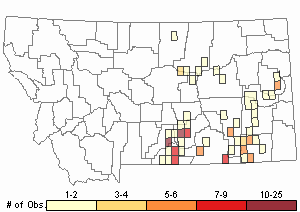
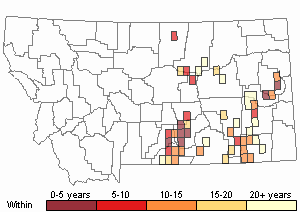
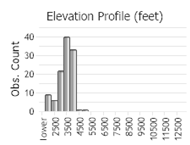
Number of Observations: 165
(Click on the following maps and charts to see full sized version)
Relative Density
Recency
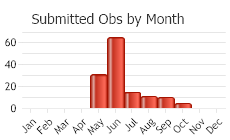
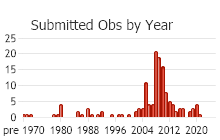
 (Observations spanning multiple months or years are excluded from time charts)
Migration
No information on the movement or migration of Milksnakes is available for Montana. The species is believed to be non-migratory. Little information is available on movements of Milksnakes throughout the species' range. They may migrate between hibernacula and summer ranges in some areas (Vogt 1981, Fitch and Fleet 1970, Hammerson 1999), and home ranges are about 20 hectares in northeastern Kansas.
Habitat
Little specific information is available. Milksnakes have been reported in areas of open sagebrush-grassland habitat (Dood 1980) and ponderosa pine savannah with sandy soils (Hendricks 1999), most often in or near areas of rocky outcrops and hillsides or badland scarps, sometimes within city limits.
National Vegetation Classification System Groups Associated with this Species
Forest and Woodland
Deciduous Forest and Woodland
Low Elevation - Xeric Forest and Woodland
Montane - Subalpine Forest and Woodland
Shrubland
Arid - Saline Shrubland
Foothills - Montane Shrubland
Sagebrush Shrubland
Grassland
Lowland - Prairie Grassland
Sparse and Barren
Sparse and Barren
Wetland and Riparian
Alkaline - Saline Wetlands
Riparian and Wetland Forest
Riparian Shrubland
Recently Disturbed or Modified
Introduced Vegetation
Recently Burned
Human Land Use
Developed
Food Habits
A carnivorous species, Milksnakes eat mostly small vertebrates, including snakes, lizards, reptile eggs, birds, bird eggs, small mammals (especially mice), and occasionally insects and worms (Hammerson 1999, St. John 2002, Stebbins 2003). The food habits in Montana have not been reported or studied.
Ecology
Milksnakes are mostly crepuscular and nocturnal, although they may on occasion be active during the day, particularly during moist surface conditions. In Colorado, Milksnakes emerge from dens in April and re-enter hibernacula in mid-October (Hammerson 1999), although they have been seen as late as mid-November. The active period in Montana is poorly documented; records extend from late May to October (Montana Natural Heritage Program Point Observation Database). Predators are largely unknown, including in Montana, but Milksnakes exhibit predator defense behavior, and rear up and strike, or vibrate the tail, when disturbed, although they are usually docile when handled.
Reproductive Characteristics
No information specific to the reproductive habits of the Milksnakes is known for Montana. Based upon information from other states, courtship and mating are believed to occur in spring, generally in May. Milksnakes lay clutches of 2 to 17 eggs; typical clutches in Colorado and adjacent areas are 4 to 6 eggs (Hammerson 1999). Eggs are laid usually in mid-June to mid-July. Eggs hatch in about 6 to 9 weeks, beginning in late August and most often in September. Some females reach sexual maturity in their 3rd or 4th year (45 to 50 centimeters snout-vent length) in Kansas (Fitch and Fleet 1970), and evidence indicates this is also the case in Colorado (Hammerson 1999). Longevity in wild populations is unreported, but captive individuals have lived more than 20 years.
Management
So few recent Milksnake records exist for Montana (Maxell et al. 2003) that it is difficult to determine if management activity is needed. Nevertheless, the widely scattered recent records indicate that Milksnakes continue to occupy a large part of the known range in the state, and some sites near a large urban center have remained occupied for the last 40 to 45 years (Laurie Vitt, personal communication). Management for this species is hampered by a lack of basic information on abundance, food habits, and habitat associations. No specific management activities are suggested at this time, other than to protect dens and regulate or restrict commercial harvest for the pet trade.
Stewardship Responsibility
References
- Literature Cited AboveLegend:
 View Online Publication
- Dood, A.R. 1980. Terry Badlands nongame survey and inventory final report. Montana Department of Fish, Wildlife, and Parks and Bureau of Land Management, Helena, MT. 70 pp.
- Fitch, H.S. and R.R. Fleet. 1970. Natural history of the milk snake (Lampropeltis triangulum) in northeastern Kansas. Herpetologica 26: 387-396.
 Hammerson, G.A. 1999. Amphibians and reptiles in Colorado. University Press of Colorado & Colorado Division of Wildlife. Denver, CO. 484 p.
- Hendricks, P. 1999a. Amphibian and reptile survey of the Bureau of Land Management Miles City District, Montana. Montana Natural Heritage Program, Helena, MT. 80 p.
- Maxell, B.A., J.K. Werner, P. Hendricks, and D.L. Flath. 2003. Herpetology in Montana: a history, status summary, checklists, dichotomous keys, accounts for native, potentially native, and exotic species, and indexed bibliography. Society for Northwestern Vertebrate Biology, Northwest Fauna Number 5. Olympia, WA. 135 p.
- St. John, A.D. 2002. Reptiles of the northwest: California to Alaska, Rockies to the coast. Lone Pine Publishing, Renton, WA. 272 p.
- Stebbins, R. C. 2003. A field guide to western reptiles and amphibians. 3rd Edition. Houghton Mifflin Company, Boston and New York. 533 p.
- Vogt, R. C. 1981. Natural history of amphibians and reptiles of Wisconsin. Milwaukee Public Museum. 205 p.
- Additional ReferencesLegend: View Online Publication
Do you know of a citation we're missing?- [PRESI] Powder River Eagle Studies Incorporated. 1998a. Big Sky Mine 1997 wildlife monitoring studies. Powder River Eagle Studies Incorporated. Gillete, WY.
- [PRESI] Powder River Eagle Studies Incorporated. 1998b. Spring Creek Mine 1997 wildlife monitoring studies. Powder River Eagle Studies Incorporated. Gillete, WY.
- Armstrong, M. P., D. Frymire, and E. J. Zimmerer. 2001. Analysis of sympatric populations of Lampropeltis triangulum syspila and Lampropeltis triangulum elapsoides, in western Kentucky and adjacent Tennessee with relation to the taxonomic status of the scarlet kingsnake. Journal of Herpetology 35:688-693.
- Badman, J.A., L. Neinaber, D.F. DeNardo, and A.T. Holycross. 2003. Milksnakes (Lampropeltis triangulum) from Cochise County: notes on captive breeding and pattern. Sonoran Herpetologist 16(2):15.
- Barten, S.L. 1981. Reproduction of Lampropeltis triangulum elapsoides from Onslow County, North Carolina. Herpetological Review 12(2): 62.
- Baxter, G.T. and M.D. Stone. 1985. Amphibians and reptiles of Wyoming. Second edition. Wyoming Game and Fish Department. Cheyenne, WY. 137 p.
- Blair, K.B., H.M. Smith, and D. Chiszar. 1994. Albinism and distributional records for Lampropeltis triangulum (Reptilia: Serpentes) in Panhandle Texas. Bulletin of the Maryland Herpetological Society 30(1): 1-5.
- Blatchford, D. 1985. The Jalisco milk snake (Lampropeltis triangulum arcifera). Herptological Review 10(3): 85-89.
- Boundy, J. 1994a. County records for Texas amphibians and reptiles. Herpetological Review 25(3): 129.
- Boundy, J. 1994b. Range extensions for Louisiana amphibians and reptiles. Herpetological Review 25(3): 128-129.
- Brunson, R.B. 1955. Check list of the amphibians and reptiles of Montana. Proceedings of the Montana Academy of Sciences 15: 27-29.
- Carlson, J. (Coordinator, Montana Animal Species of Concern Committee). 2003. Montana Animal Species of Concern January 2003. Helena, MT: Montana Natural Heritage Program and Montana Fish, Wildlife, and Parks. In Press. 12p.
- Cavitt, J.F. 2000. Tallgrass prairie snake assemblage food habits. Herpetological Review 31(1): 47-48.
- Chiszar, D. and H.M. Smith. 1992b. Lampropeltis triangulum celaenops (New Mexico milk snake). Herpetological Review 23(4): 124.
- Cohen, H.J. 1987. Life history notes, Lampropeltis triangulum hondurensis (Honduran milk snake). Maximum size. Herpetological Review 18(2): 36.
- Collins, J.T. 1991. A new taxonomic arrangement for some North American amphibians and reptiles. Herpetological Review 22:42-43.
- Collins, J.T., S.L. Collins, and K.J. Irwin. 1993. Lampropeltis triangulum (milk snake). Herpetological Review 24(3): 110.
- Cope, E.D. 1861. Catalogue of the Colubridae in the museum of the Academy of Natural Sciences of Philadelphia. Part 3. Proceedings of the Academy of Natural Sciences Philadelphia 12: 553-566.
- Cope, E.D. 1875. Check-list of North American Batrachia and Reptilia; with a systematic list of the higher groups, and an essay on geographical distribution. Based on the specimens contained in the U.S. National Museum. U.S. Natioanl Museum Bulletin 1: 1-104.
- Coues, E. and H. Yarrow. 1878. Notes on the herpetology of Dakota and Montana. Bulletin of the U.S. Geological Geographic Survey of the Territories 4: 259-291.
- Cox, T.M. 1983. A review of "pattern variation and evolution of the mountain kingsnake, Lampropeltis zonata" (by R.G. Zweifel) and a discussion of the relationship between L. zonata and L. triangulum. Northern Ohio Association Herpetology Notes 10(6): 14-17.
- Crother, B.I. (ed.) 2008. Scientific and standard English names of amphibians and reptiles of North America north of Mexico. SSAR Herpetological Circular No. 37:1-84.
- Dowling, H. G. 1993. Viewpoint: a reply to Collins (1991, 1992). Herpetol. Rev. 24:11-13.
- Ewing, P.J., M.D. Setser, E.L. Stair, B. Waurzyniak, and R.L. Cowell. 1991. Myxosarcoma in a Sinaloan milksnake. Journal of the American Veterinary Medical Association 199(12): 1775-1776.
- Fitch, H.S. 2003b. Reproduction in snakes of the Fitch Natural History Reservation in northeastern Kansas. Journal of Kansas Herpetology 6:21-24.
- Fjell, Alan K., and Brian R. Mahan., 1987, Big Sky Mine, Rosebud County, MT. Wildlife monitoring report: 1986 field season. April 1987.
- Flath, D.L. 1979. Nongame species of special interest or concern: Mammals, birds, reptiles, amphibians, fishes. Wildlife Division, Montana Department of Fish and Game. Helena, MT.
- Flath, D.L. 1998. Species of special interest or concern. Montana Department of Fish, Widlife and Parks, Helena, MT. March, 1998. 7 p.
- Frost, D.R. and J.T. Collins. 1988. Nomenclatural notes on reptiles of the United States. Herpetological Review 19(4): 73.
- Fuller, S. 1981. Simultaneous copulation by Mexican milk snakes. Northern Ohio Association Herpetology Notes 8(6): 7
- Fuller, S. 1982. Successful treatment of eastern milk snake (Lampropeltis t. triangulum) with "emtryl." Northern Ohio Association Herpetology Notes 10(3): 11.
- Garrett, C.M. 1992. Lampropeltis triangulum amaura (Louisiana milk snake). Herpetological Review 23(1): 27.
- Gates, M.T. 2005. Amphibian and reptile baseline survey: CX field study area Bighorn County, Montana. Report to Billings and Miles City Field Offices of Bureau of Land Management. Maxim Technologies, Billings, MT. 28pp + Appendices.
- Gertler, P.E. and J.Morales. 1980. Snake predation on Marmosa noctivaga. Journal of Mammalogy 61(2): 381.
- Gillingham, J.C., C.C. Carpenter, B.J. Brecke, and J.B. Murphy. 1977. Courtship and copulatory behavior of the Mexican milk snake, Lampropeltis triangulum sinaloae (Colubridae). Southwestern Naturalist 22(2): 187-194.
- Grogan, W.L., Jr. 1985. New distributional records for Maryland reptiles and amphibians. Bulletin of the Maryland Herpetological Society 21(2): 74-75.
- Groves, J.D. and P.S. Sachs. 1974. Eggs and young of the scarlet king snake, Lampropeltis triangulum elapsoides. Journal of Herpetology 7(4): 389-390.
- Gurrola, H.M.A. and C.N. Chavez. 1996. Serpentes: Lampropeltis triangulum nelsoni (milk snake). Predation. Herpetological Review 27(2): 83.
- Hammack, S.H. 1989. Reproduction of the Colombian milk snake, Lampropeltis triangulum andesiana at the Dallas zoo. International Zoo Yearbook 28: 172-177.
- Hayden, F.V. 1858. Catalogue of the collections in geology and natural history, obtained by the expedition under command of Lieutenant G.K. Warren, Topographical Engineers. pp. 104-105. In: F.N. Shubert (1981) Explorer on the northern plains: Lieutenant Gouverneur K. Warren's preliminary report of explorations in Nebraska and Dakota, in the years 1855-'56-'57. Engineer Historical Studies No. 2. Office of the Chief of Engineers, Washington, DC. 125 p.
- Hayden, F.V. 1862. On the geology and natural history of the upper Missouri. Transactions of the American Philosophical Society New Series 12(1): 1-218
- Hecht, M.K., and D. Marien. 1956. The coral snake mimic problem: a reinterpretation. Journal of Morphology. 98: 335-365.
- Hedges, S.B. 1977. The presence of the scarlet kingsnake, Lampropeltis triangulum elapsoides holbrook (reptilia, serpentes, colubridae), in the Florida Keys. Herpetological Review 8(4): 125-126.
- Heinrich, M.L. and H.E. Klaassen. 1985. Side dominance in constricting snakes. Journal of Herpetology 19(4): 531-533.
- Henderson, R.W., M.H. Binder, R.A. Sajdak, and J.A. Buday. 1980. Aggregating behavior and exploitation of subterranean habitat by gravid eastern milksnakes (Lampropeltis t. triangulum). Milwaukee Public Musuem Contributions to Biology and Geology 32: 9p.
- Hendricks, P. and J.D. Reichel. 1996b. Preliminary amphibian and reptile survey of the Ashland District, Custer National Forest: 1995. Montana Natural Heritage Program, Helena, MT. 79 p.
- Herman, D.W. 1979. Captive reproduction in the scarlet kingsnake, Lampropeltis triangulum elapsoides (Holbrook). Herpetological Review 10(4): 115.
- Hibbitts, T.D., M.P. Hibbitts, and T.J. Hibbitts. 1996. New distributional records of reptiles from western and trans-Pecos Texas, USA. Herpetological Review 27(4): 217-218.
- Hingley, K.J. 1987. The eastern milk snake: Lampropeltis t. triangulum. Snake Keeper 1(11): 4.
- Hingley, K.J. 1991. Failure to breed the Mexican milk snake, Lampropeltis triangulum annulata. Herptological Review 16(3): 123-124.
- Holycross, A.T. and C. Schwalbe. 1995. Lampropeltis triangulum (milk snake). Herpetological Review 26(1): 46.
- Howard, C.J. 1985. Husbandry and breeding of the Honduran milk snake (Lampropeltis triangulum hondurensis) at Twycross Zoo. Herptilological Review. 10(3): 81-84.
- Irwin, K.J. and S.L. Collins. 1996. Lampropeltis triangulum (milk snake). Herpetological Review 27(1): 34.
- Joslin, Gayle, and Heidi B. Youmans. 1999. Effects of recreation on Rocky Mountain wildlife: a review for Montana. [Montana]: Montana Chapter of the Wildlife Society.
- Kamb, A.H. 1978. Unusual feeding behavior of the red milk snake, Lampropeltis triangulum syspila (lacepede). Transactions of the Kansas Academy of Science 81(3): 273.
- Kennicott, R. 1860a. Descriptions of new species of North American Serpents in the Museum of the Smithsonian Institution, Washington. Proceedings of the Academy of Natural Sciences of Philadelphia 12: 328-338.
- Kirkwood, J.K. and C. Gili. 1994. Food consumption in relation to bodyweight in captive snakes. Research in Veterinary Science 57(1): 35-38.
- Klaphake, E., C. Cross, S. Patton, and L. Head. 2005. Gastric impaction in a milk snake, Lampropeltris triangulaum, caused by Kalicephalus sp. Journal of Herpetological Medicine and Surgery 15(1):21-23.
- Klemens, M.W. 1995. New distributional records of amphibians and reptiles from New Hampshire. Herpetological Review 26(1): 49.
- Kraus, F. and G.W. Schuett. 1981. An intergrade Lampropeltis triangulum from west Texas. Herpetological Review 12(2): 53.
- Lane, M. and D. Schwab. 1986. Field notes: Lampropeltis t. triangulum X L. t. elapsoides (coastal plains milksnake): City of Suffolk, the Great Dismal Swamp National Wildlife Refuge, Hudnell Ditch, 1.7 km S. of New Ditch. April 15, 1986. Catesbeiana 6(2): 14.
- Long, C.A., J.E. Long, and C.A. Long. 1987. A listing of known amphibians and reptiles from Washington Island, Lake Michigan, with new records of the milk snake and red-bellied snake. Jack-Pine Warbler 65(3-4): 39.
- Martin, P.R. 1980b. Terrestrial wildlife inventory in selected coal areas of Montana. Montana Department of Fish, Wildlife and Parks and Bureau of Land Management, Helena, MT. 84 p.
- Martin, P.R., K. Dubois and H.B. Youmans. 1981. Terrestrial wildlife inventory in selected coal areas, Powder River resources area final report. Montana Department of Fish, Wildlife and Parks and Bureau of Land Management, Helena, MT. No. YA-553-CTO- 24. 288 p.
- Matthews, W.L. 1981. Broadus-Pumpkin Creek baseline inventory - wildlife. Bureau of Land Management, Miles City, MT. 83 p.
- McAllister, C.T., R. Ward, and K.L. Williams. 1987. Noteworthy milk snakes (Lampropeltis triangulum) from Texas. Southwestern Naturalist 32(3): 406-408.
- McCrystal, H.K., R.H. Dean, and J.R. Dixon. 1984. Lampropeltis triangulum annulata (Mexican milk snake). Size. Herpetological Review 15(1): 19.
- McEneaney, T. and J. Jensen. 1974. The reptiles and amphibians of the Charles M. Russell National Wildlife Range - 1974. Charles M. Russell National Wildlife Refuge. Lewistown, MT. 3 p.
- Mendoza, Q.F. and H.A. Ruiz-Pina. 1995. Serpentes: Lampropeltis triangulum smithi. (Smith's Milk Snake). Prey. Herpetological Review 26(3): 148-149.
- Mendoza, Q.F. and Y.C.A. Rodriguez. 1992. Lampropeltis triangulum smithi (NCN). Size. Herpetological Review 23(4): 120.
- Michaels, S.J. 1989. Some observations on multiple egg clutches and a case of delayed fertilization in a colony of captive Pueblan milk snakes, Lampropeltis triangulum campbelli. Bulletin of the Chicago Herpetological Society 24(6): 109-111.
- Miller, R. and G. Grall. 1978. Reproductive data on Lampropeltis triangulum temporalis from Maryland. Bulletin of the Maryland Herpetological Society 14(1): 36-38.
- Mitchell, J.C. 1980. Notes on Lampropeltis triangulum (Colubridae) from northern Jalisco, Mexico. Southwestern Naturalist 25(2): 269.
- Mount, R.H. 1986b. Eastern milk snake. pp 68-69. In: Mount, R.H. [Ed.] Vertebrate animals of Alabama in need of special attention. Alabama Agricultural Experiment Station, Auburn, Alabama. 124 p.
- Mount, R.H. 1986d. Red milk snake. pp. 69 In: Mount, R.H. [Ed.] Vertebrate animals of Alabama in need of special attention. Alabama Agricultural Experiment Station, Auburn, Alabama. 124 p.
- Nelson, D.J. 1948. Lampropeltis triangulum gentilis in Montana. Herpetologica 4:170.
- Nelson, D.J. 1950. Lampropeltis triangulum gentilis in Montana. Herpetologica 6:41.
- Nicholson, K.E. ed. 2025. Scientific and standard English names of amphibians and reptiles of North America north of Mexico, with comments regarding confidence in our understanding. Ninth Edition. Society for the Study of Amphibians and Reptiles. 87 p.
- Norrie, S.G. 1985. Comparisons between the natural and captive environments of the Sinaloan milk snake (Lampropeltis triangulum sinaloae). Herptilological Review 10(3): 90-92.
- Painter, C.W. and R.D. Jennings. 1996. Lampropeltis triangulum celaenops (New Mexico milk snake). Herpetological Review 27(4): 213.
- Parmley, D. 1994. Reevaluation of the extinct kingsnake Lampropeltis intermedius Brattstrom (Colubridae) with comments on the ancestry of Lampropeltis triangulum. Herpetological Natural History 2(2): 83-84.
- Perez-Higareda, G. and H.M. Smith. 1987. Geographic distribution, Lampropeltis triangulum polyzona (Veracruz milk snake). Herpetological Review 18(2): 41.
- Peters, J.A., and M.B. Orejas. 1986. Part 1. Snakes. Peters, J.A., Donoso-Barros, R., Orejas-Miranda, B. & Vanzolini, P.E. Catalogue of the Neotropical Squamata. Smithsonian Institution Press, Washington, D.C. & London. 347 p.
- Peterson, K.H., D. Lazcano, G.R.D. Jacobo. 1995. Captive reproduction in the Mexican milksnake Lampropeltis triangulum annulata. Litteratura Serpentium English Edition 15(5): 128-132.
- Pilliod, D.S. and T.C. Esque. 2023. Amphibians and reptiles. pp. 861-895. In: L.B. McNew, D.K. Dahlgren, and J.L. Beck (eds). Rangeland wildlife ecology and conservation. Cham, Switzerland: Springer. 1023 p.
- Quinn, H.R. 1983. Two new subspecies of Lampropeltis triangulum from Mexico. Transactions of the Kansas Academy of Science 86(1): 113-135.
- Rau, M.E., J. Doyle, and D. Gordon. 1978. The parasites of the wild animals of Quebec. 2. The parasites of frogs and snakes of the Ile Perrot region. [Les parasites des animaux sauvages du Quebec. 2. Les parasites des grenouilles et des serpents de la region de I'ile Perrot.]. Natural Canadian 105(1): 56-57.
- Rehak, I. 1985. The scarlet king snake Lampropeltis triangulum elapsoides. Akvarium Terrarium 28(4): 31-32.
- Rehak, I. 1988. On the species of king snake Lampropeltis triangulum. Akvarium Terarium 31(2): 24-25.
- Rehak, I. 1990a. Bionomics of Lampropeltis triangulum hondurensis in captivity. Akvarium Terarium 33(7): 24-26.
- Reichel, J. and D. Flath. 1995. Identification of Montana's amphibians and reptiles. Montana Outdoors 26(3):15-34.
- Rodríguez, M.C. and H. Drummond. 2000. Exploitation of avian nestlings and lizards by insular Milksnakes, Lampropeltis triangulum. Journal of Herpetology 34(1):139-142.
- Roedel, M.D. and P. Hendricks. 1998a. Amphibian and reptile survey on the Bureau of Land Management Lewistown District: 1995-1998. Montana Natural Heritage Program, Helena, MT. 53 p.
- Roedel, M.D. and P. Hendricks. 1998b. Amphibian and reptile inventory on the Headwaters and Dillon Resource Areas in conjunction with Red Rocks Lakes National Wildlife Refuge: 1996-1998. Montana Natural Heritage Program, Helena, MT. 46 p.
- Roth, J.J. and H.M. Smith. 1990b. The milksnake, Lampropeltis triangulum, in northwest Colorado. Bulletin of the Chicago Herpetological Society 25(1): 6-7.
- Schaefer, K., D. Chiszar, and H.M. Smith. 1995. Lampropeltis triangulum gentilis (central plains milk snake). Herpetological Review 26(2): 110.
- Schuett, G.W. 1994. Lampropeltis triangulum (milk snake). Herpetological Review 25(4): 167.
- Setser, K.W., D.G. Mulcahy, and B.L. Williams. 2003. Lampropeltis triangulum (Milk Snake). Herpetological Review 34(2):150.
- Sharp, S. and M. Dobson. 1993. The Honduran milksnake, Lampropeltis triangulum hondurensis. Herptological Review 18(2): 65-68.
- Smith, H.M., C. Ristau, T. Bell, M. Bell, and D. Chiszar. 1995. Serpentes: Lampropelitis triangulum multistriata X Taylori (pale X Utah milk snake intergrade). Herpetological Review 26(4): 210.
- Smith, K.G. 2001. Lampropeltis triangulum triangulum (Eastern milk snake) antipredator behavior. Herpetological Review 32(4): 263-264.
- Strimple, P. 1991. Captive reproduction in the scarlet kingsnake, Lampropeltis triangulum elapsoides (Holbrook, 1838). Litteratura Serpentium English Edition 11(3): 50-52.
- Tanner, W.W. and R.B. Loomis. 1957. A taxonomic and distributional study of the western subspecies of the milk snake, Lampropeltis doliata. Transactions of the Kansas Academy of Science 60(1): 12-42.
- Tryon, B.W. and J.B. Murphy. 1982. Miscellaneous notes on the reproductive biology of reptiles. 5. Thirteen varieties of the genus Lampropeltis, species mexicana, triangulum and zonata. Transactions of the Kansas Academy of Science 85(2): 96-119.
- Upton, S.J., C.T. McAllister, P.S. Freed, and S.M. Barnard. 1989. Cryptosporidium spp. in wild and captive reptiles. Journal of Wildlife Diseases 25(1): 20-30.
- Van der Rijst, H. 1992. A colourful mistake. On coral snakes, king snakes and Erythrolamprus. Nordisk Herpetologisk Forening 35(1): 4-7.
- Van Devender, R.W. and P.F. Nicoletto. 1983. Lower Wilson Creek, Caldwell County, North Carolina (USA): A thermal refugium for reptiles? Brimleyana 0(9): 21-32.
- Vance, T. 1994. Lampropeltis triangulum amaura (Louisiana milk snake). Herpetological Review 25(2): 77.
- Vitt, L.J., J.P. Caldwell, and D.B. Shepard. 2005. Inventory of amphibians and reptiles in the Billings Field Office Region, Montana. Sam Noble Oklahoma Museum of Natural History and Department of Zoology, University of Oklahoma, Norman, OK. 33 pp.
- Vojtisek, V. 1994. Incubation of the eggs of Lampropeltis triangulum sinaloae. Akvarium Terarium 37(7): 34-37.
- Vojtisek, V. 1995. Periodic molting in the milk snake Lampropeltis triangulum sinaloae. Akvarium Terarium 38(6): 32-33.
- Waage, B.C. 1998. Western Energy Company Rosebud Mine 1997 annual wildlife monitoring report December 1, 1996 to November 30, 1997 survey period. Western Energy Company, Colstrip, MT.
- Waage, Bruce C., 1992, Western Energy Company Rosebud Mine, Colstrip, Montana: Annual Wildlife Monitoring Report, 1991 Field Season. December 1992.
- Wagner, E. 1982. Lampropeltis triangulum (milk snake). Coloration. Herpetological Review 13(1): 18.
- Weinstein, S.A., C.F. Dewitt, and L.A. Smith. 1992. Variability of venom-neutralizing properties of serum from snakes of the colubrid genus Lampropeltis. Journal of Herpetology 26(4): 452-461.
- Werner, J.K., B.A. Maxell, P. Hendricks and D.L. Flath. 2004. Amphibians and Reptiles of Montana. Mountain Press Publishing Company: Missoula, MT. 262 pp.
- Whipple, J.F. and J.T. Collins. 1988. First complete clutch record for the central plains milk snake (Lampropeltis triangulum gentilis) in Kansas. Transactions of the Kansas Academy of Science 91(3-4): 187-188.
- Williams, K.I. 1994. Reptilia:Squamata:Serpentes:Colubridae:Lampropeltis triangulum. Catalogue of American Amphibians and Reptiles :594. 1994. 1-10.
- Williams, K.L. 1970. Systematics of the colubrid snake Lampropeltis triangulum Lacepede. Ph.D. Thesis, Louisiana State University; 369 p.
- Williams, K.L. 1978. Systematics and natural history of the American milk snake, Lampropeltis triangulum. Milwaukee Public Museum Contributions to Biology & Geology 2:1-258.
- Williams, K.L. 1989. Systematics and natural history of the American milksnake, Lampropeltis triangulum. Second revised edition. 192 pp.
- Williams, K.L. 1994. Lampropeltis triangulum. Catalogue of American Amphibians and Reptiles 594.1-594.10.
- Winstel, A. 1987. Captive breeding and rearing of the eastern milk snake, Lampropeltis t. triangulum. Northern Ohio Association Herpetology Notes 15(1): 9-10.
- Winstel, A. 1991. Captive husbandry of the eastern milk snake (Lampropeltis t. triangulum). Vivarium 2(6): 16-17, 28.
- Yarrow, H.C. 1882. Check list of North American reptilia and batrachia, with catalogue of specimens in the U.S. National Museum. United States National Museum Bulletin 24. 249 p.
- Yeomans, L. 1988. Care and breeding of the Honduran milk snake - (Lampropeltis triangulum hondurensis) - and a case of dicephalism. Herpetological Review 13(1): 5-8.
- Web Search Engines for Articles on "Western Milksnake"
- Additional Sources of Information Related to "Reptiles"