View in other NatureServe Network Field Guides
NatureServe
Montana
Utah
Wyoming
Idaho
Wisconsin
British Columbia
South Carolina
Yukon
California
New York
North American Racer - Coluber constrictor
Other Names:
Eastern Racer
Native Species
Global Rank:
G5
State Rank:
S5
(see State Rank Reason below)
Agency Status
USFWS:
USFS:
BLM:
State Rank Reason (see State Rank above)
Species is relatively common within suitable habitat and widely distributed across portions of the state
General Description
EGGS:
White and oval with a granular surface. Eggs are approximately 33 mm (1.3 in) in length by 19 mm (0.75 in.) in width and are laid in groups of about 9-12. However, clutch size can vary widely (Hammerson 1999, Russell and Bauer 2000, Werner et al. 2004) and is closely correlated with female body length (Rosen 1991). Swain and Smith (1978) found an average weight of 8.7 g/egg (0.31oz/egg) for 89 eggs in Colorado.
NEONATES:
Newborns have a series of red/brown blotches dorsally interspersed with lighter colored scales and smaller brown spots along their sides giving them a banded appearance. Newborns average 33 cm (13 in) in total length (TL) and weigh approximately 5.5 g (0.19 oz) (Swain and Smith 1978, Werner et al. 2004). When young racers reach a total length of approximately 69 cm (27 in) in their second year this banded appearance fades into uniform adult coloration (Hammerson 1999, Werner et al. 2004).
JUVENILES AND ADULTS:
Slender with smooth scales and uniform blue, gray, or olive coloration dorsally and yellow coloration ventrally. The underside of the chin is white, or cream with 7-8 upper and 9-10 lower labial (lip) scales that are pale yellow, and large eyes with round pupils (Werner et al. 2004). Adults range 58-122 cm (23-48 in.) TL, with females typically larger than males.
Diagnostic Characteristics
Because of their banded appearance juveniles of the North American Racer can be confused with Gophersnakes (
Pituophis catenifer); however, Gophersnakes have keeled or ridged scales.
Species Range
Montana Range
Range Descriptions
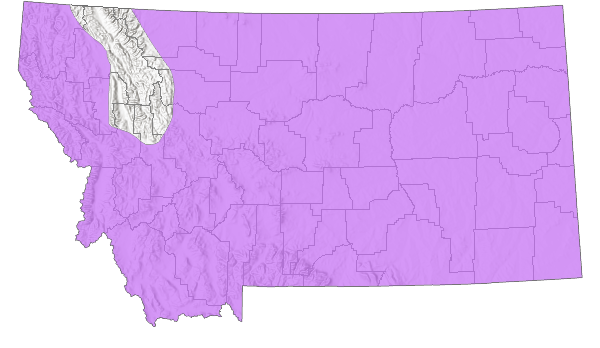
 Native
Global Range

Estimated global breeding range area is: 6,471,469 km
2 (Approximately 6% in Montana)
See information about
 iNaturalist Geomodels
Range Comments
As its common name implies, much of the range of the North American Racer or Eastern Racer is in the eastern United States. However, it is found across the Midwest and portions of the Dakotas linking it to Montana and further into the Pacific Northwest and southern British Columbia. Fringes and pockets of North American Racer are also found in California, Nevada, Utah, Wyoming, Colorado, Arizona, and New Mexico (Wilson 1978, Hammerson 1999, Russell and Bauer 2000, Werner et al. 2004). Currently, there are 11 subspecies of Coluber constrictor recognized but only the Eastern Yellow-bellied Racer (C. c. flaviventris), has been confirmed in Montana. Most records of this species in Montana are from the eastern part of the state and the drier valleys of western Montana (Maxell et al. 2003).
Maximum elevation: 2,718 m (8,916 ft) in Gallatin County, T.C. Jones (MTNHP 2024).
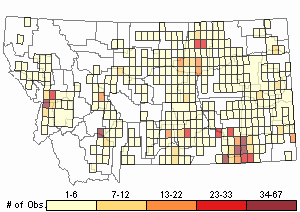
Observations in Montana Natural Heritage Program Database
Number of Observations: 1523
(Click on the following maps and charts to see full sized version)
Map Help and Descriptions
Relative Density
Recency
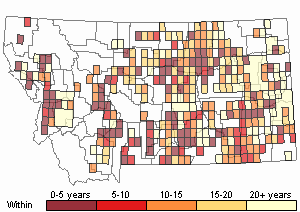
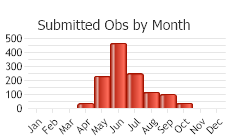
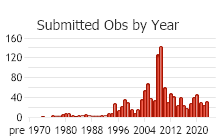
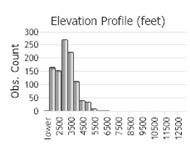 (Observations spanning multiple months or years are excluded from time charts)
Migration
Non-migratory.
Habitat
North American Racer are typically found in open habitat including shortgrass prairie, sagebrush, badlands, and valley bottom grasslands (Hammerson 1999, Werner et al. 2004). While North American Racer are largely terrestrial, inhabiting rodent burrows and spaces under rocks, boards, and vegetation during spring and summer, they have also been observed climbing shrubs and trees and even swimming (Degenhardt et al. 1996, Hammerson 1999, Werner et al. 2004). In Wyoming, primary habitats are scarp woodlands of plains and foothills often near water (Baxter and Stone 1980). Some cover seems especially important on shortgrass prairie (Fitch 1963). In the northwest, North American Racers are generally absent from dense forest/high mountains (Nussbaum et al. 1983). Hibernacula have been found in rock piles, talus, and even abandoned wells and home foundations (Brown and Parker 1976, Herrington 1988, Hammerson 1999).
National Vegetation Classification System Groups Associated with this Species
Forest and Woodland
Deciduous Forest and Woodland
Low Elevation - Xeric Forest and Woodland
Montane - Subalpine Forest and Woodland
Shrubland
Arid - Saline Shrubland
Foothills - Montane Shrubland
Sagebrush Shrubland
Grassland
Lowland - Prairie Grassland
Montane - Subalpine Grassland
Sparse and Barren
Sparse and Barren
Wetland and Riparian
Alkaline - Saline Wetlands
Riparian and Wetland Forest
Riparian Shrubland
Recently Disturbed or Modified
Introduced Vegetation
Recently Burned
Human Land Use
Agriculture
Developed
Food Habits
North American Racer forage widely using rapid locomotion to locate prey (Herzog and Burghardt 1974, Plummer and Congdon 1996). Largely opportunistic, this species consumes their prey alive and without constriction as their scientific name suggests (Werner et al. 2004). Small mammals, grasshoppers, crickets, amphibians, and birds are all consumed by North American Racer (Schonberger 1945, Fitch 1963, Rosen 1991, Hammerson 1999, Werner et al. 2004). Orthopterans can form a major part of their diet and have been reported as food in northcentral Montana (Mosimann and Rabb 1952) and Oregon (Schonberger 1945). Individuals have even been documented eating other snake species (Hammerson 1999).
Ecology
North American Racer are active from late April to October (Hammerson 1999, Werner et al. 2004) and are most active during the day when the sun can warm body temperatures to approximately 30 °C (86 °F) (Plummer and Congdon 1996, Werner et al. 2004). Hibernation lasts from late October through April and is often communal and can even occur with other snake species (Swain and Smith 1978, Hammerson 1999). Survival over the hibernation period is high (>90%), but on average 60% of adults survive annually with only 20% of juveniles surviving their first year (Hammerson 1999).
Subsequent dispersal from hibernacula to summer ranges averaged 339 m (1,112 ft) in a population of
C.c. flaviventris in Kansas (Fitch 1963). Brown and Parker (1976) found average dispersal distances from hibernacula to summer ranges for
C.c. Mormon in Utah averaged 289 m (948 ft) and 739 m (2,425 ft) during 1966 and 1971-1972, respectively. Mean home range size for North American Racer in Kansas was 2.9 ha (7.2 ac) and 1.8 ha (4.5 ac) for males and females, respectively (Fitch 1963). Rosen (1991) found that larger
C. c. foxii moved farther between relocations than did smaller individuals, indicating that larger individuals had larger home ranges possibly due to increased energetic demands.
Red-tailed Hawks (
Buteo jamaicensis) have been observed killing North American Racer and it is likely that a suite of other animals prey on this species as well (Hammerson 1999). North American Racer can be relatively long-lived in the wild with a small percentage of individuals within a population >10 years old (Hammerson 1999).
Reproductive Characteristics
In Kansas, North American Racer breed after emerging from hibernation in the spring (Brown and Parker 1976). Roughly 90% of adult females lay eggs in late-June/early July (Hammerson 1999) and the females may deposit eggs in shallow burrows, abandoned rodent burrows, or rotting logs (Porchuk and Brooks 1995, Brown and Parker 1976, Hammerson 1999). Swain and Smith (1978) even found a communal nest with over 100 eggs under a large rock in Colorado. Clutch size can average from 5.8 (C. c. mormon) to 11.6 (C. c. flaviventris) (Fitch 1963, Fitch 1970, Brown and Parker 1976). Eggs will hatch after an average of 51 days in late August/early September and growth of hatchlings is best in years with abundant precipitation. Individuals can breed in their second spring; however, most females will deposit their first clutch of eggs at age four (Hammerson 1999).
Management
The following was taken from the Status and Conservation section for the North American Racer account in
Maxell et al. 2009.
Eastern Racer are common and have been documented in 40 counties and on both sides of the Continental Divide in Montana (Maxell et al. 2003). There is some debate whether
C.c. flaviventris occurs east of the divide and
C.c. mormon occurs west of the divide; however, research has not been conducted to ascertain whether this separation, or integration, occurs (Maxell et al. 2003). Similar to other species of snakes, Eastern Racers may be negatively impacted by disturbance to their hibernacula. Because they are ectothermic, snakes do not respond to human disturbance as effectively at cooler temperatures, such as the overwintering period, than they would at warmer temperatures (Prior and Weatherhead 1994). In addition, because Eastern Racers can concentrate in large numbers and display substantial site fidelity year after year (Brown and Parker 1976, Swain and Smith 1978), they can be impacted by even small, localized disturbance if it occurs near hibernacula or nesting sites. For example, roadways and off-road vehicle (ORV) use may impact Eastern Racers if they occur near hibernacula or intersect movement to such areas. Snake mortality on roadways, at times in great numbers, has been documented widely with some drivers even purposely swerving to kill snakes (Langley et al. 1989, Krivda 1993, Rosen and Lowe 1994). In general, snakes near human population centers or areas with high levels of recreational use can experience mortality from humans, predation from pets or even predation from small carnivores that can exist at higher densities near human concentrations (Maxell and Hokit 1999). Although Eastern Racers are not venomous, they can bite when provoked (Degenhardt et al. 1996) and a general lack of knowledge about snakes coupled with deeply anchored fears sometimes leads humans to destroy snakes on sight, regardless of the species (Dodd 1993, Maxell and Hokit 1999). In addition, popular large-scale Western Diamondback Rattlesnake (
Crotalus atrox) roundups are known to kill not only thousands of the targeted species, but also many other incidental species including Eastern Racers (Weir 1992). Near homes and construction sites plastic netting, commonly used to protect fruit trees and gardens from pests, has also been found to entangle and kill Eastern Racers (Stuart et al. 2001). Although Eastern Racers are beneficial to farmers through consumption of agricultural pests and possibly disease control, mowing has been shown to kill large numbers of Eastern Racers (Degenhardt et al. 1996, Hammerson 1999, Werner et al. 2004). Chemical contamination may adversely affect snakes (Werner et al. 2004); however, changes in agricultural practices and federal laws can sometimes mitigate these impacts. For example, DDT levels in snakes have declined since the banning of the pesticide (Fleet and Plapp 1978). Snakes may harbor pollutants indicative of overall environmental health (Bauerle et al. 1975, Stafford et al. 1976, Anderson 1977), thereby adding to the value of their conservation and persistence. In addition, rattlesnakes (e.g.
Crotalus sp.) consume deer mice (
Peromyscus maniculatus) and other rodents which may help control the spread of harmful viruses such as hantavirus (Degenhardt et al. 1996).
Stewardship Responsibility
References
- Literature Cited AboveLegend:
 View Online Publication
- Anderson, M.E. 1977. Aspects of the ecology of two sympatric species of Thamnophis and heavy metal accumulation with the species. M.S. thesis, University of Montana, Missoula. 147 pp.
- Bauerle, B., D.L. Spencer, and W. Wheeler. 1975. The use of snakes as pollution indicator species. Copeia 1975: 366-368.
 Baxter, G.T. and M.D. Stone. 1980. Amphibians and reptiles of Wyoming. Wyoming Game & Fish Department, Cheyenne. 137 pp.
- Brown, W.S. and W.S. Parker. 1976b. Movement ecology of Coluber constrictor near communal hibernacula. Copeia 1976(2): 225-242.
- Degenhardt, W. G., C. W. Painter, and A. H. Price. 1996. Amphibians and reptiles of New Mexico. University of New Mexico Press, Albuquerque.
- Dodd, C.K., Jr. 1993. Strategies for snake conservation. In Snakes; ecology and behavior. Ed. R. A. Seigel and J. T. Collins. 363-393. New York: McGraw-Hill.
- Fitch, H.S. 1963. Natural history of the racer, coluber constrictor. University of Kansas Museum of Natural History Publication 15(8): 351-468.
- Fitch, H.S. 1970. Reproductive cycles in lizards and snakes. University of Kansas. Museum Natural History Miscellaneous Publication 52:1-247.
- Fleet, R.R. and F.W. Plapp, Jr. 1978. DDT residues in snakes decline since DDT ban. Bulletin of Environmental Contaminants and Toxicology 19: 383-388.
- Hammerson, G.A. 1999. Amphibians and reptiles in Colorado. University Press of Colorado & Colorado Division of Wildlife. Denver, CO. 484 p.
- Herrington, R.E. 1988. Talus use by amphibians and reptiles in the Pacific Northwest. pp. 216-221. In: R.C. Szaro, K.E. Severson, and D.R. Patton, technical coordinators. Management of amphibians, reptiles, and small mammals in North America. General Technical Report RM-166. U.S. Forest Service, Rocky Mountain Forest and Range Experiment Station, Fort Collins, Colorado.
- Herzog, H.A., Jr. and G.M. Burghardt. 1974. Prey movement and predatory behavior of juvenile western yellow-bellied racers, Coluber constrictor mormon. Herpetologica 30(3): 285-289.
- Krivda, W. 1993. Road kills of migrating garter snakes at The Pas, Manitoba. Blue Jay 51(4): 197-198.
- Langley, W.M., H.W. Lipps, and J.F. Theis. 1989. Responses of Kansas motorists to snake models on a rural highway. Transactions of the Kansas Academy of Science 92(1-2) 43-48.
- Maxell, B.A. and D.G. Hokit. 1999. Amphibians and reptiles. Pages 2.1– 2.30 In G. Joslin and H. Youmans, committee chairs. Effects of recreation on Rocky Mountain wildlife: a compendium of the current state of understanding in Montana. Committee on Effects of Recreation on Wildlife, Montana Chapter of the Wildlife Society.
- Maxell, B.A., J.K. Werner, P. Hendricks, and D.L. Flath. 2003. Herpetology in Montana: a history, status summary, checklists, dichotomous keys, accounts for native, potentially native, and exotic species, and indexed bibliography. Society for Northwestern Vertebrate Biology, Northwest Fauna Number 5. Olympia, WA. 135 p.
- Maxell, B.A., P. Hendricks, M.T. Gates, and S. Lenard. 2009. Montana amphibian and reptile status assessment, literature review, and conservation plan, June 2009. Montana Natural Heritage Program. Helena, MT. 643 p.
- Mosimann, J.E. and G.B. Rabb. 1952. The herpetology of Tiber Reservoir Area, Montana. Copeia(1): 23-27.
- Nussbaum, R.A., E.D. Brodie, Jr. and R.M. Storm. 1983. Amphibians and reptiles of the Pacific Northwest. University of Idaho Press. Moscow, ID. 332 pp.
- Plummer, M.V. and J.D. Congdon. 1996. Rates of metabolism and water flux in free-ranging racers, Coluber constrictor. Copeia 1: 8-14.
- Porchuk, B.D. and R.J. Brooks. 1995. Coluber constrictor (blue racer), Elaphe vulpina (eastern fox snake) and Chelydra serpentina (snapping turtle). Reproduction. Herpetological Review 26(3): 148.
- Prior, K.A. and P.J. Weatherhead. 1994. Response of free-ranging eastern Massasauga rattlesnakes to human disturbance. Journal of Herpetology 28(2): 255-257.
- Rosen, P.C. 1991. Comparative ecology and life history of the racer (Coluber constrictor) in Michigan. Copeia 1991:897-909.
- Rosen, P.C. and C.H. Lowe. 1994. Highway mortality of snakes in the Sonoran desert of southern Arizona. Biological Conservation 68: 143-148.
- Russell, A. P. and A. M. Bauer. 2000. The Amphibians and Reptiles of Alberta: A field guide and primer of boreal herpetology. University of Calgary Press, Toronto, Ontario. 279 p.
- Schonberger, C.F. 1945. Food of some amphibians and reptiles of Oregon and Washington. Copeia 1945: 120-121.
- Stafford, D.P., F.W. Plapp, Jr., and R.R. Fleet. 1976. Snakes as indicators of environmental contamination: relation of detoxifying enzymes and pesticide residues to species occurrence in three aquatic ecosystems. Archives of Environmental Contamination and Toxicology 5 :15-27.
- Stuart, J.N., M.L. Watson, T.L. Brown, and C. Eustice. 2001. Plastic netting: an entanglement hazard to snakes and other wildlife. Herpetological Review 32(3): 162-164.
- Swain, T.A. and H.M. Smith. 1978. Communal nesting in Coluber constrictor in Colorado (Reptilia: Serpentes). Herpetologica 34(2): 175-177.
- Weir, J. 1992. The Sweetwater rattlesnake round-up: A case study in environmental ethics. Conservation Biology 6: 116-127.
- Werner, J.K., B.A. Maxell, P. Hendricks and D.L. Flath. 2004. Amphibians and Reptiles of Montana. Mountain Press Publishing Company: Missoula, MT. 262 pp.
- Wilson, L.D. 1978. Coluber constrictor. Catalogue of American Amphibians and Reptiles 218.1-218.4.
- Additional ReferencesLegend: View Online Publication
Do you know of a citation we're missing?- [EI] Econ Incorporated. 1984. Terrestrial wildlife inventory for the Lame Jones and Ismay coal lease tracts. Econ Incorporated. Helena, MT.
- [OEA] Olson Elliot and Associates Research. 1985. 1983-1984 Wildlife monitoring report for the CX Ranch project. Olson Elliot and Associates Research. Helena, MT.
- [PRESI] Powder River Eagle Studies Incorporated. 1998a. Big Sky Mine 1997 wildlife monitoring studies. Powder River Eagle Studies Incorporated. Gillete, WY.
- [PRESI] Powder River Eagle Studies Incorporated. 1998b. Spring Creek Mine 1997 wildlife monitoring studies. Powder River Eagle Studies Incorporated. Gillete, WY.
- [VTNWI] VTN Wyoming Incorporated. No Date. Second year's analysis of terrestrial wildlife on proposed mine access and railroad routes in southern Montana and northern Wyoming, March 1979 - February 1980. VTN Wyoming Incorporated. Sheridan, WY. 62 p.
- [WESCO] Western Ecological Services Company. 1983a. Wildlife inventory of the Knowlton known recoverable coal resource area, Montana. Western Ecological Services Company, Novato, CA. 107 p.
- [WESCO] Western Ecological Services Company. 1983b. Wildlife inventory of the Southwest Circle known recoverable coal resource area, Montana. Western Ecological Services Company, Novato, CA. 131 p.
- [WESTECH] Western Technology and Engineering Incorporated. 1991. Update On the Wildlife Resources of the Little Rocky Mountains Environmental Study Area. Western Technology and Engineering, Inc., Helena, Mt.
- [WESTECH] Western Technology and Engineering Incorporated. 1998. Wildlife Monitoring Absaloka Mine Area 1997. Western Technology and Engineering, Inc., Helena, Mt.
- Allen, J. A. 1874. Notes on the natural history of portions of Dakota and Montana Territories, being the substance of a report to the Secretary of War on the collections made by the North Pacific Railroad Expedition of 1873. Proceedings of the Boston Society of Natural History. pp. 68-70.
- Atkinson, E.C. and M.L. Atkinson. 2004. Amphibian and reptile survey of the Ashland and Sioux of the Custer National Forest with special emphasis on the Three-Mile Stewardship Area:2002. Marmot's Edge Conservation. 22 p.
- Auffenberg, W. 1949. The racer, Coluber constrictor stejnegerianus in texas. Herpetologica 5: 53-58.
- Auffenberg, W. 1955. A reconsideration of the racer, C. constrictor, in eastern United States. Tulane Studies in Zoology 2(6): 89-155.
- Bauer, Delane, 2002, 2002 Four Seasons Wildlife Study. Savage Mine Report, Richland County, Montana.
- Baxter, G.T. and M.D. Stone. 1985. Amphibians and reptiles of Wyoming. Second edition. Wyoming Game and Fish Department. Cheyenne, WY. 137 p.
- Bealor, M.T. and G.M. Burghardt. 2002. Coluber constrictor constrictor (northern black racer). Ingestion of plant material. Herpetological Review 33(3):210.
- Bergeron, D. 1978. Terrestrial Wildlife Survey Coal creek Mine Area, Montana. Unpublished report for Coal Creek Mining Co., Ashland, Montana.
- Bergeron, D.J. 1978a. Terrestrial wildlife survey Divide Mine area, Montana 1977-1978. Western Technology and Engineering, Inc. Helena, MT.
- Bergeron, D.J. 1978b. Terrestrial wildlife survey P-M Mine area, Montana 1977-1978. Western Technology and Engineering, Inc. Helena, MT.
- BLM. 1982b. Moorhead baseline inventory - wildlife. Bureau of Land Management, Miles City District Office. Miles City, MT. 29 pp.
- Boundy, J. 2001. Herpetofaunal surveys in the Clark Fork Valley region, Montana. Herpetological Natural History 8: 15-26.
- Bramblett, R.G., and A.V. Zale. 2002. Montana Prairie Riparian Native Species Report. Montana Cooperative Fishery Research Unit, Montana State University - Bozeman.
- Brothers, D.R. 1994. Serpentes: Elaphe obsoleta (Ratsnake) reproduction. Herpetological Review 25(3): 124.
- Brown, W.S. 1973. Ecology of the racer, Coluber constrictor mormon (serpentes, colubridae), in a cold temperate desert in northern Utah. Ph.D. Thesis, University Utah. 218 p.
- Brown, W.S. and W.S. Parker. 1974. Population structure and demography of the snake, Coluber constrictor, in Utah. American Zoologist 14: 1294.
- Brown, W.S. and W.S. Parker. 1984. Growth, reproduction, and demography of the racer, Coluber constrictor mormon, in northern Utah. Pp. 13-40. In R.A. Seigel (Ed.) Contributions to Vertebrate Ecology and Systematics: A tribute to Henry S. Fitch. Special Publication University of Kansas Museum of Natural History 10.
- Brown, W.S., W.S. Parker, and J.A. Elder. 1974. Thermal and spatial relationships of two species of colubrid snakes during hibernation. Herpetologica 30(1): 32-38.
- Brunson, R.B. 1955. Check list of the amphibians and reptiles of Montana. Proceedings of the Montana Academy of Sciences 15: 27-29.
- Bureau of Indian Affairs, Department of the Interior. 1981. Draft Environmental Impact Statement. Unpublished report for the Crow/Shell Coal Lease, Crow Indian Reservation, Montana.
- Burgdorf, S.J., D.C. Rudolph, R.N. Conner, D. Saenz, and R.R. Schaefer. 2005. A successful trap design for capturing large terrestrial snakes. Herpetological Review 36(4):421-424.
- Burger, J. 1990a. Effects of incubation temperature on behavior of young black racers (Coluber constrictor) and kingsnakes (Lampropeltis getulus). Journal of Herpetology 24(2): 158-163.
- Burger, J., R.T. Zappalorti, and M. Gochfeld. 2000. The defensive behaviors of pine snakes (Pituophis melanoleucus) and black racers (Coluber constrictor) to disturbance during hibernation. Herpetological Natural History 7(1):59-66.
- Butts, T.W. 1997. Mountain Inc. wildlife monitoring Bull Mountains Mine No. 1, 1996. Western Technology and Engineering. Helena, MT.
- Cale, W.G. and J.W. Gibbons. 1972. Relationships between body size, size of the fat bodies, and total lipid content of the canebrake rattlesnake (Crotalus horridus) and the black racer (Coluber constrictor). Herpetological 28(1): 51-53.
- Campbell, C.A., D.W. Perrin, J.M. Macartney, B. Porchuk, F.R. Cook, and R.J. Brooks. 1991. Status Report on the Racer, Coluber constrictor. Committee On the Status of Endangered Wildlife in Canada (COSEWIC). 42 P.
- Cavitt, J.F. 2000. Fire and a tallgrass prairie reptile community: effects on relative abundance and seasonal activity. 34(1): 12-20.
- Cavitt, J.F. 2000. Tallgrass prairie snake assemblage food habits. Herpetological Review 31(1): 47-48.
- Chiszar, D., J.D. Drew, and H.M. Smith. 1992. Coluber constrictor flaviventris (eastern yellowbelly racer). Herpetological Review 23(3): 90.
- Church, D.R. and J.C. Mitchell. Coluber contrictor constrictor (nothern black racer). Winter activity. Herpetological Review 91(1):62-63.
- Cook, D.G. and F.J. Aldridge. 1984. Coluber constrictor priapus (southern black racer). Food. Herpetological Review 15(2):49.
- Cook, F.R. and C.G.V.Z. De Jong. 1975. Eastern yellow-bellied racer in central southern Saskatchewan. Canadian Field Naturalist 89: 174-175.
- Cooper, J. G. 1869. Notes on the fauna of the Upper Missouri. American Naturalist 3(6):294-299.
- Cooper, S.V., C. Jean, and P. Hendricks. 2001. Biological survey of a prairie landscape in Montana's glaciated plains. Report to the Bureau of Land Management. Montana Natural Heritage Program, Helena, MT. 24 pp. plus appendices.
- Cooper, W.E., G.M. Gordon, and W.S. Brown. 2000. Behavioural responses by hatchling racers (Coluber constrictor) from two geographically distinct populations to chemical stimuli from potential prey and predeators. Amphibia-Reptilia 21(1): 103.
- Cope, E.D. 1875. Check-list of North American Batrachia and Reptilia; with a systematic list of the higher groups, and an essay on geographical distribution. Based on the specimens contained in the U.S. National Museum. U.S. Natioanl Museum Bulletin 1: 1-104.
- Cope, E.D. 1900. The crocodilians, lizards, and snakes of North America. Report of the U.S. National Museum 1898: 153-1270.
- Corn, P.S. and R.B. Bury. 1986. Morphological variation and zoogeography of racers (Coluber constrictor) in the Central Rocky Mountains. Herpetologica 42:258-264.
- Coues, E. and H. Yarrow. 1878. Notes on the herpetology of Dakota and Montana. Bulletin of the U.S. Geological Geographic Survey of the Territories 4: 259-291.
- Creer, D.A. 2005. Correlations between ontogenetic change in color pattern and antipredator behavior in the racer, Coluber constrictor. Ethology 111(3):287-300.
- Crother, B.I. (ed.) 2008. Scientific and standard English names of amphibians and reptiles of North America north of Mexico. SSAR Herpetological Circular No. 37:1-84.
- Day, D. 1989. Montco Terrestrial Wildlife Monitoring Report. Unpublished report for Montco, Billings, Montana.
- Day, D., P.J. Farmer, and C.E. Farmer. 1989. Montco terrestrial wildlife monitoring report December, 1987 - July, 1989. Montco, Billings, MT, and Western Technology and Engineering, Inc. Helena, MT.
- Dodd, C.K., Jr. and R. Franz. 1995. Seasonal abundance and habitat use of selected snakes trapped in xeric and mesic communities of north-central Florida. Bulletin of the Florida Museum of Natural History 38(1-9): 43-67.
- Dood, A.R. 1980. Terry Badlands nongame survey and inventory final report. Montana Department of Fish, Wildlife, and Parks and Bureau of Land Management, Helena, MT. 70 pp.
- Durian, F.E. III and L. Lenhoff. 2004. Potential effects of mowing prior to summer burn on the eastern Massasauga (Sistrurus c. catenatus) at Squam Creek National Wildlife Refuge, Holt County, Missouri, USA. Transactions of the Missouri Academy of Science 38:21-25.
- Dyer, W.G. 1994. Some helminths of the racer, Coluber constrictor, and the eastern hognose snake, Heterodon platirhinos, in southern Illinois. Transactions of the Illinois State Academy of Science 87(1-2): 43-45.
- Dyer, W.G. and S.R. Ballard. 1989. Ochetosomatid digeneans from Illinois (USA) snakes. Transactions of the Illinois State Academy of Science 82(3-4): 159-162.
- ECON, Inc. (Ecological Consulting Service), Helena, MT., 1976, Colstrip 10 x 20 Area wildlife and wildlife habitat annual monitoring report, 1976. Proj. 135-85-A. December 31, 1976.
- ECON, Inc. (Ecological Consulting Service), Helena, MT., 1979, Annual wildllife report of the Colstrip Area for 1979, including a special raptor research study. Proj. 216-85-A. March 1, 1980.
- Engeman, R.M., T.A. Scripps, and T.G. Bonzer. 1984. Coluber constrictor mormon (western yellow-belly racer). Behavior. Herpetological Review 15(4): 112.
- Farmer, P. 1980. Terrestrial wildlife monitoring study, Pearl area, Montana June, 1978 - May, 1980. Western Technology and Engineering, Inc. Helena, MT.
- Farmer, P. and K. Burgess. 1983. Jardine area baseline terrestrial wildlife study May 15, 1981 - May 15, 1982. Western Technology and Engineering Inc. Helena, MT.
- Farmer, P. J. 1980. Terrestrial Wildlife Monitoring Study, Pearl Area, Montana, June, 1978 - May, 1980. Tech. Rep. by WESTECH for Shell Oil Co.
- Farmer, P. J. and K. Burgess. 1984. Jardine area baseline terrestrial wildlife study. West. Tech. & Eng., Helena.
- Finley, K.J. and M.A. Jasieniuk. 1978. The eastern yellow-bellied racer in canada. Blue Jay 36(2): 88-91.
- Fitch, H.S. 2003b. Reproduction in snakes of the Fitch Natural History Reservation in northeastern Kansas. Journal of Kansas Herpetology 6:21-24.
- Fitch, H.S. 2004. The effect of female size on number of eggs or young snakes. Journal of Kansas Herpetology 9:11-12.
- Fitch, H.S. 2005. Observations on wandering of juvenile snakes in northeastern Kansas. Journal of Kansas Herpetology 13:11-12.
- Fitch, H.S. and H.W. Shirer. 1971. A radiotelemetric study of spatial relationships in some common snakes. Copeia 1971(1): 118-128.
- Fitch, H.S., W.S. Brown, and W.S. Parker, 1981. Coluber mormon, a species distinct from C. constrictor. Transactions of the Kansas Academy of Science 84(1): 196-203.
- Fjell, Alan K., 1986, Peabody Coal Company Big Sky Mine, Rosebud County, MT. Wildlife monitoring report: 1985 field season. March 1986.
- Fjell, Alan K., and Brian R. Mahan, compilers., 1984, Peabody Coal Company Big Sky Mine, Rosebud County, MT. Wildlife monitoring report: 1983 field season. February 1984.
- Fjell, Alan K., and Brian R. Mahan., 1983, Peabody Coal Company Big Sky Mine, Rosebud County, MT. Wildlife monitoring report: 1982 field season. May 1983.
- Fjell, Alan K., and Brian R. Mahan., 1985, Peabody Coal Company Big Sky Mine, Rosebud County, MT. Wildlife monitoring report: 1984 field season. February 1985.
- Fjell, Alan K., and Brian R. Mahan., 1987, Big Sky Mine, Rosebud County, MT. Wildlife monitoring report: 1986 field season. April 1987.
- Flath, D.L. 2002. Reptile and amphibian surveys in the Madison-Missouri River Corridor, Montana. Annual Progress Report. 14pp.
- Foley, G.W. 1971. Perennial communal nesting in the black racer (Coluber constrictor). Herpetological Review 3: 41.
- Franz, R. 1971. Notes on the distribution and ecology of the herpetofauna of northwestern Montana. Bulletin of the Maryland Herpetological Society 7: 1-10.
- Garcia and Associates, 2004. Northern Goshawk Surveys for the East Short Pines and the Ekalaka Hills, Sioux Ranger District, Custer National Forest. 8 pp. plus appendices.
- Garrison, R.W. 1994. A revision of the New World genus Erpetogomphus Hagen in Selys (Odonata: Gomphidae). Tijdschrift voor Entomologie 137(2): 173-269.
- Gates, M.T. 2005. Amphibian and reptile baseline survey: CX field study area Bighorn County, Montana. Report to Billings and Miles City Field Offices of Bureau of Land Management. Maxim Technologies, Billings, MT. 28pp + Appendices.
- Geiger, R.A. and T.F. Winsor. 1977. 239pu contamination in snakes inhabiting the rocky flats plant site. Health Physiology 33(2): 145-148.
- Gildart, R.C. and J. Wassink. 1982. Montana wildlife. Montana Geographic Series. Number three. Montana Magazine, Inc. Helena, MT. 128 p.
- Glidewell, J. 1974. Records of the snake Coluber constrictor (reptilia: colubridae) from New Mexico and the Chihuahuan desert of Texas. Southwestern Naturalist 19(2): 215-217.
- Green, J.J. and V.A. Cobb. 2005. Coluber constrictor (Racer). Reproduction. Herpetological Review 36:322.
- Greene, H.W. 1984. Taxonomic status of the western racer (Coluber constrictor mormon). Journal of Herpetology 18(2):210-211.
- Guillette, L.J., Jr. and W.P. Sullivan, 1983. Coluber constrictor flaviventris (eastern yellowbelly racer). Reproduction. Herpetological Review 14(1): 19.
- Guyer, C. and M.S. Laska. 1996. Coluber (Masticophis) mentovarius (tropical racer). Predation. Herpetological Review. 27(4): 203.
- Hammerson, G.A. 1987. Thermal biology of the snake Coluber constrictor in west-central California (USA). Journal of Thermal Biology 12(3): 195-198.
- Hammerson, G.A., L. Valentine, and L.J. Livo. 1991a. Coluber constrictor (racer). Herpetological Review 22(2): 67.
- Hanauska-Brown, L., B.A. Maxell, A. Petersen, and S. Story. 2014. Diversity Monitoring in Montana 2008-2010 Final Report. Montana Fish, Wildlife & Parks. Helena, MT. 78 pp.
- Hayes, M.P. 1985. Coluber constrictor priapus (southern black racer). Food. Herpetological Review 16(3): 78.
- Hayrend, F.L. and A. Call. 1951. Growth and age in the western striped racer and great basin rattlesnake. Herpetologica 7: 28-40.
- Hayslett, M.S. 1992. Field notes. Coluber constrictor constrictor (northern black racer). Catesbeiana 12(2): 46-47.
- Hendricks, P. 1999a. Amphibian and reptile survey of the Bureau of Land Management Miles City District, Montana. Montana Natural Heritage Program, Helena, MT. 80 p.
- Hendricks, P. and J.D. Reichel. 1996a. Amphibian and reptile survey of the Bitterroot National Forest: 1995. Montana Natural Heritage Program. Helena, MT. 95 p.
- Hendricks, P. and J.D. Reichel. 1996b. Preliminary amphibian and reptile survey of the Ashland District, Custer National Forest: 1995. Montana Natural Heritage Program, Helena, MT. 79 p.
- Hendricks, P. and J.D. Reichel. 1998. Amphibian and reptile survey on Montana refuges: 1996. Montana Natural Heritage Program, Helena, MT. 19 p.
- Hendricks, P., S. Lenard, D.M. Stagliano, and B.A. Maxell. 2013. Baseline nongame wildlife surveys on the Fort Peck Indian Reservation. Report to the Assiniboine and Sioux Tribes of the Fort Peck Indian Reservation. Montana Natural Heritage Program, Helena, MT. 83 p.
- Hirth, H.F., R.C. Pendleton, A.C. King, and T.R. Downard. 1969. Dispersal of snakes from a hibernaculum in northwestern Utah. Ecology 50: 332-339.
- Hobert, J., R. Dunoho, C. Montgomery, K. Waldron, and S.P. Mackessy. 1996. Coluber constrictor flaviventris (eastern yellowbelly racer). Herpetological Review 27(1): 33.
- Holman, J.A. 1994. A "lower eocene colubrid-like" snake (reptilia: serpentes) from New Jersey is holocene. Journal of Vertebrate Paleontology 14(1): 132-133.
- Hossack, B., D. Pilliod, and P.S. Corn. 2001a. Reptile and amphibian inventory at Grant-Kohrs Ranch National Historic Site and Little Bighorn Battlefield National Monument. USGS Northern Rocky Mountain Science Center, Aldo Leopold Wilderness Research Institute, Missoula, MT. 6 p.
- Hudson, R. and G. Carl. 1983. Coluber constrictor flaviventris (eastern yellowbelly racer). Coloration. Herpetological Review 14(1): 19.
- Humphris, Michael., 1993, Wildlife Monitoring Report. Spring Creek Coal Company 1993 Mining Annual Report. Appendix I. April 11, 1993.
- Humphris, Michael., 1994, Wildlife Monitoring Report. Spring Creek Coal Company 1994 Mining Annual Report. Appendix I. April 1994.
- Iverson, J.B., H. Higgins, A.G. Sirulnik, and C.A. Young. 1995. Coluber constrictor flaviventris (eastern yellow-bellied racer). Nesting. Herpetological Review 26(3): 147-148.
- Jayne, B.C. and J.D. Davis. 1991. Kinematics and performance capacity for the concertina locomotion of a snake (Coluber constrictor). Journal of Experimental Biology 156(0): 539-556.
- Joslin, Gayle, and Heidi B. Youmans. 1999. Effects of recreation on Rocky Mountain wildlife: a review for Montana. [Montana]: Montana Chapter of the Wildlife Society.
- Kasprzak, W., W. Golec, and E. Hadas. 1989. Epizootics of reptilian Amoebiasis at the zoological gardens of Poznan (Poland); epidemiological and chemotaxonomic studies. Acta Protozoology 28(3-4): 285-291. 1989.
- Keller, W.L. and E.J. Heske. 2000. Habitat use by three species of snakes at the middle fork fish and wildlife area, Illinois. Journal of Herpetology 34(4): 558-564.
- Keller, W.L. and E.J. Heske. 2002. Coluber contrictor (racer). Reproduction. Herpetological Review 33(4):2002.
- Keogh, J.S. and F.P. DeSerto. 1994. Temperature dependent defensive behavior in three species of North American colubrid snakes. Journal of Herpetology 28(2): 258-261.
- Klimstra, W.D. 1959. Foods of the racer, Coluber constrictor, in southern Illinois. Copeia 1959: 210-214.
- Knight, A. and D.P. Mindell. 1994. On the phylogenetic relationship of Colubrinae, Elapidae, and Viperidae and the evolution of front-fanged venom systems in snakes. Copeia 1994(1): 1-9.
- Kreba, R. 1978. Observations of an eastern yellow-bellied racer in captivity. Blue Jay 36(2): 94-98.
- Land & Water Consulting, Inc., Missoula, MT., 2002, Montana Dept. of Transportation Wetland Mitigation Monitoring Report, Year 2002: Cow Coulee, Townsend, Montana. Proj. No. 130091.013. February 2003. In 2002 Wetland Mitigation Monitoring Reports, Vol. I.
- Lemke, D.E. and E.L. Schneider. 1988. Distribution of the spotted racer (Coluber constrictor anthicus) in Arkansas. Southwestern Naturalist 33(4): 499-500.
- Lillywhite, H.B. 1985b. Trailing movements and sexual behavior in Coluber constrictor. Journal of Herpetology 19(2): 306-308.
- Livo, L.J. 1988. Distributional records of amphibians and reptiles from Colorado. Herpetological Review 19(3): 61.
- Lopez, T..J. and L.R. Maxson. 1995. Mitochondrial DNA sequence variation and genetic differentiation among colubrine snakes (Reptilia: Colubridae: Colubrinae). Biochemical Systematics and Ecology 23(5): 487-505.
- Lowichik, A. and R.G. Yaeger. 1987. Ecological aspects of snake Hemogregarine infections from two habitats in southeastern Louisiana. Journal of Parasitology 73(6): 1109-1115.
- Lynch, W. 1978. Death-feigning in the eastern yellow-bellied racer. Blue Jay 36(2): 92-93.
- Madison, D.M. 1978. Behavioral and sociochemical susceptilbility of meadow voles (Microtus pennsylvanicus) to snake predators. American Midland Naturalist 100(1): 23-28.
- Martin, P.R. 1980a. Terrestrial wildlife habitat inventory in southeastern Montana. Montana Department of Fish, Wildlife and Parks and Bureau of Land Management, Helena MT. 114 p.
- Martin, P.R. 1980b. Terrestrial wildlife inventory in selected coal areas of Montana. Montana Department of Fish, Wildlife and Parks and Bureau of Land Management, Helena, MT. 84 p.
- Martin, P.R., K. Dubois and H.B. Youmans. 1981. Terrestrial wildlife inventory in selected coal areas, Powder River resources area final report. Montana Department of Fish, Wildlife and Parks and Bureau of Land Management, Helena, MT. No. YA-553-CTO- 24. 288 p.
- Matthews, W.L. 1979. Wibaux-Beach wildlife baseline study - nongame species. Bureau of Land Management, Miles City, MT. 93 p.
- Matthews, W.L. 1980b. Wildlife of Prairie County Terry study area. Bureau of Land Management, Miles City, MT. 52 p.
- Matthews, W.L. 1981. Broadus-Pumpkin Creek baseline inventory - wildlife. Bureau of Land Management, Miles City, MT. 83 p.
- Matthews, W.L. 1982. Bloomfield-North Fork Baseline Inventories - Wildlife. Unpublished report to the Bureau of Land Management, Miles City, Montana. 61 pp.
- Maxell, B.A. 2016. Northern Goshawk surveys on the Beartooth, Ashland, and Sioux Districts of the Custer-Gallatin National Forest: 2012-2014. Montana Natural Heritage Program. Helena, MT. 114pp.
- McDonald, M. 1982. Terrestrial wildlife inventory, Dominy Project area, July, 1979 - June, 1981. Draft Tech. Rep. for Western Energy Co. by Westech, Helena, MT.
- McEneaney, T. and J. Jensen. 1974. The reptiles and amphibians of the Charles M. Russell National Wildlife Range - 1974. Charles M. Russell National Wildlife Refuge. Lewistown, MT. 3 p.
- Mcintosh, A.G.D. and P.T. Gregory. 1976. Predation on a bat by a western yellow- bellied racer. Canadian Field Naturalist 90(1): 73.
- Meshake, W.E., Jr. and B. Ferster. 1995. Two species of snakes prey on Cuban treefrogs in southern Florida. Florida Field Naturalist 23(4): 97-98.
- Nagle, R.D., R.C. van Loben Sels, and J.D. Congdon. 1995. Observations of agonistic and mutualistic interactions between birds and non-avian vertebrates on the E. S. George Reserve, Michigan. Canadian Field Naturalist 109(4): 464-466.
- Nicholson, K.E. ed. 2025. Scientific and standard English names of amphibians and reptiles of North America north of Mexico, with comments regarding confidence in our understanding. Ninth Edition. Society for the Study of Amphibians and Reptiles. 87 p.
- Noble, G.K. 1937. Sense organs involved in courtship of Storeria, Thamnophis and other snakes. Bulletin of the American Museum of National History 73: 673-725.
- Nolan, W.F. and H.M. Frankel. 1982. Effects of temperature on ventilation and acid-base status in the black racer snake, Coluber constrictor. Comparative Biochemistry and Physiology A 73(1): 57-61.
- OEA Research. 1985. Wildlife Inventory:Monitoring Report for the CX Ranch Project. 1983-1984. Unpublished report for Consolidation Coal Company, Pittsburgh, Pennsylvania.
- Oechsli, L.M. 2000. Ex-urban development in the Rocky Mountain West: consequences for native vegetation, wildlife diversity, and land-use planning in Big Sky, Montana. M.Sc. Thesis. Montana State University, Bozeman. 73 p.
- Olson, D.J. and R.E. Warner. 2001. Grassland snakes diet. Herpetological Review 32(3): 186-187.
- Olson, D.J. and R.E. Warner. 2003. Comparison of artificial cover and line transects for the capture of grassland snakes. Herpetological Review 34(3):215-218.
- Ortenburger, A.I. 1928. Whipsnakes and racers. Genera Masticophis and Coluber. Mem. University of Michigan Museum 1: 1-214.
- Packard, G.C. and M.J. Packard. 1987. Water relations and nitrogen excretion in embryos of the oviparous snake Coluber constrictor. Copeia 2: 395-406.
- Packard, M.J., G.C. Packard, and W.H.N. Gutzke. 1984. Calcium metabolism in embryos of the oviparous snake Coluber constrictor. Journal of Experimental Biology 110: 99-112.
- Peabody Coal Company, Flagstaff, AZ., 1991, Wildlife monitoring report: 1990 field season, Big Sky Mine. July 1991.
- Perry, R.W., R.E. Brown, and D.C. Rudolph. 2001. Mutual mortality of great horned owl and southern black racer: a potential risk of raptors preying on snakes. Wilson Bulletin 113(3):345-347.
- Peterson, C.R. and J.P. Shive. 2002. Herpetological survey of southcentral Idaho. Idaho Bureau of Land Management Technical Bulletin 02-3:1-97.
- Pilliod, D.S. and T.C. Esque. 2023. Amphibians and reptiles. pp. 861-895. In: L.B. McNew, D.K. Dahlgren, and J.L. Beck (eds). Rangeland wildlife ecology and conservation. Cham, Switzerland: Springer. 1023 p.
- Plummer, M.V. and J.D. Congdon. 1992. Life history: Coluber constrictor (black racer). Predation. Herpetological Review 23(3): 80-81.
- Plummer, M.V. and J.D. Congdon. 1994. Radiotelemetric study of activity and movements of racers (Coluber constrictor) associated with a Carolina Bay in South Carolina. Copeia 1994(1): 20-26.
- Pregill, G.K. 1977. Axial myology of the racer /Coluber constrictor/ with emphasis on the neck region. Transactions of the San Diego Society of Natural History 18(11): 185-206.
- Printiss, D.J. 1994. Coluber constrictor priapus (southern black racer). Prey. Herpetological Review 25(2): 70.
- Rauscher, R.L. 1998. Amphibian and reptile survey on selected Montana Bureau of Reclamation impoundments. Montana Department of Fish, Wildlife and Parks, Nongame Program. Bozeman, MT. 24 pp.
- Rauscher, R.L. 2000. Amphibian and reptile survey on selected Montana Bureau of Reclamation impoundments. Unpublished report, Montana Fish, Wildlife & Parks Non-game Program. 12 pp + maps, tables.
- Reichel, J. and D. Flath. 1995. Identification of Montana's amphibians and reptiles. Montana Outdoors 26(3):15-34.
- Reichel, J.D. 1995b. Preliminary amphibian and reptile survey of the Sioux District of the Custer National Forest: 1994. Montana Natural Heritage Program, Helena, MT. 75 p.
- Reichel, J.D. 1996. Preliminary amphibian and reptile survey of the Helena National Forest: 1995. Montana Natural Heritage Program. Helena, MT. 87 pp.
- Reichel, J.D. 1997. Amphibian and reptile survey in northcentral Montana on the Lewistown District, BLM. Unpublished report.
- Reichel, J.D. 1997a. Amphibian, reptile and northern bog lemming survey on the Rocky Mountain Front: 1996. Montana Natural Heritage Program, Helena, MT. 81 p.
- Resetar, Alan. 1988. Distribution and Ecology of Amphibians and Reptiles in Selected Areas of Lake, Porter, Laporte and Newton Counties, Indiana with Special Emphasis on State-Listed Species. Prepared for Indiana Department of Natural Resources Nongame and Endangered Wildlife Program. 109 pp.
- Robinson, J.M. III, R.S. Brodey, and J.M. Robinson, Jr. 1974. Winter records of garter and black snakes. Bulletin of the Philadelphia Herpetological Society 22: 33-34.
- Rodgers, T. L. and W. L. Jellison. 1942. A collection of amphibians and reptiles from western Montana. Copeia (1):10-13.
- Roedel, M.D. and P. Hendricks. 1998a. Amphibian and reptile survey on the Bureau of Land Management Lewistown District: 1995-1998. Montana Natural Heritage Program, Helena, MT. 53 p.
- Roedel, M.D. and P. Hendricks. 1998b. Amphibian and reptile inventory on the Headwaters and Dillon Resource Areas in conjunction with Red Rocks Lakes National Wildlife Refuge: 1996-1998. Montana Natural Heritage Program, Helena, MT. 46 p.
- Roh, B.R. 1994b. Coluber constrictor flaviventris (eastern yellowbelly racer). Herpetological Review 25(4): 166.
- Rosen, P.C. 1989. Coluber constrictor paludicola (Everglades racer). Foraging. Herpetologial Review 20(3): 71.
- Roth, J.J. and D. Chiszar. 1992. Coluber constrictor mormon (western yellowbelly racer). Herpetological Review 23(3): 90-91.
- Schatti, B. 1987. The phylogenetic significance of morphological characters in the holarctic racers of the genus Coluber Linnaeus, 1758 (Reptilia, Serpentes). Amphibia-Reptilia 8(4): 401-416.
- Schwab, D. 1985. Field notes: Coluber constrictor constrictor (northern black racer): Sussex County, Virginia, Co. Rt. 604, 1 km S of US 460 and 5 km west of Wakefield. 7 June 1985. Catesbeiana 5(2): 15.
- Schwab, D. 1988b. Field notes. Coluber constrictor constrictor (northern black racer). Catesbeiana 8(2): 32.
- Scow, K.L. 1978. Terrestrial wildlife survey, Zortman and Landusky areas, Little Rocky Mountains, Montana. Unpublished report to Zortman & Landusky Mining Companies, Inc.
- Setser, K. and J.F. Cavitt. 2003. Effects of burning on snakes in Kansas, USA tallgrass prairie. Natural Areas Journal 23(4):315-319.
- Sexton, O.J. and S.R. Hunt. 1980. Temperature relationships and movements of snakes (Elaphe obsoleta, Coluber constrictor) in a cave hibernaculum. Herpetologica 36(1): 20-26.
- Shane, T.G. and L.M. Edwards. 2000. Racer as a winter prey item of red-tailed hawks. Kansas Ornithological Society Bulletin 51(4):39-40.
- Shewchuk, C.H. and J.D. Austin. 2001. Food habits of the racer (Coluber contrictor mormon) in the northern part of its range. Herpetological Journal 11(4):151-155.
- Smith, H.M. 1971. Distribution of the racer Coluber constrictor in Mexico. Journal of Herpetology 5: 212-214.
- Smith, H.M., C.E. Bock, and J.H. Bock. 1993. Coluber constrictor flaviventris (eastern yellowbelly racer). Herpetological Review 24(4): 155.
- Smith, L.L., R. Franz, and C.K. Dodd, Jr. 1993. Additions to the herpetofauna of Egmont Key, Hillsborough County, Florida. Florida Scientist 56(4): 231-234.
- Somers, P.H., L.J. Livo, R.R.J. Smith, D. Chiszar, and H.M. Smith. 1995. Coluber constrictor mormon (Western yellowbelly racer). Herpetological Review 26(3): 156.
- Sperger, R.H., R. Humphrey, D. Chiszar, and H.M. Smith. 1995c. Coluber constrictor flaviventris (eastern yellowbelly racer). Herpetological Review 26(1): 46.
- Spring Creek Coal Company., 1992, Wildlife Monitoring Report. Spring Creek Coal Company 1992 Mining Annual Report. Appendix I.
- St. John, A.D. 2002. Reptiles of the northwest: California to Alaska, Rockies to the coast. Lone Pine Publishing, Renton, WA. 272 p.
- Stebbins, R. C. 2003. A field guide to western reptiles and amphibians. 3rd Edition. Houghton Mifflin Company, Boston and New York. 533 p.
- Stinner, J.N. 1987a. Cardiovascular and metabolic responses to temperature in Coluber constrictor. American Journal of Physiology 253: 222-227.
- Stinner, J.N. and D.L. Ely. 1993. Blood pressure during routine activity, stress, and feeding in black racer snakes (Coluber constrictor). American Journal of Physiology 264: R79-R84.
- Stinner, J.N. and R.L. Wardle. 1988. Effect of temperature upon carbon dioxide stores in the snake Coluber constrictor and the turtle Chrysemys scripta. Journal of Experimental Biology 137(0): 529-548.
- Stinner, J.N., M.R. Grguric, and S.L. Beaty. 1996. Ventilatory and blood acid-base adjustments to a decrease in body temperature from 30 to 10 degree C in black racer snakes Coluber constrictor. Journal of Experimental Biology 199(4): 815-823.
- Stovall, R.H. 1976. Observations on the micro- and ultrastructure of the visual cells of certain snakes (reptilia, serpentes, colubridae). Journal of Herpetology 10(4): 269-275.
- Stuart, J.N. 1992. Coluber constrictor (racer). Herpetological Review 23(3): 90.
- Stuart, L.C. 1930. An extension of the range of Coluber constrictor mormon (Baird and Girard). Copeia 1930:44.
- Swain, T.A. and H.M. Smith. 1977. Communal nesting in the blue racer in Colorado (reptilia: serpentes). Journal of the Colorado-Wyoming Academy of Science 9(1): 45.
- Taggart, T.W. and C. Schmidt. 2002. Geographic distribution. Coluber constrictor. Journal of Kansas Herpetology 2:10.
- Thompson, L.S. 1981. Circle West wildlife monitoring study: Third annual report. Technical report No. 8. Montana Department of Natural Resources and Conservation. Helena, Montana.
- Thompson, L.S. 1982. Circle West Wildlife Monitoring Study. Fourth annual report. Technical report 10. Montana Department of Natural Resources and Conservation, Helena, Montana.
- Timken, R. No Date. Amphibians and reptiles of the Beaverhead National Forest. Western Montana College, Dillon, MT. 16 p.
- Tobey, F.J. 1989b. Coluber constrictor constrictor (northern black racer). Catesbeiana 9(2): 35.
- Tucker, J.K. and G.L. Paukstis. 1995. Coluber constrictor foxii (blue racer). Herpetological Review 26(1): 46.
- Tumlison, R. and J. Gann. 1988. Distribution of the spotted racer (Coluber constrictor anthicus) in Arkansas. Southwestern Naturalist 33(4): 500-501.
- Upton, S.J., C.T. McAllister, and S.E. Trauth. 1994. Caryospora masticophis n. sp. (Apicomplexa) from Masticophis flagellum and Coluber constrictor (Serpentes) in Arkansas, U.S.A. Transactions of the American Microscopical Society 113(3): 395-399.
- Van Devender, R.W. and P.F. Nicoletto. 1983. Lower Wilson Creek, Caldwell County, North Carolina (USA): A thermal refugium for reptiles? Brimleyana 0(9): 21-32.
- Vann, S., H. Hedden, A. Jones, and K. Fox. 2005. Coluber constrictor constrictor (Northern Black Racer). Behavior. Herpetological Review 36:322.
- Velhagen, W.A. and A.H. Savitzky. 1998. Evolution of embryonic growth in thamnophiine snakes. Copeia 1998: 549-558.
- Visher, S.S. 1914. A preliminary report of the biology of Harding County, northwestern South Dakota. South Dakota Geological Survey Bulletin No. 6. State Publishing Co., Pierre, SD. 126 pp.
- Vitt, L.J. 1974. Body temperatures of high latitude reptiles. Copeia 1974(1): 255-256.
- Vitt, L.J., J.P. Caldwell, and D.B. Shepard. 2005. Inventory of amphibians and reptiles in the Billings Field Office Region, Montana. Sam Noble Oklahoma Museum of Natural History and Department of Zoology, University of Oklahoma, Norman, OK. 33 pp.
- Waage, B.C. 1998. Western Energy Company Rosebud Mine 1997 annual wildlife monitoring report December 1, 1996 to November 30, 1997 survey period. Western Energy Company, Colstrip, MT.
- Waage, Bruce C., 1995, Western Energy Company Rosebud Mine, Colstrip, Montana:1994 Annual Wildlife Monitoring Report; December 1, 1993 - November 30, 1994. February 27, 1995.
- Waage, Bruce C., 1996, Western Energy Company Rosebud Mine, Colstrip, Montana: 1995 Annual Wildlife Monitoring Report; December 1, 1994 - November 30, 1995. February 28, 1996.
- Waage, Bruce C., 1998, Western Energy Company Rosebud Mine, Colstrip, Montana: 1997 Annual Wildlife Monitoring Report; December 1, 1996 - November 30, 1997 Survey Period. March 23, 1998.
- Waage, Bruce C., 1999, Western Energy Company Rosebud Mine, Colstrip, Montana: 1998 Annual Wildlife Monitoring Report; December 1, 1997 - November 30, 1998 Survey Period. February 24, 1999.
- Waage, Bruce C., 2001, Western Energy Company Rosebud Mine, Colstrip, Montana: 2000 Annual Wildlife Monitoring Report; December 1, 1999 - November 30, 2000. March 30, 2001.
- Waage, Bruce C., 2002, Western Energy Company Rosebud Mine, Colstrip, Montana. 2001 Annual Wildlife Monitoring Report; December 1, 2000 - November 30, 2001. Febr. 26, 2002.
- Walton, B.M., B.C. Jayne, and A.F. Bennett. 1989. The cost of locomotion in the snake, Coluber constrictor. American Zoologists 29(4): 22A. Abstract only.
- Walton, M., B.C. Jayne, and A.F. Bennett. 1990. The energetic cost of limbless locomotion. Science 249(4968): 524-527.
- Webb, R.G. 2001. Proposed deletion of two colubrid snakes from the Mexican state of Durango herpetofauna. Herpetological Review 32: 159-160.
- Werner, J.K. and J.D. Reichel. 1994. Amphibian and reptile survey of the Kootenai National Forest: 1994. Montana Natural Heritage Program. Helena, MT. 104 p.
- Werner, J.K. and J.D. Reichel. 1996. Amphibian and reptile monitoring/survey of the Kootenai National Forest: 1995. Montana Natural Heritage Program. Helena, MT. 115 pp.
- Werner, J.K. and T. Plummer. 1995a. Amphibian and reptile survey of the Flathead Indian Reservation 1993-1994. Salish Kootenai College, Pablo, MT. 55 pp.
- Werner, J.K. and T. Plummer. 1995b. Amphibian monitoring program on the Flathead Indian Reservation 1995. Salish Kootenai College, Pablo, MT. 46 p.
- Werner, J.K., T. Plummer, and J. Weaslehead. 1998a. Amphibians and reptiles of the Flathead Indian Reservation. Intermountain Journal of Sciences 4(1-2): 33-49.
- Westech, Inc. [Western Technology and Engineering]. No date. Preliminary wildlife reconnaissance, Ruby and Little Ben mine areas, Little Rocky Mountains, Montana. Technical Report for Zortman and Landusky Mining Companies.
- Western Technology & Engineering, Inc. (WESTECH)., 1991, 1991 Bull Mountains Mine No. 1 Terrestrial Wildlife Monitoring Study. In Meridian Minerals Company Bull Mountains Mine No. 1 Permit Application, Musselshell County, Montana. Vol. 7 of 14: Section 26
- Western Technology and Engineering, Inc. (WESTECH). 1994. Wildlife Monitoring Absaloka Mine Area Annual Report, 1993. Montana SMP 85005. OSMP Montana 0007c. Mar. 12, 1994.
- Western Technology and Engineering, Inc. (WESTECH)., 1989, Wildlife Monitoring: Absaloka Mine Area Annual Report, 1989. 12/21/88-12/20/89. Montana SMP 85005 R1. OSMP Montana 0007B. Febr. 15, 1990.
- Western Technology and Engineering, Inc. (WESTECH)., 1991, Wildlife Monitoring and Additional Baseline Inventory: Absaloka Mine Area Annual Report, 1991. Montana SMP 85005 R1. OSMP Montana 0007B. Febr. 25, 1991.
- Western Technology and Engineering, Inc. (WESTECH)., 1994, Wildlife Monitoring Absaloka Mine Area Annual Report, 1994. Montana SMP 85005. OSMP Montana 0007D. Febr. 24, 1994.
- Western Technology and Engineering, Inc. (WESTECH)., 1996, Wildlife Monitoring Absaloka Mine Area Annual Report, 1995. Montana SMP 85005. OSMP Montana 0007D. Febr. 23, 1996.
- Western Technology and Engineering, Inc. (WESTECH)., 1997, Wildlife Monitoring Absaloka Mine Area Annual Report, 1996. Montana SMP 85005. OSMP Montana 0007D. Mar. 1997.
- Western Technology and Engineering, Inc. (WESTECH)., 1999, Wildlife Monitoring Absaloka Mine Area Annual Report, 1998. SMP 85005. OSMP Montana 0007E. April 1999.
- Western Technology and Engineering, Inc. (WESTECH)., 2000, Wildlife Monitoring Absaloka Mine Area Annual Report, 1999. Montana SMP 85005. OSMP Montana 0007E. February 2000.
- Western Technology and Engineering, Inc. (WESTECH)., 2001, Wildlife Monitoring Absaloka Mine Area Annual Report, 2000. Montana SMP 85005. OSMP Montana 0007E. February 2001.
- Westmoreland Resources, Inc., Hardin, MT., 1981, 1981 Wildlife Report. April 1982.
- Wied, M.P. 1865. Verzeichniss der reptilien, welche auf einer reise in nordlichen America beobachtet wurden, von Maximilian, Prinzen zu Wied. Eigengangen bei der Akademie am 1, Juni 1865. Druck von E. Blochmann und Sohn, Dresden, Germany. 141 p.
- Wilson, L.D. 1970. The racer Coluber constrictor (Serpentes: Colubridae) in Louisiana and eastern Texas. Texas Journal of Science 22: 67-85.
- Withgott, J.H. 1996. Post-prandial chemosensory searching in black rat snakes. Animal Behaviour 52(4): 775-781.
- Wozniak, E.J. and S.R. Telford, Jr. 1991. The fate of Hepatozoon species naturally infecting Florida black racers and watersnakes in potential mosquito and soft tick vectors, and histological evidence of pathogenicity in unnatural host species. International Journal For Parasitology 21(5): 511-516.
- Wozniak, E.J. and S.R. Telford. 1990. The fate of reptilian hepatozoon sp. in potential mosquito and soft tick vectors and experimentally infected lizard hosts. American Society of Parasitologists Annual Meeting Program Abstracts 65: 65.
- Wright, A.S. 1987. Coluber constrictor, the black racer. pp. 55-56. In: Welch, K.R. Handbook on the maintenance of reptiles in captivity. Robert E. Kreiger, Florida.
- Wright, P.L. 1950. Synaptomys borealis from Glacier National Park, Montana. Journal of Mammalogy 31(4):460.
- Wright, R.A.S. 1988. Field notes: Coluber constrictor constrictor (black racer): Buckingham County, U.S. Rt. 60, 1.7mi. E of Mt. Rush, Virginia. 3 July 1986. Catesbeiana 8(1): 15.
- Web Search Engines for Articles on "North American Racer"
- Additional Sources of Information Related to "Reptiles"