View in other NatureServe Network Field Guides
NatureServe
Montana
Utah
Wyoming
Idaho
Wisconsin
British Columbia
South Carolina
Yukon
California
New York
Northern Bog Lemming - Synaptomys borealis
Other Names:
Mictomys borealis
State Rank Reason (see State Rank above)
Although populations of this species exist across much of western Montana, most
appear isolated due to the species-specific habitat requirements and total area
occupied is relatively small. Species faces significant threats to persistence from
degradation of wetland habitats and isolation of populations that increase risk of
local extirpation.
General Description
The Northern Bog Lemming has a grizzled reddish-brown coat on the back that grades to gray on the belly; the coat is relatively long and loose. The ears extend noticeably beyond the body fur and are sparsely haired on the edge. The tail is extremely short. There are 16 teeth in the skull (dental formula: I 1/1, C 0/0, P 0/0, M 3/3), with the upper incisors broadly grooved. Body measurements are: total length 120 millimeters, tail 21 to 23 millimeters, hind foot 18 to 19 millimeters, and mass 22 to 25 grams (Foresman 2012).
Diagnostic Characteristics
The Northern Bog Lemming can be distinguished from all other mice and voles in Montana by a combination of a very short tail (equal to or only slightly longer than the hind foot), broad shallow grooves on the outer surface of the upper incisors, and the deep reentrant angles on the outer side of the upper cheek teeth and the inner side of the lower cheek teeth (Foresman 2012, 2001).
Species Range
Montana Range
Range Descriptions
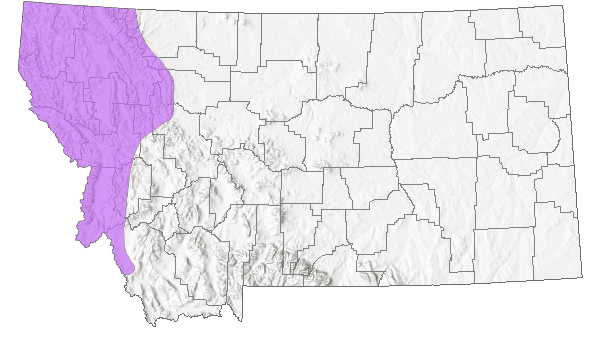
 Native
Western Hemisphere Range
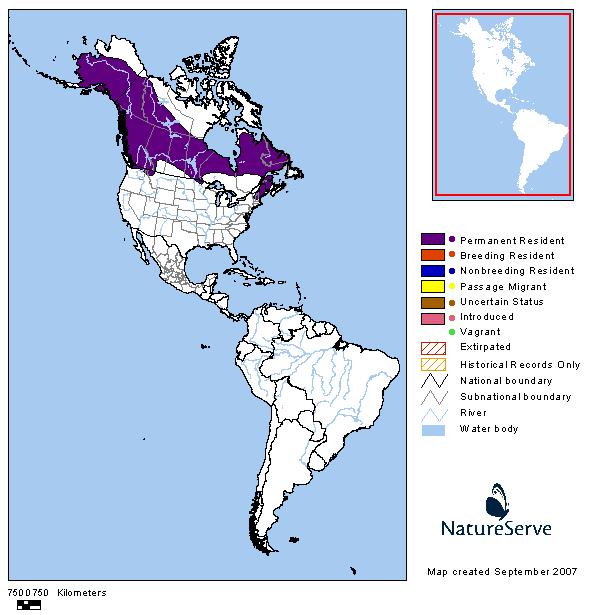
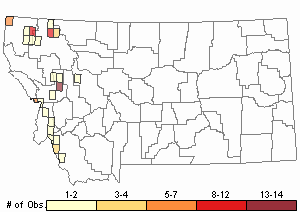
Observations in Montana Natural Heritage Program Database
Number of Observations: 76
(Click on the following maps and charts to see full sized version)
Map Help and Descriptions
Relative Density
Recency
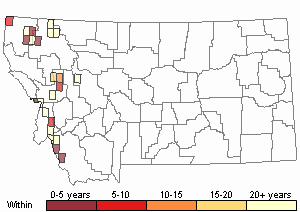
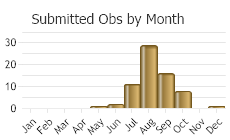
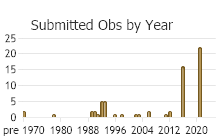
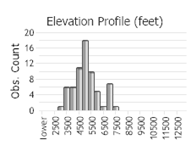 (Observations spanning multiple months or years are excluded from time charts)
Migration
No information on movement is available for Montana.
Habitat
Northern Bog Lemmings in Montana have been found in at least nine community types, including Engelmann spruce, subalpine fir, birch, willow, sedge (Carex), spikerush (Eleocharis), or combinations of the above, often occurring in wet meadows, fens, or bog-like environments. Wright (1950) captured lemmings in a swampy area containing spruce trees, timothy, alder and other moist-site plants (Wright 1950). The Upper Rattlesnake Creek specimen was captured in a wet-sedge/bluejoint meadow near subalpine fir (Adelman 1979). Areas with extensive moss mats, primarily sphagnum, are the most likely sites in which to find new populations (Wright 1950, Reichel and Beckstrom 1994, Reichel and Corn 1997, Pearson 1999, Foresman 2012).
Throughout their range a variety of habitats are occupied, especially near the southern edge of the global distribution, and include sphagnum bogs, wet meadows, moist mixed and coniferous forests, montane sedge meadows, krummholz spruce-fir forest with dense herbaceous and mossy understory, alpine tundra, mossy streamsides, and even sagebrush slopes in the case of S. b. artemisiae in British Columbia (Clough and Albright 1987, West 1999). Typically, occupied habitat has high moisture levels. The Northern Bog Lemming occupies burrow systems up to a foot deep, and also surface runways. Young are born in nests that may be underground or on the surface in concealing vegetation.
National Vegetation Classification System Groups Associated with this Species
Forest and Woodland
Montane - Subalpine Forest and Woodland
Grassland
Montane - Subalpine Grassland
Wetland and Riparian
Alkaline - Saline Wetlands
Alpine Riparian and Wetland
Peatland
Riparian and Wetland Forest
Riparian Shrubland
Wet Meadow and Marsh
Food Habits
Northern Bog Lemmings feed on grasses, sedges, and other herbaceous vegetation, but also snails, slugs, and other invertebrates (West 1999, Foresman 2012). In Montana, diet (7 stomachs from 7 sites) includes at least 17 moss species, making up an average 59% of the stomach contents (Reichel et al. in preparation).
Ecology
The Northern Bog Lemming is active throughout the year, and apparently during both day and night. It maintains a home range of probably less than 1 acre, although data regarding movements are unavailable. Population densities may range up to 36 per acre. It is very sociable and may be found in small colonies. Other small mammals present at Northern Bog Lemming sites in Montana include shrews (Sorex vagrans, S. palustris) and voles (Microtis pennsylvanicus, M. richarsoni, M. longicaudus, Clethrionomys gapperi) (Wright 1950, Reichel and Beckstrom 1994). Predators in Montana include Martens (Martes americana) and Terrestrial Gartersnakes (Thamnophis elegans) (Hoffmann et al. 1969).
Reproductive Characteristics
Information on reproduction in Montana is very limited. Scrotal males have been captured on June 16, July 26 and August 29 in Lincoln County, and pregnant females in Lewis and Clark County on August 31 (Reichel and Beckstrom 1994). One litter from Montana numbered 3 (Reichel and Beckstrom 1993). Information from other portions of their range indicates Northern Bog Lemmings breed from late April to early October, with most occurring May through August (based on 178 museum specimens from across the global range) (James D. Reichel, unpublished data). Gestation probably lasts 3 weeks. Litter size ranges 2 to 9, with an average of 4 (mean of 3.98 embryos and 3.75 placental scars in 69 museum specimens) (James D. Reichel, unpublished data). Two or three litters per year are capable of being produced (West 1999); at least some individuals breed during the summer of their birth.
Management
No special management activities have been developed or implemented for this species in Montana. Nevertheless, some populations on U.S.D.A. Forest Service lands are provided added protection through special management/conservation policy guidelines applied to peatlands, including Research Natural Area (RNA) designation (Chadde et al. 1998). Peatlands with RNA designation typically disallow manipulative management, such as timber harvest and livestock grazing, and water quality of these peatlands is protected under the Clean Water Act and state water quality standards. Protection guidelines (Reichel and Corn 1997) should be applied to all sites where Northern Bog Lemmings are known to occur, as well as potential peatland sites not yet surveyed for them. Guidelines include 1) assumption that Northern Bog Lemmings are present at sphagnum or fen moss habitat patches unless site-specific surveys indicate otherwise, 2) restriction of timber harvest to a zone beyond a 100 meter buffer surrounding sphagnum or other fen moss mats, or associated riparian areas which could provide corridors for dispersal to adjacent patches of suitable habitat, 3) minimizing livestock grazing in drainages with unsurveyed moss mats present, and maintaining range conditions there and in those with populations present at good to excellent, and 4) elimination of management activities that could destroy moss mats (road-building, pothole blasting, trail construction, dam construction, alteration of surface and subsurface waterflow, recreational vehicle use in fen habitats). Additional surveys should be undertaken to better understand the macro- and micro-distribution in Montana, and known sites should be monitored routinely to determine population persistence and trends.
Stewardship Responsibility
References
- Literature Cited AboveLegend:
 View Online Publication
- Adelman, E.B. 1979. A survey of the nongame mammals in the Upper Rattlesnake Creek drainage of western Montana. M.S. thesis. University of Montana, Missoula. 129 pp.
- Chadde, S.W., J.S. Shelly, RJ. Bursik, R.K. Moseley, A.G. Evenden, M. Mantas, F. Rabe, and B. Heide. 1998. Peatlands on national forests of the northern Rocky Mountains: ecology and conservation. General Technical Report RMRS-GTR-11. Ogden, UT: U.S. Department of Agriculture, Forest Service, Rocky Mountain Research Station. 75 p.
 Clough, G. C. and J. J. Albright. 1987. Occurrence of the northern bog lemming, Synaptomys borealis, in the northeastern United States. Canadian Field-Naturalist 101:611-613.
- Foresman, K. R. 2001. Key to the mammals of Montana. University of Montana Bookstore, Missoula, Montana. 92 pp.
- Foresman, K.R. 2012. Mammals of Montana. Second edition. Mountain Press Publishing, Missoula, Montana. 429 pp.
- Pearson, D. E. 1999. Small mammals of the Bitterroot National Forest: a literature review and annotated bibliography. General Technical Report RMRS-GTR-25. Ogden, UT: U.S. Department of Agriculture, Forest Service, Rocky Mountain Research Station. 63 pp.
- Reichel, J. D., J. C. Elliott, and P. Hendricks. In preparation. Mosses: an important food of northern bog lemmings in Montana.
- Reichel, J.D. and J.G. Corn. 1997. Northern bog lemmings: survey, population parameters, and population analysis. Unpublished report to the Kootenai National Forest. Montana Natural Heritage Program, Helena, MT. 27 pp.
- Reichel, J.D. and S.G. Beckstrom. 1993. Northern bog lemming survey: 1992. Unpublished report. Montana Natural Heritage Program, Helena, MT. 64 p.
- Reichel, J.D. and S.G. Beckstrom. 1994. Northern bog lemming survey: 1993. Unpublished report. Montana Natural Heritage Program. Helena, MT. 87 pp.
- West, S. D. 1999. Northern bog lemming Synaptomys borealis. In: D. E. Wilson and S. Ruff, eds. The Smithsonian book of North American mammals. pp. 655-656. Smithsonian Institution Press, Washington, D.C.
- Wright, P.L. 1950. Synaptomys borealis from Glacier National Park, Montana. Journal of Mammalogy 31(4):460.
- Additional ReferencesLegend: View Online Publication
Do you know of a citation we're missing?- Anderson, S. 1962. A new northern record of Synaptomys borealis in Ungava. Journal of Mammalogy 43:421-422.
- Banfield, A. W. F., and Allan Brooks. 1981. The mammals of Canada. Toronto, ON: University of Toronto Press.
- Cross, E.C. 1938. Synaptomys borealis from Godbout, Quebec. Journal of Mammalogy 19:378.
- Dice, L.R. 1923. Mammal associations and habitats of the Flathead Lake Region, Montana. Ecology 4(3): 247-260.
- Flath, D.L. 1979. Nongame species of special interest or concern: Mammals, birds, reptiles, amphibians, fishes. Wildlife Division, Montana Department of Fish and Game. Helena, MT.
- Foresman, K.R. 2001. The wild mammals of Montana. American Society of Mammalogists, Special Publication Number 12. Lawrence, KS. 278 pp.
- Groves, C. and E. Yensen. 1989. Rediscovery of the northern bog lemming (Synaptomys borealis) in Idaho. Northw. Nat. 70:14-15.
- Hall, E. R. 1981. Mammals of North America, 2nd edition. (2 vols.). John Wiley and Sons, New York. 1181 p.
- Hall, E.R. 1981. The mammals of North America, volumes I and II. John Wiley & Sons, New York, NY. 1181 pp.
- Hoffmann, R.S. and D.L. Pattie. 1968. A guide to Montana mammals: identification, habitat, distribution, and abundance. Missoula, MT: University of Montana. 133 p.
- Hoffmann, R.S., P.L. Wright, and F.E. Newby. 1969. The distribution of some mammals in Montana. I. Mammals other than bats. Journal of Mammalogy 50(3): 579-604.
- Hope, A.G., k.M. Headlee, Z.H. Olson, B.J. Wiens. 2023. Systematics, biogeography and phylogenomics of Northern Bog Lemmings (Cricetidae), cold-temperate rodents of conservation concern under global change. Systematics and Biodiversity 21(1): doi:10.1080/14772000.2023.2237050.
- Jones, J. K., Jr., R. S. Hoffman, D. W. Rice, C. Jones, R. J. Baker, and M. D. Engstrom. 1992. Revised checklist of North American mammals north of Mexico, 1991. Occasional Papers, The Museum, Texas Tech University, 146:1-23.
- Jonkel, C.J. 1959. An ecological and physiological study of Pine Marten. M.S. Thesis. Montana State Univ., Missoula. 81 pp.
- Joslin, Gayle, and Heidi B. Youmans. 1999. Effects of recreation on Rocky Mountain wildlife: a review for Montana. [Montana]: Montana Chapter of the Wildlife Society.
- Koenigswald, W. von, and L. D. Martin. 1984. Revision of the fossil Lemminae (Rodentia, Mammalia). Spec. Publ. Carnegie Mus. Nat. Hist. 9:122-137.
- Kritzman, E.B. 1977. Little mammals of the Pacific Northwest. Pacific Search Press, Seattle, WA.
- Layser, E. F. and T. E. Burke. 1973. The northern bog lemming and its unique habitat in northeastern Washington. Murrelet 54:7-8.
- Martell, A.M. 1974. A northern range extension for the northern bog lemming, Synaptomys borealis borealis (Richardson). Canadian Field-Naturalist 88:348.
- Mead, J. I., C. J. Bell, and L. K. Murray. 1992. Mictomys borealis (Northern Bog Lemming) and the Wisconsin paleoecology of the East-Central Great Basin. Quaternary Res. 37:229-238.
- Multiple Authors. 1992. Abstracts from Montana Rare Animal Meeting. Lewistown, MT. November 5-6, 1992. 20 p.
- Pearson, D. E. 1991. The northern bog lemming in Montana and the contiguous United States: distribution, ecology and relic species theory. Senior thesis, Univ. of Montana, Missoula. 33 pp.
- Prince, L.A. 1942. Synaptomys borealis from Fort Severn, Hudson Bay, Ontario. Journal of Mammalogy 23:216.
- Reichel, J.D. 1996, Annotated bibiliography of bog lemmings. Helena, MT: Montana Natural Heritage Program.
- Reichel, J.D. 1996. Northern bog lemming survey: 1995: Garnet Resource Area. Montana Natural Heritage Program. Helena, MT. 35 pp.
- Reichel, J.D., D.L. Genter and E. Atkinson. 1992. Sensitive animal species in the Elkhorn and Big Belt Mountains of the Helena National Forest. Unpublished report to the Helena National Forest. Montana Natural Heritage Program, Helena. 158 p.
- Reid, F. 2006. Peterson Field Guide to Mammals of North America, 4th Edition. Houghton Mifflin Company: Boston and New York, 608 pp.
- Weckwerth, R. P. and V. D. Hawley. 1962. Marten food habits and population fluctuations in Montana. J. Wildl. Manage. 26(1): 55-74.
- Wetzel, R.M. and H.L. Gunderson. 1949. The lemming vole, Synaptomys borealis, in northern Minnesota. Journal of Mammalogy 30:437.
- Wilson, C., R. E. Johnson and J. D. Reichel. 1980. New records for the northern bog lemming in Washington. Murrelet 61:104-106.
- Wilson, D. E., and D. M. Reeder (editors). 1993. Mammal Species of the World: a Taxonomic and Geographic Reference. Second Edition. Smithsonian Institution Press, Washington, DC. xviii + 1206 pp.
- Web Search Engines for Articles on "Northern Bog Lemming"
- Additional Sources of Information Related to "Mammals"