View in other NatureServe Network Field Guides
NatureServe
Montana
Utah
Wyoming
Idaho
Wisconsin
British Columbia
South Carolina
Yukon
California
New York
Townsend's Big-eared Bat - Corynorhinus townsendii
State Rank Reason (see State Rank above)
Species is widely distributed, but rarely captured or detected. It faces significant
threats from loss of roosts in mines due to natural subsidence of adits as well as
intentional closure by land managers for public safety. Short-term trend is poorly
defined.
General Description
Townsend’s Big-eared Bat is a moderately sized bat found throughout the state where suitable habitat exists, primarily near caves, mines, rock outcrops, and badlands. As the common name suggests, the species has large ears compared to its overall size. Although it never appear to be common in any portion of the state, it’s distribution is widespread and is among the most commonly observed species during cave surveys.
The species has large ears (30 to 39 millimeters) joined across forehead are a prominent feature in Townsend's Big-eared Bat; the tragus is long and pointed. The dorsal hairs are brownish at the tips, contrasting a little or considerably with the lighter underfur; ventral hairs are dark brownish-gray in color with brown to cinnamon tips. The hairs on the toes do not project beyond the toenails. There are two large, fleshy lumps on the snout, the basis for one of its common names, "lump-nosed bat." Total length is 90 to 113 millimeters; forearm length is 39.0 to 47.6 millimeters; adult mass is 5.0 to 13.5 grams. The greatest length of the skull is 15.2 to 17.4 millimeters; the skull has 36 teeth (Handley 1959, Kunz and Martin 1982, Nagorsen and Brigham 1993).
Diagnostic Characteristics
Townsend's Big-eared Bat differs from other Montana bats by its combination of extremely long, brownish ears that are joined at the base, the prominent lumps on the nose, the absence of large, white spots in the pelage (as with the Spotted Bat) and a dorsal pelage that is darker at the tips than the base (opposite that of the Pallid Bat, which is also larger-bodied).
The species is infrequently captured in mist nets. Nets set over water can be used, but captures are typically rare. The species is more frequently captured by placing nets within tight flyways in high clutter environments such as tall brush and densely forested areas. Surveys of caves and mines are an efficient way to detect the species as it is one of the most commonly encountered species within these features, particularly in the winter. Acoustic methods are effective and call sequences distinct, but echolocation is typically much quieter than other bat species and microphones must be placed close to roosts or foraging areas to ensure any individuals in the area are recorded.
Species Range
Montana Range
Range Descriptions
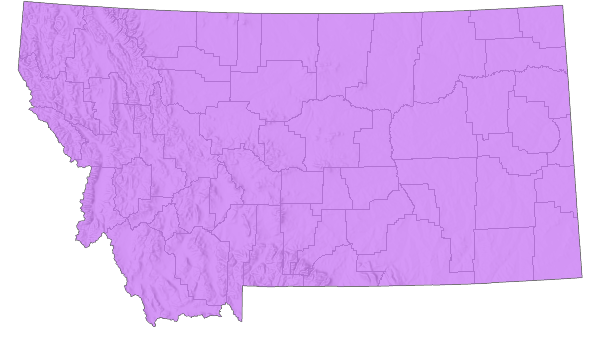
 Native
Global Range

Estimated global breeding range area is: 5,721,500 km
2 (Approximately 7% in Montana)
See information about
 iNaturalist Geomodels
Range Comments
Townsend’s Big-eared Bat has been documented across Montana in areas with suitable foraging and roosting habitats. These bats forage in high clutter environments such as tall brush and forest understory. Active season roosts include caves, mines, erosion cavities, and structures like buildings and bridges. As such only the short-grass prairies of northcentral and northeast Montana appear to be uninhabited by this species.
Observations in Montana Natural Heritage Program Database
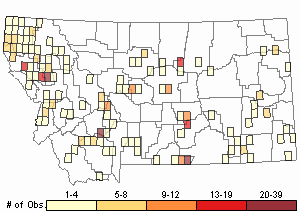
Number of Observations: 462
(Click on the following maps and charts to see full sized version)
Map Help and Descriptions
Relative Density
Recency
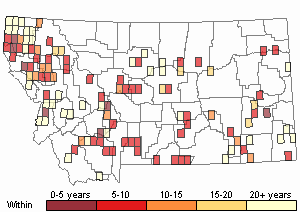
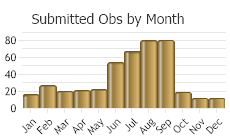
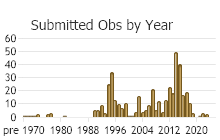
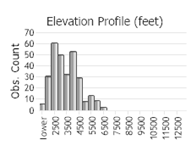 (Observations spanning multiple months or years are excluded from time charts)
Migration
Little information on movement is available for this species. Townsend's Big-eared Bat is present yearround in Montana, with summer or winter records from several localities (Hoffmann et al. 1969, Swenson and Shanks 1979, Hendricks 2000, Hendricks et al. 2000, Hendricks and Kampwerth 2001), but movements of individuals between active season roosts and hibernacula have not been reported or studied. The species has been consistently detected in several caves in western and central Montana in both the active and hibernation seasons. While not conclusive, anecdotally this supports the hypothesis that seasonal movement is limited.
Habitat
Of all of Montana’s bat species, Townsend’s Big-eared Bat is the most closely associated with caves, mines, and other similar features such as talus caves and erosion cavities found in badlands and river breaks. Caves and abandoned mines are used for maternity roosts and hibernacula (Worthington 1991, Hendricks et al. 1996, Hendricks 2000, Hendricks et al. 2000, Foresman 2012, Hendricks and Kampwerth 2001); use of buildings in late summer has also been reported (Swenson and Shanks 1979). In hibernacula, ambient temperatures ranged from -1.0 to 8.0 degrees (30 to 46 when torpid Townsend's Big-eared Bats were present) (Hendricks and Kampwerth 2001). Temperatures at maternity roosts are poorly documented; the temperature was 12 degrees (54 in mid-July near a colony in an abandoned mine in Lake County), and 18 degrees (66 in August near a colony in a large and relatively open cave chamber in Lewis and Clark County). Most caves and mines in Montana appear to be too cool in summer for use as maternity roosts.
National Vegetation Classification System Groups Associated with this Species
Alpine
Alpine - Sparse and Barren
Forest and Woodland
Deciduous Forest and Woodland
Low Elevation - Xeric Forest and Woodland
Montane - Subalpine Forest and Woodland
Shrubland
Arid - Saline Shrubland
Foothills - Montane Shrubland
Sagebrush Shrubland
Grassland
Lowland - Prairie Grassland
Montane - Subalpine Grassland
Sparse and Barren
Sparse and Barren
Wetland and Riparian
Alkaline - Saline Wetlands
Alpine Riparian and Wetland
Peatland
Riparian and Wetland Forest
Riparian Shrubland
Wet Meadow and Marsh
Recently Disturbed or Modified
Harvested Forest
Insect-Killed Forest
Introduced Vegetation
Recently Burned
Human Land Use
Developed
Food Habits
Townsend's Big-eared Bat feeds on various nocturnal flying insects near the foliage of trees and shrubs, but appears to specialize primarily on small moths (Kunz and Martin 1982); other insects in the diet include lacewings, beetles, true flies, and wasps. There are reports of gleaning insects from foliage, but most are captured in the air, often near foliage. In a California study, individuals hunted primarily around the perimeter of trees, usually 10 to 30 meters off the ground, between mid-canopy and near the top of the canopy (Fellers and Pierson 2002). The diet and foraging behavior of Townsend's Big-eared Bat in Montana have not been reported or studied.
Ecology
Females form maternity colonies during the spring and summer. Colonies are typically composed of 20 to 180 females, each giving birth to one pup after a gestation period of 55 to 100 days (Pearson et al. 1952, Genter personal observation). Pups are able to fly in 3 weeks and are weaned at 6 weeks. Both sexes congregate at cooler caverns (called swarming sites) in late summer/early fall.
Townsend's Big-eared Bat emerges from day roosts in coastal California and central Oregon within an hour after sunset (Dobkin et al. 1995, Fellers and Pierson 2002); limited information from Montana indicates a similar emergence time (P. Hendricks and J. Carlson personal observation). In Oregon, individuals moved up to 24 kilometers from hibernacula to foraging areas (Dobkin et al. 1995). In California, foraging individuals traveled less than 10.5 kilometers from primary day roosts and tended to forage in the same areas each night. The mean center of activity for females was 3.2 kilometers from the roost, and 1.3 kilometers for males; 41 to 88% of tagged bats returned to their roost each night. Individual bats used nine alternate roosts (Fellers and Pierson 2002).
Townsend's Big-eared Bat tends to hibernate singly, but does occur in clusters during winter in some areas (Schmidly 1991). It tends not to associate closely in day roosts and hibernacula with other species of bats, although individuals of other species may be present elsewhere in the roost (Handley 1959, Kunz and Martin 1982, Genter 1986, Choate and Anderson 1997, Kuenzi et al. 1999). In Montana, Townsend's Big-eared Bat has been found at summer and winter roosts in the presence of other bat species (Swenson and Shanks 1979, Worthington 1991, Hendricks et al. 2000, Hendricks and Kampwerth 2001), although it usually hibernates in the open and alone, rather than in clusters or wedged in cracks.
Crude population density in Oklahoma was estimated at one bat per hectare (Humphrey and Kunz 1976, Kunz and Martin 1982), about 3 to 4 times greater than that reported in California (Pearson et al. 1952). Natality rates for colonies of adult females typically exceed 90%, but may be as low as 35% (Kunz and Martin 1982, Fellers 2000); pre-weaning post-natal mortality of adults generally is 4 to 5%. Adult survivorship is relatively high (about 70 to 80% in females in California). Regional population increases in California may be dependent on the establishment of new nursery colonies (Pearson et al. 1952), since colony size has been reported to remain static year after year. Predation has been suggested as the primary limiting factor in Kansas and Oklahoma (Handley 1959), although lack of suitable roosting habitat seems more likely to limit population size in this region (Humphrey and Kunz 1976). Predators of Townsend's Big-eared Bat are poorly documented, but include the Black Rat and Eastern Woodrat (Clark et al. 1990, Fellers 2000), as well as the Black Ratsnake, Spotted Skunk, Domestic Cat, and Ringtail (Pierson et al. 1999); predators can significantly depress reproductive success in some maternity colonies. No demographic data or estimates of population size are available for any population in Montana, nor have any predators been documented.
Reproductive Characteristics
No published studies are available on the reproductive biology of this species in Montana, and other documentation is very limited. Only five maternity colonies are known in Montana, with an estimated size in recent years of 25 to 100 adult females each. Lone adult females captured in early August in the Pryor Mountains were non-lactating (P. Hendricks and J. Carlson personal observation); flying juveniles appear in the same region sometime between late June and early September (Worthington 1991).
Based upon studies in other areas of the species' range mating begins in autumn and continues into winter. Ovulation and fertilization are delayed until late winter/early spring. Gestation lasts 2.0 to 3.5 months. A single young is born during a five week period, beginning mainly in late May in California, June in west Texas, and the second week of July in Washington (Pearson et al. 1952, Easterla 1973, Kunz and Martin 1982). Young can fly at 2.5 to 3.0 weeks, and are weaned by 6 weeks. In central California, summer colonies start to break up in August when the older young are just over 3 months old. Females become sexually mature their first summer; males are not sexually active until their second year. Young fly at 1 month of age and are weaned at 2 months. Most adult females breed every year. Maternity colonies are often smaller than 100 adult females, but up to 550 adult females are present in some (Easterla 1973, Humphrey and Kunz 1976, Pierson et al. 1991, Szewczak et al. 1998, Fellers 2000, Sherwin et al. 2000, Fellers and Pierson 2002). Males roost separately (apparently solitary) during this time. Maximum longevity is estimated to be about 16 to 17 years (Kunz and Martin 1982).
Management
The response by Townsend's Big-eared Bats to human activities is largely undocumented in Montana. The maternity colony at Lewis and Clark Caverns has persisted for over a century, even though it is exposed daily to tour groups. In eastern Montana, numerous abandoned coal mines have been completely closed in recent decades, several of which were used as hibernacula; these mines are no longer accessible to bats. Abandoned mine reclamation has also been underway in western Montana during the same time. During the last decade, mine surveys prior to closure have been undertaken by land management agencies to determine the potential of abandoned mines as bat habitat. In some cases bat-friendly gates were installed at known Townsend's Big-eared Bat roosts, and the roosts have continued to be used after gate installation (Hendricks 1999, Hendricks and Kampwerth 2001). Some caves in the Pryor Mountains and Little Rocky Mountains with documented use by Townsend's Big-eared Bat are protected with bat-friendly gates (Worthington 1991, Hendricks et al. 2000). Abandoned mines should be surveyed for Townsend's Big-eared Bats or other bat species prior to any reclamation activity. Surveys should follow protocols in the conservation assessment and conservation strategy (Pierson et al. 1999). Installation of bat-friendly gates should be considered as a protective measure for all Townsend's Big-eared Bat roosts. Other land management activity (cave management, pesticide spraying, timber harvest, other vegetation conversion) at or near known roosts should also be conducted according to the best management practices outlined in the conservation assessment and strategy. Maternity roosts and hibernacula should be routinely monitored to establish population trends across the state. Undiscovered maternity colonies and hibernacula undoubtedly exist in Montana. All observations of Townsend's Big-eared Bat roosts should be reported to the appropriate land management agency, the Montana Natural Heritage Program, or the Montana Department of Fish, Wildlife and Parks.
Stewardship Responsibility
References
- Literature Cited AboveLegend:
 View Online Publication
 Choate, J. R. and J. M. Anderson. 1997. Bats of Jewel Cave National Monument, South Dakota. Prairie Naturalist 29:39-47.
- Clark, B. K., B. S. Clark, and D. M. Leslie, Jr. 1990. Endangered Ozark big-eared bat eaten by eastern woodrat. Prairie Naturalist 22:273-274.
- Dobkin, D. S., R. D. Gettinger, and M. G. Gerdes. 1995. Springtime movements, roost use, and foraging activity of Townsend's big-eared bat (Plecotus townsendii) in central Oregon. Great Basin Naturalist 55:315-321.
- Easterla, D. A. 1973. Ecology of the 18 species of Chiroptera at Big Bend National Park, Texas. Part I and II. Northwest Missouri State University Studies 34:1-165.
- Fellers, G. M. 2000. Predation on Corynorhinus townsendii by Rattus rattus. Southwestern Naturalist 45:524-527
- Fellers, G. M. and E. D. Pierson. 2002. Habitat use and foraging behavior of Townsend's big-eared bat (Corynorhinus townsendii) in coastal California. Journal of Mammalogy 83:167-177.
- Foresman, K.R. 2012. Mammals of Montana. Second edition. Mountain Press Publishing, Missoula, Montana. 429 pp.
- Genter, D. L. 1986. Wintering bats of the upper Snake River plain: occurrence in lava-tube caves. Great Basin Naturalist 46(2):241-244.
- Handley, C. O., Jr. 1959. A revision of American bats of the genera Euderma and Plecotus. Proceedings of the U.S. National Museum 110:95-246.
- Hendricks, P. 2000. Preliminary bat inventory of caves and abandoned mines on BLM lands, Judith Mountains, Montana. Montana Natural Heritage Program, Helena, Montana. 21 pp.
- Hendricks, P. and D. Kampwerth. 2001. Roost environments for bats using abandoned mines in southwestern Montana : a preliminary assessment. Report to the U.S. Bureau of Land Management. Montana Natural Heritage Program, Helena, Montana. 19 pp.
- Hendricks, P., D. L. Genter, and S. Martinez. 2000. Bats of Azure Cave and the Little Rocky Mountains, Montana. Canadian Field-Naturalist 114 :89-97.
- Hendricks, P., K.A. Jurist, D.L. Genter and J.D. Reichel. 1996. Bats of the Kootenai National Forest, Montana. Unpublished report. Montana Natural Heritage Program, Helena, Montana. 99 pp.
- Hoffmann, R. S., D. L. Pattie and J. F. Bell. 1969. The distribution of some mammals in Montana. II. Bats. Journal of Mammalogy 50(4): 737-741.
- Humphrey, S. R. and T. H. Kunz. 1976. Ecology of a Pleistocene relict, the western big-eared Bat (Plecotus townsendii) in the southern Great Plains. Journal of Mammalogy 57(3):470-494.
- Kuenzi, A. J., G. T. Downard, and M. L. Morrison. 1999. Bat distribution and hibernacula use in west central Nevada. Great Basin Naturalist 59:213-220.
- Kunz, T. H. and R. A. Martin. 1982. Plecotus townsendii. Mammalian Species Number 175 :1-6.
- Nagorsen, D.W. and R.M. Brigham. 1993. Bats of British Columbia. Volume I. The Mammals of British Columbia. UBC Press, Vancouver. 164 pp.
- Pearson, O.P., M.R. Koford, and A.K. Pearson. 1952. Reproduction of the lump-nosed bat (Corynorhinus townsendii) in California. Journal of Mammalogy 33:273-320.
- Pierson, E. D., W. E. Rainey, and D. M. Koontz. 1991. Bats and mines: experimental mitigation for Townsend's big-eared bat at the McLaughlin Mine in California. In: R.D. Comer et al. eds. Proceedings V: issues and technology in the management of impacted wildlife. pp. 31-44. Thorne Ecological Institute, April 8-10, Snowmass, Colorado.
- Pierson, E.D., M.C. Wackenhut, J.S. Altenbach, P. Bradley, P. Call, D.L. Genter, C.E. Harris, B.L. Keller, B. Lengus, L. Lewis, and B. Luce. 1999. Species conservation assessment and strategy for Townsend's big-eared bat (Corynorhinus townsendii townsendii and Corynorhinus townsendii pallescens). Idaho Conservation Effort, Idaho Department of Fish and Game, Boise, Idaho. 68 pp.
- Schmidly, D. J. 1991. The bats of Texas. Texas A and M University Press, College Station. 188 pp.
- Sherwin, R. E., D. Stricklan, and D. S. Rogers. 2000. Roosting affinities of Townsend's big-eared bat (Corynorhinus townsendii) in northern Utah. Journal of Mammalogy 81:939-947.
- Swenson, J.E. and G.F. Shanks, Jr. 1979. Noteworthy records of bats from northeastern Montana. Journal of Mammalogy. 60(3): 650-652
- Szewczak, J. M., S. M. Szewczak, M. L. Morrison, and L. S. Hall. 1998. Bats of the White and Inyo mountains of California-Nevada. Great Basin Naturalist 58:66-75.
- Additional ReferencesLegend: View Online Publication
Do you know of a citation we're missing?- Abernethy, I.M., M.D. Andersen, and D.A. Keinath. 2012. Bats of southern Wyoming: distribution and migration year 2 report. Prepared for the USDI Bureau of Land Management by the Wyoming Natural Diversity Database, University of Wyoming, Laramie, Wyoming.
- Adams, R.A. 2003. Bats of the Rocky Mountain West: natural history, ecology and conservation. University Press of Colorado: Boulder, CO. 289 pp.
- Adams, R.A., S.C. Pedersen, K.M. Thibault, J. Jadin, and B. Petru. 2003. Calcium as a Limiting Resource to Insectivorous Bats: Can Water Holes Provide a Supplemental Mineral Source. Journal of Zoology 260(2): 189-194.
- Agnarsson, I., C.M. Zambrana-Torrelio, N.P. Flores-Saldana, L.J. May-Collado. 2011. A time-calibrated species-level phylogeny of bats (Chiroptera, Mammalia). PLoS Currents Tree of Life. Edition1. RRN1212.
- Albers, Mark., 1995, Draft Biological Assessment: Tongue River Basin Project. May 1995. In Tongue River Basin Project Draft Environmental Impact Statement. Appendix B. June 1995.
- Almberg, E., D. Bachen, C. Stratton, S. Hilty, M. Becker, J. Ramsey, and K. Smucker. 2023. Montana's 2023 annual white-nose syndrome surveillance and bat monitoring report. Montana Fish, Wildlife & Parks. 21 p.
- Amichai, E., G. Blumrosen, and Y. Yovel. 2015. Calling louder and longer: how bats use biosonar under severe acoustic interference from other bats. Proceedings of the Royal Society B: Biological Sciences, The Royal Society 282(1821): 20152064.
- Anderson, R.G. 1993. Investigations and management of Townsend's bigeared bats (Plecotus townsendii) in Hell's Canyon National Recreation Area [Abstract only]. Northwest Science 67 (2) :123.
- Arnett, E.B. 2007. Presence, relative abundance, and resource selection of bats in managed forest landscapes in western Oregon. Ph.D. dissertation, Oregon State University, Corvallis, Oregon.
- Bachen, D.A., A.L. McEwan, B.O. Burkholder, S.L. Hilty, S.A. Blum, and B.A. Maxell.. 2018. Bats of Montana: Identification and Natural History. Report to Montana Department of Environmental Quality. Montana Natural Heritage Program. Helena, MT. 111pp.
- Bachen, D.A., and B.A. Maxell. 2014. Distribution and status of bird, small mammal, reptile, and amphibian species, South Dakota Field Office-BLM. Report to the Bureau of Land Management, South Dakota Field Office. Montana Natural Heritage Program, Helena, Montana 25 pp. plus appendices.
- Baker, R.H. and C.J. Phillips. 1965. Mammals from El Nevado de Colima, Mexico. Journal of Mammalogy 46(4): 691-693.
- Barclay, R.M.R. 1991. Population Structure of Temperate Zone Insectivorous Bats in Relation to Foraging Behavior and Energy Demand. Journal of Animal Ecology 60(1): 165.
- Bat Conservation International. G4 Harp Trap: Assembly and Advice. 8 p.
- Baxter, D.M., J.M. Psyllakis, M.P. Gillingham, and E.L. O'Brien. 2006. Behavioural response of bats to perceived predation risk while foraging. Ethology 112(10): 977-983.
- Bell, J.F., G.J. Moore, G.H. Raymond, and C.E. Tibbs. 1962. Characteristics of Rabies in Bats in Montana. American Journal of Public Health 52(8): 1293-1301.
- Bell, J.F., W.J. Hadlow and W.L. Jellison. 1957. A survey of chiropteran rabies in western Montana. Public Health Reports. 72(1): 16-18.
- Bender, M.J. and G.D. Hartman. 2015. Bat Activity Increases with Barometric Pressure and Temperature During Autumn in Central Georgia. Southeastern Naturalist 14(2): 231-242.
- Berthinussen, A. and J. Altringham. 2012. The effect of a major road on bat activity and diversity. Journal of Applied Ecology 49(1): 82-89.
- Betts, B.J. 2010. Activity Budgets of Townsend's Big-eared Bats at a Maternity Colony in Northeastern Oregon. Northwestern Naturalist 91: 13-22.
- Betts, B.J. 2010. Thermoregulatory Mechanisms Used in a Maternity Colony of Townsend's Big-eared Bats in Northeastern Oregon. Northwestern Naturalist 91: 288-298
- Bogan, M.A., and K. Geluso. 1999. Bat roosts and historic structures on National Park Service lands in the Rocky Mountain region. Albuquerque, NM: U.S. Geological Survey, Midcontinent Ecological Science Center, Dept. of Biology, the University of New Mexico. Unpublished report. 25 pp
- Bogdanowicz, W., S. Kasper, and R. D. Owen. 1998. Phylogeny of plecotine bats: reevaluation of morphological and chromosomal data. Journal of Mammalogy 79:78-90.
- Bosworth, W.R. and L.K. Barry. 1993. Characteristics of Winter Activity in Plecotus townsendii in Southeastern Idaho. Northwest Science 67(2): 124.
- Brennan, R.E., W. Caire, N. Pugh, S. Chapman, A.H. Robbins, and D.E. Akiyoshi. 2015. Examination of bats in western Oklahoma for antibodies against Pseudogymnoascus destructans, the causative agent of White-Nose Syndrome. Southwestern Naturalist 60(2/3): 145-150.
- British Columbia Ministry of Environment, Lands, and Parks. 1998. Inventory Methods for Bats; Standards for Components of British Columbia's Biodiversity No. 20. Prepared for the Terrestrial Ecosystems Task Force Resources Inventory Committee. Version 2.0. 58 p.
- Burford, L. S., and M. J. Lacki. 1995. Habitat use by Corynorhinus townsendii virginianus in the Daniel Boone National Forest. American Midland Naturalist 134:340-345.
- Butts, T. 1997. Bat surveys Indian Creek Canyon, Elkhorn Mountains, Montana. Continental Divide Wildlife Consulting. Helena, MT 32 pg.
- Butts, T.W. 1993. A preliminary survey of the bats of the Deerlodge National Forest, Montana: 1991. Montana Natural Heritage Program. Helena, MT. 35 pp.
- Butts, T.W. 1993. A survey of the bats of the Deerlodge National Forest Montana: 1992. Montana Natural Heritage Program. Helena, MT. 39 pp.
- Butts, T.W. 1993. A survey of the bats of the Townsend Ranger District, Helena National Forest, Montana. Montana Natural Heritage Program. Helena, Montana. 16 pp.
- Butts, T.W. 1993. Azure Cave bat surveys, Little Rocky Mountains, Montana, September 1992 and March 1993. Unpublished report for Zortman Mining, Inc. 13 pp.
- Butts, T.W., Western Technology and R.L. Eng. 1993. Continental Lime Indian Creek Mine, Townsend, MT. Life of Mine Wildlife Reconnaissance. In Life-of-Mine Amendment. Continental Lime, Inc., Indian Creek Mine & Plant. Vol. 2. October 13, 1992.
- Callahan, E.V. and R.D. Drobney. 1997. Selection of summer roosting sites by Indiana bats (Myotis sodalis) in Missouri. Journal of Mammalogy 78(3): 818.
- Caltrider, T. 2008. Assessing the use of a night vision camcorder as a method for determining population estimates of the Western Big-eared Bat. Undergraduate Thesis. College of Forestry and Conservation. University of Montana, Missoula. 15pp.
- Carlson, J.C. and P. Hendricks. 2001. A Proposal for: Bat Use of Highway Structures: A Pilot Study. Submitted to the Montana Department of Transportation.
- Carlson, J.C. and S.V. Cooper. 2003. Plant and Animal Resources and Ecological Condition of the Forks Ranch Unit of the Padlock Ranch, Big Horn County, Montana and Sheridan County, Wyoming. Unpublished report to The Nature Conservancy Montana Field Office.
- Chester, J.M., N.P. Campbell, K. Karsmizki, and D. Wirtz. 1979. Resource inventory and evaluation. Azure Cave, Montana. BLM unpublished report. 55 pp.
- Christy, R. E. and S. W. West. 1993. Biology of bats in Douglas-fir forests. U.S.D.A., Forest Serv., Pac. Northw. res. Station, Gen. Tech. Rep. PNW-GTR-308.
- Chung-MacCoubrey, A.L. 2005. Use of pinyon–juniper woodlands by bats in New Mexico. Forest Ecology and Management 204: 209–220.
- Clark, B. K., B. S. Clark, and D. M. Leslie, Jr. 1997. Seasonal variation in use of caves by the Endangered Ozark Big-eared Bat (Corynorhinus townsendii ingens) in Oklahoma. Am. Mid. Nat. 137:388-392.
- Clark, B. S., D. M. Leslie, Jr. and T. S. Carter. Foraging Activity of Adult Female Ozark Big-Eared Bats (Plecotus townsendii ingens) in Summer. J. Mamm., 74(2):422-427.
- Clement, M.J., J.M. O'Keefe, and B. Walters. 2015. A method for estimating abundance of mobile populations using telemetry and counts of unmarked animals. Ecosphere 6(10): 184.
- Clement, M.J., T.J. Rodhouse, P.C. Ormsbee, J.M. Szewczak, and J.D. Nichols. 2014. Accounting for false-positive acoustic detections of bats using occupancy models. Journal of Applied Ecology 51(5): 1460-1467.
- Cockrum, E.L., B. Musgrove, and Y. Peteryszyn. 1996. Bats of Mohave County, Arizona: populations and movements. Occasional Papers of The Museum, Texas Tech University 157: 1-71.
- Coleman, J.L. and R.R. Barclay. 2013. Prey availability and foraging activity of grassland bats in relation to urbanization. Journal of Mammalogy 94(5): 1111-1122.
- Corbett, J. 2011. Evaluation and management of select natural cave and abandoned mine features of the Lewis & Clark and Helena National Forests, Montana. Bat Conservation International. 18pp plus appendices.
- Cryan, P. M., M. A. Bogan, and J. S. Altenbach. 2000. Effect of elevation on distribution of female bats in the Black Hills, South Dakota. Journal of Mammalogy 81:719-725.
- Cvikel, N., E. Levin, E. Hurme, I. Borissov, A. Boonman, E. Amichai, and Y. Yovel. 2015. On-board recordings reveal no jamming avoidance in wild bats. Proceedings of the Royal Society B: Biological Sciences, The Royal Society 282(1798).
- Dalquest, W.W. 1947. Notes on the Natural History of the Bat Corynorhinus rafinesquii in California. Journal of Mammalogy 28(1): 17-30.
- Davis, R. 1966. Homing performance and homing ability in bats. Ecological Monographs 36(3): 201-237.
- Davis, W.B. 1937. Some mammals from western Montana and eastern Idaho. The Murrelet 18(2): 22-27.
- Department of Health and Environmental Sciences Food and Consumer Safety Bureau. 1981. Montana Bats Part I: Control. Vector Control Bulletin Number 2. 6 p.
- Department of Health and Environmental Sciences Food and Consumer Safety Bureau. 1981. Montana Bats Part II: Identification and Biology. Vector Control Bulletin Number 2A. 10 p.
- Diamond, G.E. and J.M. Diamond. 2014. Bats and mines: evaluating Townsend's big-eared bat (Corynorhinus townsendii) maternity colony behavioral response to gating. Western North American Naturalist 74(4): 416-426.
- Doering, R.W. and L.K. Barry. 1993. The Thermal Implications of Roost Site Selection in Hibernating Plecotus townsendii. Northwest Science 67(2): 127.
- Dubois, K. 1999. Region 4 bat surveys: 1998 progress report. Unpublished report, Montana Fish, Wildlife & Parks Region 4 Headquarters, Great Falls, Montana. 20 pp.
- DuBois, K. 2000. Species occurrence and Distribution of Bats in North Central Montana: Range Map Changes Resulting from Two Years of Field Surveys. Intermountain Journal of Sciences 6(4): 376.
- Ducummon, S.L. 1997. The North American bats and mines project: a cooperative approach for integrating bat conservation and mine-land reclamation. Paper presented at the 1997 National Meeting of the American Society for Mining and Reclamation, Austin, Texas.
- Ellison, L.E. 2010. A Retrospective Survival Analysis of Townsend's Big-eared Bat (Corynorhinus townsendii) from Washington State. Northwestern Naturalist 91(2): 172-182.
- Feigley, H.P. 1998. An Examination of the Issues and Feasibility of Conducting Surveys of Abandoned Mines for Bats. Montana Natural Heritage Program, Helena, MT. 12 p.
- Feigley, H.P., M. Brown, S. Martinez, and K. Schletz. 1997.Assessment of mines for importance to bat species of concern, southwestern Montana. Report to: U.S. Geological Survey, Biological Resources Division, Midcontinent Ecological Science Center; 4512 McMurry Ave., Fort Collins, CO 80525-3400. 9pp.
- Fenton, M.B. 1990. The Foraging Behavior and Ecology of Animal-Eating Bats. Canadian Journal of Zoology 68(3): 411-422.
- Fenton, M.B. 2003. Science and the conservation of bats: where to next? Wildlife Society Bulletin 31(1) 6-15.
- Fitzgerald, T. 1989. New records of bats from northeastern Colorado. Journal of the Colorado-Wyoming Academy of Science 21:22.
- Foresman, K.R. 2001. The wild mammals of Montana. American Society of Mammalogists, Special Publication Number 12. Lawrence, KS. 278 pp.
- Frost, D. R., and R. M. Timm. 1992. Phylogeny of plecotine bats (Chiroptera: "Vespertilionidae"): proposal of a logically consistent taxonomy. Am. Mus. Novitates 3034:1-16.
- Garber, Christopher S. 1991. A survey for Townsend's Big-eared Bat (Plecotus townsendii) and the Spotted Bat, (Euderma maculatum) on the Targhee National Forest in Wyoming. Unpublished Report to the USDA Forest Service. Wyoming Natural Diversity Database,
- Geluso, K. 2007. Winter activity of bats over water and along flyways in New Mexico. Southwestern Naturalist 52(4): 482-492.
- Genoways, H. H., and J. K. Jones, Jr. 1972. Mammals from southwestern North Dakota. Occasional Papers, The Museum, Texas Tech University 6:1-36.
- Genter, D. L. 1989. Townsend's Big-Eared Bat, Plecotus townsendii. In: T. W. Clark, A. H. Harvey, R. D. Dorn, D. L. Genter, and C. Groves, (Eds.), Rare, Sensitive, and Threatened Species of the Greater Yellowstone Ecosystem. N. Rockies Conserv. Coop., Mon
- Genter, D. L. and L. H. Metzgar. 1985. Survey of the bat species and their habitat use in Grand Teton National Park. Pp. 65-69 in: Univ. Wyo.-Natl. Park Serv. Res. Center. Annual report 9.
- Genter, D.L. 1988. Status and distribution of the spotted bat (Euderma maculatum) and western big-eared bat (Plecotus townsendii) in the Custer National Forest, MT. Unpublished report to the U.S.D.A. Forest Service. Montana Natural Heritage Program, Helena, MT.
- Genter, D.L. and K.A. Jurist. 1995. Bats of Montana. Guide for Assessing Mines for Bats Workshop, June 14-15, 1995, Helena, MT, hosted by Montana Department of State Lands and the Abandoned Mine Reclamation Bureau. Montana Natural Heritage Program. 11 pp.
- Gillies, K.E., P.J. Murphy, and M.D. Matocq. 2014. Hibernacula Characteristics of Townsend's Big-eared Bats in Southeastern Idaho. Natural Areas Journal 34(1): 24-30.
- Griscom, H.R. and D.A. Keinath. 2011. Inventory and status of bats at Devils Tower National Monument. Report prepared for the USDI National Park Service by the Wyoming Natural Diversity Database. University of Wyoming, Laramie, Wyoming.
- Griscom, H.R., M.D. Anderson, and D.A. Keinath. 2012. Bats of southern Wyoming: distribution and migration, year 1 report. Prepared for the USDI Bureau of Land Management by the Wyoming Natural Diversity Database. University of Wyoming, Laramie, Wyoming.
- Gruver, J.C. and D.A. Keinath. 2006. Townsend's Big-eared Bat (Corynorhinus townsendii): a technical conservation assessment. Rocky Mountain Region. USDA Forest Service, Golden, CO.
- Hanauska-Brown, L., B.A. Maxell, A. Petersen, and S. Story. 2014. Diversity Monitoring in Montana 2008-2010 Final Report. Montana Fish, Wildlife & Parks. Helena, MT. 78 pp.
- Harmata, A., D. Flath, R. Hazlewood, and S. Milodragovich. 2002. Initial Site Evaluation for Wind Resource Development in Montana: An Index Relative to Potential Impacts on Vertebrate Wildlife. Intermountain Journal of Sciences 8(4): 253-254.
- Harvey, M.J., J.S. Altenbach, and T.L. Best. 2011. Bats of the United States and Canada. Johns Hopkins University Press. Baltimore, Maryland. p. 202
- Hayes, M.A., R.A. Schoot, and K.W. Navo. 2011. Hibernacula Selection by Townsend's Big-eared Bat in Southwestern Colorado. Journal of Wildlife Management 75(1): 137-143.
- Hein, C.D., S.B. Castleberry, and K.V. Miller. 2009. Site-occupancy of bats in relation to forested corridors. Forest Ecology and Management 257(4): 1200-1207.
- Hendricks, P. 1997. Mine assessments for bat activity, Garnet Resource Area, BLM: 1997. Unpublished report to USDI, Bureau of Land Management. 17pp.
- Hendricks, P. 1998. Bats surveys of Azure Cave and the Little Rocky Mountains: 1997-1998. November 1998.
- Hendricks, P. 1999. Effect of gate installation on continued use by bats of four abandoned mine workings in western Montana. Unpublished report to Montana Department of Environmental Quality. Montana Natural Heritage Program, Helena, Montana. 13 pp.
- Hendricks, P. 1999. Mine Assessments for Bat Activity, Helena National Forest: 1999. Montana Natural Heritage Program. Helena, MT. 12 pp.
- Hendricks, P. 2000. Assessment of abandoned mines for bat use on Bureau of Land Management lands in the Philipsburg, Montana area: 1999. Montana Natural Heritage Program, Helena, MT.13pp.
- Hendricks, P. 2000. Bat survey along the Norris-Madison Junction Road corridor, Yellowstone National Park, Wyoming, 1999. Montana Natural Heritage Program, Helena, MT. 15pp.
- Hendricks, P. 2003. Assessment of Selected Abandoned Mines for Use by Bats in the Garnet and Avon Areas: 2002. Montana Natural Heritage Program. Helena, MT. 12 p.
- Hendricks, P. and B.A. Maxell. 2005. Bat Surveys on USFS Northern Region Lands in Montana: 2005. Report to the USDA Forest Service, Northern Region. Montana Natural Heritage Program, Helena, MT. 12 pp. plus appendices.
- Hendricks, P. and D.L. Genter. 1997. Bat surveys of Azure Cave and the Little Rocky Mountains: 1996. Montana Natural Heritage Program. Helena, MT. 25 pp.
- Hendricks, P. and J.C. Carlson. 2001. Bat use of abandoned mines in the Pryor Mountains. Report to the Montana Department of Environmental Quality, Mine Waste Cleanup Bureau. Montana Natural Heritage Program. Helena, Montana. 8 pp.
- Hendricks, P. and L.M. Hendricks. 2010. Water Aquistion During Daylight by Free-Ranging Myotis Bats. Northwestern Naturalist 91(3): 336-338.
- Hendricks, P., B.A. Maxell, S. Lenard, C. Currier and J. Johnson. 2006. Riparian Bat Surveys in Eastern Montana. A report to the USDI Bureau of Land Management, Montana State Office. Montana Natural Heritage Program, Helena, Montana. 13 pp. plus appendices.
- Hendricks, P., C. Currier, and J. Carlson. 2004. Bats of the BLM Billings Field Office in south-central Montana, with emphasis on the Pryor Mountains. Report to Bureau of Land Management Billings Field Office. Montana Natural Heritage Program, Helena, MT. 19 pp. + appendices.
- Hendricks, P., D. Kampwerth and M. Brown. 1999. Assessment of abandoned mines for bat use on Bureau of Land Management lands in southwestern Montana: 1997-1998. Montana Natural Heritage Program, Helena. 29 pp.
- Hendricks, P., K. Jurist, D.L. Genter, and J.D. Reichel. 1995. Bat survey of the Sioux District, Custer National Forest: 1994. Montana Natural Heritage Program. Helena, Montana. 41 pp.
- Hendricks, P., K.A. Jurist, D.L. Genter, and J.D. Reichel. 1995. Bat survey of the Kootenai National Forest, Montana: 1994. MTNHP report.
- Hendricks, P., S. Lenard, C. Currier and J. Johnson. 2005. Bat Use of Highway Bridges in South-Central Montana. FHWA/MT-05-007/8159. Final Report prepared for the Montana Department of Transportation, in cooperation with the U.S. Department of Transportation Federal Highway Administration, prepared by the Montana Natural Heritage Program.
- Hendricks, P., S. Lenard, C. Currier, and B.A. Maxell. 2007. Filling the distribution gaps for small mammals in Montana. Helena, MT.: Montana Natural Heritage Program.
- Hendricks, P., S. Lenard, D.M. Stagliano, and B.A. Maxell. 2013. Baseline nongame wildlife surveys on the Fort Peck Indian Reservation. Report to the Assiniboine and Sioux Tribes of the Fort Peck Indian Reservation. Montana Natural Heritage Program, Helena, MT. 83 p.
- Hendricks, Paul. 2012. Winter Records of Bats in Montana. Northwestern Naturalist. 93:154-162.
- Hill J.E. and J.D. Smith: 1984. Bats: a natural history. Univ. Texas Press Austin. 243 pp.
- Hinman, K.E. and T.K. Snow, eds. 2003. Arizona Bat Conservation Strategic Plan. Nongame and Endangered Wildlife Program Technical Report 213. Arizona Game and Fish Department, Phoenix, Arizona.
- Holroyd, S.L., V.J. Craig, and P. Govindarajulu. 2016. Best Management Practices for Bats in British Columbia. Ministry of Environment, Victoria, BC. 301pp.
- Hughes, S.E. 1968. Temperature of the Bat, Plecotus townsendii, During Arousal. Journal of Mammalogy 49(1): 140-142.
- Humphrey, S. R. 1975. Nursery roosts and community diversity of Nearctic bats. Journal of Mammalogy 56:321-346.
- Idaho State Conservation Effort. 1995. Habitat conservation assessment and conservation strategy for the Townsend's big-eared bat. Draft unpubl. rep. no. 1. Boise, Id.
- Ingersoll, T.E., K.W. Navo, and P. De Valpine. 2010. Microclimate Preferences During Swarming and Hibernation in the Townsend's Big-eared Bat, Corynorhinus townsendii. Journal of Mammalogy 91(5): 1242-1250.
- Jean, C., P. Hendricks, M. Jones, S. Cooper, and J. Carlson. 2002. Ecological communities on the Red Rock Lakes National Wildlife Refuge: inventory and review of aspen and wetland systems. Report to Red Rock Lakes National Wildlife Refuge.
- Jiang, T., H. Wu, J. Feng. 2015. Patterns and causes of geographic variation in bat echolocation pulses. Integrative Zoology 10(3): 241-256.
- Jones, J.K., Jr., R.P. Lampe, C.A. Spenrath, and T.H. Kunz. 1973. Notes on the distribution and natural history of bats in southeastern Montana. Occasional papers (Texas Tech University Museum) 15:1-11.
- Joslin, Gayle, and Heidi B. Youmans. 1999. Effects of recreation on Rocky Mountain wildlife: a review for Montana. [Montana]: Montana Chapter of the Wildlife Society.
- Keeley, B. W., and M. D. Tuttle. 1999. “Bats in American Bridges.” Resource Publication No. 4. Bat Conservation International. Austin, TX. 41 p.
- Keinath, D. 2004. Bat and Terrestrial Mammal Inventories in the Greater Yellowstone Network: A progress report. Wyoming Natural Diversity Database, Laramie, WY. 17 pp.
- Keinath, D. 2005. Supplementary Mammal Inventory of Bighorn Canyon National Recreation Area. Final Report. Wyoming Natural Diversity Database, Laramie, WY. 21 pp.
- Keinath, D.A. 2001. Bat Habitat Delineation and Survey Suggestions for Bighorn Canyon National Recreation Area. Unpublished report prepared by the Wyoming Natural Diversity Database for the North American Bat Conservation Partnership.
- Keinath, D.A. 2005. A bat Conservation Evaluation for White Grass Ranch, Grand Teton National Park, Wyoming. Unpublished report for Grand Teton National Park by the Wyoming Natural Diversity Data Base, Laramie, WY.
- Keinath, D.A. 2007. Yellowstone's World of Bats: Taking Inventory of Yellowstone's Night Life. Yellowstone Science 15: 3-13.
- Kingston, T., G. Jones, Z. Akbar, and T.H. Kunz. 2003. Alternation of echolocation calls in 5 species of aerial-feeding insectivorous bats from Malaysia. Journal of Mammalogy 84(1): 205-215.
- Kubista, C.E. and A. Bruckner. 2015. Importance of urban trees and buildings as daytime roosts for bats. Biologia 70(11): 1545-1552.
- Kudray, G.M., P. Hendricks, E. Crowe, and S.V. Cooper. 2004. Riparian forests of the Wild and Scenic Missouri River: ecology and management. Prepared for Lewistown Field Office, Bureau of Land Management, Lewistown, Montana. Montana Natural Heritage Program, Helena, MT. 29 pp. plus appendices.
- Kunz, T. H. (ed). 1988. Ecological and behavioral methods for the study of bats. Smithsonian Inst., Washington D.C., 533 pp.
- Kunz, T. H. and R. A. Martin. 1982. Corynorhinus townsendii. American Society of Mammalogists, Lawrence, KS. Mammalian Species No. 175:1-6.
- Kunz, T.H. and M.B. Fenton. 2003. Bat Ecology. Chicago, Ill: University of Chicago Press. p. 1-745.
- Kunz, T.H. and P.A. Racey. 1998. Bat biology and conservation. International Bat Research Conference 1995. Boston University. Smithsonian Institution Press.
- Lacki, M.J., D.A. Michael, and G.S. Laura. 1994. Observations on Seasonal Cycle, Population Patterns and Roost Selection in Summer Colonies of Plecotus townsendii virginianus in Kentucky. American Midland Naturalist 131(1): 34-42.
- LaMarr, S. and A.J. Kuenzi. 2011. Bat species presence in southwestern Montana. Intermountain Journal of Sciences. 17:1-4. Pp 14-19.
- Lampe, R.P., J.K. Jones Jr., R.S. Hoffmann, and E.C. Birney. 1974. The mammals of Carter County, southeastern Montana. Occa. Pap. Mus. Nat. Hist. Univ. Kan. 25:1-39.
- Lemke, T. 1991. Big Sky UFOs. Montana Outdoors 22(6):2-7.
- Lenard, S. and P. Hendricks. 2012. Bat Surveys at Army Corps of Engineers Libby Dam, Libby, Montana 2011. A report to the US Army Corps of Engineers, Libby Dam. Montana Natural Heritage Program, Helena, MT. 21 pp.
- Lenard, S., B.A. Maxell, P. Hendricks, and C. Currier. 2007. Bat Surveys on USFS Northern Region 1 Lands in Montana: 2006. Report to the USDA Forest Service, Northern Region. Montana Natural Heritage Program, Helena, Montana. 23 pp. plus appendices.
- Lenard, S., P. Hendricks, and B.A. Maxell. 2009. Bat surveys on USFS Northern Region lands in Montana: 2007. A report to the USDA Forest Service, Northern Region. Helena, MT. Montana Natural Heritage Program. 21 pp plus appendices.
- Lewis, S. E. 1995. “Roost Fidelity of Bats: a Review.” Journal of Mammalogy 76:481-496.
- Lilley, T.M., J.S. Johnson, L. Ruokolainen, E.J. Rogers, C.A. Wilson, S.M. Schell, K.A. Field, and D.M. Reeder. 2016. White-nose syndrome survivors do not exhibit frequent arousals associated with Pseudogymnoascus destructans infection. Frontiers in Zoology 13(1): 1.
- López-González, C. and L. Torres-Morales. 2004. Use of Abandoned Mines by Long-eared Bats, Genus Corynorhinus (Chiroptera: Vespertilionidae) in Durango, Mexico. Journal of Mammalogy 85(5): 989-994.
- Madson, M. and G. Hanson. 1992. Bat hibernaculum search in the Pryor Mountains, southcentral Montana (Draft). Montana Natural Heritage Program. 35 pp.
- Madson, M., G. Hanson, S. Martinez, and D. Genter. 1993. Wintering bats in Montana: results of surveys in the Pryor Mountains with annotation on area caves and mines. Montana Natural Heritage Program. Helena, MT. 36 pp.
- Madson. M. 1990. Tate-Potter Cave. Unpublished report, with maps. 6 pp.
- Marcot, B. G. 1984. Winter use of some northwestern California caves by western big-eared bats and long-eared Myotis. Murrelet 65(2):46.
- Martinez, S. 1996. Evaluation of selected bat habitat sites in south central and north western Montana, 1995. Unpublished report to the Montana Natural Heritage Program and The Nature Conservancy.
- Martinez, S. 1999. Evaluation of selected bat habitat sites along the Mammoth-Norris grand loop road corridor, Yellowstone National Park, Wyoming, 1997-1998. [Unpublished report submitted to the Montana Natural Heritage Program, Helena, MT]. 16pp.
- Mathews, F., N. Roche, T. Aughney, N. Jones, J. Day, J. Baker, and S. Langton. 2015. Barriers and benefits: implications of artificial night-lighting for the distribution of common bats in Britain and Ireland. Philosophical Transactions of the Royal Society B: Biological Sciences 370(1667): 20140124.
- Matthews, W. L., and J. E. Swenson. 1982. The mammals of east-central Montana. Proc. Mont. Acad. Sci. 41:1-13.
- Mazurek, M. 2004. A Maternity Roost of Townsend's Big-eared Bats (Corynorhinus townsendii) in Coast Redwood Basal Hollows in Northwestern California. Northwestern Naturalist 85(2): 60-62.
- McGee, M., D.A. Keinath and G.P. Beauvais. 2002. Survey for rare vertebrates in the Pinedale Field Office of the USDI Bureau of Land Management (Wyoming). Unpublished report prepared for USDI Bureau of Land Management. Wyoming State Office by the Wyoming Natural Diversity Database. University of Wyoming, Laramie, Wyoming.
- Montana Bat Working Group. 2020. Recommendations to reduce bat fatalities at wind energy facilities in Montana. Presented to the Montana Fish and Wildlife Commission.
- Montana Dept. of Fish, Wildlife and Parks. 2019. Final Project Report for Lick Creek and Old Dry Wolf Cave Bat Surveys 2016-2018. Helena, MT: Final Project Report. 32 pp.
- Mumford, R. E. And J. B. Cope. 1964. Distribution and Status of the Chrioptera of Indiana. Am. Midl. Nat. 72(2):473-489.
- Nagorsen, D.W., A.A. Bryant, D. Kerridge, G. Roberts, A. Roberts, and M.J. Sarell. 1993. Winter bat records for British Columbia. Northwestern Naturalist. 74(3): 61-66.
- Natural Resources Conservation Service and Bat Conservation International. 1998. Bats and mines: Evaluating abandoned mines for bats: recommendations for survey and closure. 6 p.
- Neuweiler, G. 1989. Foraging ecology and audition in echolocating bats. Trends in Ecology and Evolution 4(6): 160-166.
- Neuweiler, G. 1990. Auditory adaptations for prey capture in echolocating bats. Physiological Reviews 70(3): 615-641.
- Nowak, R.M. and E.P. Walker. 1994. Walker's bats of the world. Johns Hopkins University Press. Baltimore, Maryland.
- Ober, H.K. and J.P. Hayes. 2008. Prey Selection by Bats in Forests of Western Oregon. Journal of Mammalogy 89(5): 1191-1200.
- Olson, C.R., D.P. Hobson, and M.J. Pybus. 2011. Changes in Population Size of Bats at a Hibernaculum in Alberta, Canada, in Relation to Cave Disturbance and Access Restrictions. Northwestern Naturalist 92(3): 224-230.
- Peck, J. and A. Kuenzi. 2003. Relationship of Orientation on Internal Temperature of Artificial Bat Roosts, Southwestern Montana. Intermountain Journal of Sciences 9(1): 19-25.
- Perkins, J. M., and T. Schommer. 1993. Survey Protocol and an Interim Species Conservation Strategy for Plecotus townsendii in the Blue Mountains of Oregon and Washington. [Unpublished Report]. 23 Pp.
- Perkins, J. M., J. M. Barss, and J. Peterson. 1990. Winter records of bats in Oregon and Washington. Northwestern Naturalist 71:59-62.
- Perkins, M. 1985. The Plight of Plecotus. Bats - Newsletter of Bat Conservation International 2(1):1-2.
- Perkins, M.J. 1992. Plecotus townsendii survey for the Nez Perce National Forest. Unpublished Report. Cooperative Challenge Cost Share Project, Idaho Fish and Game Conservation Data Center Report, Boise, Idaho, USA. 31 p.
- Perkins, M.J., and C. Levesque. 1987. Distribution, status and habitat affinities of Townsend's big-eared bat (Plecotus townsendii) in Oregon. Oregon Department of Fish and Wildlife, nongame wildlife program; technical report 86-5-01. Portland, OR. 49pp.
- Piaggio, A. J., K.G. Miller, M.D. Matocq, and S.L. Perkins. 2009. Eight Polymorphic Microsatellite Loci Developed and Characterized from Townsend's big-eared Bat, Corynorhinus townsendii. Molecular Ecology Resources 9(1): 258-260.
- Piaggio, A.J., K.W. Navo, and C.W. Stihler. 2009. Intraspecific Comparison of Population Structure, Genetic Diversity, and Dispersal Among Three Subspecies of Townsend's Big-eared Bats, Corynorhinus townsendii townsendii, C. t. pallescens, and the Endendangered C. t. virginianus. Conservation Genetics 10(1): 143-159.
- Quay, W.B. 1948. Notes on Some Bats from Nebraska and Wyoming. Journal of Mammalogy 29(2): 181-182.
- Rabe, M. J., T. E. Morrell, H. Green, J. C. demos, Jr., and C. R. Miller. 1998. Characteristics of ponderosa pine snag roosts used by reproductive bats in northeastern Arizona. Journal of Wildlife Management 62:612-621.
- Reichel, J.D., D.L. Genter and E. Atkinson. 1992. Sensitive animal species in the Elkhorn and Big Belt Mountains of the Helena National Forest. Unpublished report to the Helena National Forest. Montana Natural Heritage Program, Helena. 158 p.
- Reid, A., T. Hill, R. Clarke, J. Gwilliam, and J. Krebs. 2010. Roosting Ecology of Female Townsend's Big-eared Bats (Corynorhinus townsendii) in South-Eastern British Columbia: Implications for Conservation Management. Northwestern Naturalist 91(2): 215-218.
- Reid, F. 2006. Peterson Field Guide to Mammals of North America, 4th Edition. Houghton Mifflin Company: Boston and New York, 608 pp.
- Roemer, D.M. 1994. Results of field surveys for bats on the Kootenai National Forest and the Lolo National Forest of western Montana, 1993. Unpublished report for the Kootenai National Forest. Montana Natural Heritage Program, Helena. 19 pp.
- Rossillon, M. 1995. The McDonald Mine, west of Ravalli: a cultural resource inventory and evaluation. Renewable Technologies, Inc.. Butte. MT. Unpublished report. 24 pp.
- Sasse, D. 1989. Lick Creek Cave - Survey for Bats. White Sulfur Springs, MT: USDA Forest Service, Lewis & Clark National Forest. Report to the district ranger of Kings Hill Ranger District.
- Sasse, D. C. 1991 . Survey of Tate-Potter Cave. Unpublished report, U.S. Forest Service Belt Creek Information Station, Neihart, MT. 1 3 pp.
- Schmidt, C.A. 2003. Conservation assessment for the Townsend's big-eared bat in the Black Hills National Forest, South Dakota and Wyoming. USDA Forest Service, Black Hills National Forest, Custer, SD.
- Schmidt, U. and G. Joermann. 1986. The Influence of Acoustical Interferences on Echolocation in Bats. Mammalia 50(3): 379-390.
- Schwab, N.A. 2004. Bat Conservation Strategy and plan for the State of Montana. Intermountain Journal of Sciences 10(1-4): 80.
- Schwab, N.A., T.J. Mabee and R.J. Ritchie. 2012. An acoustic study of winter bat activity at three hibernacula, Montana, 2011. ABR Inc - Environmental Research and Services. Forest Grove, OR. 34pp.
- Schwab, Nathan. 2003. Mine Assessments for Bat Activity on Lands Managed by the BLM, Missoula Field Office 2003. Report to USDI BLM Missoula FO. Missoula, MT. 10pp.
- Schwab, Nathan. 2004. Mine Assessment for Bat Activity on Lands Managed by the BLM, Missoula Field Office 2004. USDI BLM Missoula FO. Missoula, MT. 16 pp.
- Senger, C.M. 1975. Nine Year Banding Study of the Western Big-eared Bat (Plecotus townsendii) in Western Washington. American Society of Mammalogists. Special Publications, 5516-19.
- Sherwin, R. E., W. L. Gannon, and J. S. Altenbach. 2003. Managing complex systems simply: understanding inherent variation in the use of roosts by Townsend’s Big-eared Bat. Wildlife Society Bulletin 31:62-72.
- Sherwin, R.E., J.S. Altenbach, and D.L. Waldien. 2009. Managing abandoned mines for bats. Bat Conservation International.
- Sherwin, R.E., S. Haymond, D. Stricklan,and R. Olsen. 2002. Freeze-branding to permanently mark bats. Wildlife Society Bulletin 30(1): 97-100.
- Smith, S.J., D.M. Leslie Jr., M.J. Hamilton, J.B. Lack, and R.A. Van Den Bussche. 2008. Subspecific Affinities and Conservation Genetics of Western Big-eared Bats (Corynorhinus townsendii pallescens) at the Edge of Their Distribution Range. Journal of Mammalogy 89(4): 799-814.
- Swenson, J. E. and J. C. Bent. 1977. The bats of Yellowstone County, southcentral Montana. Proceedings of the Montana Academy of Sciences 37:82-84.
- Swenson, J.E. 1970. Notes on distribution of Myotis leibii in eastern Montana. Blue Jay 28(4):173-174.
- Taylor, D.A.R. and M.D. Tuttle. 2007. Water for wildlife: a handbook for ranchers and range managers. Bat Conservation International. 20 p.
- Thomas, D. W. and S. D. West. 1991. Forest age associations of bats in the southern Washington Cascade and Oregon Coast Ranges. Pp. 295-303 in: Ruggiero, L. F., K. B. Aubry, A. B. Carey, and M. H. Huff (tech. coord.). Wildlife and vegetation of unmanaged Douglas-fir forests. U.S.D.A. Forest Serv., Pac. Northw. Res. Station. Gen. tech. report PNW-GTR-285. 533 pp.
- Thomas, D.W. 1995. Hibernating Bats Are Sensitive to Nontactile Human Disturbance. Journal of Mammalogy 76(3): 940-946.
- Tigner, J. and E.D. Stukel. 2003. Bats of the Black Hills: a description of status and conservation needs. South Dakota Department of Game, Fish, and Parks. Wildlife Division Report 2003-05. 94 p.
- Tigner, Joel. 2005. Active Season Bat Surveys of Select Abandoned Mines in the Thompson River Valley, Sanders County, MT. BATWORKS, Rapid City, SD. 16pp.
- Tigner, Joel. 2006. Bat Hibernacula Surveys of Select Abandoned Mines in the Thompson River Valley, Sanders County, Montana. BATWORKS, Rapid City, SD. 9pp.
- Tigner, Joel. 2007. Bat hibernacula surveys (in) gated mines, Pryor Mountains, Carbon County, Montana - Report to BLM. Batworks 2416 Cameron Drive, Rapid City, SD 57702.
- Tumlison, R., and M. E. Douglas. 1992. Parsimony analysis and the phylogeny of the plecotine bats (Chiroptera: Vespertilionidae). J. Mamm. 73:276-285.
- Turner, R. W. 1974. Mammals of the Black Hills of South Dakota and Wyoming. Mus. Nat. Hist. Univ. Kansas Misc. Pub. No. 60. 178 pp.
- Tuttle, M.D. and D.A.R. Taylor. 1998. Bats and mines. Bat Conservation International, Inc. Resource Publication No. 3. 52 p.
- Twente, J. W., Jr. 1955. Some aspects of habitat selection and other behavior of cavern-dwelling bats. Ecology 36(4): 706-732.
- Van Gelder, R.G. 1956. Echo-location failure in migratory bats. Transactions of the Kansas Academy of Science 59(2): 220-222.
- Van Zyll de Jong, C.G. and P. Geraghty. 1985. Handbook of Canadian Mammals: Volume 2: Bats. Canadian Museum of Nature. 212 p.
- Verts, B. J. and L. N. Carraway. 1998. Land mammals of Oregon. University of California Press, Berkeley. xvi + 668 pp.
- Vonhof, M. J., and R.M.R. Barclay. 1996. Roost-site selection and roosting ecology of forest-dwelling bats in southern British Columbia. Canadian Journal of Zoology 74:1797-1805.
- Wackenhut, M.C. 1990. Bat species overwintering in lava-tube caves in Lincoln, Gooding, Blaine, Bingham, and Butte counties, Idaho with special reference to annual return of banded Plecotus townsendii . MS thesis, Idaho State Univ., Pocatello. 64 pp.
- Weller, T.J. and D.C. Lee. 2007. Mist Net Effort Required to Inventory a Forest Bat Species Assemblage. Journal of Wildlife Management 71(1): 251-257.
- Weller, T.J., S.C. Thomas, and J.A. Baldwin. 2014. Use of Long-Term Opportunistic Surveys to Estimate Trends in Abundance of Hibernating Townsend's Big-eared Bats. Journal of Fish and Wildlife Management 5(1): 59-69.
- Western Association of Fish and Wildlife Agencies Nongame and Endangered Species Committee. 2006. Species conservation assessment and conservation strategy for the Townsend's big-eared bat; memorandum of understanding- progress report. July 2006 update.
- Wethington, T.A., D.J. Leslie, M.S. Gregory, M.K. Wethington, and M. Greogory. 1996. Prehibernation Habitat Use and Foraging Activity by Endangered Ozark Big-eared Bats (Plecotus townsendii ingens). American Midland Naturalist 135(2): 218-230.
- Willis, C.K. 2015. Conservation Physiology and Conservation Pathogens: White-Nose Syndrome and Integrative Biology for Host–Pathogen Systems. Integrative Comparative Biology 55(4): 631-641
- Wilson, D. E., F. R. Cole, J. D. Nichols, R. Rudran, and M. S. Foster, (eds.). 1996. Measuring and monitoring biological diversity: standard methods for mammals. Smithsonian Institution, U.S.A. 409 pp.
- Wolfe, M.L. and A. Kozlowski. 2006. Bat inventories at Grant-Kohrs Ranch National Historic Site and Little Bighorn Battlefield National Monument, FInal Report. Rocky Mountains Cooperative Ecosystems Studies Unit. Utah State University. Logan, UT. 26 pp.
- Woodruff, K., and H. Ferguson. 2005. Management recommendations for priority species: Townsend's Big-eared bat. Washington Department of Fish and Wildlife. Volume V: Mammals. P. 3.
- Worthington, D.J. 1991. Abundance and distribution of bats in the Pryor Mountains of south central Montana and north eastern Wyoming. Montana Natural Heritage Program, Helena, MT.
- Worthington, D.J. and H.N. Ross. 1990. Abundance and distribution of bats in the Pryor Mountains of south central Montana. Unpublished report for the Montana Natural Heritage Program. 20 p.
- Zukal, J., J. Pikula, and H. Bandouchova. 2015. Bats as bioindicators of heavy metal pollution: history and prospect. Mammalian Biology 80(3): 220-227.
- Web Search Engines for Articles on "Townsend's Big-eared Bat"
- Additional Sources of Information Related to "Mammals"