View in other NatureServe Network Field Guides
NatureServe
Montana
Utah
Wyoming
Idaho
Wisconsin
British Columbia
South Carolina
Yukon
California
New York
Northern Hoary Bat - Lasiurus cinereus
Other Names:
Aeorestes cinereus
State Rank Reason (see State Rank above)
Species is common but rarely abundant within and in proximity to forested areas across the state. It appears to have suffered significant declines recently likely due to collisions with wind turbines. It faces substantial threats from ongoing and future wind projects as well as loss of riparian forests due to habitat conversion.
General Description
The Hoary Bat is a large lasurine (20 to 35 g) with long pointed wings and heavily-furred interfemoral membrane. Pelage overall is frosted or hoary (mixed brownish and grayish with white-tipped hairs, wrist and shoulder patches whitish), yellowish on the throat, forearm length about 46 to 55 mm. Ears are short and rounded, rimmed in dark brown or black, tragus short and broad. It has large teeth; dental formula I 1/3, C 1/1, P 2/2, M 3/3 (Shump and Shump 1982, Adams 2003).
Diagnostic Characteristics
Hoary Bat is the largest bat species found in Montana, and only one of two with an interfemoral membrane completely furred on the dorsal surface, the other being the Eastern Red Bat. The Hoary Bat has a distinctive appearance along with its large size (35 g in weight, to about 140 mm in total length): dorsal pelage in is a mixture of browns and grays, tinges with white, giving the bat a frosted or hoary appearance (Shump and Shump 1982), unlike the reddish dorsal pelage of the smaller Eastern Red Bat. Definitive Hoary Bat calls are also of lower characteristic frequency and appearance: < 23 kHz lasting up to 20 milliseconds for Hoary versus 38-50 kHz lasting > 10 milliseconds for Eastern Red.
Species Range
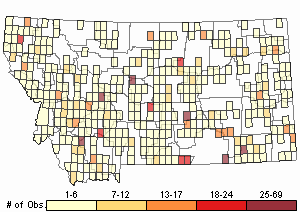
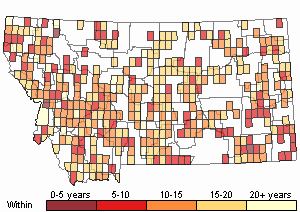
Observations in Montana Natural Heritage Program Database
Number of Observations: 1550
(Click on the following maps and charts to see full sized version)
Map Help and Descriptions
Relative Density
Recency
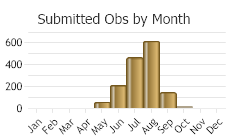
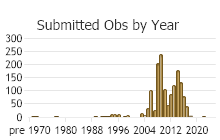
 (Observations spanning multiple months or years are excluded from time charts)
Migration
Hoary Bat is migratory and only a summer resident in Montana, with records from early June through September. Normal arrival and departure dates are uncertain.
Habitat
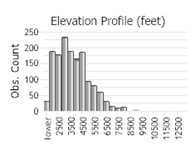
During the summer, Hoary Bats occupy forested areas. A female with two naked pups was found in mid-July using a wooden bridge in Stillwater County as a temporary day roost (Hendricks et al. 2005) but no other Montana roosts have been reported. Often captured foraging over water sources embedded within forested terrain, both conifer and hardwood, as well as along riparian corridors. Reported in Montana over a broad elevation range (579 to 2774 m; 1900 to 9100 ft) during August, the highest record from treeline along the Gravelly Range road (Madison County), the lowest from the Yellowstone River near Sidney (Richland County); probably most common throughout summer in Montana at lower elevations.
National Vegetation Classification System Groups Associated with this Species
Forest and Woodland
Deciduous Forest and Woodland
Low Elevation - Xeric Forest and Woodland
Montane - Subalpine Forest and Woodland
Shrubland
Arid - Saline Shrubland
Foothills - Montane Shrubland
Sagebrush Shrubland
Grassland
Lowland - Prairie Grassland
Montane - Subalpine Grassland
Sparse and Barren
Sparse and Barren
Wetland and Riparian
Alkaline - Saline Wetlands
Alpine Riparian and Wetland
Peatland
Riparian and Wetland Forest
Riparian Shrubland
Wet Meadow and Marsh
Recently Disturbed or Modified
Harvested Forest
Insect-Killed Forest
Introduced Vegetation
Recently Burned
Human Land Use
Agriculture
Developed
Food Habits
Reported to favor moths (Shump and Shump 1982), but stomach contents of 7 individuals captured in Carter County (Jones et al. 1973) revealed beetles (Scarabidae and Dytiscidae), moths, true bugs (Corixidae, Miridae), leafhoppers (Cicindellidae), lacewings (Myremeleontidae, Hemerobiidae), and true flies (Anthomyiidae, Calliphoridae, Tipulidae, Chironomidae, Muscidae). They are also carnivorous, and have been reported to attack, kill, and eat pipistrelle bats (Shump and Shump 1982, Adams 2003).
Ecology
Little information available from Montana: a female Hoary Bat with pups roosted 5.3 m above ground on 16 July on the underside of a wooden bridge in Stillwater County, the first time reported for this species (Hendricks et al. 2005) and within 1.5 m of a small maternity colony of Big Brown Bats; a desiccated adult was found 17 June 1974 impaled on a hawthorn near Goat Haunt Ranger Station in Glacier National Park (Roemer 1995). Throughout the range, this bat appears to be solitary, roosting primarily in trees but reported infrequently from caves (dead individuals), squirrel nests, and clinging to the sides of buildings. Most day roosts are 3 to 5 m above ground, and in such trees as elm, plum, box elder, osage orange, and black cherry. Their flight is swift and direct; they generally emerge at dusk (although in winter they may arouse from hibernation and forage on warm afternoons), and most captures occur 3 to 4 hours after sunset. No important predators of Hoary Bats are known but undoubtedly hawks and owls capture some, and there is at least one report of predation by a snake (Shump and Shump 1982).
Reproductive Characteristics
Through 2010, reproductive status in Montana, based on examination of > 120 individuals, is as follows: for adult female Hoary Bats, pregnant (13 June to 10 July), lactating (11 June to 2 August), post-lactating (15-29 July), nulliparous (21 July to 15 August); for adult male Hoary Bat, non-reproductive (14 June to 30 August), scrotal (10 July to 31 August); for young of the year: naked pups (16 July), volant juveniles (16 July to 31 August). See descriptions in Jones et al. (1973) for summary from Carter County, and Hendricks et al. (2005) for observation of adult female with naked pups. Litter size reported from other regions is usually 2, ranging 1 to 4 pups. Mating probably occurs during late summer and autumn migration, but implantation delayed until spring (Shump and Shump 1982).
Management
No management measures have been enacted specifically for the protection of Hoary Bat in Montana. There are a number of reports of fatal collisions with barbed wire, including in Yellowstone County (Swenson and Bent 1977, Shump and Shump 1982). This species is vulnerable to collision with wind turbines at wind farms (Johnson et al. 2003, Arnett et al. 2008). Fatalities of migrating Hoary Bats may be predictable events, because this species appears to be drawn to prominent landmarks that they see during migration, and this is related to autumn flocking and mating behaviors (Cryan and Brown 2007). Increasing rotor start-up wind speed or changing the pitch angle of blades and lowering the required generator speed for electricity production had the same effect in reducing bat fatalities at an Alberta wind farm by 57-60% (Baerwald et al. 2009) and may be promising mitigation techniques at wind energy facilities.
Stewardship Responsibility
References
- Literature Cited AboveLegend:
 View Online Publication
- Adams, R.A. 2003. Bats of the Rocky Mountain West: natural history, ecology and conservation. University Press of Colorado: Boulder, CO. 289 pp.
 Arnett, E., W.K. Brown, W.P. Erickson, J.K. Fiedler, B.L. Hamilton, T.H. Henry, and A. Jain. 2008. Patterns of bat fatalities at wind energy facilities in North America. Journal of Wildlife Management 72(1): 61-78.
- Baerwald, E.F., J. Edworthy, M. Holder, and R.M. R. Barclay. 2009. A large-scale mitigation experiment to reduce bat fatalities at wind energy facilities. Journal of Wildlife Management 73(7): 1077-1081.
- Cryan, P.M. and A.C. Brown. 2007. Migration of bats past a remote island offers clues toward the problem of bat fatalities at wind turbines. Biological Conservation 139(1-2): 1-11.
- Hendricks, P., J. Johnson, S. Lenard, and C. Currier. 2005. Use of a bridge for day roosting by the hoary bat, Lasiurus cinereus. Canadian Field-Naturalist 119(1):132.
- Johnson, G., W. Erickson, J. White, and R. McKinney. 2003. Avian and bat mortality during the first year of operation at the Klondike phase I Wind Project, Sherman County, Oregon. Prepared for Northwestern Wind Power by West, Inc., Cheyenne, WY. 17 pp.
- Jones, J.K., Jr., R.P. Lampe, C.A. Spenrath, and T.H. Kunz. 1973. Notes on the distribution and natural history of bats in southeastern Montana. Occasional papers (Texas Tech University Museum) 15:1-11.
- Roemer, D. 1995. Montana Chiroptera from the University of Montana mammals collection. Unpublished report. Environmental Studies Department, University of Montana, Missoula. 22 pp.
- Shump, K. A., Jr. and A. U. Shump. 1982. Lasiurus cinereus. American Society of Mammalogists, Lawrence, KS. Mammalian Species No. 185:1-5.
- Swenson, J. E. and J. C. Bent. 1977. The bats of Yellowstone County, southcentral Montana. Proceedings of the Montana Academy of Sciences 37:82-84.
- Additional ReferencesLegend: View Online Publication
Do you know of a citation we're missing?- Abernethy, I.M., M.D. Andersen, and D.A. Keinath. 2012. Bats of southern Wyoming: distribution and migration year 2 report. Prepared for the USDI Bureau of Land Management by the Wyoming Natural Diversity Database, University of Wyoming, Laramie, Wyoming.
- Adams, R.A., S.C. Pedersen, K.M. Thibault, J. Jadin, and B. Petru. 2003. Calcium as a Limiting Resource to Insectivorous Bats: Can Water Holes Provide a Supplemental Mineral Source. Journal of Zoology 260(2): 189-194.
- Agnarsson, I., C.M. Zambrana-Torrelio, N.P. Flores-Saldana, L.J. May-Collado. 2011. A time-calibrated species-level phylogeny of bats (Chiroptera, Mammalia). PLoS Currents Tree of Life. Edition1. RRN1212.
- Almberg, E., D. Bachen, C. Stratton, S. Hilty, M. Becker, J. Ramsey, and K. Smucker. 2023. Montana's 2023 annual white-nose syndrome surveillance and bat monitoring report. Montana Fish, Wildlife & Parks. 21 p.
- Amichai, E., G. Blumrosen, and Y. Yovel. 2015. Calling louder and longer: how bats use biosonar under severe acoustic interference from other bats. Proceedings of the Royal Society B: Biological Sciences, The Royal Society 282(1821): 20152064.
- Arnett, E.B. 2007. Presence, relative abundance, and resource selection of bats in managed forest landscapes in western Oregon. Ph.D. dissertation, Oregon State University, Corvallis, Oregon.
- Arnett, E.B., C.D. Hein, M.R. Schirmacher, M.M.P. Huso, and J.M. Szewczak. 2013. Evaluating the Effectiveness of an Ultrasonic Acoustic Deterrent for Reducing Bat Fatalities at Wind Turbines. PLoS ONE 8(6): e65794.
- Bachen, D.A., A.L. McEwan, B.O. Burkholder, S.L. Hilty, S.A. Blum, and B.A. Maxell.. 2018. Bats of Montana: Identification and Natural History. Report to Montana Department of Environmental Quality. Montana Natural Heritage Program. Helena, MT. 111pp.
- Bachen, D.A., and B.A. Maxell. 2014. Distribution and status of bird, small mammal, reptile, and amphibian species, South Dakota Field Office-BLM. Report to the Bureau of Land Management, South Dakota Field Office. Montana Natural Heritage Program, Helena, Montana 25 pp. plus appendices.
- Baerwald, E.F. and R.M.R. Barclay. 2011. Patterns of Activity and Fatality of Migratory Bats at a Wind Energy Facility in Alberta, Canada. Journal of Wildlife Management 75(5): 1103-1114.
- Baerwald, E.F. and R.R. Barclay. 2009. Geographic Variation in Activity and Fatality of Migratory Bats at Wind Energy Facilities. Journal Of Mammalogy 90(6): 1341-1349.
- Baerwald, E.F., W.P. Patterson, and R.M.R. Barclay. 2014. Origins and migratory patterns of bats killed by wind turbines in southern Alberta: evidence from stable isotopes. Ecosphere 5(9): 118.
- Baker, R.H. and C.J. Phillips. 1965. Mammals from El Nevado de Colima, Mexico. Journal of Mammalogy 46(4): 691-693.
- Barclay, R.M., J.H. Fullard, and D.S. Jacobs. 1999. Variation in the Echolocation Calls of the Hoary Bat (Lasiurus cinereus): Influence of Body Size, Habitat Structure, and Geographic Location. Canadian Journal of Zoology 77(4): 530-534.
- Barclay, R.M.R. 1984. Observations on the migration, ecology and behaviour of bats at Delta Marsh, Manitoba. Canadian Field-Naturalist. 98(3): 331-336.
- Barclay, R.M.R. 1985. Long versus short-range foraging strategies of hoary (Lasiurus cinereus) and silver-haired (Lasionycteris noctivagans) bats and the consequences for prey selection. Canadian Journal of Zoology 63:2507-2515.
- Barclay, R.M.R. 1986. The echolocation calls of Hoary (Lasiurus cinereus) and Silver-haired (Lasionycteris noctivagans) bats as adaptations for long- versus short-range foraging strategies and the consequences for prey selection. Canadian Journal of Zoology. 64: 2700-2705.
- Barclay, R.M.R. 1989. The effect of reproductive condition on the foraging behavior of female hoary bats, Lasiurus cinereus. Behavioral Ecology and Sociobiology 24:31-37.
- Barclay, R.M.R. 1991. Population Structure of Temperate Zone Insectivorous Bats in Relation to Foraging Behavior and Energy Demand. Journal of Animal Ecology 60(1): 165.
- Bat Conservation International. G4 Harp Trap: Assembly and Advice. 8 p.
- Baxter, D.M., J.M. Psyllakis, M.P. Gillingham, and E.L. O'Brien. 2006. Behavioural response of bats to perceived predation risk while foraging. Ethology 112(10): 977-983.
- Bell, J.F., G.J. Moore, G.H. Raymond, and C.E. Tibbs. 1962. Characteristics of Rabies in Bats in Montana. American Journal of Public Health 52(8): 1293-1301.
- Bell, J.F., W.J. Hadlow and W.L. Jellison. 1957. A survey of chiropteran rabies in western Montana. Public Health Reports. 72(1): 16-18.
- Bender, M.J. and G.D. Hartman. 2015. Bat Activity Increases with Barometric Pressure and Temperature During Autumn in Central Georgia. Southeastern Naturalist 14(2): 231-242.
- Benedict, R.A. 2004. Reproductive activity and distribution of bats in Nebraska. Western North American Naturalist 64(2): 231-248.
- Berthinussen, A. and J. Altringham. 2012. The effect of a major road on bat activity and diversity. Journal of Applied Ecology 49(1): 82-89.
- Bogan, M.A., and K. Geluso. 1999. Bat roosts and historic structures on National Park Service lands in the Rocky Mountain region. Albuquerque, NM: U.S. Geological Survey, Midcontinent Ecological Science Center, Dept. of Biology, the University of New Mexico. Unpublished report. 25 pp
- Bouchard, S., J. Zigouris, and M.B. Fenton. 2001. Autumn mating and likely resorption of an embryo by a hoary bat, Lasiurus cinereus (Chiroptera: Vespertilionidae). American Midland Naturalist 145(1): 210-212.
- British Columbia Ministry of Environment, Lands, and Parks. 1998. Inventory Methods for Bats; Standards for Components of British Columbia's Biodiversity No. 20. Prepared for the Terrestrial Ecosystems Task Force Resources Inventory Committee. Version 2.0. 58 p.
- Butts, T. 1997. Bat surveys Indian Creek Canyon, Elkhorn Mountains, Montana. Continental Divide Wildlife Consulting. Helena, MT 32 pg.
- Butts, T.W. 1993. A preliminary survey of the bats of the Deerlodge National Forest, Montana: 1991. Montana Natural Heritage Program. Helena, MT. 35 pp.
- Butts, T.W. 1993. A survey of the bats of the Deerlodge National Forest Montana: 1992. Montana Natural Heritage Program. Helena, MT. 39 pp.
- Butts, T.W. 1993. A survey of the bats of the Townsend Ranger District, Helena National Forest, Montana. Montana Natural Heritage Program. Helena, Montana. 16 pp.
- Callahan, E.V. and R.D. Drobney. 1997. Selection of summer roosting sites by Indiana bats (Myotis sodalis) in Missouri. Journal of Mammalogy 78(3): 818.
- Carlson, J.C. and P. Hendricks. 2001. A Proposal for: Bat Use of Highway Structures: A Pilot Study. Submitted to the Montana Department of Transportation.
- Carlson, J.C. and S.V. Cooper. 2003. Plant and Animal Resources and Ecological Condition of the Forks Ranch Unit of the Padlock Ranch, Big Horn County, Montana and Sheridan County, Wyoming. Unpublished report to The Nature Conservancy Montana Field Office.
- Chester, J.M., N.P. Campbell, K. Karsmizki, and D. Wirtz. 1979. Resource inventory and evaluation. Azure Cave, Montana. BLM unpublished report. 55 pp.
- Choate, J. R. and J. M. Anderson. 1997. Bats of Jewel Cave National Monument, South Dakota. Prairie Naturalist 29:39-47.
- Christy, R. E. and S. W. West. 1993. Biology of bats in Douglas-fir forests. U.S.D.A., Forest Serv., Pac. Northw. res. Station, Gen. Tech. Rep. PNW-GTR-308.
- Chung-MacCoubrey, A.L. 2005. Use of pinyon–juniper woodlands by bats in New Mexico. Forest Ecology and Management 204: 209–220.
- Clement, M.J., J.M. O'Keefe, and B. Walters. 2015. A method for estimating abundance of mobile populations using telemetry and counts of unmarked animals. Ecosphere 6(10): 184.
- Clement, M.J., T.J. Rodhouse, P.C. Ormsbee, J.M. Szewczak, and J.D. Nichols. 2014. Accounting for false-positive acoustic detections of bats using occupancy models. Journal of Applied Ecology 51(5): 1460-1467.
- Cockrum, E.L., B. Musgrove, and Y. Peteryszyn. 1996. Bats of Mohave County, Arizona: populations and movements. Occasional Papers of The Museum, Texas Tech University 157: 1-71.
- Coleman, J.L. and R.R. Barclay. 2013. Prey availability and foraging activity of grassland bats in relation to urbanization. Journal of Mammalogy 94(5): 1111-1122.
- Coleman, L.S., W.M. Ford, C.A. Dobony, and E.R. Britzke. 2014. A Comparison of Passive and Active Acoustic Sampling for a Bat Community Impacted by White-Nose Syndrome. Journal of Fish and Wildlife Management 5(2): 217-226.
- Constantine, D.G., G.L. Humphrey, and T.B Herbenick. 1979. Rabies in Myotis thysanodes, Lasiurus ega, Euderma maculatum, and Eumops perotis in California. Journal of Wildlife Diseases 15(2): 343-345.
- Corbett, J. 2011. Evaluation and management of select natural cave and abandoned mine features of the Lewis & Clark and Helena National Forests, Montana. Bat Conservation International. 18pp plus appendices.
- Cox, M.R., E.V. Willcox, P.D. Keyser, and A.L. Vander Yacht. 2016. Bat response to prescribed fire and overstory thinning in hardwood forest on the Cumberland Plateau, Tennessee. Forest Ecology and Management 359: 221-231.
- Cryan, P. M. 2003. Seasonal distribution of migratory tree bats (Lasiurus and Lasionycteris) in North America. Journal of Mammalogy 84:579-593.
- Cryan, P. M., M. A. Bogan, and J. S. Altenbach. 2000. Effect of elevation on distribution of female bats in the Black Hills, South Dakota. Journal of Mammalogy 81:719-725.
- Cryan, P.M. and B.O. Wolf. 2003. Sex Differences in the Thermoregulation and Evaporative Water Loss of a Heterothermic Bat (Lasiurus cinereus) During its Spring Migration. Journal of Experimental Biology 206(19): 3381-3390.
- Cryan, P.M., C.A. Stricker, and M.B. Wunder. 2014. Continental-scale, seasonal movements of a heterothermic migratory tree bat. Ecological Applications 24(4): 602-616.
- Cryan, P.M., J.W. Jameson, E.F. Baerwald, C.R. Willis, R.M.R. Barclay, E.A. Snider, and E.G. Crichton. 2012. Evidence of Late-Summer Mating Readiness and Early Sexual Maturation in Migratory Tree-Roosting Bats Found Dead at Wind Turbines. PLoS One 7(10): e47586.
- Cryan, P.M., M.A. Bogan, R.O. Rye, G.P. Landis, and C.L. Kester. 2004. Stable hydrogen isotope analysis of bat hair as evidence for seasonal molt and long-distance migration. Journal of Mammalogy 85(5): 995-1001.
- Cvikel, N., E. Levin, E. Hurme, I. Borissov, A. Boonman, E. Amichai, and Y. Yovel. 2015. On-board recordings reveal no jamming avoidance in wild bats. Proceedings of the Royal Society B: Biological Sciences, The Royal Society 282(1798).
- Davis, R. 1966. Homing performance and homing ability in bats. Ecological Monographs 36(3): 201-237.
- Davis, W.B. 1937. Some mammals from western Montana and eastern Idaho. The Murrelet 18(2): 22-27.
- Department of Health and Environmental Sciences Food and Consumer Safety Bureau. 1981. Montana Bats Part I: Control. Vector Control Bulletin Number 2. 6 p.
- Department of Health and Environmental Sciences Food and Consumer Safety Bureau. 1981. Montana Bats Part II: Identification and Biology. Vector Control Bulletin Number 2A. 10 p.
- Dubois, K. 1999. Region 4 bat surveys: 1998 progress report. Unpublished report, Montana Fish, Wildlife & Parks Region 4 Headquarters, Great Falls, Montana. 20 pp.
- DuBois, K. 2000. Species occurrence and Distribution of Bats in North Central Montana: Range Map Changes Resulting from Two Years of Field Surveys. Intermountain Journal of Sciences 6(4): 376.
- Ducummon, S.L. 1997. The North American bats and mines project: a cooperative approach for integrating bat conservation and mine-land reclamation. Paper presented at the 1997 National Meeting of the American Society for Mining and Reclamation, Austin, Texas.
- Duff, A.A. and T.E. Morrell. 2007. Predictive Occurrence Models for Bat Species in California. Journal of Wildlife Management 71(3): 693-700.
- Easterla, D. A. 1973. Ecology of the 18 species of Chiroptera at Big Bend National Park, Texas. Part I and II. Northwest Missouri State University Studies 34:1-165.
- Everette, A.L., T.J. O'Shea, L.E. Ellison, L.A. Stone, and J.L. McCance. 2001. Bat use of a high-plains urban wildlife refuge. Wildlife Society Bulletin 29(3): 967-973.
- Feigley, H.P. 1998. An Examination of the Issues and Feasibility of Conducting Surveys of Abandoned Mines for Bats. Montana Natural Heritage Program, Helena, MT. 12 p.
- Feigley, H.P., M. Brown, S. Martinez, and K. Schletz. 1997.Assessment of mines for importance to bat species of concern, southwestern Montana. Report to: U.S. Geological Survey, Biological Resources Division, Midcontinent Ecological Science Center; 4512 McMurry Ave., Fort Collins, CO 80525-3400. 9pp.
- Fenton, M. B., H. G Merriam, and G L. Holroyd. 1983. Bats of Kootenay, Glacier, and Mount Revelstoke national parks in Canada: identification by echolocation calls, distribution, and biology. Canadian Journal of Zoology 61 :2503-2508.
- Fenton, M.B. 1990. The Foraging Behavior and Ecology of Animal-Eating Bats. Canadian Journal of Zoology 68(3): 411-422.
- Fenton, M.B. 2003. Science and the conservation of bats: where to next? Wildlife Society Bulletin 31(1) 6-15.
- Fenton, M.B., M.D. Skowronski, L.P. McGuire, and P.A. Faure. 2011. Variation in the use of harmonics in the calls of laryngeally echolocating bats. Acta Chiropterologica 13(1): 169-178.
- Findley, J.S. And C. Jones. 1964. Seasonal Distribution of the Hoary Bat. J. Mammal. 45:461-470.
- Fitzgerald, T. 1989. New records of bats from northeastern Colorado. Journal of the Colorado-Wyoming Academy of Science 21:22.
- Ford, W.M., E.R. Britzke, C.A. Dobony, J.L. Rodrigue, and L.B. Johnson. 2011. Patterns of Acoustical Activity of Bats Prior to and Following White-Nose Syndrome Occurrence. Journal of Fish and Wildlife Management 2(2): 125-134.
- Ford, W.M., M.A. Menzel, J.L. Rodrigue, J.M. Menzel, and J.B. Johnson. 2005. Relating bat species presence to simple habitat measures in a central Appalachian forest. Biological Conservation 126(4): 528-539.
- Foresman, K.R. 2001. The wild mammals of Montana. American Society of Mammalogists, Special Publication Number 12. Lawrence, KS. 278 pp.
- Foresman, K.R. 2012. Mammals of Montana. Second edition. Mountain Press Publishing, Missoula, Montana. 429 pp.
- Gehrt, S.D. and J.E. Chelsvig. 2004. Species-specific patterns of bat activity in an urban landscape. Ecological Applications 14(2): 625-635.
- Geluso, K. 2006. Bats in a human-made forest of central Nebraska. The Prairie Naturalist 38(1): 13-23.
- Geluso, K. 2007. Winter activity of bats over water and along flyways in New Mexico. Southwestern Naturalist 52(4): 482-492.
- Genoways, H. H., and J. K. Jones, Jr. 1972. Mammals from southwestern North Dakota. Occasional Papers, The Museum, Texas Tech University 6:1-36.
- Genter, D. L. 1986. Wintering bats of the upper Snake River plain: occurrence in lava-tube caves. Great Basin Naturalist 46(2):241-244.
- Genter, D.L. and K.A. Jurist. 1995. Bats of Montana. Guide for Assessing Mines for Bats Workshop, June 14-15, 1995, Helena, MT, hosted by Montana Department of State Lands and the Abandoned Mine Reclamation Bureau. Montana Natural Heritage Program. 11 pp.
- Gilbert, A.T., G.F. McCracken, L.L. Sheeler, L.I. Muller, D. O’Rourke, W.J. Kelch, and J.C. New Jr. 2015. Rabies surveillance among bats in Tennessee, USA, 1996-2010. Journal of Wildlife Diseases 51(4): 821-832.
- Gniadek, S. 1983. Southwest Glendive Wildlife Baseline Inventory. Miles City, Mont: Bureau of Land Management, Miles City District Office. 56 pp with appendices.
- Griscom, H.R. and D.A. Keinath. 2011. Inventory and status of bats at Devils Tower National Monument. Report prepared for the USDI National Park Service by the Wyoming Natural Diversity Database. University of Wyoming, Laramie, Wyoming.
- Griscom, H.R., M.D. Anderson, and D.A. Keinath. 2012. Bats of southern Wyoming: distribution and migration, year 1 report. Prepared for the USDI Bureau of Land Management by the Wyoming Natural Diversity Database. University of Wyoming, Laramie, Wyoming.
- Gruver, J.C. 2002. Assessment of bat community structure and roosting habitat preferences for the hoary bat (Lasiurus cinereus) near Foote Creek Rim, Wyoming. M.Sc. Thesis. Laramie, WY: University of Wyoming. 149 p.
- Hanauska-Brown, L., B.A. Maxell, A. Petersen, and S. Story. 2014. Diversity Monitoring in Montana 2008-2010 Final Report. Montana Fish, Wildlife & Parks. Helena, MT. 78 pp.
- Harmata, A., D. Flath, R. Hazlewood, and S. Milodragovich. 2002. Initial Site Evaluation for Wind Resource Development in Montana: An Index Relative to Potential Impacts on Vertebrate Wildlife. Intermountain Journal of Sciences 8(4): 253-254.
- Harvey, M.J., J.S. Altenbach, and T.L. Best. 2011. Bats of the United States and Canada. Johns Hopkins University Press. Baltimore, Maryland. p. 202
- Hayes, M.A., K. Ozenberger, P.M. Cryan, and M.B. Wunder. 2015. Not to Put Too Fine a Point on It - Does Increasing Precision of Geographic Referencing Improve Species Distribution Models for a Wide-Ranging Migratory Bat?. Acta Chiropterologica 17(1): 159-169.
- Hein, C.D., S.B. Castleberry, and K.V. Miller. 2009. Site-occupancy of bats in relation to forested corridors. Forest Ecology and Management 257(4): 1200-1207.
- Hendricks, P. 1997. Mine assessments for bat activity, Garnet Resource Area, BLM: 1997. Unpublished report to USDI, Bureau of Land Management. 17pp.
- Hendricks, P. 1998. Bats surveys of Azure Cave and the Little Rocky Mountains: 1997-1998. November 1998.
- Hendricks, P. 1999. Effect of gate installation on continued use by bats of four abandoned mine workings in western Montana. Unpublished report to Montana Department of Environmental Quality. Montana Natural Heritage Program, Helena, Montana. 13 pp.
- Hendricks, P. 1999. Mine Assessments for Bat Activity, Helena National Forest: 1999. Montana Natural Heritage Program. Helena, MT. 12 pp.
- Hendricks, P. 2000. Assessment of abandoned mines for bat use on Bureau of Land Management lands in the Philipsburg, Montana area: 1999. Montana Natural Heritage Program, Helena, MT.13pp.
- Hendricks, P. 2000. Bat survey along the Norris-Madison Junction Road corridor, Yellowstone National Park, Wyoming, 1999. Montana Natural Heritage Program, Helena, MT. 15pp.
- Hendricks, P. 2000. Preliminary bat inventory of caves and abandoned mines on BLM lands, Judith Mountains, Montana. Montana Natural Heritage Program, Helena, Montana. 21 pp.
- Hendricks, P. 2003. Assessment of Selected Abandoned Mines for Use by Bats in the Garnet and Avon Areas: 2002. Montana Natural Heritage Program. Helena, MT. 12 p.
- Hendricks, P. and B.A. Maxell. 2005. Bat Surveys on USFS Northern Region Lands in Montana: 2005. Report to the USDA Forest Service, Northern Region. Montana Natural Heritage Program, Helena, MT. 12 pp. plus appendices.
- Hendricks, P. and D. Kampwerth. 2001. Roost environments for bats using abandoned mines in southwestern Montana : a preliminary assessment. Report to the U.S. Bureau of Land Management. Montana Natural Heritage Program, Helena, Montana. 19 pp.
- Hendricks, P. and D.L. Genter. 1997. Bat surveys of Azure Cave and the Little Rocky Mountains: 1996. Montana Natural Heritage Program. Helena, MT. 25 pp.
- Hendricks, P. and J.C. Carlson. 2001. Bat use of abandoned mines in the Pryor Mountains. Report to the Montana Department of Environmental Quality, Mine Waste Cleanup Bureau. Montana Natural Heritage Program. Helena, Montana. 8 pp.
- Hendricks, P. and L.M. Hendricks. 2010. Water Aquistion During Daylight by Free-Ranging Myotis Bats. Northwestern Naturalist 91(3): 336-338.
- Hendricks, P., B.A. Maxell, S. Lenard, C. Currier and J. Johnson. 2006. Riparian Bat Surveys in Eastern Montana. A report to the USDI Bureau of Land Management, Montana State Office. Montana Natural Heritage Program, Helena, Montana. 13 pp. plus appendices.
- Hendricks, P., C. Currier, and J. Carlson. 2004. Bats of the BLM Billings Field Office in south-central Montana, with emphasis on the Pryor Mountains. Report to Bureau of Land Management Billings Field Office. Montana Natural Heritage Program, Helena, MT. 19 pp. + appendices.
- Hendricks, P., D. Kampwerth and M. Brown. 1999. Assessment of abandoned mines for bat use on Bureau of Land Management lands in southwestern Montana: 1997-1998. Montana Natural Heritage Program, Helena. 29 pp.
- Hendricks, P., D. L. Genter, and S. Martinez. 2000. Bats of Azure Cave and the Little Rocky Mountains, Montana. Canadian Field-Naturalist 114 :89-97.
- Hendricks, P., K. Jurist, D.L. Genter, and J.D. Reichel. 1995. Bat survey of the Sioux District, Custer National Forest: 1994. Montana Natural Heritage Program. Helena, Montana. 41 pp.
- Hendricks, P., K.A. Jurist, D.L. Genter and J.D. Reichel. 1996. Bats of the Kootenai National Forest, Montana. Unpublished report. Montana Natural Heritage Program, Helena, Montana. 99 pp.
- Hendricks, P., K.A. Jurist, D.L. Genter, and J.D. Reichel. 1995. Bat survey of the Kootenai National Forest, Montana: 1994. MTNHP report.
- Hendricks, P., S. Lenard, C. Currier and J. Johnson. 2005. Bat Use of Highway Bridges in South-Central Montana. FHWA/MT-05-007/8159. Final Report prepared for the Montana Department of Transportation, in cooperation with the U.S. Department of Transportation Federal Highway Administration, prepared by the Montana Natural Heritage Program.
- Hendricks, P., S. Lenard, C. Currier, and B.A. Maxell. 2007. Filling the distribution gaps for small mammals in Montana. Helena, MT.: Montana Natural Heritage Program.
- Hendricks, P., S. Lenard, D.M. Stagliano, and B.A. Maxell. 2013. Baseline nongame wildlife surveys on the Fort Peck Indian Reservation. Report to the Assiniboine and Sioux Tribes of the Fort Peck Indian Reservation. Montana Natural Heritage Program, Helena, MT. 83 p.
- Hendricks, Paul. 2012. Winter Records of Bats in Montana. Northwestern Naturalist. 93:154-162.
- Hickey, M.B.C., L. Acharya, and S. Pennington. 1996. Resource Partitioning by Two Species of Vespertilionid Bats (Lasiurus cinereus and Lasiurus borealis) Feeding Around Street Lights. Journal of Mammalogy 77(2): 325-334.
- Hill J.E. and J.D. Smith: 1984. Bats: a natural history. Univ. Texas Press Austin. 243 pp.
- Hilty, S.L. 2020. Characterizing summer roosts of male little brown Myotis (Myotis lucifugus) in lodgepole pine-dominated forests. M.Sc. Thesis. Bozeman, MT: Montana State University. 70 p.
- Hinman, K.E. and T.K. Snow, eds. 2003. Arizona Bat Conservation Strategic Plan. Nongame and Endangered Wildlife Program Technical Report 213. Arizona Game and Fish Department, Phoenix, Arizona.
- Hoffmann, R. S., D. L. Pattie and J. F. Bell. 1969. The distribution of some mammals in Montana. II. Bats. Journal of Mammalogy 50(4): 737-741.
- Holroyd, S.L., V.J. Craig, and P. Govindarajulu. 2016. Best Management Practices for Bats in British Columbia. Ministry of Environment, Victoria, BC. 301pp.
- Humphrey, S. R. 1975. Nursery roosts and community diversity of Nearctic bats. Journal of Mammalogy 56:321-346.
- Jameson, J.W. and C.K. Willis. 2012. Bat Mortality at a Wind Power Facility in Central Canada. Northwestern Naturalist 93(3): 194-202.
- Jameson, J.W. and C.K. Willis. 2014. Activity of tree bats at anthropogenic tall structures: implications for mortality of bats at wind turbines. Animal Behaviour 97: 145-152.
- Jantzen, M., and M. Fenton. 2013. The depth of edge influence among insectivorous bats at forest-field interfaces. Canadian Journal of Zoology 91(5): 287-292.
- Jean, C., P. Hendricks, M. Jones, S. Cooper, and J. Carlson. 2002. Ecological communities on the Red Rock Lakes National Wildlife Refuge: inventory and review of aspen and wetland systems. Report to Red Rock Lakes National Wildlife Refuge.
- Jiang, T., H. Wu, J. Feng. 2015. Patterns and causes of geographic variation in bat echolocation pulses. Integrative Zoology 10(3): 241-256.
- Johnson, G.D., M.K. Perlik, W.P. Erickson, and M.D. Strickland. 2004. Bat Activity, Composition, and Collision Mortality at a Large Wind Plant in Minnesota. Wildlife Society Bulletin 32(4): 1278-1288.
- Johnson, G.D., W.P. Erickson, M.D. Strickland, M.F. Shepherd, D.A. Shepherd, and S.A. Sarappo. 2003. Mortality of Bats at a Large-scale Wind Power Development at Buffalo Ridge, Minnesota. American Midland Naturalist 150(2): 332-342.
- Johnson, J.S., K.S. Watrous, G.J. Giumarro, T.S. Peterson, S.A. Boyden, and M.J. Lacki. 2011. Seasonal and geographic trends in acoustic detection of tree-roosting bats. Acta Chiropterologica 13(1): 157-168.
- Joslin, Gayle, and Heidi B. Youmans. 1999. Effects of recreation on Rocky Mountain wildlife: a review for Montana. [Montana]: Montana Chapter of the Wildlife Society.
- Kalcounis, M. C., K. A. Hobson, R. M. Brigham, and K. R. Hecker. 1999. Bat activity in the boreal forest: importance of stand type and vertical strata. Journal of Mammalogy 80:673- 682.
- Keeley, B. W., and M. D. Tuttle. 1999. “Bats in American Bridges.” Resource Publication No. 4. Bat Conservation International. Austin, TX. 41 p.
- Keinath, D. 2004. Bat and Terrestrial Mammal Inventories in the Greater Yellowstone Network: A progress report. Wyoming Natural Diversity Database, Laramie, WY. 17 pp.
- Keinath, D. 2005. Supplementary Mammal Inventory of Bighorn Canyon National Recreation Area. Final Report. Wyoming Natural Diversity Database, Laramie, WY. 21 pp.
- Keinath, D.A. 2001. Bat Habitat Delineation and Survey Suggestions for Bighorn Canyon National Recreation Area. Unpublished report prepared by the Wyoming Natural Diversity Database for the North American Bat Conservation Partnership.
- Keinath, D.A. 2005. A bat Conservation Evaluation for White Grass Ranch, Grand Teton National Park, Wyoming. Unpublished report for Grand Teton National Park by the Wyoming Natural Diversity Data Base, Laramie, WY.
- Keinath, D.A. 2007. Yellowstone's World of Bats: Taking Inventory of Yellowstone's Night Life. Yellowstone Science 15: 3-13.
- Kingston, T., G. Jones, Z. Akbar, and T.H. Kunz. 2003. Alternation of echolocation calls in 5 species of aerial-feeding insectivorous bats from Malaysia. Journal of Mammalogy 84(1): 205-215.
- Kitzes, J. and A. Merenlender. 2014. Large roads reduce bat activity across multiple species. Plos ONE 9(5): 1-5.
- Klug, B.J. and E.F. Baerwald. 2010. Incidence and Management of Live and Injured Bats at Wind Energy Facilities. Journal of Wildlife Rehabilitation 30(2): 11-16.
- Klug, B.J. and R.M.R. Barclay. 2013. Thermoregulation during reproduction in the solitary, foliage-roosting hoary bat (Lasiurus cinereus). Journal of Mammalogy 94(2): 477-487.
- Klug, B.J., D.A. Goldsmith, and R.M. Barclay. 2012. Roost selection by the solitary, foliage-roosting hoary bat (Lasiurus cinereus) during lactation. Canadian Journal of Zoology 90(3): 329-336.
- Koehler, C.E. and R.M.R. Barclay. 1988. The Potential for Vocal Signatures in the Calls of Young Hoary Bats (Lasiurus cinereus). Canadian Journal of Zoology 66(9): 1982-1985.
- Koehler, C.E. and R.M.R. Barclay. 2000. Post-natal growth and breeding biology of the hoary bat (Lasiurus cinereus). Journal of Mammalogy 81(1): 234-244.
- Korstian, J.M., A.M. Hale, and D.A. Williams. 2015. Genetic Diversity, Historic Population Size, and Population Structure in 2 North American Tree Bats. Journal of Mammalogy 96(5): 972-980.
- Kubista, C.E. and A. Bruckner. 2015. Importance of urban trees and buildings as daytime roosts for bats. Biologia 70(11): 1545-1552.
- Kudray, G.M., P. Hendricks, E. Crowe, and S.V. Cooper. 2004. Riparian forests of the Wild and Scenic Missouri River: ecology and management. Prepared for Lewistown Field Office, Bureau of Land Management, Lewistown, Montana. Montana Natural Heritage Program, Helena, MT. 29 pp. plus appendices.
- Kuenzi, A. J., G. T. Downard, and M. L. Morrison. 1999. Bat distribution and hibernacula use in west central Nevada. Great Basin Naturalist 59:213-220.
- Kunz, T. H. (ed). 1988. Ecological and behavioral methods for the study of bats. Smithsonian Inst., Washington D.C., 533 pp.
- Kunz, T.H. and M.B. Fenton. 2003. Bat Ecology. Chicago, Ill: University of Chicago Press. p. 1-745.
- Kunz, T.H. and P.A. Racey. 1998. Bat biology and conservation. International Bat Research Conference 1995. Boston University. Smithsonian Institution Press.
- Kurta, A. 2010. Reproductive timing, distribution, and sex ratios of tree bats in Lower Michigan. Journal of Mammalogy 91(3): 586-592.
- LaMarr, S. and A.J. Kuenzi. 2011. Bat species presence in southwestern Montana. Intermountain Journal of Sciences. 17:1-4. Pp 14-19.
- Lampe, R.P., J.K. Jones Jr., R.S. Hoffmann, and E.C. Birney. 1974. The mammals of Carter County, southeastern Montana. Occa. Pap. Mus. Nat. Hist. Univ. Kan. 25:1-39.
- Lemke, T. 1991. Big Sky UFOs. Montana Outdoors 22(6):2-7.
- Lenard, S. and P. Hendricks. 2012. Bat Surveys at Army Corps of Engineers Libby Dam, Libby, Montana 2011. A report to the US Army Corps of Engineers, Libby Dam. Montana Natural Heritage Program, Helena, MT. 21 pp.
- Lenard, S., B.A. Maxell, P. Hendricks, and C. Currier. 2007. Bat Surveys on USFS Northern Region 1 Lands in Montana: 2006. Report to the USDA Forest Service, Northern Region. Montana Natural Heritage Program, Helena, Montana. 23 pp. plus appendices.
- Lenard, S., P. Hendricks, and B.A. Maxell. 2009. Bat surveys on USFS Northern Region lands in Montana: 2007. A report to the USDA Forest Service, Northern Region. Helena, MT. Montana Natural Heritage Program. 21 pp plus appendices.
- Lewis, S. E. 1995. “Roost Fidelity of Bats: a Review.” Journal of Mammalogy 76:481-496.
- Lilley, T.M., J.S. Johnson, L. Ruokolainen, E.J. Rogers, C.A. Wilson, S.M. Schell, K.A. Field, and D.M. Reeder. 2016. White-nose syndrome survivors do not exhibit frequent arousals associated with Pseudogymnoascus destructans infection. Frontiers in Zoology 13(1): 1.
- Madson, M. and G. Hanson. 1992. Bat hibernaculum search in the Pryor Mountains, southcentral Montana (Draft). Montana Natural Heritage Program. 35 pp.
- Madson. M. 1990. Tate-Potter Cave. Unpublished report, with maps. 6 pp.
- Martinez, S. 1996. Evaluation of selected bat habitat sites in south central and north western Montana, 1995. Unpublished report to the Montana Natural Heritage Program and The Nature Conservancy.
- Martinez, S. 1999. Evaluation of selected bat habitat sites along the Mammoth-Norris grand loop road corridor, Yellowstone National Park, Wyoming, 1997-1998. [Unpublished report submitted to the Montana Natural Heritage Program, Helena, MT]. 16pp.
- Mathews, F., N. Roche, T. Aughney, N. Jones, J. Day, J. Baker, and S. Langton. 2015. Barriers and benefits: implications of artificial night-lighting for the distribution of common bats in Britain and Ireland. Philosophical Transactions of the Royal Society B: Biological Sciences 370(1667): 20140124.
- Matthews, W. L., and J. E. Swenson. 1982. The mammals of east-central Montana. Proc. Mont. Acad. Sci. 41:1-13.
- Matthews, W.L. 1980a. Wibaux-Beach comparison study: Sydney, Glendive and Plevna Study Areas. Bureau of Land Management, Miles City, MT. 50 p.
- Maxell, B.A. 2016. Northern Goshawk surveys on the Beartooth, Ashland, and Sioux Districts of the Custer-Gallatin National Forest: 2012-2014. Montana Natural Heritage Program. Helena, MT. 114pp.
- McGee, M., D.A. Keinath and G.P. Beauvais. 2002. Survey for rare vertebrates in the Pinedale Field Office of the USDI Bureau of Land Management (Wyoming). Unpublished report prepared for USDI Bureau of Land Management. Wyoming State Office by the Wyoming Natural Diversity Database. University of Wyoming, Laramie, Wyoming.
- McGuire, L.P., K.A. Jonasson, and C.G. Guglielmo. 2014. Bats on a Budget: Torpor-Assisted Migration Saves Time and Energy. PLoS ONE 9(12): e115724.
- McGuire, L.P., M.B. Fenton, C.G. Guglielmo. 2013. Phenotypic flexibility in migrating bats: seasonal variation in body composition, organ sizes and fatty acid profiles. Journal of Experimental Biology 216(5): 800-808.
- Miller, D.A. 2003. Species Diversity, Reproduction, and Sex Ratios of Bats in Managed Pine Forest Landscapes of Mississippi. Southeastern Naturalist 2(1): 59-72.
- Montana Bat Working Group. 2020. Recommendations to reduce bat fatalities at wind energy facilities in Montana. Presented to the Montana Fish and Wildlife Commission.
- Mumford, R. E. And J. B. Cope. 1964. Distribution and Status of the Chrioptera of Indiana. Am. Midl. Nat. 72(2):473-489.
- Nagorsen, D.W. and R.M. Brigham. 1993. Bats of British Columbia. Volume I. The Mammals of British Columbia. UBC Press, Vancouver. 164 pp.
- Nagorsen, D.W., A.A. Bryant, D. Kerridge, G. Roberts, A. Roberts, and M.J. Sarell. 1993. Winter bat records for British Columbia. Northwestern Naturalist. 74(3): 61-66.
- Natural Resources Conservation Service and Bat Conservation International. 1998. Bats and mines: Evaluating abandoned mines for bats: recommendations for survey and closure. 6 p.
- Neuweiler, G. 1989. Foraging ecology and audition in echolocating bats. Trends in Ecology and Evolution 4(6): 160-166.
- Neuweiler, G. 1990. Auditory adaptations for prey capture in echolocating bats. Physiological Reviews 70(3): 615-641.
- Nowak, R.M. and E.P. Walker. 1994. Walker's bats of the world. Johns Hopkins University Press. Baltimore, Maryland.
- Ober, H.K. and J.P. Hayes. 2008. Prey Selection by Bats in Forests of Western Oregon. Journal of Mammalogy 89(5): 1191-1200.
- Oechsli, L.M. 2000. Ex-urban development in the Rocky Mountain West: consequences for native vegetation, wildlife diversity, and land-use planning in Big Sky, Montana. M.Sc. Thesis. Montana State University, Bozeman. 73 p.
- O'Farrell, M.J., B. Gannon and C. Corben. 2000. Geographic variation in the echolocation calls of the hoary bat (Lasiurus cinereus). Acta Chiropterologica 2(2): 185-196.
- Olson, C.R., D.P. Hobson, and M.J. Pybus. 2011. Changes in Population Size of Bats at a Hibernaculum in Alberta, Canada, in Relation to Cave Disturbance and Access Restrictions. Northwestern Naturalist 92(3): 224-230.
- Peck, J. and A. Kuenzi. 2003. Relationship of Orientation on Internal Temperature of Artificial Bat Roosts, Southwestern Montana. Intermountain Journal of Sciences 9(1): 19-25.
- Perkins, J. M., J. M. Barss, and J. Peterson. 1990. Winter records of bats in Oregon and Washington. Northwestern Naturalist 71:59-62.
- Perkins, M. J. and S. P. Cross. 1988. Differential use of some coniferous forest habitats by hoary and silver-haired bats in Oregon. The Murrelet 69:21-24.
- Pybus, M.J. 1986. Rabies in insectivorous bats of western Canada, 1979 to 1983. Journal of Wildlife Diseases 22(3): 307-313.
- Quay, W.B. 1948. Notes on Some Bats from Nebraska and Wyoming. Journal of Mammalogy 29(2): 181-182.
- Rabe, M. J., T. E. Morrell, H. Green, J. C. demos, Jr., and C. R. Miller. 1998. Characteristics of ponderosa pine snag roosts used by reproductive bats in northeastern Arizona. Journal of Wildlife Management 62:612-621.
- Reid, F. 2006. Peterson Field Guide to Mammals of North America, 4th Edition. Houghton Mifflin Company: Boston and New York, 608 pp.
- Reimer, J.P., E.F. Baerwald, and R.M.R. Barclay. 2010. Diet of Hoary (Lasiurus cinereus) and Silver-haired (Lasionycteris noctivagans) Bats While Migrating Through Southwestern Alberta in Late Summer and Autumn. American Midland Naturalist 164(2): 230-237.
- Rodhouse, T.J., R.M. Rodriguez, K.M. Banner, P.C. Ormsbee, J. Barnett, and K.M. Irvine. 2019. Evidence of region‐wide bat population decline from long‐term monitoring and Bayesian occupancy models with empirically informed priors. Ecology and Evolution 00:1-11.
- Rodríguez-San Pedro, A. and J. Simonetti. 2015. The relative influence of forest loss and fragmentation on insectivorous bats: does the type of matrix matter?. Landscape Ecology 30(8): 1561-1572.
- Roemer, D.M. 1994. Results of field surveys for bats on the Kootenai National Forest and the Lolo National Forest of western Montana, 1993. Unpublished report for the Kootenai National Forest. Montana Natural Heritage Program, Helena. 19 pp.
- Rolseth, S.L. and C.E. Koehler. 1994. Differences in the diets of juvenile and adult hoary bats, lasiurus cinereus. Journal of Mammalogy 75(2): 394.
- Rossillon, M. 1995. The McDonald Mine, west of Ravalli: a cultural resource inventory and evaluation. Renewable Technologies, Inc.. Butte. MT. Unpublished report. 24 pp.
- Sasse, D. 1989. Lick Creek Cave - Survey for Bats. White Sulfur Springs, MT: USDA Forest Service, Lewis & Clark National Forest. Report to the district ranger of Kings Hill Ranger District.
- Sasse, D. C. 1991 . Survey of Tate-Potter Cave. Unpublished report, U.S. Forest Service Belt Creek Information Station, Neihart, MT. 1 3 pp.
- Schmidt, U. and G. Joermann. 1986. The Influence of Acoustical Interferences on Echolocation in Bats. Mammalia 50(3): 379-390.
- Schwab, N.A. 2004. Bat Conservation Strategy and plan for the State of Montana. Intermountain Journal of Sciences 10(1-4): 80.
- Schwab, Nathan. 2003. Mine Assessments for Bat Activity on Lands Managed by the BLM, Missoula Field Office 2003. Report to USDI BLM Missoula FO. Missoula, MT. 10pp.
- Schwab, Nathan. 2004. Mine Assessment for Bat Activity on Lands Managed by the BLM, Missoula Field Office 2004. USDI BLM Missoula FO. Missoula, MT. 16 pp.
- Sherwin, R.E., J.S. Altenbach, and D.L. Waldien. 2009. Managing abandoned mines for bats. Bat Conservation International.
- Storz, J.F. and C.E. Williams. 1996. Summer population structure of subalpine bats in Colorado. The Southwestern Naturalist 41(4): 322-324.
- Swenson, J.E. and G.F. Shanks, Jr. 1979. Noteworthy records of bats from northeastern Montana. Journal of Mammalogy. 60(3): 650-652
- Taylor, D.A.R. and M.D. Tuttle. 2007. Water for wildlife: a handbook for ranchers and range managers. Bat Conservation International. 20 p.
- Thomas, D.W. 1995. Hibernating Bats Are Sensitive to Nontactile Human Disturbance. Journal of Mammalogy 76(3): 940-946.
- Thompson, L.S. 1982. Distribution of Montana amphibians, reptiles, and mammals. Bozeman: Montana Audubon Council. 24 pp.
- Tigner, J. and E.D. Stukel. 2003. Bats of the Black Hills: a description of status and conservation needs. South Dakota Department of Game, Fish, and Parks. Wildlife Division Report 2003-05. 94 p.
- Tigner, Joel. 2005. Active Season Bat Surveys of Select Abandoned Mines in the Thompson River Valley, Sanders County, MT. BATWORKS, Rapid City, SD. 16pp.
- Tigner, Joel. 2006. Bat Hibernacula Surveys of Select Abandoned Mines in the Thompson River Valley, Sanders County, Montana. BATWORKS, Rapid City, SD. 9pp.
- Tigner, Joel. 2007. Bat hibernacula surveys (in) gated mines, Pryor Mountains, Carbon County, Montana - Report to BLM. Batworks 2416 Cameron Drive, Rapid City, SD 57702.
- Turner, R. W. 1974. Mammals of the Black Hills of South Dakota and Wyoming. Mus. Nat. Hist. Univ. Kansas Misc. Pub. No. 60. 178 pp.
- Tuttle, M.D. and D.A.R. Taylor. 1998. Bats and mines. Bat Conservation International, Inc. Resource Publication No. 3. 52 p.
- Twente, J. W., Jr. 1955. Some aspects of habitat selection and other behavior of cavern-dwelling bats. Ecology 36(4): 706-732.
- Valdez, E.W. and P.M. Cryan. 2009. Food Habits of the Hoary Bat (Lasiurus cinereus) During Spring Migration Through New Mexico. Southwestern Naturalist 54(2): 195-200.
- Valdez, E.W. and P.M. Cryan. 2013. Insect prey eaten by hoary bats (Lasiurus cinereus) prior to fatal collisions with wind turbines. Western North American Naturalist 73(4): 516-524.
- Van Gelder, R.G. 1956. Echo-location failure in migratory bats. Transactions of the Kansas Academy of Science 59(2): 220-222.
- Van Zyll de Jong, C.G. and P. Geraghty. 1985. Handbook of Canadian Mammals: Volume 2: Bats. Canadian Museum of Nature. 212 p.
- Veilleux, J.P., P.R. Moosman Jr., D.S. Reynolds, K.E. LaGory, L. Walston Jr. 2009. Observations of Summer Roosting and Foraging Behavior of a Hoary Bat (Lasiurus cinereus) in Southern New Hampshire. Northeastern Naturalist 16(1): 148-152.
- Vonhof, M. J., and R.M.R. Barclay. 1996. Roost-site selection and roosting ecology of forest-dwelling bats in southern British Columbia. Canadian Journal of Zoology 74:1797-1805.
- Waage, B.C. 1988. Western Energy Company Rosebud Mine, Colstrip, Montana: Annual Wildlife Monitoring Report, 1988 Field Season. December 1988.
- Weller, T.J. and D.C. Lee. 2007. Mist Net Effort Required to Inventory a Forest Bat Species Assemblage. Journal of Wildlife Management 71(1): 251-257.
- Whitaker, J.O., H.K. Dannelly, and D.A. Prentice. 2004. Chitinase in Insectivorous Bats. Journal of Mammalogy 85(1): 15-18.
- Willis, C.K. 2015. Conservation Physiology and Conservation Pathogens: White-Nose Syndrome and Integrative Biology for Host–Pathogen Systems. Integrative Comparative Biology 55(4): 631-641
- Willis, C.K.R., and R. M. Brigham. 2005. Physiological and ecological aspects of roost selection by reproductive female hoary bats (Lasiurus cinereus). Journal of Mammalogy 86:85-94.
- Willis, C.K.R., R.M. Brigham, and F. Geiser. 2006. Deep, prolonged torpor by pregnant, free-ranging bats. Naturwissenschaften 93(2): 80-83.
- Wilson, D. E., F. R. Cole, J. D. Nichols, R. Rudran, and M. S. Foster, (eds.). 1996. Measuring and monitoring biological diversity: standard methods for mammals. Smithsonian Institution, U.S.A. 409 pp.
- Wolfe, M.L. and A. Kozlowski. 2006. Bat inventories at Grant-Kohrs Ranch National Historic Site and Little Bighorn Battlefield National Monument, FInal Report. Rocky Mountains Cooperative Ecosystems Studies Unit. Utah State University. Logan, UT. 26 pp.
- Worthington, D.J. 1991. Abundance and distribution of bats in the Pryor Mountains of south central Montana and north eastern Wyoming. Montana Natural Heritage Program, Helena, MT.
- Worthington, D.J. and H.N. Ross. 1990. Abundance and distribution of bats in the Pryor Mountains of south central Montana. Unpublished report for the Montana Natural Heritage Program. 20 p.
- Worthington, David J. 1991. Abundance and distribution of bats in the Pryor Mountains of south central Montana. M.S. Thesis. University of Montana. Missoula, MT.
- Zukal, J., J. Pikula, and H. Bandouchova. 2015. Bats as bioindicators of heavy metal pollution: history and prospect. Mammalian Biology 80(3): 220-227.
- Web Search Engines for Articles on "Northern Hoary Bat"
- Additional Sources of Information Related to "Mammals"