View in other NatureServe Network Field Guides
NatureServe
Montana
Utah
Wyoming
Idaho
Wisconsin
British Columbia
South Carolina
Yukon
California
New York
Yellow Perch - Perca flavescens
General Description
The yellow perch is a very familiar species to most fishermen. This fish was introduced into Montana and is found in abundance in many lakes and reservoirs located east and west of the Divide. Perch support one of the largest fisheries in Montana and are considered one of the best eating fish in the state. Because of their tendency to travel in schools, perch often can be caught in large numbers, which makes up for their relatively small size and difficulty in cleaning. Young yellow perch are important prey for several sport fish. Perch drape strings of gelatinous material with eggs embedded inside over substrate or vegetation. Perch foods are invertebrates and small fish.
Diagnostic Characteristics
Many small teeth but no canine teeth. Anal fin has two spines and 6 to 8 soft rays. Lower fins reddish orange in breeding males.
Species Range
Montana Range
Range Descriptions
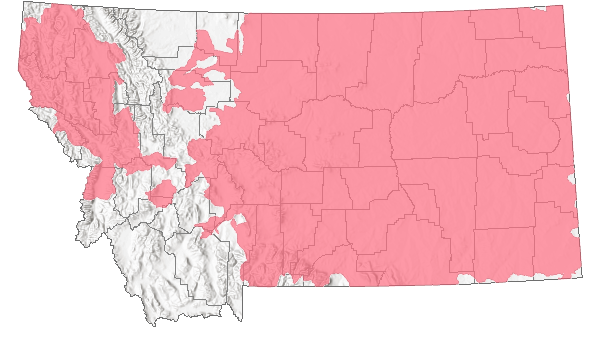
 Non-native
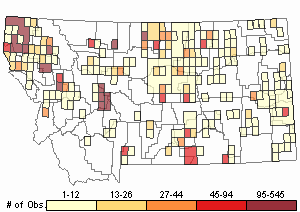
Observations in Montana Natural Heritage Program Database
Number of Observations: 4585
(Click on the following maps and charts to see full sized version)
Map Help and Descriptions
Relative Density
Recency
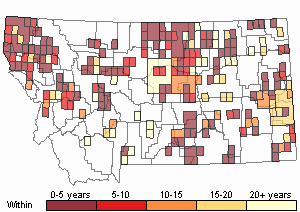
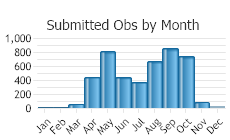
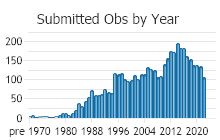
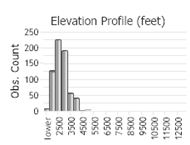 (Observations spanning multiple months or years are excluded from time charts)
Migration
May move into tributary streams to spawn.
Habitat
Prefers warm to cool clear lakes with vegetation and to a lesser extent, slow, weedy streams, but is adaptable. Usually spawns over aquatic vegetation but silt-free sand and gravel bars may be used.
Food Habits
Adults eat aquatic invertebrates and small fish. Young feed largely on zooplankton.
Ecology
Travel in schools make up of fish of approximately the same size. Important forage fish. Populations often stunt.
Reproductive Characteristics
Sexually mature in 2 years. Spawns April-May at 45-50 degrees F. Incubation: 10-20 days. No parental care.
Management
Stewardship Responsibility
References
- Literature Cited AboveLegend:
 View Online Publication
- Lee, D.S., C.R. Gilbert, C.H. Hocutt, R.E. Jenkins, D. E. McAllister, J. R. Stauffer, Jr. 1980. Atlas of North American freshwater fishes. North Carolina State Musuem of Natural History. 867 p.
- Scott, W.B. and E.J. Crossman. 1973. Rainbow trout, Kamloops trout, Steelhead trout Salmo gairdneri Richardson. pp. 184-191. In: Freshwater fishes of Canada. Ottawa, Canada: Fisheries Research Board of Canada, Bulletin 184. 966 p.
- Additional ReferencesLegend: View Online Publication
Do you know of a citation we're missing? Bandow, F.L. 1969. Observations on the life history of the yellow perch and fish populations in Canyon Ferry Reservoir, Montana. M.Sc. Thesis. Bozeman, MT: Montana State University. 32 p.
- Barfoot, C.A. 1993. Longitudinal distribution of fishes and habitat in Little Beaver Creek, Montana. M.Sc. Thesis. Bozeman, MT: Montana State University. 66 p.
- Barnard, D. and J. Vashro. 1986. ASARCo Rock Creek project, baseline fisheries assessment. MTFWP Report under contract to ASARCo. 22 p.
- Barndt, S.A. 1996. The Biology and Status of the Arctic Grayling in Sunnyslope Canal, Montana. M.Sc. Thesis. Bozeman, MT: Montana State University. 136 p.
- Brandt, Troy M. 2000. Fish diversity behavior and microhabitat use in secondary channels of the Bitterroot River, Montana. M.S. Thesis. University of Montana. Missoula, MT.
- Craig, V.E. 1952. A story of fish production as it applies to Montana. M.Sc. Thesis. Bozeman, MT: Montana State University. 92 p.
- Dieterman, D.J., M.P. Ruggles, M.L. Wildhaber, and D.L. Galat (eds). 1996. Population structure and habitat use of benthic fishes along the Missouri and Lower Yellowstone Rivers. 1996 Annual report of Missouri River Benthic Fish Study PD-95-5832 to U.S. Army Corps of Engineers and U.S. Bureau of Reclamation. 238 p.
- Duncan, M.B. 2019. Distributions, abundances, and movements of small, nongame fishes in a large Great Plains river network. Ph.D. Dissertation. Bozeman, MT: Montana State University. 255 p.
- Echo, J.B. 1954. Some ecological relationships between the yellow perch, trout, and other fish in Thompson Lakes, Montana. M.Sc. Thesis. Bozeman, MT: Montana State University. 20 p.
- Holton, G.D. 1981. Identification of Montana's most common game and sport fishes. Montana Outdoors May/June reprint. 8 p.
- Johnson, R.L. 1962. The yield and standing crop of fish in Dailey Lake, Montana. M.Sc. Thesis. Bozeman, MT: Montana State University. 25 p.
- Jones, Thomas S. 1991. Floodplain distribution of fishes of the Bitterroot River with emphasis on introduced populations of Northern Pike. M.S. Thesis. University of Montana. Missoula, MT.
- Joslin, Gayle, and Heidi B. Youmans. 1999. Effects of recreation on Rocky Mountain wildlife: a review for Montana. [Montana]: Montana Chapter of the Wildlife Society.
- Knight, D.E. 1982. Accumulation of dietary methylmercury by Walleye and White Crappie in the Tongue River Reservoir, Montana. M.Sc. Thesis. Bozeman, Montana: Montana State University. 103 p.
- Montana Department of Fish, Wildlife and Parks. 1989. Northeast Montana Warmwater Ecosystem Investigations: project period 7/1/88 through 6/30/89. Proj.# F-46-R-2; Job# V-e. 21p.
- Montana Fish, Wildlife and Parks. 1989. Hauser Reservoir fisheries management plan: September 1989-September 1994. 16 p.
- Mullins, M.S. 1991. Biology and predator use of cisco (Coregonus artedi) in Fort Peck Reservoir, Montana. M.Sc. Thesis. Bozeman, MT: Montana State University. 68 p.
- Penkal, R.F. 1977. Black bass populations of the Tongue River Reservoir, Montana. M.Sc. Thesis. Bozeman, MT: Montana State University. 111 p.
- Pol, Michael V., 1993. Ecology of juvenile Yellow Perch in Lolo Bay, Flathead Lake, Montana. M.S. Thesis. University of Montana. Missoula, MT.
- Rahrer, J.F. 1963. Age and growth of four species of fish, Flathead Lake, Montana. M.Sc. Thesis. Bozeman, MT: Montana State University. 16 p.
- Spinelli, J.P. 2010. Spatial and temporal entrainment of fish from Hauser Reservoir, Montana. M.Sc. Thesis. Bozeman, Montana: Montana State University. 107 p.
- Stash, S.W. 2001. Distribution, relative abundance, and habitat associations of Milk River fishes related to irrigation diversion dams. M.Sc. Thesis. Bozeman, MT: Montana State University. 82 p.
- Stevenson, H.R. 1975. The trout fishery of the Bighorn River below Yellowtail Dam, Montana. M.Sc. Thesis. Bozeman, MT: Montana State University. 67 p.
- Stringer, A.L. 2018. Status of Northern Pearl Dace and chrosomid dace in prairie streams of Montana. M.Sc. Thesis. Bozeman, MT: Montana State University. 150 p.
- Sylvester, R. and B. Marotz. 2006. Evaluation of the Biological Effects of the Northwest Power Conservation Council's Mainstem Amendment on the Fisheries Upstream and Downstream of Hungry Horse and Libby Dams, Montana. Montana Fish, Wildlife, and Parks Annual Report prepared for U.S. Department of EnergyBonneville Power Administration. Bonneville Power Administration Project No. 2006-008-00 Contract No. 28350. 124 p.Contract No. 28350
- Sylvester, R. and B. Stephens. 2011. Evaluation of the physical and biological effects of the Northwest Power Conservation Council's Mainstem Amendment upstream and downstream of Libby Dam, Montana. Libby, MT: Montana Fish, Wildlife, and Parks Annual Report prepared for U.S. Department of Energy Bonneville Power Administration. Bonneville Power Administration Project No. 2006-008-00, Contract Nos. 43309 and 48555. 282 p.
- Sylvester, R., A. Steed, J. Tohtz, and B. Marotz. 2008. Evaluation of the Biological Effects of the Northwest Power Conservation Council's Mainstem Amendment on the Fisheries Upstream and Downstream of Hungry Horse and Libby Dams, Montana. Montana Fish, Wildlife, and Parks Annual Report prepared for U.S. Department of EnergyBonneville Power Administration. Bonneville Power Administration Project No. 2006-008-00 Contract No. 28350. 124 p.Contract No. 28350
- Sylvester, R.M., B.C. Stephens, and J.T. Frye. 2014. Mainstem Columbia Amendments Research at Libby Dam - Evaluation of the Physical and Biological Effects of the Northwest Power Conservation Council's Mainstem Amendment Upstream and Downstream of Libby Dam, Montana. Libby, MT: Montana Fish, Wildlife, and Parks Annual Report prepared for U.S. Department of Energy Bonneville Power Administration. Bonneville Power Administration Project No. 2006-008-00. 461 p.
- USDI Bureau of Land Management. No date. Fishes of the Miles city, Montana BLM District. Miles City, MT: Miles City BLM District pamphlet. 12 p.
- Wollitz, R.E. 1958. The effects of certain commercial toxicants on limnology of 3 cold water ponds near Three Forks, Montana. M.Sc. Thesis. Bozeman, MT: Montana State University. 63 p.
- Workman, D.L. 1970. A comparison of fish population estimates for two pothole lakes in Montana. M.Sc. Thesis. Bozeman, MT: Montana State University. 26 p.
- Wuellner, M.R. 2007. Influence of reach and watershed characteristics on fish distributions in small streams of eastern Montana. M.Sc. Thesis. Bozeman, MT: Montana State University. 80 p.
- Young, B.A., T.L. Welker, M.L. Wildhaber, C.R. Berry, and D. Scarnecchia (eds). 1997. Population structure and habitat use of benthic fishes along the Missouri and Lower Yellowstone Rivers. 1997 Annual report of Missouri River Benthic Fish Study PD-95-5832 to U.S. Army Corps of Engineers and U.S. Bureau of Reclamation. 207 p.
- Zollweg, E.C. 1998. Piscine predation on bull trout in the Flathead River, Montana. M.Sc. Thesis. Bozeman, MT: Montana State University. 97 p.
- Web Search Engines for Articles on "Yellow Perch"
- Additional Sources of Information Related to "Fish"