View in other NatureServe Network Field Guides
NatureServe
Montana
Utah
Wyoming
Idaho
Wisconsin
British Columbia
South Carolina
Yukon
California
New York
Smallmouth Buffalo - Ictiobus bubalus
State Rank Reason (see State Rank above)
Species is relatively common and secure
General Description
Montana's two buffalo fishes are both found east of the Divide. They are both large, heavy, deep-bodied fishes with long dorsal fins. They prefer reservoirs and larger rivers. In past years there has been a small commercial fishery for them in Fort Peck Reservoir. The smallmouth buffalo is the smaller of the two. They are generally bottom feeders and are reportedly good to eat, but bony.
Diagnostic Characteristics
Bronze to slate or olive on back and sides, often with a bluish cast; lighter below. Fins dark. Top of upper lip is well below margin of eye.
Species Range
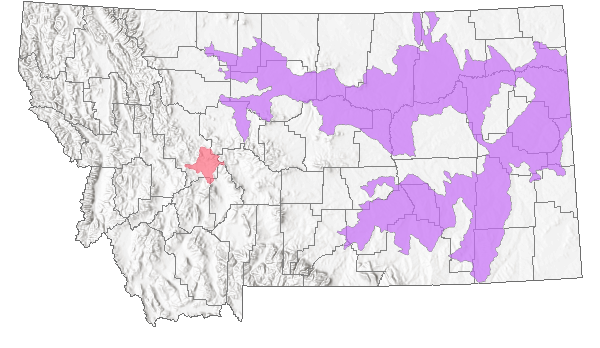
Montana Range
Range Descriptions
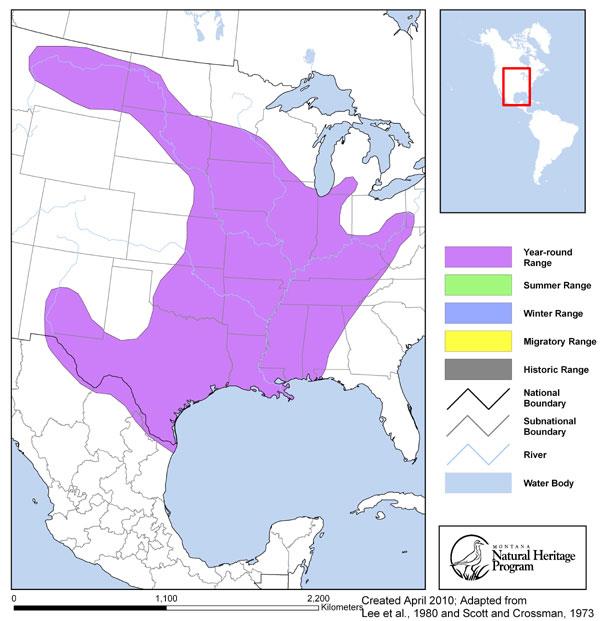
 Western Hemisphere Range
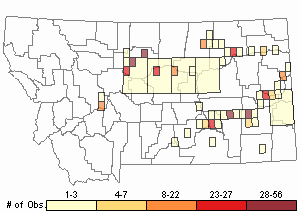
Observations in Montana Natural Heritage Program Database
Number of Observations: 583
(Click on the following maps and charts to see full sized version)
Map Help and Descriptions
Relative Density
Recency
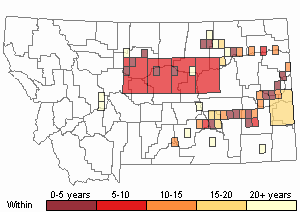
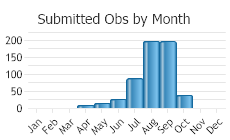
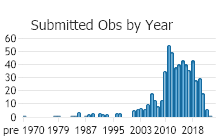
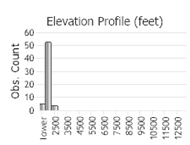 (Observations spanning multiple months or years are excluded from time charts)
Migration
Make long spawning movements from lower Missouri River to upstream areas. Dispersal downstream follows.
Habitat
Found in rivers and impoundments in both shallow and deep water over firm bottoms. Spawn in larger streams with backwater areas.
Food Habits
Mostly aquatic insects, crustaceans, and mollusks. Some plant material also.
Ecology
Downstream portions of Yellowstone River important as rearing areas. Ft. Peck Reservoir is important rearing area.
Reproductive Characteristics
Sexually mature at 3 yrs. Incubation: 10 days. Eggs laid over bottom or on vegetation. Spawns late May - July on middle Missouri River with peak in mid-June.
Management
The management of this and other native and non-native fish species and their habitats is outlined in Montana Fish, Wildlife and Parks'
2023-2026 Statewide Fisheries Management PlanStewardship Responsibility
References
- Literature Cited AboveLegend:
 View Online Publication
- Lee, D.S., C.R. Gilbert, C.H. Hocutt, R.E. Jenkins, D. E. McAllister, J. R. Stauffer, Jr. 1980. Atlas of North American freshwater fishes. North Carolina State Musuem of Natural History. 867 p.
- Scott, W.B. and E.J. Crossman. 1973. Rainbow trout, Kamloops trout, Steelhead trout Salmo gairdneri Richardson. pp. 184-191. In: Freshwater fishes of Canada. Ottawa, Canada: Fisheries Research Board of Canada, Bulletin 184. 966 p.
- Additional ReferencesLegend: View Online Publication
Do you know of a citation we're missing? Dieterman, D.J., M.P. Ruggles, M.L. Wildhaber, and D.L. Galat (eds). 1996. Population structure and habitat use of benthic fishes along the Missouri and Lower Yellowstone Rivers. 1996 Annual report of Missouri River Benthic Fish Study PD-95-5832 to U.S. Army Corps of Engineers and U.S. Bureau of Reclamation. 238 p.
- Duncan, M.B. 2019. Distributions, abundances, and movements of small, nongame fishes in a large Great Plains river network. Ph.D. Dissertation. Bozeman, MT: Montana State University. 255 p.
- Joslin, Gayle, and Heidi B. Youmans. 1999. Effects of recreation on Rocky Mountain wildlife: a review for Montana. [Montana]: Montana Chapter of the Wildlife Society.
- Montana Department of Fish, Wildlife and Parks. 1989. Northeast Montana Warmwater Ecosystem Investigations: project period 7/1/88 through 6/30/89. Proj.# F-46-R-2; Job# V-e. 21p.
- Montana Fish, Wildlife and Parks. 1989. Hauser Reservoir fisheries management plan: September 1989-September 1994. 16 p.
- Mullen, J.A. 2007. Spatiotemporal variation of fish assemblages in Montana prairie streams. M.Sc. Thesis. Bozeman, MT: Montana State University. 102 p.
- Mullins, M.S. 1991. Biology and predator use of cisco (Coregonus artedi) in Fort Peck Reservoir, Montana. M.Sc. Thesis. Bozeman, MT: Montana State University. 68 p.
- Stash, S.W. 2001. Distribution, relative abundance, and habitat associations of Milk River fishes related to irrigation diversion dams. M.Sc. Thesis. Bozeman, MT: Montana State University. 82 p.
- Stringer, A.L. 2018. Status of Northern Pearl Dace and chrosomid dace in prairie streams of Montana. M.Sc. Thesis. Bozeman, MT: Montana State University. 150 p.
- Trenka, R.J. 2000. Community structure and habitat associations of fishes of the lower Tongue and Powder Rivers. M.Sc. Thesis. Bozeman, MT: Montana State University. 85 p.
- USDI Bureau of Land Management. No date. Fishes of the Miles city, Montana BLM District. Miles City, MT: Miles City BLM District pamphlet. 12 p.
- Young, B.A., T.L. Welker, M.L. Wildhaber, C.R. Berry, and D. Scarnecchia (eds). 1997. Population structure and habitat use of benthic fishes along the Missouri and Lower Yellowstone Rivers. 1997 Annual report of Missouri River Benthic Fish Study PD-95-5832 to U.S. Army Corps of Engineers and U.S. Bureau of Reclamation. 207 p.
- Web Search Engines for Articles on "Smallmouth Buffalo"
- Additional Sources of Information Related to "Fish"