View in other NatureServe Network Field Guides
NatureServe
Montana
Utah
Wyoming
Idaho
Wisconsin
British Columbia
South Carolina
Yukon
California
New York
Northern Pearl Dace - Margariscus nachtriebi
State Rank Reason (see State Rank above)
Species has a relatively restricted distribution in the state and faces severe threats from the introduction of Northern Pike and warming water temperatures and drought
General Description
The Pearl Dace is a small, native minnow of both the eastern and northern drainages within the Glaciated Plains ecoregion of Montana, and is an indicator species of the complete Coolwater Northern Glaciated Plains Fish Assemblage. Pearl Dace are not abundant when they are collected at the relatively few sites in cool, small streams and ponds they are known to inhabit. This factor, as well as introduced Northern Pike invasions into their small prairie streams, has caused them to be designated as a Montana Species of Special Concern vulnerable to extinction in the state. Unlike most of the minnows, males establish and defend territories during the spawning season. Their diet includes a wide variety of plants and animals. Pearl Dace grow to a maximum length of about 6 inches.
For a comprehensive review of the ecology, conservation status, threats, and management of this and other Montana fish species of concern, please see
Montana Chapter of the American Fisheries Society Species of Concern Status Reviews.Diagnostic Characteristics
The Pearl Dace has a dark back, sides that are dusky-silver, and a white underside. Scattered dark lines give some individuals a speckled appearance. Young have a dusky midline band that fades on large specimens but may be distinct on the caudal peduncle. Breeding males are orange-red on the sides and below. A small, flap-like barbel is present in the groove of the upper lip just above each corner of the mouth, and is sometimes absent from one or both sides. Pearl Dace have a lateral line, usually complete.
Species Range
Montana Range
Range Descriptions
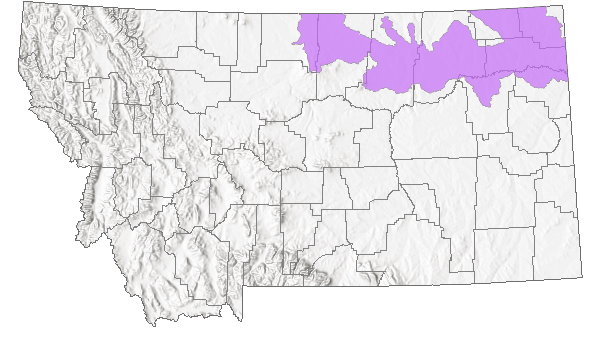
 Native
Range Comments
The range of pearl dace includes most of Canada, from Nova Scotia to eastern British Columbia, north to the southern Northwest Territories. In the United States, pearl dace occur from Maine south to Virginia, and across the northern tier states from New Hampshire to Montana, with relict populations in South Dakota, Nebraska, and Iowa (Menzel and Boyce 1973; Lee et al. 1980). The Pearl Dace is at the southern end of its range in northern Montana, but is considered abundant in other parts of its northeastern range.
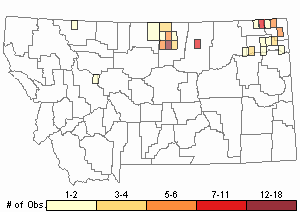
Observations in Montana Natural Heritage Program Database
Number of Observations: 91
(Click on the following maps and charts to see full sized version)
Map Help and Descriptions
Relative Density
Recency
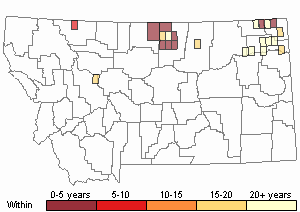
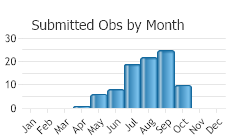
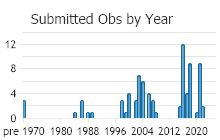
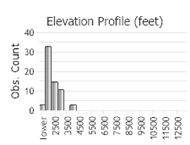 (Observations spanning multiple months or years are excluded from time charts)
Migration
Pearl Dace do not migrate extensively and they tend to be residents of a series of permanent pools.
Habitat
Pearl Dace prefer small cool streams, either clear or turbid (Brown 1971). They spawn in clear water at depths of 1 to 2 feet over a gravel or sand bottom (Brown 1971).
Food Habits
Pearl Dace eat a variety of aquatic organisms including insects, crustaceans, worms, and small fish (Brown 1971).
Ecology
Pearl Dace are often associated with the Northern Redbelly Dace, Brook Stickleback and Brassy Minnows in the Northern Glaciated Coolwater Fish Assemblege (Stagliano 2005). Young of the year may be associated with a aquatic vegetation for security cover, while adults generally are water column feeder. Water column feeders in these prairie stream pools are particularly vulnerable to introduced predators, since they did not evolve with them.
Reproductive Characteristics
The species is sexually mature in two years and spawns during spring near the bottom (Brown 1971).
Management
The management of this and other native and non-native fish species and their habitats is outlined in Montana Fish, Wildlife and Parks'
2023-2026 Statewide Fisheries Management PlanThe management of this species should involve routine monitoring (once every 2 to 3 years) of existing populations, since there are only 12 documented in the state. The monitoring program should be designed to detect population trends, range expansion or losses and collect additional information on life history and ecology. This could be conducted while sampling for other species. The lack of proper monitoring of these populations could lead to their demise by virtue of not recognizing if and when they are in jeopardy of becoming extirpated by any artificial or natural entity.
Stewardship Responsibility
Threats or Limiting Factors
Threats include: introduced species, especially Northern Pike, and loss of habitat from stock ponds, dams and diversions disrupting hydrologic regimes in the permanent pools of the prairie streams they inhabit.
References
- Literature Cited AboveLegend:
 View Online Publication
 Brown, C.J.D. 1971. Fishes of Montana. Bozeman, MT: Big Sky Books/Montana State University. 207 p.
- Lee, D.S., C.R. Gilbert, C.H. Hocutt, R.E. Jenkins, D. E. McAllister, J. R. Stauffer, Jr. 1980. Atlas of North American freshwater fishes. North Carolina State Musuem of Natural History. 867 p.
- Scott, W.B. and E.J. Crossman. 1973. Rainbow trout, Kamloops trout, Steelhead trout Salmo gairdneri Richardson. pp. 184-191. In: Freshwater fishes of Canada. Ottawa, Canada: Fisheries Research Board of Canada, Bulletin 184. 966 p.
- Stagliano, D.M. 2005. Aquatic community classification and ecosystem diversity in Montana's Missouri River watershed. Prepared for Bureau of Land Management. Montana Natural Heritage Program, Helena, MT. 65 pp. plus appendices.
- Additional ReferencesLegend: View Online Publication
Do you know of a citation we're missing?- Joslin, Gayle, and Heidi B. Youmans. 1999. Effects of recreation on Rocky Mountain wildlife: a review for Montana. [Montana]: Montana Chapter of the Wildlife Society.
- Schultz, L.P. 1941. Fishes of Glacier National Park, Montana. USDI Conservation Bulletin No. 22. Washington D.C.: US Government Printing Office. 42 p.
- Stash, S.W. 2001. Distribution, relative abundance, and habitat associations of Milk River fishes related to irrigation diversion dams. M.Sc. Thesis. Bozeman, MT: Montana State University. 82 p.
- Stringer, A.L. 2018. Status of Northern Pearl Dace and chrosomid dace in prairie streams of Montana. M.Sc. Thesis. Bozeman, MT: Montana State University. 150 p.
- Wuellner, M.R. 2007. Influence of reach and watershed characteristics on fish distributions in small streams of eastern Montana. M.Sc. Thesis. Bozeman, MT: Montana State University. 80 p.
- Web Search Engines for Articles on "Northern Pearl Dace"
- Additional Sources of Information Related to "Fish"