View in other NatureServe Network Field Guides
NatureServe
Montana
Utah
Wyoming
Idaho
Wisconsin
British Columbia
South Carolina
Yukon
California
New York
Sand Shiner - Miniellus stramineus
Other Names:
Notropis stramineus
Native Species
Global Rank:
G5
State Rank:
S5
(see State Rank Reason below)
Agency Status
USFWS:
USFS:
BLM:
FWP SWAP:
SGIN
State Rank Reason (see State Rank above)
Species is common and secure and faces few substantial threats
General Description
The smallest of the shiners in Montana is the sand shiner. This species is native to the plains area of eastern Montana, where it lives in schools, primarily in clear streams with sandy bottoms. It attains a length of about 3 inches and so is too small to be used much as a bait minnow. The sand shiner is one of our least known minnow species.
Diagnostic Characteristics
Back light olive, sides silvery (sometimes with bluish purple sheen), underside white. A thin black stripe along midline of back expands into a wedge at front of dorsal fin. Black dashes on lateral line scale may be faint on fish from turbid water. Eye large. Body somewhat flat sided but not deep.
Species Range
Montana Range
Range Descriptions
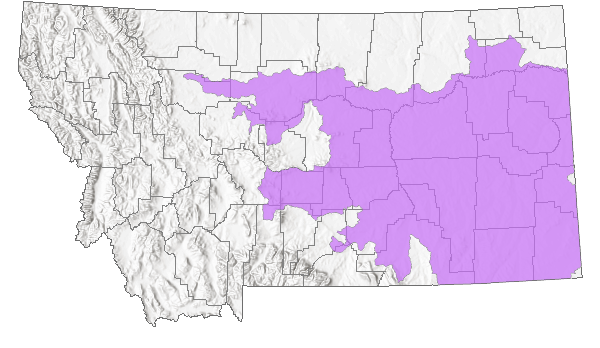
 Native
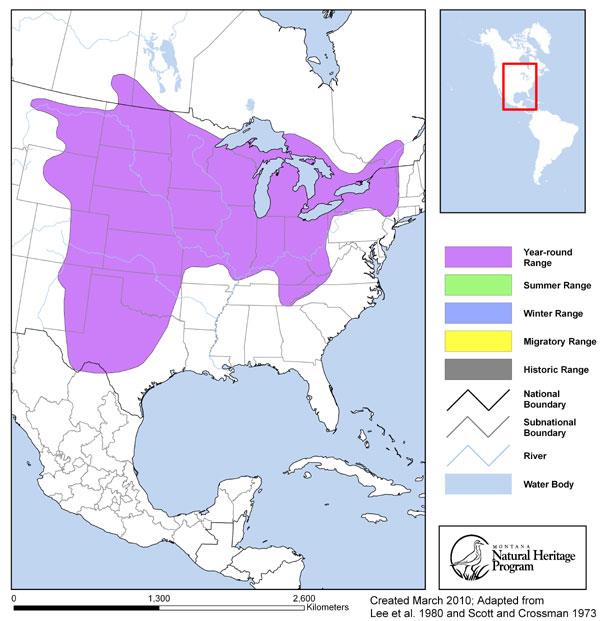
Western Hemisphere Range
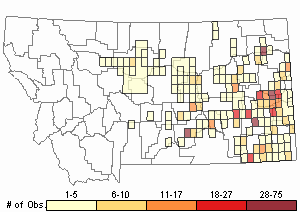
Observations in Montana Natural Heritage Program Database
Number of Observations: 858
(Click on the following maps and charts to see full sized version)
Map Help and Descriptions
Relative Density
Recency
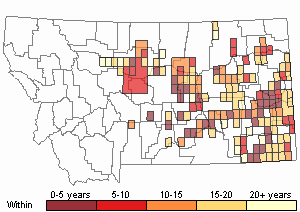
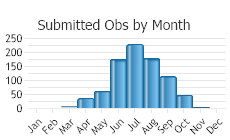
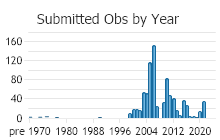
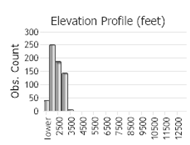 (Observations spanning multiple months or years are excluded from time charts)
Habitat
Streams both large and small, with clear water, rapid current, and sand or gravel bottom; also sandy shallows of lakes. Southeast Montana study showed widest distributions at mouth sections of study streams.
Food Habits
Food consists largely of small aquatic insects and crustaceans and finely divided detritus.
Ecology
Among the smallest Montana fishes.
Reproductive Characteristics
Sexually mature at 1 yr. Spawns May - Aug. with late July - Aug. peak.
Management
The management of this and other native and non-native fish species and their habitats is outlined in Montana Fish, Wildlife and Parks'
2023-2026 Statewide Fisheries Management PlanStewardship Responsibility
References
- Literature Cited AboveLegend:
 View Online Publication
- Lee, D.S., C.R. Gilbert, C.H. Hocutt, R.E. Jenkins, D. E. McAllister, J. R. Stauffer, Jr. 1980. Atlas of North American freshwater fishes. North Carolina State Musuem of Natural History. 867 p.
- Scott, W.B. and E.J. Crossman. 1973. Rainbow trout, Kamloops trout, Steelhead trout Salmo gairdneri Richardson. pp. 184-191. In: Freshwater fishes of Canada. Ottawa, Canada: Fisheries Research Board of Canada, Bulletin 184. 966 p.
- Additional ReferencesLegend: View Online Publication
Do you know of a citation we're missing? Barfoot, C.A. 1993. Longitudinal distribution of fishes and habitat in Little Beaver Creek, Montana. M.Sc. Thesis. Bozeman, MT: Montana State University. 66 p.
- Barfoot, C.A. and R.G. White. 1999. Fish assemblages and habitat relationships in a small northern Great Plains stream. The Prairie Naturalist 31(2):87-107.
- Duncan, M.B. 2019. Distributions, abundances, and movements of small, nongame fishes in a large Great Plains river network. Ph.D. Dissertation. Bozeman, MT: Montana State University. 255 p.
- Hendricks, P., S. Lenard, D.M. Stagliano, and B.A. Maxell. 2013. Baseline nongame wildlife surveys on the Fort Peck Indian Reservation. Report to the Assiniboine and Sioux Tribes of the Fort Peck Indian Reservation. Montana Natural Heritage Program, Helena, MT. 83 p.
- Joslin, Gayle, and Heidi B. Youmans. 1999. Effects of recreation on Rocky Mountain wildlife: a review for Montana. [Montana]: Montana Chapter of the Wildlife Society.
- Mullen, J.A. 2007. Spatiotemporal variation of fish assemblages in Montana prairie streams. M.Sc. Thesis. Bozeman, MT: Montana State University. 102 p.
- Mullins, M.S. 1991. Biology and predator use of cisco (Coregonus artedi) in Fort Peck Reservoir, Montana. M.Sc. Thesis. Bozeman, MT: Montana State University. 68 p.
- Rosenthal, L.R. 2007. Evaluation of distribution and fish passage in relation to road culverts in two eastern Montana prairie streams. M.Sc. Thesis. Bozeman, MT: Montana State University. 78 p.
- Stringer, A.L. 2018. Status of Northern Pearl Dace and chrosomid dace in prairie streams of Montana. M.Sc. Thesis. Bozeman, MT: Montana State University. 150 p.
- Wuellner, M.R. 2007. Influence of reach and watershed characteristics on fish distributions in small streams of eastern Montana. M.Sc. Thesis. Bozeman, MT: Montana State University. 80 p.
- Web Search Engines for Articles on "Sand Shiner"
- Additional Sources of Information Related to "Fish"