View in other NatureServe Network Field Guides
NatureServe
Montana
Utah
Wyoming
Idaho
Wisconsin
British Columbia
South Carolina
Yukon
California
New York
Spottail Shiner - Hudsonius hudsonius
Other Names:
Notropis hudsonius
General Description
The spottail shiner is a relatively new member to Montana's fish fauna. It was introduced into Ft. Peck from the Midwest in 1982 to serve as forage for sauger, walleye and northern pike because it is a shoreline inhabitant and thus lives in the same habitat as those predators. As the name suggests, they have a prominent black spot at the base of the tail. Spottails have become well established and have increased their range within the reservoir. Maximum length is about 5 inches.
Diagnostic Characteristics
Overall silvery with pale green to olive back. Lower edge of tail fin may be whitish. Eye large, body flat sided.
Species Range
Montana Range
Range Descriptions
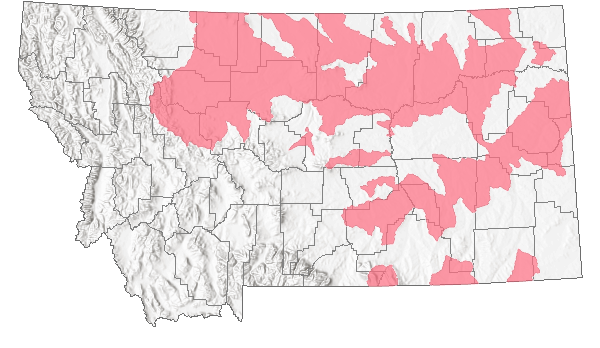
 Non-native
Western Hemisphere Range
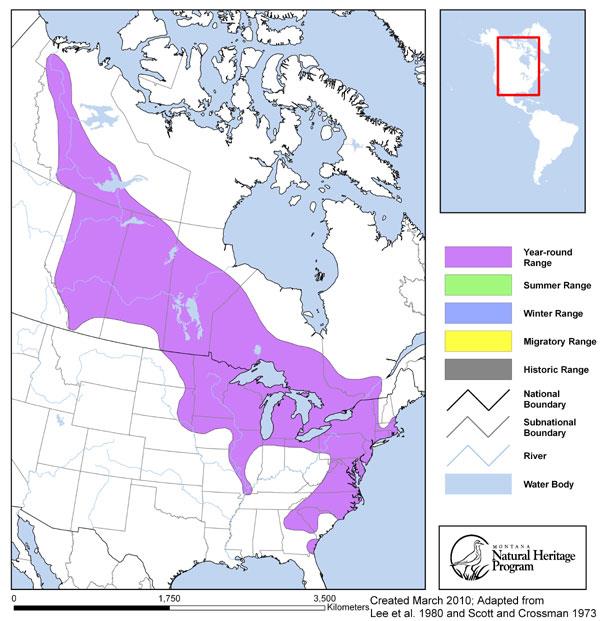
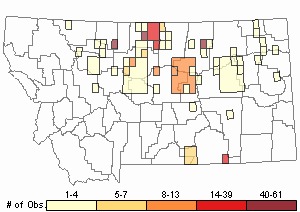
Observations in Montana Natural Heritage Program Database
Number of Observations: 428
(Click on the following maps and charts to see full sized version)
Map Help and Descriptions
Relative Density
Recency
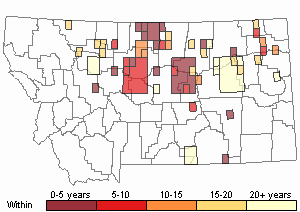
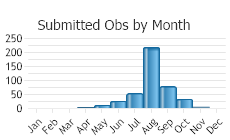
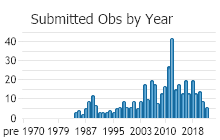
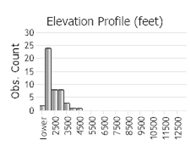 (Observations spanning multiple months or years are excluded from time charts)
Habitat
Large lakes an rivers. Usually spawn over sandy shoals of lakes and, to a lesser degree, in lower reaches of tributary streams. A shoreline species. Avoids strong currents.
Food Habits
Plankton, aquatic insect larvae, algae, and eggs and larvae of their own kind may, at times, be significant food items.
Ecology
Brought into Montana as a prey species for walleye, sauger, pike, etc.
Reproductive Characteristics
Canadian populations spawn in June or July. 2 yr. old females produced 1,300-2,600 eggs. Broadcasts spawn around shorelines.
Management
Stewardship Responsibility
References
- Literature Cited AboveLegend:
 View Online Publication
- Lee, D.S., C.R. Gilbert, C.H. Hocutt, R.E. Jenkins, D. E. McAllister, J. R. Stauffer, Jr. 1980. Atlas of North American freshwater fishes. North Carolina State Musuem of Natural History. 867 p.
- Scott, W.B. and E.J. Crossman. 1973. Rainbow trout, Kamloops trout, Steelhead trout Salmo gairdneri Richardson. pp. 184-191. In: Freshwater fishes of Canada. Ottawa, Canada: Fisheries Research Board of Canada, Bulletin 184. 966 p.
- Additional ReferencesLegend: View Online Publication
Do you know of a citation we're missing? Barndt, S.A. 1996. The Biology and Status of the Arctic Grayling in Sunnyslope Canal, Montana. M.Sc. Thesis. Bozeman, MT: Montana State University. 136 p.
- Duncan, M.B. 2019. Distributions, abundances, and movements of small, nongame fishes in a large Great Plains river network. Ph.D. Dissertation. Bozeman, MT: Montana State University. 255 p.
- Hendricks, P., S. Lenard, D.M. Stagliano, and B.A. Maxell. 2013. Baseline nongame wildlife surveys on the Fort Peck Indian Reservation. Report to the Assiniboine and Sioux Tribes of the Fort Peck Indian Reservation. Montana Natural Heritage Program, Helena, MT. 83 p.
- Joslin, Gayle, and Heidi B. Youmans. 1999. Effects of recreation on Rocky Mountain wildlife: a review for Montana. [Montana]: Montana Chapter of the Wildlife Society.
- Mullins, M.S. 1991. Biology and predator use of cisco (Coregonus artedi) in Fort Peck Reservoir, Montana. M.Sc. Thesis. Bozeman, MT: Montana State University. 68 p.
- Scott, W.B. and E.J. Crossman. 1973. Spottail Shiner Notropis hudsonius (Clinton). pp. 459-463. In: Freshwater Fishes of Canada. Ottawa, Canada: Fisheries Research Board of Canada, Bulletin 184. 966 p.
- Stash, S.W. 2001. Distribution, relative abundance, and habitat associations of Milk River fishes related to irrigation diversion dams. M.Sc. Thesis. Bozeman, MT: Montana State University. 82 p.
- Stringer, A.L. 2018. Status of Northern Pearl Dace and chrosomid dace in prairie streams of Montana. M.Sc. Thesis. Bozeman, MT: Montana State University. 150 p.
- Wuellner, M.R. 2007. Influence of reach and watershed characteristics on fish distributions in small streams of eastern Montana. M.Sc. Thesis. Bozeman, MT: Montana State University. 80 p.
- Young, B.A., T.L. Welker, M.L. Wildhaber, C.R. Berry, and D. Scarnecchia (eds). 1997. Population structure and habitat use of benthic fishes along the Missouri and Lower Yellowstone Rivers. 1997 Annual report of Missouri River Benthic Fish Study PD-95-5832 to U.S. Army Corps of Engineers and U.S. Bureau of Reclamation. 207 p.
- Web Search Engines for Articles on "Spottail Shiner"
- Additional Sources of Information Related to "Fish"