View in other NatureServe Network Field Guides
NatureServe
Montana
Utah
Wyoming
Idaho
Wisconsin
British Columbia
South Carolina
Yukon
California
New York
Brassy Minnow - Hybognathus hankinsoni
Native Species
Global Rank:
G5
State Rank:
S5
(see State Rank Reason below)
Agency Status
USFWS:
USFS:
BLM:
FWP SWAP:
SGIN
State Rank Reason (see State Rank above)
Species is widespread, faces low-level threats and populations are stable
General Description
As its name implies, live specimens of the brassy minnow have a greenish-brassy color. This native species lives in warm-cool water prairie streams east of the Continental Divide in Montana. It is more frequently collected in smaller and clearer perennial streams than the western silvery or plains minnow. Close associates found with this species include the brook stickleback, lake chub and northern redbelly dace. Its herbivorous food habits are probably similar to western silvery and plains minnows. Brassy minnows are somewhat smaller than its sister species, only reaching a length of about 4 inches.
Diagnostic Characteristics
The back of the brassy minnow is olive-green to brown, the sides are yellowish or dull silver becoming brassy in adults, and the underside is white. A dusky midside stripe is usually present.
Species Range
Montana Range
Range Descriptions
 Native
Western Hemisphere Range
Range Comments
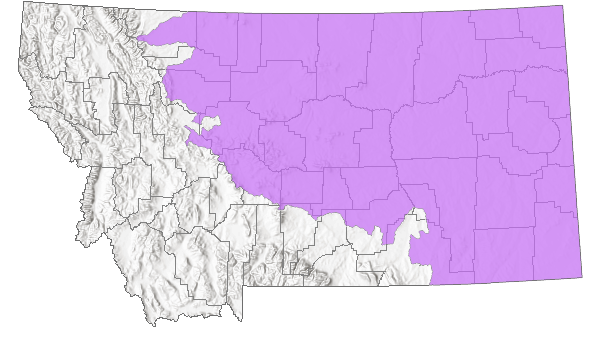
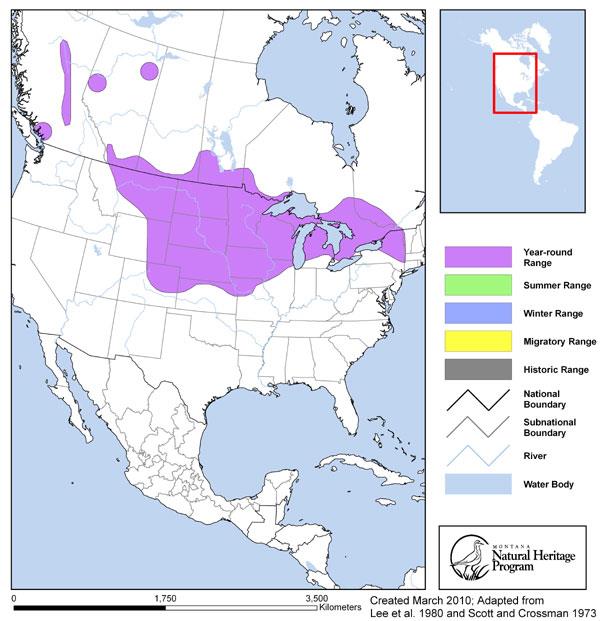
Native range includes the Missouri, Platte and Mississippi River drainages, from Canada, Montana and North Dakota south to Colorado, Kansas and northern Missouri; Mississippi River from mouth of Missouri River upstream to Illinois and Michigan. In Montana, this species is found east of the continental divide in streams of the Northern Prairies and Northwestern Great Plains Ecoregions.
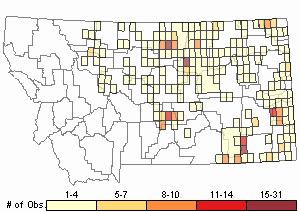
Observations in Montana Natural Heritage Program Database
Number of Observations: 570
(Click on the following maps and charts to see full sized version)
Map Help and Descriptions
Relative Density
Recency
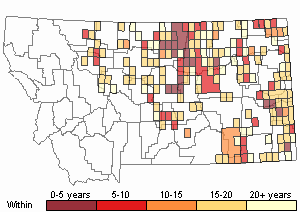
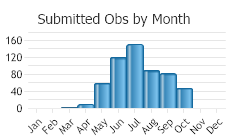
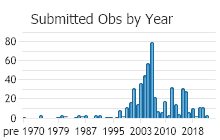
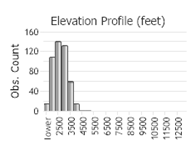 (Observations spanning multiple months or years are excluded from time charts)
Habitat
The brassy minnow favors the upper reaches of creeks characterized by no current, silt or mud bottoms, and aquatic vegetation in southeast Montana. They prefer clear, slow streams but have been collected in larger rivers with higher turbidity, and occasionally in lakes.
Food Habits
Brassy minnows are herbivorous. They feed mainly on diatoms and other algae, which it scrapes from the bottom or off aquatic vegetation.
Ecology
These fish tend to be abundant in habitats with few predators, as they seem to be very vulnerable to fish predation.
Reproductive Characteristics
Brassy minnows probably spawn in the second or third year during May through July.
Management
The management of this and other native and non-native fish species and their habitats is outlined in Montana Fish, Wildlife and Parks'
2023-2026 Statewide Fisheries Management PlanStewardship Responsibility
Threats or Limiting Factors
Threats to this minnow species is largely from introduced predatory fishes, such as northern pike and walleye
References
- Literature Cited AboveLegend:
 View Online Publication
- Lee, D.S., C.R. Gilbert, C.H. Hocutt, R.E. Jenkins, D. E. McAllister, J. R. Stauffer, Jr. 1980. Atlas of North American freshwater fishes. North Carolina State Musuem of Natural History. 867 p.
- Scott, W.B. and E.J. Crossman. 1973. Rainbow trout, Kamloops trout, Steelhead trout Salmo gairdneri Richardson. pp. 184-191. In: Freshwater fishes of Canada. Ottawa, Canada: Fisheries Research Board of Canada, Bulletin 184. 966 p.
- Additional ReferencesLegend: View Online Publication
Do you know of a citation we're missing? Barfoot, C.A. 1993. Longitudinal distribution of fishes and habitat in Little Beaver Creek, Montana. M.Sc. Thesis. Bozeman, MT: Montana State University. 66 p.
- Barfoot, C.A. and R.G. White. 1999. Fish assemblages and habitat relationships in a small northern Great Plains stream. The Prairie Naturalist 31(2):87-107.
- Duncan, M.B. 2019. Distributions, abundances, and movements of small, nongame fishes in a large Great Plains river network. Ph.D. Dissertation. Bozeman, MT: Montana State University. 255 p.
- Hendricks, P., S. Lenard, D.M. Stagliano, and B.A. Maxell. 2013. Baseline nongame wildlife surveys on the Fort Peck Indian Reservation. Report to the Assiniboine and Sioux Tribes of the Fort Peck Indian Reservation. Montana Natural Heritage Program, Helena, MT. 83 p.
- Joslin, Gayle, and Heidi B. Youmans. 1999. Effects of recreation on Rocky Mountain wildlife: a review for Montana. [Montana]: Montana Chapter of the Wildlife Society.
- Mullen, J.A. 2007. Spatiotemporal variation of fish assemblages in Montana prairie streams. M.Sc. Thesis. Bozeman, MT: Montana State University. 102 p.
- Mullins, M.S. 1991. Biology and predator use of cisco (Coregonus artedi) in Fort Peck Reservoir, Montana. M.Sc. Thesis. Bozeman, MT: Montana State University. 68 p.
- Rosenthal, L.R. 2007. Evaluation of distribution and fish passage in relation to road culverts in two eastern Montana prairie streams. M.Sc. Thesis. Bozeman, MT: Montana State University. 78 p.
- Stash, S.W. 2001. Distribution, relative abundance, and habitat associations of Milk River fishes related to irrigation diversion dams. M.Sc. Thesis. Bozeman, MT: Montana State University. 82 p.
- Stringer, A.L. 2018. Status of Northern Pearl Dace and chrosomid dace in prairie streams of Montana. M.Sc. Thesis. Bozeman, MT: Montana State University. 150 p.
- Wuellner, M.R. 2007. Influence of reach and watershed characteristics on fish distributions in small streams of eastern Montana. M.Sc. Thesis. Bozeman, MT: Montana State University. 80 p.
- Web Search Engines for Articles on "Brassy Minnow"
- Additional Sources of Information Related to "Fish"