View in other NatureServe Network Field Guides
NatureServe
Montana
Utah
Wyoming
Idaho
Wisconsin
British Columbia
South Carolina
Yukon
California
New York
Arctic Grayling - Thymallus arcticus
State Rank Reason (see State Rank above)
Species is declining and faces numerous threats likely to impact persistence and habitat suitability
General Description
The Arctic Grayling is a species native to northern North America. The only populations native to the lower 48 states were in Michigan and Montana, and the Michigan population is now extinct. Consequently, the fluvial or river-dwelling population in the upper Big Hole River are the last remnants of this native Fish of Special Concern. Originally, the fluvial Arctic Grayling was widespread throughout the upper Missouri river drainage as far downstream as Great Falls. Lewis and Clark made note of these "new kind of white or silvery trout" in 1805. The lake-dwelling form is fairly common in 30 or more lakes across the western half of the state. These lake fish are genetically, but not visibly, different from our native fluvial Arctic Grayling. Grayling are gullible to the angler's lures and also seem to be easily out-competed by other salmonid species. This probably explains much of their demise from their native range. They are spring spawners and broadcast their eggs over a gravel bottom in moving streams. Grayling can overpopulate, producing severely stunted populations in some mountain lakes. Grayling are truly a unique Montana species. The iridescent hues of a spawning grayling's dorsal fin are brilliant. Exceptional individuals can weigh up to 3 pounds and reach 20 inches in length. They are generalists, eating a variety of aquatic invertebrates (Montana Fish, Wildlife, and Parks).
For a comprehensive review of the ecology, conservation status, threats, and management of this and other Montana fish species of concern, please see
Montana Chapter of the American Fisheries Society Species of Concern Status Reviews.Diagnostic Characteristics
The Montana Arctic grayling has a large, sail-like dorsal (back) fin and colorful body markings. The grayling comes in a wide array of colors. Their dorsal fins are typically fringed in red and dotted with large iridescent red, aqua, or purple spots and markings. These colorful markings are most dramatic on large grayling.
Species Range
Montana Range
Range Descriptions
Western Hemisphere Range
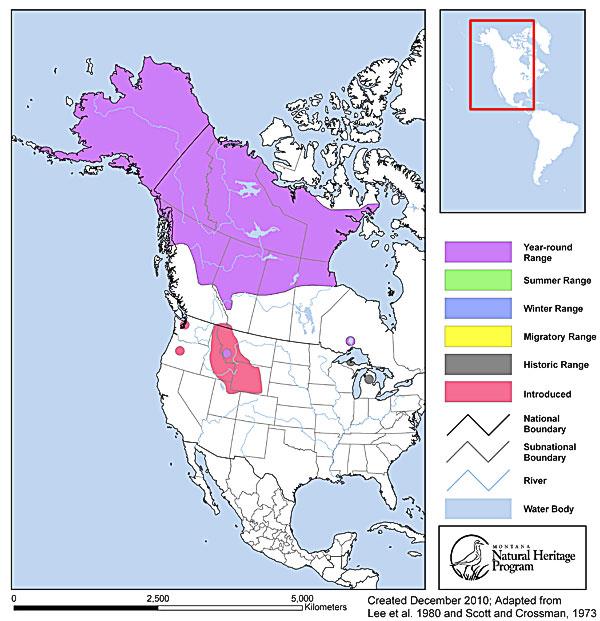
Range Comments
Arctic grayling are native to northern North America. In the contiguous 48 states, native glacial-relic, populations of grayling were once found in both Montana and Michigan. The Michigan populations went extinct due to habitat degradation and over fishing. In Montana, both life forms of Arctic grayling exist, lake dwelling (lacustrine or adfluvial) and river dwelling (fluvial). Currently, adfluvial Arctic grayling are common in lakes across the western half of Montana. Historically, fluvial Arctic graying were widespread throughout the Missouri River drainage upstream of Great Falls. They now are reduced to a single, native population in the Big Hole River, in southwest Montana.
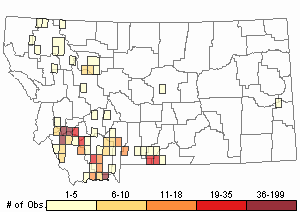
Observations in Montana Natural Heritage Program Database
Number of Observations: 790
(Click on the following maps and charts to see full sized version)
Relative Density
Recency
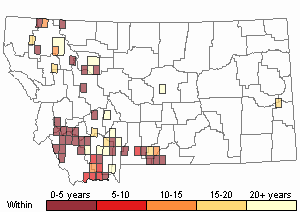

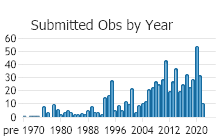
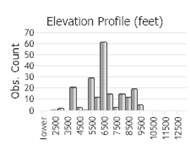 (Observations spanning multiple months or years are excluded from time charts)
Migration
Very migratory during spawning and early life stages; up to 60 mile seasonal movements between habitats in Big Hole. Utilizes various habitats in multiple places over their life history.
Habitat
Today in Montana Arctic Grayling are found primarily small, cold, clear lakes with tributaries suitable for spawning. They do not coexist well with other fishes except cutthroat trout and others with which they evolved.
Food Habits
Arctic grayling feed mainly on aquatic insects, but eat what is available to them. River populations are mostly insectivores, while zooplankton are important food sources in lake populations.
Ecology
Although fluvial Arctic Grayling inhabit the entire Big Hole River, highest densities occur in the vicinity of Wisdom. The majority of spawning occurs near Wisdom in the main stem and several tributaries (Liknes and Gould 1987, Shepard and Oswald 1989, Byorth 1994). Fluvial Arctic Grayling are reared in the vicinity of where they hatch; thus, the Wisdom area provides the majority of rearing habitat as well (
Montana AFS Species Status Account).
Arctic Grayling rarely live beyond 5 years in the Big Hole River. Fast growth rates and short life spans result in domination of spawning by fish aged 3 and 4 years. Thus, poor recruitment in a given year may substantially affect recruitment to the population for several years (
Montana AFS Species Status Account).
Reproductive Characteristics
Arctic Grayling grow quickly in the Big Hole River, reaching full sexual maturity and nearly maximal size by age 3 (
Montana AFS Species Status Account).
Management
The management of this and other native and non-native fish species and their habitats is outlined in Montana Fish, Wildlife and Parks'
2023-2026 Statewide Fisheries Management PlanOn 20 August 2014, the U.S. Fish and Wildlife Service published a notice in the Federal Register indicating that, "after review of the best available scientific and commercial information, we find that listing the Upper Missouri River DPS of Arctic Grayling is not warranted at this time. The best available scientific and
commercial information indicates that habitat-related threats previously identified, including habitat fragmentation, dewatering, thermal stress, entrainment, riparian habitat loss, and effects from climate change, for the Upper Missouri River DPS of Arctic Grayling have been sufficiently ameliorated and that 19 of 20 populations of Arctic Grayling are either stable or increasing. This action removes the Upper Missouri River DPS of the Arctic Grayling from our candidate list". Additional information on the species' management can be found on the U.S. Fish and Wildlife Service's
Species AccountStewardship Responsibility
Threats or Limiting Factors
Factors potentially threatening persistence of fluvial Arctic grayling in the Big Hole River include water quality and quantity, competition with introduced species, predation, habitat degradation, and negative effects of angling. Water quantity issues include drought, irrigation withdrawals, and recruitment limitation due to sudden runoff events.
References
- Literature Cited AboveLegend:
 View Online Publication
 Byorth, P. A. 1994. Big Hole River Arctic grayling recovery project: annual monitoring report 1993. Submitted to: Fluvial Arctic Grayling Workgroup. Montana Department of Fish, Wildlife, and Parks, Bozeman.
- Lee, D.S., C.R. Gilbert, C.H. Hocutt, R.E. Jenkins, D. E. McAllister, J. R. Stauffer, Jr. 1980. Atlas of North American freshwater fishes. North Carolina State Musuem of Natural History. 867 p.
- Scott, W.B. and E.J. Crossman. 1973. Rainbow trout, Kamloops trout, Steelhead trout Salmo gairdneri Richardson. pp. 184-191. In: Freshwater fishes of Canada. Ottawa, Canada: Fisheries Research Board of Canada, Bulletin 184. 966 p.
- Additional ReferencesLegend: View Online Publication
Do you know of a citation we're missing?- Armstrong, R.H., H. Hop, and J.H. Triplehorn. 1986. A review of Arctic grayling studies in Alaska, 1952-1982, with an indexed bibliography of the holarctic genus Thymallus (grayling) to 1985. Biol. Papers of the University of Alaska, No.23. 110 p.
- Barndt, S.A. 1996. The Biology and Status of the Arctic Grayling in Sunnyslope Canal, Montana. M.Sc. Thesis. Bozeman, MT: Montana State University. 136 p.
- Behnke, R.J. 1992. About trout, grayling. Trout, Summer 1992:65-68.
- Bishop, F. G. 1971. Observations on spawning habits and fecundity of the Arctic grayling. Progressive Fish-Cuiturist 33:12-19.
- Brown, C.J.D. 1938. Observations on the life-history and breeding habits of the Montana grayling. Copeia 3:132-136.
- Brown, C.J.D. 1938. The feeding habits of the Montana grayling (Thymallus montanus). Journal of Wildlife Management 2(3):135-145.
- Brown, C.J.D. 1943. Age and growth of Montana grayling. Journal of Wildlife Management 7(4):353-364.
- Craig, P. C, and V. A. Poulin. 1975. Movements and growth of Arctic grayling ( Thymailus arcticus ) and juvenile Arctic char ( Salvelinus alpinus ) in a small arctic stream, Alaska. Journal of the Fisheries Research Board of Canada 32:689-698.
- Craig, V.E. 1952. A story of fish production as it applies to Montana. M.Sc. Thesis. Bozeman, MT: Montana State University. 92 p.
- Curtis, M. 1977. The age, growth and management of the Arctic grayling ( Thymailus arcticus ) in Wyoming. M.S. Thesis, University of Wyoming, Laramie, Wyoming.
- Cutting, K.A., J.M. Ferguson, M.L. Anderson, K. Cook, S.C. Davis, and R. Levine. 2018. Linking beaver dam affected flow dynamics to upstream passage of Arctic Grayling. Ecology and Evolution 2018; 8:12905-12917.
- Davis, M.N. 2016. Winter survival and habitat as limiting factors for Arctic Grayling at Red Rock Lakes National Wildlife Refuge. M.Sc. Thesis. Bozeman, MT: Montana State University. 115 p.
- deBruyn, M., ana P. McCart. 1974. Life iiistory of the grayling ( Thymallus arcticus) in Beaufort Sea drainages in the Yukon Territory. Pages 92-130 in Arctic Gas Biological Report Series, Volume 20, Aquatic Environments Limited, Calgary, Alberta.
- Deleray, M.A. 1991. Movement and utilization of fluvial habitat by age-0 Arctic grayling, and characteristics of spawning adults, in the outlet of Deer Lake, Gallatin County, Montana. M.Sc. Thesis. Bozeman, MT: Montana State University. 75 p.
- Dwyer, W.P. and R.G. White. 1995. Influence of electroshock on short-term growth of adult rainbow trout and juvenile Arctic grayling and cutthroat trout. North American Journal of Fisheries Management 15:148-151.
- Eriksen, C. H. 1975. Physiological ecology and management of the r&rs "southern" grayling Thymallus arcticus tricolor Cope. Verh. Internat. Verein . Limnol . 19:2448-2455.
- Evans, B. I. And W. J. O'Brien. 1988. A reevaluation of the search cycle of planktivorous arctic grayling, Thymallus arcticus. Canadian Journal of Fisheries and Aquatic Sciences 45:187-192.
- Everett, Rebecca J, 1986. The population genetics of Arctic Grayling (thymallus arcticus) of Montana. M.S.Thesis. University of Montana. Missoula, MT.
- Feldmeth, C.R. and C.H. Eriksen. 1978. A hypothesis to explain the distribution of native trout in a drainage of Montana's Big Hole River. Verh. Internat. Verein. Limnol. 20:2040-2044.
- Gangloff, M.M. 1996. Winter habitat and distribution of Artic Grayling in Upper Red Rock Lake, Red Rock Lakes National Wildlife Refuge, Montana. M.Sc. Thesis. Bozeman, MT: Montana State University. 101p.
- Gilpin, M. 1996. A population viability analysis (PVA) of the Arctic grayling in southwestern Montana. Unpubl. report to MT Dept. Fish Wildl. Parks. 16 p.
- Gustafson, D. L. 1990. Ecology of aquatic insects in the Gallatin River drainage. Ph.D. Dissertation. Bozeman, MT: Montana State University. 194 p.
- Henshall, J. A. 1907. Culture of the Montana grayling. U.S. Bureau of Fisheries, Document 628, Washington, D.C.
- Holton, G.D. 1971. Montana grayling: the lady of the streams. Montana Outdoors 2(5):18-23.
- Holton, G.D. 1981. Identification of Montana's most common game and sport fishes. Montana Outdoors May/June reprint. 8 p.
- Hop, H. 1985. Winter telemetry study of Arctic grayling Thymallus arcticus (Pallas) in the Arctic National Wildlife Refuge, Alaska. Proceedings of the Western Assoc. of Fish and Wildlife Agencies, July 15-18. Snowmass, Co. pp. 224-231.
- Jeanes, E.D. 1996. Behavioral responses to water current of age-0 Arctic Grayling from the Madison River, and their use of stream habitat. M.Sc. Thesis. Bozeman, MT: Montana State University. 60p.
- Joslin, Gayle, and Heidi B. Youmans. 1999. Effects of recreation on Rocky Mountain wildlife: a review for Montana. [Montana]: Montana Chapter of the Wildlife Society.
- Katzman, L.A. 1998. Effects of predation on status of Arctic grayling at Red Rock Lakes National Wildlife Refuge, Montana. M.Sc. Thesis. Bozeman, MT: Montana State University. 207 p.
- Kaya, C. 2000. Arctic grayling in Yellowstone: status, management, and recent restoration efforts. Yellowstone Science 8(3):12-17.
- Kaya, C.M. 1986. The remnant, declining, stream-dwelling Montana grayling-are they a distinct behavioral form whose preservation is essential to the continued existence of stream fisheries for this native fish? Bozeman, MT: Montana State University. 15 p.
- Kaya, C.M. 1990. Status report on fluvial arctic grayling (Thymallus arcticus) in Montana. Helena, MT: Montana Fish, Wildlife and Parks. 97 p.
- Kaya, C.M. 1992. Restoration of fluvial arctic grayling to Montana streams: assessment of reintroduction potential of streams in the native range, the Upper Missouri River Drainage above Great Falls. Bozeman, MT: Montana State University, Biology Dept. Report prepared for Montana Chapter of the American Fisheries Society. 102 p.
- Kaya, CM. 1989. Innate differences in behavioral responses to water current of Arctic grayling from fluvial and lacustrine populations in Montana. 119th Annual Meeting of the American Fisheries Society, Anchorage (abstract)
- Kratt, L. F., and R. J, F. Bmith. 1977. A post-hiatching subgravel stage in the life history of the Arctic grayling, Thymallus arcticus . Transactions of the American Fisheries Society 106:241-243.
- Krueger, R.C. 2002. Correlations amoung environmental features, Myxobolus cerebralis infection prevalence in oliogochaetes, and salmonid infection risk in the Madison River, Montana. M.Sc. Thesis. Bozeman, MT: Montana State University. 73 p.
- Krueger, S. W. 1981. Freshwater habitat relationships, Arctic grayling, Thymallus arcticus . Unpublished Report, Alaska Department of Fisn and Game, Habitat Division, Juneau, Alaska
- Kruse, T. E. 1959. Grayling of Grebe Lake, Yellowstone National Park, Wyoming. Fishery Bulletin 149, Volume 59, U.S. Fish and Wildlife Service, Washington, D.C.
- Lance, M.J. 2019. Spatial and temporal variability in movements and vital rates of sympatric salmonids in an unfragmented, inland watershed. M.Sc. Thesis. Bozeman, MT: Montana State University. 116 p.
- LaPerriere, J.D. and R.F. Carlson. 1973. Thermal tolerances of interior Alaskan arctic grayling, Thymallus arcticus . Inst. Water Resour. Rep. IWR-4 6. Univ. Alaska, Fairbanks.
- Leary, R.F. 1992. Establishment, maintenance, and use of a genetic reserve of Big Hole River Arctic grayling. Missoula, MT: University of Montana, wild Trout and Salmon Genetics Laboratory Report 91/5. 11 p.
- Liermann, B.W. 2001. An evaluation of the reintroduction of fluvial Arctic Grayling into the upper Ruby River. M.Sc. Thesis. Bozeman, MT: Montana State University. 91 p.
- Liknes, G.A. 1981. The fluvial arctic grayling (Thymallus arcticus) of the upper Big Hole drainage, Montana. M.Sc. Thesis. Bozeman, MT: Montana State University, 59 p.
- Liknes, G.A. and W.R. Gould. 1987. The distribution, habitat and population characteristics of fluvial Arctic grayling (Thymallus arcticus) in Montana. Northwest Science 61(2):122-129.
- Lohr S.C., P.A. Byorth, C.M. Kaya, and W.P. Dwyer. 1996. High temperature tolerances of fluvial Arctic grayling and comparisons with summer river temperatures of the Big Hole River, Montana. MTFWP and Arctic Grayling Recovery Program. 29 p.
- Lund, J.A. 1974. The reproduction of salmonids in the inlets of Elk Lake, Montana. M.Sc. Thesis. Bozeman, MT: Montana State University. 43 p.
- Lynch, J.C. 1977. Comparative genetics of Montana and Arctic Grayling, Thymallus arcticus. M.Sc. Thesis. Bozeman, Montana: Montana State University. 136 p.
- Lynch, J.C. And E.R. Vyse. 1979. Genetic Variability and Divergence in Grayling, Thymallus Arcticus. Genetics 92:263-278.
- Magee, J.P. And P.A. Byorth. 1994. Competitive interactions of fluvial Arctic grayling and brook trout in the upper Big Hole River, Montana. Dillon, MT: MTFWP submitted to Fluvial Arctic Grayling Workgroup. 38 p.
- Magee, James P., 2000, Montana fluvial arctic grayling recovery project : annual monitoring report
- Marcus, M.D., M.K. Young, L.E. Noel and B.A. Mullan. 1990. Salmonid-habitat relationships in the western United States: a review and indexed bibliography. USFS General Tech. Report RM-188. 84 p.
- Marsh, Jason William. 2021. Fish assemblage response to habitat restoration in Elk Springs Creek, Montana: Implications for Arctic Grayling (Thymallus arcticus) restorationc. M.S. Thesis. Montana State University, Bozeman, MT. 95 pp.
- McCullough, A.R. 2017. Relations among Arctic Grayling, nonnative salmonids, and abiotic conditions in the Big Hole River, Montana. M.Sc. Thesis. Bozeman, MT: Montana State University. 143 p.
- McMichael, G. 1990. Distribution, relative abundance and habitat utilization of the Arctic grayling (Thymallus arcticus) in the upper Big Hole River drainage, Montana. Helena, MT: Montana Natural Heritage Program. 40 p.
- Mogen, J.T. 1996. Status and biology of the spawning population of Red Rock Lakes Arctic grayling. M.Sc. Thesis. Bozeman, MT: Montana State University. 90 p.
- Montana Chapter of the American Fisheries Society species status accounts.
- Montana Fluvial Arctic Grayling Workgroup. 1993. Montana fluvial arctic grayling restoration plan: final draft. Helena, MT: Montana Department of Fish, Wildlife, and Parks. 28 p.
- Montana Fluvial Arctic Grayling Workgroup. 1995. Montana fluvial arctic grayling restoration plan: final draft. Helena, MT: MTFWP. 21 p.
- Montana State Fish and Game Department. 1930. Nation watches Montana grayling. Montana Wild Life 3(8):9-11.
- Nelson, P.H. 1953. Life history and management of the American Grayling (Thymallus signifer tricolor) in Montana. M.Sc. Thesis. Bozeman, MT: Montana State University. 45 p.
- Nelson, P.H. 1954. Life history and management of the American Grayling (Thymallus signifer tricolor) in Montana. Journal of Wildlife Management 18(3):324-342.
- Peterman, L.G. 1972. The biology and population characteristics of the Arctic grayling in Lake Agnes, Montana. M.Sc. Thesis. Bozeman, MT: Montana State University. 29 p.
- Peterson, N.W. 1970. The yield of wild and hatchery trout from Big Spring Creek, Montana. M.Sc. Thesis. Bozeman, Montana: Montana State University. 35 p.
- Peterson, N.W. 1981. Montana's stream-dwelling grayling: Worthy of 'extra special concern'. Montana Outdoors 12(4):14-17.
- Rawson, D. S. 1950. The grayling ( Thymallus sianifer ) in northern Saskatchewan. Canadian Fish Culturist 6:3-10.
- Reiland, E.W. 1997. Fish loss to irrigation canals and methods to reduce these losses on the West Gallatin River, Montana. M.Sc. Thesis. Bozeman, MT: Montana State University. 170 p.
- Reinert, J.H. 2020. Biotic and physical responses to biomimicry structures in a Rocky Mountain incised stream. M.Sc. Thesis. Bozeman, MT: Montana State University. 45 p.
- Roy F. Weston, Inc., Bozeman, MT., and Western Technology and Engineering, Inc., Helena, MT., 1989, Stillwater PGM Resources East Boulder Project Addendum F: Supplemental Biological Studies. Final Report. December 1989.
- Schultz, L.P. 1941. Fishes of Glacier National Park, Montana. USDI Conservation Bulletin No. 22. Washington D.C.: US Government Printing Office. 42 p.
- Shepard, B.B. and R.A. Oswald. 1990. Timing, location and population characteristics of spawning Montana Arctic Grayling (Thymallus arcticus montanus [Milner] ) in the Big Hole River Drainage, 1989. Helena, MT: MTFWP. 21 p.
- Shepard, B.B., and R.A. Oswald. 1989. Timing, location and population characteristics of spawning Montana Arctic Grayling (Thymallus arcticus montanus (Milner)) in the Big Hole River drainage, 1988. Bozeman, MT: Montana Dept. of Fish, Wildlife and Parks. 38 p.
- Skaar, D. 1989. Distribution, relative abundance and habitat utilization of the arctic grayling (Thymallus arcticus) in the upper Big Hole River drainage, Montana, July 5 to September 8, 1988. Montana Natural Heritage Program 55 pp.
- Sloat, M.R. 2001. Status of westslope cutthroat trout in the Madison River basin: the influence of dispersal barriers and stream temperature. M.Sc. Thesis. Bozeman, MT: Montana State University. 118 p.
- Steed, A. C. 2007. Population viability of Arctic Grayling (Thymus arcticus) in the Gibbon River, Yellowstone National Park. M.Sc. Thesis. Bozeman, Montana. Montana State University. 78 p.
- Stuart K. M, and G. R. Chislett. 1979. Aspects of the life history cf Arctic grayling in the Sukunka drainage. Final Report, British Columbia Fish and Wildlife Branch, Prince George, British Columbia.
- Tack, S. L. 1971. Distribution, abundance, and natural history of the Arctic grayling in the Tanana River drainage. Alaska Department of Fish and Game, Federal Aid in Fish Restoration, Annual Report of Progress, 1970-1971. Project F-9-3, 12(R-I), Juneau, Alaska.
- Tack, S. L. 1973. Distribution, abupdance, and natural history of the Arctic grayling in the Tanana River drainage. Alaska Department of Fish and Game, Federal Aid in Fish Restoration, Annual Report of Progress, 1972-1973. Project F-9-5, 14(R-I), Juneau, Alaska.
- Tack, S. L. 1974. Distribution, abundance, and natural history of the Arctic grayling in the Tanana River drainage. Alaska Department or Fish and Game, Federal Aid in Fish Restoration, Annual Performance Report, 1973-1974. Project F-9-6, 15(R-I), Juneau, Alaska.
- Tack, S. L. 1980. Migrations and distribution of Arctic grayling, Thymallus arcticus (Pallas), in interior and arctic Alaska. Alaska Department of Fish and Game, Federal Aid in Fish Restoration, Annual Performance Report, 1979- 1980. Project F-9-12, 21(R-I), Juneau, Alaska.
- Triano, B.L. 2020. Attraction, entrance, and passage efficiency of Arctic Grayling, trout, and suckers at Denil fishways in the Big Hole River basin, Montana. M.Sc. Thesis. Bozeman, MT: Montana State University. 67 p.
- Tripp, D.B., and P.J. McCart. 1974. Life histories of grayling ( Tnymallus arcticus ) and longnose suckers ( Catostomus catostomus ) in the Donnelly River System, Northwest Territories. Pages 1-91 iji Arctic Gas Biological Report Series, Volume 20, Aquatic Environments Limited, Calgary, Alberta.
- Tryon , C. A. Jr. 1947. The Montana grayling. Progressive Fish-Culturist 9:136-142.
- Vatland, S.J. 2015. Effects of stream temperature and climate change on fluvial arctic grayling and non-native salmonids in the Upper Big Hole River, Montana. Ph.D. Dissertation. Bozeman, MT: Montana State University. 119 p.
- Vincent, R.E. 1962. Biogeographical and ecological factors contributing to the decline of Arctic grayling, Thymallus arcticus pallas, in Michigan and Montana. Ph.D. Dissertation. Ann Arbor, MI: University of Michigan. 169 p.
- Ward, J. C. 1951. The biology of the Arctic grayling in the southern Athabasca draxnage. M.A. Thesis, University of Alberta, Edmonton, Alberta, Canada.
- Warner, G. W. 1955. Spawning habits of grayling in interior Alaska. U.S. Fish and Wildlife Service and Alaska Game Commission, Federal Aid in Fish Restoration, Quarterly Progress Report. Project F-l-R-5, Work Plan E, Job Number 1, 5(2), Juneau, Alaska.
- Warner, G. W. 1957. Movements and migrations of grayling in interior Alaska. U.S. Fish and Wildlife Service and Alaska Game Commission, Federal Aid in Fish Restoration, Quarterly Progress Repor t. Project F-l-R-6, Work Plan C, Job Number 3, 6(4), Juneau, Alaska.
- Watling, H., and C.J.D. Brown. 1955. The embryological development of the American grayling (Thymallus signifer tricolor) from fertilization to hatching. Transactions of the American Microscopical Society 74(1):85-93.
- Weisel, G.F. 1966. Young salmonoid fishes of western Montana. Proceedings of the Montana Academy of Sciences 26:1-21.
- Wells, J.D. 1976. The fishery of Hyalite Reservoir during 1974 and 1975. M.Sc. Thesis. Bozeman, Montana: Montana State University. 47 p.
- Whitehead, B.K. 2020. The response of parafluvial soils to beaver mimicry restoration in a montane stream. M.Sc. Thesis. Bozeman, MT: Montana State University. 114 p.
- Willard, E.E. and M. Herman. 1977. Montana grayling and its habitat. U.S. Forest Service, University of Montana Forestry School. 15 p.
- Williams, F. T. 1968. Grayling investigations on Tolsona and Moose Lakes. Alaska Department of Fish and Game, Federal Aid m Fish Restoration, Annual Report of Progress, 1967-1963. Project F-5-R-9, 9(14-B) : 257-264 , Juneau, Alaska.
- Williams, J.E., J.E. Johnson, D.A. Hendrickson, S. Contreras-Balderas, J.D. Williams, M. Navarro-Mendoza, D.E. McAllister, and J.E. Deacon. 1989. Fishes of North America endangered, threatened, or of special concern: 1989. Fisheries 14(6):2-20.
- Wojcik, F. J. 1954. Spawning hiabits of grayling in interior Alaska. U.S. Fish and Wildlife Service and Alaska Game Commission, Federal Aid in Fish Restoration, Quarterly Progress Report. Project F-l-R-3, Work Plan 1, 3(3), Juneau, Alaska.
- Wojcik, F. J. 1955. Life history and management of the grayling in interior Alaska. M.S. Thesis, University of Alaska, Fairbanks, Alaska.
- Wuerthner, G. 1992. Montana Grayling heading for extinction? Trout, Summer 1992:60-64.
- Zubik, R.J. 1983. The fishery of Hyalite Reservoir, Montana, with an evaluation of Cutthroat Trout reproduction in its tributaries. M.Sc. Thesis. Bozeman, Montana: Montana State University. 70 p.
- Zymonas, N.D. 2006. Age structure, growth, and factors affecting relative abundance of life history forms of Bull Trout in the Clark Fork river drainage, Montana and Idaho. M.Sc. Thesis. Bozeman, MT: Montana State University. 142 p.
- Web Search Engines for Articles on "Arctic Grayling"
- Additional Sources of Information Related to "Fish"