View in other NatureServe Network Field Guides
NatureServe
Montana
Utah
Wyoming
Idaho
Wisconsin
British Columbia
South Carolina
Yukon
California
New York
General Description
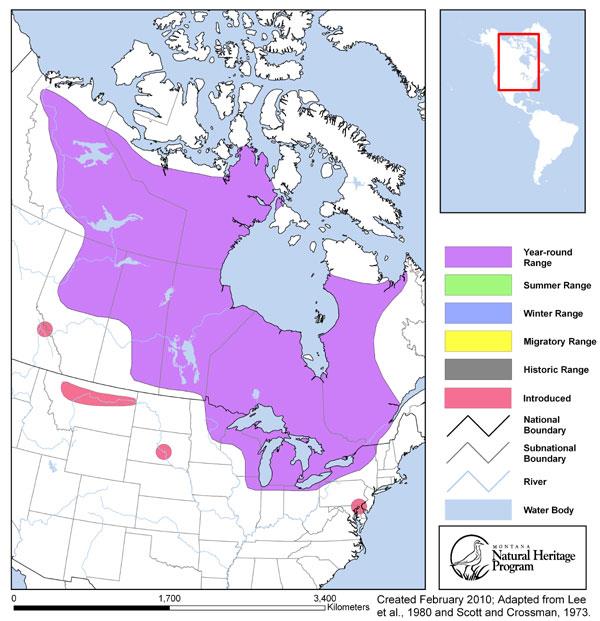
Cisco is Montana's newest fish species. They were introduced by the Montana Department of Fish, Wildlife and Parks into Fort Peck Reservoir in 1984, from Saskatchewan, to act as a forage fish for walleye and lake trout. They have produced a rapidly expanding self-reproducing population. Studies are ongoing to determine the value of Cisco as a forage fish. Cisco, also known as lake herring, are widespread across eastern and central Canada. They spawn in the fall in shallow water. Cisco are an open water or pelagic species, forming large schools at medium depths where they feed mostly on plankton.
Diagnostic Characteristics
These fish are silvery and somewhat darker on the back. The lower jaw often protrudes slightly with the mouth closed, but the jaws may be equal or the upper may be slightly longer. They have 38 or more gill rakers on the first arch, two flaps of skin between the nostrils (see Lake Whitefish for illustration), and the membrane surrounding the eye has a distinct notch below the pupil (see Mountain Whitefish for illustration).
Species Range
Montana Range
Range Descriptions
 Non-native
Western Hemisphere Range
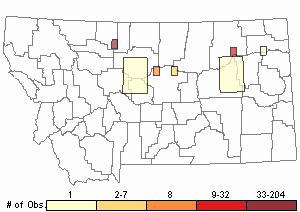
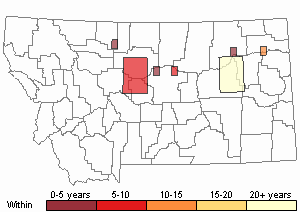
Observations in Montana Natural Heritage Program Database
Number of Observations: 343
(Click on the following maps and charts to see full sized version)
Relative Density
Recency
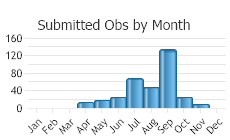
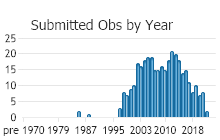
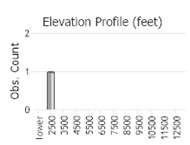 (Observations spanning multiple months or years are excluded from time charts)
Habitat
Habitat includes deep lakes and large rivers. Pelagic species are usually found in open, deep water. They spawn over shoreline substrate.
Food Habits
Cisco are largely plankton feeders. Some terrestrial and emergent aquatic insects are taken, and rarely fish.
Ecology
Summer kills can be a major threat to populations in inland lakes.
Reproductive Characteristics
Successful reproduction in the state started in the fall of 1985. Spawning occurs in mid-November at 40 degrees F. in Fort Peck Reservoir. They broadcast spawn over the shoreline substrate. Eggs hatch in late April-early May and most fish mature at ages 1-4 years.
Management
Stewardship Responsibility
References
- Literature Cited AboveLegend:
 View Online Publication
- Lee, D.S., C.R. Gilbert, C.H. Hocutt, R.E. Jenkins, D. E. McAllister, J. R. Stauffer, Jr. 1980. Atlas of North American freshwater fishes. North Carolina State Musuem of Natural History. 867 p.
- Scott, W.B. and E.J. Crossman. 1973. Rainbow trout, Kamloops trout, Steelhead trout Salmo gairdneri Richardson. pp. 184-191. In: Freshwater fishes of Canada. Ottawa, Canada: Fisheries Research Board of Canada, Bulletin 184. 966 p.
- Additional ReferencesLegend: View Online Publication
Do you know of a citation we're missing? Dieterman, D.J., M.P. Ruggles, M.L. Wildhaber, and D.L. Galat (eds). 1996. Population structure and habitat use of benthic fishes along the Missouri and Lower Yellowstone Rivers. 1996 Annual report of Missouri River Benthic Fish Study PD-95-5832 to U.S. Army Corps of Engineers and U.S. Bureau of Reclamation. 238 p.
- Duncan, M.B. 2019. Distributions, abundances, and movements of small, nongame fishes in a large Great Plains river network. Ph.D. Dissertation. Bozeman, MT: Montana State University. 255 p.
- Joslin, Gayle, and Heidi B. Youmans. 1999. Effects of recreation on Rocky Mountain wildlife: a review for Montana. [Montana]: Montana Chapter of the Wildlife Society.
- Montana Department of Fish, Wildlife and Parks. 1989. Northeast Montana Warmwater Ecosystem Investigations: project period 7/1/88 through 6/30/89. Proj.# F-46-R-2; Job# V-e. 21p.
- Mullins, M.S. 1991. Biology and predator use of cisco (Coregonus artedi) in Fort Peck Reservoir, Montana. M.Sc. Thesis. Bozeman, MT: Montana State University. 68 p.
- Young, B.A., T.L. Welker, M.L. Wildhaber, C.R. Berry, and D. Scarnecchia (eds). 1997. Population structure and habitat use of benthic fishes along the Missouri and Lower Yellowstone Rivers. 1997 Annual report of Missouri River Benthic Fish Study PD-95-5832 to U.S. Army Corps of Engineers and U.S. Bureau of Reclamation. 207 p.
- Web Search Engines for Articles on "Cisco"
- Additional Sources of Information Related to "Fish"