View in other NatureServe Network Field Guides
NatureServe
Montana
Utah
Wyoming
Idaho
Wisconsin
British Columbia
South Carolina
Yukon
California
New York
White Sturgeon - Acipenser transmontanus
State Rank Reason (see State Rank above)
Species is limited to the Kootenai River below the Libby dam, is not consistently reproducing in the wild, and populations of adult wild-born fish are continuing to decline. Species faces threats from altered hydrology.
General Description
An inhabitant of large, cool rivers, the White Sturgeon is only found in about 170 river miles of the Kootenai River downstream of Kootenai Falls in Montana to Kootenay Lake in British Columbia, Canada (USFWS 1999, Holton et al. 2003). The species is the largest freshwater fish in North America, but this landlocked population is notably smaller than elsewhere in its range. White Sturgeon in Montana have been reported up to 6 ft in length and over 80 pounds (Stephens at el. 2019), while an individual in Kootenay Lake exceeded 350 pounds and was 10 feet in length (Hempsall 2015). Like other sturgeons, these ‘living fossils’ have changed little since the Late Cretaceous (66-100 million years) and may live up to 100 years (Bemis 1997, Krieger and Fuerst 2002, USFWS 1999).
For a comprehensive review of the ecology, conservation status, threats, and management of this and other Montana fish species of concern, please see
Montana Chapter of the American Fisheries Society Species of Concern Status Reviews.Diagnostic Characteristics
Sturgeons have cartilaginous skeletons with a persistent notochord, a protractile tube-like mouth, and sensory barbels on the underside of the snout. White Sturgeon are large fishes with 11 to 14 dorsal, 36 to 48 lateral, and 9 to 12 ventral scutes (bony plates). They are smaller than ocean-going populations, with no reports larger than 200 pounds from the Kootenai River, and are gray in color.
Species Range
Montana Range
Range Descriptions
 Native
Western Hemisphere Range
Range Comments
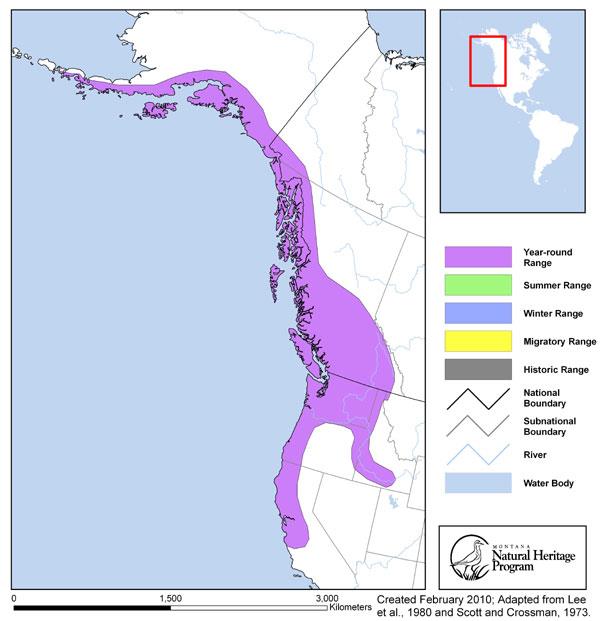
The Kootenai River basin in British Columbia, Montana, and Idaho. Kootenai sturgeon currently occupy the waters in the shaded area, although they are now very rare in Montana (Paragamian et al. 2005).
Observations in Montana Natural Heritage Program Database
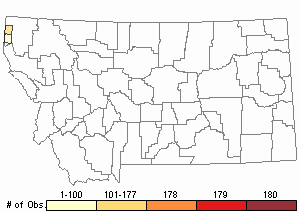
Number of Observations: 277
(Click on the following maps and charts to see full sized version)
Relative Density
Recency
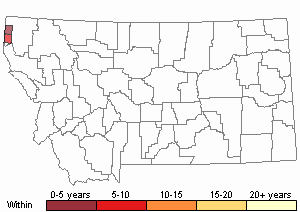
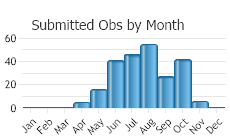
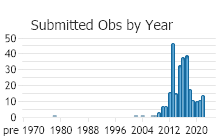
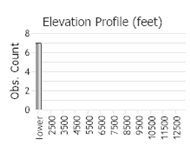 (Observations spanning multiple months or years are excluded from time charts)
Migration
The White Sturgeon population in Montana is part of a landlocked population occurring only in Kootenai River from Kootenai Falls in Montana downstream to Bonnington Falls in British Columbia (USFWS 1993).
Habitat
Large cold rivers.
Food Habits
The White Sturgeon is a bottom feeder and will eat almost any available organism. They feed mostly on fish, but also eat crustaceans, mollusks, worms, and considerable plant material (Brown 1971, Weisel 1957).
Ecology
Historically, White Sturgeon responded to spring runoff and warming water temperatures by moving upstream to the spawning areas and preparing physiologically for spawning. Decline in Montana seems to be linked to changes in the Kootenai's flow pattern resulting from completion of Libby dam (Holton 1980, USFWS 1993).
Reproductive Characteristics
There has been almost no reproduction since 1974 (USFWS 1993). The range in Montana may be part of the breeding area for the population, believed to extend from Shorty's Island, Idaho upstream to Kootenai Falls, Montana (USFWS 1993).
The size and age of first sexual maturity is variable within the species. In the Kootenai watershed, females have been observed to mature as early as age 22 years and males at age 16 years (Paragamian et al. 1997). Females are reported to spawn only once every two to eleven years (Conte et al. 1988, Hanson et al. 1992). Empirical evidence suggests that female White Sturgeon from the Kootenai River exhibited spawning periodicities of over 5 years (Paragamian et al. 1997,
Montana AFS Species Status Account).
Throughout their range, White Sturgeon generally broadcast their eggs over clean cobble at depths greater than 6 meters (20 feet) at column velocities less than 0.24 meters per second (0.77 feet per second). Water temperatures associated with White Sturgeon spawning typically ranged from 14 to 20 degrees C. (57 to 68 F.). Empirical embryonic developmental stage and water temperature data were used (Wang et al. 1985) to back-calculate the timing of White Sturgeon spawning events in the Kootenai River, which coincided with lower water temperatures (8.6 to 12.9 C.). Spawning has occurred at relatively low discharges (13 to 20 kcfs) and over finer substrate than is considered optimal for egg to fry survival. It remains uncertain whether any juveniles survive when eggs are dispersed over fine substrates. Furthermore, several potentially important early life (post-fertilization) mortality factors, and possible intermittent female stock limitations, have been suggested as mechanisms to explain prolonged (more than 25 years) White Sturgeon recruitment failure in the Kootenai River (Anders and Richards 1996, Anders et al. 2002,
Montana AFS Species Status Account).
Management
The management of this and other native and non-native fish species and their habitats is outlined in Montana Fish, Wildlife and Parks'
2023-2026 Statewide Fisheries Management PlanThe Kootenai River population of White Sturgeon (
Acipenser transmontanus) was listed as endangered under the Endangered Species Act (USFWS 1994), due to a lack of juvenile recruitment to the population since the mid-1960s. Almost no recruitment has occurred since Libby Dam began regulating the Kootenai River in 1972 (Duke et al. 1999, USFWS 1999). In the final rule, the Service stated "there is no recent evidence of successful spawning and survival past the egg stage" and "regulations and experimental flow programs have not been effective in arresting the decline of the species". A small number of recruits from a cohort spawned in 1974 indicated fairly successful natural reproduction, associated with high, protracted springtime river flows. Between 1992 and 2000, the wild population was augmented with 4,879 juvenile White Sturgeon (age 1 and 2) from the Kootenai Tribal Conservation Aquaculture Facility located in Bonners Ferry, Idaho, to address concerns of increasing demographic and genetic risk to a non-recruiting population (Ireland et al. 2002,
Montana AFS Species Status Account).
Recovery of the White Sturgeon population in the Kootenai River is contingent upon re-establishing natural recruitment, minimizing additional loss of genetic variability, and successfully mitigating biological and habitat alterations that continue to harm the population. The White Sturgeon Recovery Plan (USFWS 1999) recommends simultaneous implementation of three high priority recovery approaches: 1) augment spring flows in the Kootenai River to enhance natural production; 2) implement a conservation aquaculture program to prevent extinction and preserve genetic variability; and 3) re-establish suitable habitat conditions to increase White Sturgeon survival past
the embryonic and larval stages (
Montana AFS Species Status Account).
The Kootenai River White Sturgeon Study and Conservation Aquaculture Project was initiated to preserve the genetic variability of the population, begin rebuilding natural age class structure, and prevent extinction while measures are implemented to restore natural recruitment (Anders and Westerhof 1996, USFWS 1999, Ireland 2000, Ireland et al. 2002). A breeding plan has been implemented to guide management in the systematic collection and spawning of wild adults before they are lost from the breeding population (Kincaid 1993). The implementation of the breeding plan includes measures to minimize potential detrimental effects of conventional stocking programs (
Montana AFS Species Status Account).
Additional information on the biology and management of White Sturgeon populations can be found on the U.S. Fish and Wildlife Service's
Environmental Conservation Online System Species ProfileStewardship Responsibility
References
- Literature Cited AboveLegend:
 View Online Publication
 Anders, P. and D. Richards. 1996. Implications of ecosystem collapse on white sturgeon (Acipenser transmontanus) in the Kootenai River, Idaho, Montana, and British Columbia. Pp. 27-40. In: Proceedings of the International Congress on the Biology of Fishes, San Francisco State University, CA. July 14-18, 1996.
- Anders, P. J., D. L. Richards, and M. S. Powell. 2002. The first endangered white sturgeon population: repercussions in an altered large river-floodplain ecosystem. American Fisheries Society Symposium 28:67-82.
- Anders, P.J. and R.E. Westerhof. 1996. Conservation aquaculture of endangered white sturgeon (Acipenser transmontanus) in the Kootenai River, Idaho. Pp. 51-62 In: Proceedings from the International Congress on the Biology of Fishes: Culture and Management of Sturgeon and Paddlefish Symposium Proceedings. San Francisco State University, CA. July 14–18, 1996.
- Bemis, William, Eric Findeis and Lance Grande. 1997. An overview of Acipenseriformes. Environmental Biology of Fishes 48: 25–71.
- Brown, C.J.D. 1971. Fishes of Montana. Bozeman, MT: Big Sky Books/Montana State University. 207 p.
- Conte, F.C, S.I. Doroshov, P.B. Lutes, and E.M. Strange. 1988. Hatchery manual for the white sturgeon Acipenser transmontanus Richardson, with application to other North American Acipenseridae. Cooperative Extension, University of California, Division of Agriculture and Natural Resources. Publication 3322.
- Duke, S., P. Anders, G. Ennis, R. Hallock, J. Hammond, S. Ireland, J. Laufle, et al. 1999. Recovery plan for Kootenai River white sturgeon (Acipenser transmontanus). Journal of Applied Ichthyology 15(4-5): 157-163.
- Hanson, D. L., T. G. Cochnauer, J. D. DeVore, H. E. Forner, T. T. Kisanuki, D. W. Kohlhorst, P. Lumley, G. McCabe, A. A. Nigro, S. Parker, D. Swartz and A. Van Vooren. 1992. White sturgeon management framework plan. Pacific States Marine Fisheries Commission. 220 pp.
- Hempsall, V. 2015. Koogopogo: Super-sized Sturgeon. Kootenay Mountain Culture Magazine 27 (Summer 2015).
- Holton, G. D. 1980. The riddle of existence: fishes of special concern. Montana Outdoors 11(1):2-6.
- Holton, G.D. and H.E. Johnson. 2003. A field guide to Montana fishes. 3rd edition. Montana Fish, Wildlife & Parks, Helena, MT. 95 pp.
- Ireland, S. C., P. J. Anders, and J. T. Siple. 2002. Conservation aquaculture: an adaptive approach to prevent extinction of an endangered white sturgeon population. American Fisheries Society Symposium 28:211-222.
- Ireland, S.C. 2000. Kootenai River white sturgeon studies and conservation aquaculture. Annual Progress Report. Prepared for U.S. Department of Energy and Bonneville Power Administration. Contract Number 88 BI 93743, Project No. 88-64. Portland, OR.
- Kincaid, H.L. 1993. Breeding plan to preserve the genetic variability of the Kootenai River white sturgeon. Bonneville Power Administration, Portland, OR. 22 pp.
- Krieger, Jeannette and Paul Fuerst. 2002. Evidence for a Slowed Rate of Molecular Evolution in the Order Acipenseriformes. Mol. Biol. Evol. 19(6):891–897.
- Lee, D.S., C.R. Gilbert, C.H. Hocutt, R.E. Jenkins, D. E. McAllister, J. R. Stauffer, Jr. 1980. Atlas of North American freshwater fishes. North Carolina State Musuem of Natural History. 867 p.
- Montana Chapter of the American Fisheries Society species status accounts.
- Paragamian, V.L., G. Kruse,. and V. Wakkinen. 1997. Kootenai River white sturgeon investigations. Annual Progress Report FY 1997. Idaho Department of Fish and Game and the Bonneville Power Administration. Contract No. DE-AI79-88BP93497; Project No. 88-65. Portland, Oregon. 67 pp.
- Scott, W.B. and E.J. Crossman. 1973. Rainbow trout, Kamloops trout, Steelhead trout Salmo gairdneri Richardson. pp. 184-191. In: Freshwater fishes of Canada. Ottawa, Canada: Fisheries Research Board of Canada, Bulletin 184. 966 p.
- Stephens, Brain, Ryan Sylvester, and Jordan Frye. 2019. Kootenai River white sturgeon Acipenser transmontanus: 2009-2018 Investigations in Montana. Libby, MT: Montana Fish, Wildlife & Parks. 48 pp.
- U.S. Fish and Wildlife Service (USFWS) 1999. White sturgeon; Kootenai River population recovery plan. Region 1, USFWS, Portland, Oregon.
- U.S. Fish and Wildlife Service (USFWS). 1994. Determination of endangered status for the Kootenai River population of the white sturgeon. Federal Register 59(171):45989-6002.
- Wang, Y.L., F.P. Binkowski, and S. I. Doroshov. 1985. Effect of temperature on early development of white and lake sturgeon, Acipenser transmontanus and A. fulvescens. Environmental Biology of Fishes 14(1): 43-50.
- Weisel, G.F. 1957. Fish guide for intermountain Montana. Montana State University Press. Missoula, MT. 88 pp.
- Additional ReferencesLegend: View Online Publication
Do you know of a citation we're missing?- Apperson, K.A. and P.J. Anders. 1990. Kootenai River white sturgeon investigations and experimental culture. Boise, ID: Idaho Dept. of Fish and Game, Project 88-65, Annual Report. 50 p.
- Apperson, K.A. and V.D. Wakkinen. 1992. Kootenai River white sturgeon investigations and experimental culture annual report. Report prepared for the U.S. Department of Energy, Bonneville Power Administration, Division of Fish and Wildlife, Portland, OR. 36 p.
- Binkowski, F. P., and S. I. Doroshov (editors). 1985. North American Sturgeons: Biology and Aquaculture Potential. Dr. W. Junk Publishers, Dordrecht, Netherlands. 163 pp.
- Chapman, D.W. 1982. Effects of Kootenai River hydroelectric project, FERC No. 2752, on Kootenai River Fisheries. Billings, MT: draft technical report to Bureau of Indian Affairs. 154 p.
- Duke, S. D., and R. Hallock. 2001. Recovery Progress Report for the Endangered Kootenai River White Sturgeon, Acipenser transmontanus. Endangered Species Update 18(3):75-78.
- Harrison, J. 1992. A threat to the big fish. Are Kootenai River white sturgeon the next endangered species? Northwest Energy News, November/December. 7 p.
- Joslin, Gayle, and Heidi B. Youmans. 1999. Effects of recreation on Rocky Mountain wildlife: a review for Montana. [Montana]: Montana Chapter of the Wildlife Society.
- Oldenburg, E.W. 2008. Effects of acclimation on poststocking dispersal of age-1 pallid sturgeon. M.Sc. Thesis. Bozeman, MT: Montana State University. 45 p.
- Paragamian, V.L., R.C.P. Beamesderfer, and S.C. Ireland. 2005. Status, population dynamics, and future prospects of the endangered Kootenai River white sturgeon population with and without hatchery intervention. Transactions of the American Fisheries Society 134:518-532.
- Stephens, B. and R. Sylvester. 2013. Kootenai River White Sturgeon Acipenser transmontanus: 2009-2012 Investigations in Montana. Libby, MT: Montana Fish, Wildlife, and Parks. BPA Project Number: 2006-008-00 Contract Numbers: 38489, 43309, 48555, 53910, and 57973. 56 p.
- Stephens, B. and R. Sylvester. 2014. Kootenai River White Sturgeon Acipenser transmontanus: 2009-2012 Investigations in Montana. Libby, MT: Montana Fish, Wildlife, and Parks. BPA Project Number: 2006-008-00 Contract Numbers: 38489, 43309, 48555, 53910, and 57973. 54 p.
- Stephens, B., R. Sylvester, and B. Phillips. 2010. Kootenai River White Sturgeon Acipenser transmontanus: 2009 Investigations in Montana. Libby, MT: Montana Fish, Wildlife, and Parks Section 10(a)(1)(A) Permit TE-210255-0. 26 p.
- Stephens, B., R. Sylvester, and J. Frye. 2015. Kootenai River White Sturgeon Acipenser transmontanus: 2009-2014 Investigations in Montana. Libby, MT: Montana Fish, Wildlife, and Parks. BPA Project Number: 2006-008-00 Contract Numbers: 38489, 43309, 48555, 53910, 57973, and 65705. 34 p.
- Stephens, B., R. Sylvester, and J. Frye. 2016. Kootenai River White Sturgeon Acipenser transmontanus: 2009-2014 Investigations in Montana. Libby, MT: Montana Fish, Wildlife, and Parks. BPA Project Number: 2006-008-00 Contract Numbers: 65705 and 70084. 31 p.
- Stephens, B., R. Sylvester, and J. Frye. 2017. Kootenai River White Sturgeon Acipenser transmontanus: 2009-2016 Investigations in Montana. Libby, MT: Montana Fish, Wildlife and Parks. BPA Project Number: 2006-008-00. 24 p.
- Stephens, B., R. Sylvester, and J. Frye. 2019. Kootenai River White Sturgeon Acipenser transmontanus: 2009-2018 Investigations in Montana. Libby, MT: Montana Fish, Wildlife and Parks. BPA Project Number: 2006-008-00. 48 p.
- Sylvester, R. and B. Marotz. 2006. Evaluation of the Biological Effects of the Northwest Power Conservation Council's Mainstem Amendment on the Fisheries Upstream and Downstream of Hungry Horse and Libby Dams, Montana. Montana Fish, Wildlife, and Parks Annual Report prepared for U.S. Department of EnergyBonneville Power Administration. Bonneville Power Administration Project No. 2006-008-00 Contract No. 28350. 124 p.Contract No. 28350
- Sylvester, R. and B. Stephens. 2011. Evaluation of the physical and biological effects of the Northwest Power Conservation Council's Mainstem Amendment upstream and downstream of Libby Dam, Montana. Libby, MT: Montana Fish, Wildlife, and Parks Annual Report prepared for U.S. Department of Energy Bonneville Power Administration. Bonneville Power Administration Project No. 2006-008-00, Contract Nos. 43309 and 48555. 282 p.
- Sylvester, R. and B. Stephens. 2012. Evaluation of the physical and biological effects of the Northwest Power Conservation Council's Mainstem Amendment upstream and downstream of Libby Dam, Montana. Libby, MT: Montana Fish, Wildlife, and Parks Annual Report prepared for U.S. Department of Energy Bonneville Power Administration. Bonneville Power Administration Project No. 2006-008-00, Contract Nos. 48555 and 53910. 358 p.
- Sylvester, R., A. Steed, J. Tohtz, and B. Marotz. 2008. Evaluation of the Biological Effects of the Northwest Power Conservation Council's Mainstem Amendment on the Fisheries Upstream and Downstream of Hungry Horse and Libby Dams, Montana. Montana Fish, Wildlife, and Parks Annual Report prepared for U.S. Department of EnergyBonneville Power Administration. Bonneville Power Administration Project No. 2006-008-00 Contract No. 28350. 124 p.Contract No. 28350
- Sylvester, R., J. Frye, and C. Gabreski. 2020. Kootenai River White Sturgeon Acipenser transmontanus: 2009-2019 Investigations in Montana. Libby, MT: Montana Fish, Wildlife, and Parks BPA Project Numbers 2006-008-00 (2009-2019) and 1995-004-00 (2019-2020). 70 p.
- Sylvester, R.M. and B. Stephens. 2013. Mainstem Columbia Amendments Research at Libby Dam - Evaluation of the Physical and Biological Effects of the Northwest Power Conservation Council's Mainstem Amendment Upstream and Downstream of Libby Dam, Montana. Libby, MT: Montana Fish, Wildlife, and Parks Annual Report prepared for U.S. Department of Energy Bonneville Power Administration. Bonneville Power Administration Project No. 2006-008-00. 386 p.
- Sylvester, R.M., B.C. Stephens, and J.T. Frye. 2014. Mainstem Columbia Amendments Research at Libby Dam - Evaluation of the Physical and Biological Effects of the Northwest Power Conservation Council's Mainstem Amendment Upstream and Downstream of Libby Dam, Montana. Libby, MT: Montana Fish, Wildlife, and Parks Annual Report prepared for U.S. Department of Energy Bonneville Power Administration. Bonneville Power Administration Project No. 2006-008-00. 461 p.
- Sylvester, R.M., J.T. Frye, C.R. Gabreski, M.A. Webb, and H.C. Glassic. 2021. Kootenai River white sturgeon Acipenser transmontanus: 2009-2020 investigations in Montana. Montana Fish, Wildlife & Parks for the United States Fish & Wildlife Service Permit TE-210255-2. 87 p.
- U.S. Fish and Wildlife Service. 1993. Endangered and threatened wildlife and plants: proposed endangered status for the Kootenai River population of the white sturgeon. Federal Register 58(128):36379-36387.
- Web Search Engines for Articles on "White Sturgeon"
- Additional Sources of Information Related to "Fish"