View in other NatureServe Network Field Guides
NatureServe
Montana
Utah
Wyoming
Idaho
Wisconsin
British Columbia
South Carolina
Yukon
California
New York
Short-eared Owl - Asio flammeus
State Rank Reason (see State Rank above)
Species is widely distributed across steppe and grassland habitats in Montana. In contrast to other areas of North America it appears stable (BBS, IMBCR, Project WAfLS data). It faces numerous threats from habitat degradation including loss from row crop conversion, excessive grazing, and general habitat change as well as direct mortality from vehicle strikes and poisoning from rodenticide application.
General Description
Short-eared Owls are a small to medium-sized owl. Published lengths range from 37 to 39 centimeters (Cramp 1985) to 34 to 42 centimeters (Mikkola 1983), with females slightly larger than males and considerably heavier, averaging 411 grams compared to 350 grams for males (Mikkola 1983). They are excellent flyers with long wings (95 to 110 centimeters) (Cramp 1985), and light wing-loading (0.333 gram per centimeter squared) (Clark 1975). There is little difference in wing length between the sexes (Clark and Ward 1974). The back and upper wing surfaces are tawny-brown to buff-colored with heavy but indistinct streaking. The ventral surfaces are much lighter, with bold, vertical brown streaking on the breast, and a pair of barely visible ear tufts close together at the top of the facial disk. The belly is pale, lightly streaked; the wings are long and have a buffy patch beyond the wrist above and a dark patch at the base of the primaries below; the dark facial disk contrasts with yellow eyes; and the legs and feet are feathered. Mature males are bright white on the underwing, while mature females show somewhat more buff coloration (Bent 1938, Village 1987). It is, nonetheless, difficult to sex or age these birds in the field. Females are generally darker than males but young birds are also darker than older ones (Mikkola 1983), thus a young male may be darker than an old female. Both sexes have a distinct, black carpal bar and dark wingtips. Juveniles possess full adult plumage by October of the first year (Bent 1938, Cramp 1985). The facial disc is circular and whitish with dark areas around the bright, yellow eyes, black bill. Recently fledged and juvenile Short-eared Owls show much darker coloration overall and a much darker facial disc which whitens with age. The Short-eared Owl gets its common name from the small ear tufts over the eyes. These inconspicuous tufts are part of the facial disc and are generally not seen except when female is in camouflage position on nest or erected when the bird is annoyed or alert. They may possibly aid in making birds more cryptic when in vegetation by breaking the line of the circular facial disc.
The bird is generally silent but does vocalize in courtship (a low, repeated, hooting "
voo, hoo, hoo, hoo", or in conjunction with defensive behavior or annoyance, yaps or barks). The call is given approximately 15 times during courtship flight and is also accompanied by an audible wing-clap and dive between calls. Young give a food-begging call ("
pssssip") that apparently aids adults in locating them from the time they leave the nest until after fledging. Adults may squeal while feigning injury during broken-wing acts to distract intruders from nests or young. Both young and adults will clack their bills when annoyed or in defense. Apparently, no data exist on the use of broadcasting tape-recorded vocalizations for detection or monitoring purposes.
For a comprehensive review of the conservation status, habitat use, and ecology of this and other Montana bird species, please see
Marks et al. 2016, Birds of Montana.Diagnostic Characteristics
Short-eared Owls can be distinguished by large "wrist" patches and moth-like flight. Long-eared Owl (Asio otis) has a smaller "wrist" patch, buffy underwings, and a darker belly. Although Long-eared Owls hunt similarly to Short-eared Owls, they are rarely seen hunting during the day. Short-eared Owls are probably the most diurnal of owls (Lockie 1955, Clark 1975) and may often be observed from late afternoon until nightfall, or at dawn. A crow-sized owl seen abroad during daylight in open country will most likely be a Short-eared Owl. However, they also hunt at night. They are easily recognized by their blunt-headed profile and the fact that they glide with their wings held horizontally. This contrasts with the shallow v-shape of the Northern Harrier (Circus cyaneus) with which the Short-eared Owl often shares habitat and may be confused. Northern Harriers may also be distinguished by their white rump patch. Habitat is useful in separating Short-eared Owls from Long-eared Owls, the latter being predominantly a woodland dweller. The Long-eared Owl is also more slender with much longer ear tufts. Burrowing Owl also inhabits open country but is smaller (24 centimeters vs. 38 centimeters), has relatively longer legs, a yellow to whitish bill, and (in adults) has at least some horizontal barring on the breast. The Short-eared Owl's style of flight is unique and has at times been called mechanical, moth-like, or even slovenly (Peterson 1934).
Species Range
Montana Range
Range Descriptions
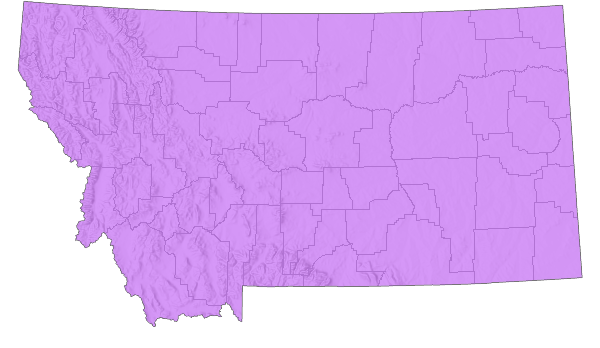
 Year-round
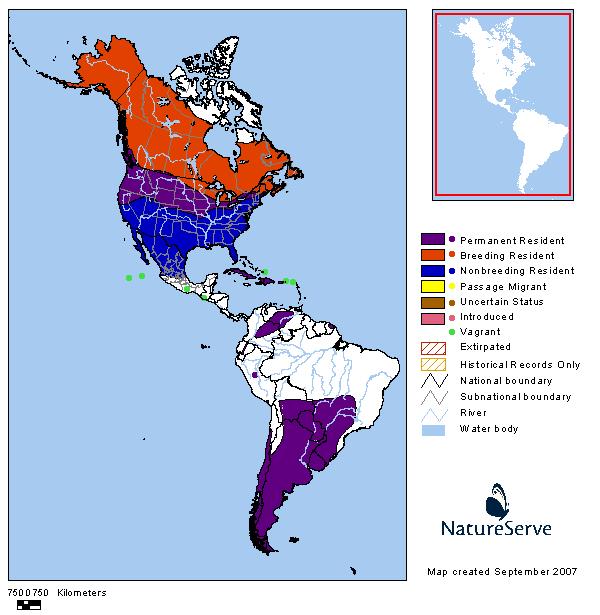
Western Hemisphere Range
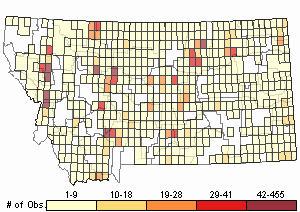
Observations in Montana Natural Heritage Program Database
Number of Observations: 3925
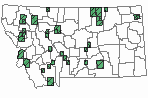
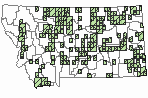
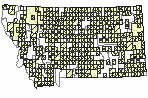
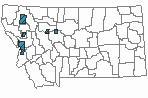
(Click on the following maps and charts to see full sized version)
Map Help and Descriptions
Relative Density
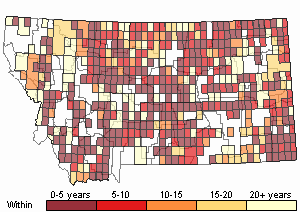
Recency
SUMMER (Feb 16 - Dec 14)
Direct Evidence of Breeding
Indirect Evidence of Breeding
No Evidence of Breeding
WINTER (Dec 15 - Feb 15)
Regularly Observed
Not Regularly Observed
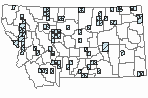

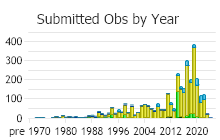
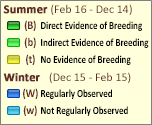 (Observations spanning multiple months or years are excluded from time charts)
Migration
Migratory; however, some individuals may not migrate. Migratory in northern parts of range (Johnsgard 1988). Some suggestion of migration in MT: late February to early March (Davis 1961).
Habitat
Open grasslands, plains, and agricultural areas with suitable vegetation and food.
National Vegetation Classification System Groups Associated with this Species
Forest and Woodland
Deciduous Forest and Woodland
Low Elevation - Xeric Forest and Woodland
Shrubland
Arid - Saline Shrubland
Foothills - Montane Shrubland
Sagebrush Shrubland
Grassland
Lowland - Prairie Grassland
Montane - Subalpine Grassland
Wetland and Riparian
Alkaline - Saline Wetlands
Peatland
Riparian and Wetland Forest
Riparian Shrubland
Wet Meadow and Marsh
Recently Disturbed or Modified
Introduced Vegetation
Human Land Use
Agriculture
Developed
Food Habits
A vole or field mouse specialist; almost the entire diet made up of these small rodents. A study of Short-eared Owl pellets in Ninepipes NWR yielded a 3.7:1 ratio of female:male Microtus (montanus and pennsylvanicus) eaten; snap-trap data yielded a 2.4:1 ratio (Holt and Williams 1995); it is impossible, however, to conclude from this data that Short-eared Owls were preferentially selecting females over males, as there could be more females in the prey population.
Ecology
Reproduction and population dynamics are closely linked to fluctuating prey density (Wiggins et al. 2006).
Reproductive Characteristics
Begins nesting in late February to March. Nests on the ground in a small depression, often with grasses placed around the depression; nest resembles a small bowl. Clutch size four to ten. Incubation approximately 26 days. Young fledge at 30 to 40 days. Egg records are from April 3 to June 13 (Davis 1961).
Management
Short-eared owls require relatively large areas of grassland and are ground nesters, and thus are susceptible to the increased predation pressure often associated with fragmented habitats and nearby rural developments. As a result, they seem to be especially sensitive to loss and fragmentation of habitat. (Wiggins et al. 2006)
Stewardship Responsibility
References
- Literature Cited AboveLegend:
 View Online Publication
 Bent, A.C. 1938. Life histories of North American birds of prey. Part 2. U.S. Nat. Mus. Bull. 170. 482 pp., 92 pls.
- Clark, R.J. and J.G. Ward. 1974. Interspecific competition in two species of open country raptors; Circus cyaneus and Asio flammeus. Proc. Pa. Acad. Sci. 48:79-87.
- Clark, W.S. 1975. A field study of the Short-Eared Owl, Asio flammeus (Pontoppidan), in North America. Wildl. Monogr. No. 47. 67 pp.
- Cramp, S., ed. 1985. Handbook of the birds of Europe, the Middle East, and North Africa. Volume 4, the birds of the western Palearctic. Terns to woodpeckers. Oxford University Press, Oxford, England.
- Davis, C.V. 1961. A distributional study of the birds of Montana. Ph.D. Dissertation. Corvallis, OR: Oregon State University. 462 p.
- Holt, D.W. and P.A. Williams. 1995. Sex of voles eaten by Short-eared owls. Northwestern Naturalist 76:145-147.
- Johnsgard, P. 1988. North American owls: biology and natural history. Smithsonian Institution Press. 336 pp.
- Lockie, J.D. 1955. The breeding habits and food of short-eared owls after a vole plague. Bird Study 2:53-69.
- Marks, J.S., P. Hendricks, and D. Casey. 2016. Birds of Montana. Arrington, VA. Buteo Books. 659 pages.
- Mikkola, H. 1983. Owls of Europe. Buteo Books, Vermillion, South Dakota. 400 pp.
- Peterson, R.T. 1934. A field guide to the birds. First edition. Houghton Mifflin Co., Cambridge, Massachusetts.
- Village, A. 1987. Numbers, territory-size and turnover of short-eared owls Asio flammeus in relation to vole abundance. Ornis Scandinavica 18:198-204.
- Wiggins, D.A., D.W. Holt, and S.M. Leasure. 2006. Short-eared Owl (Asio flammeus). The Birds of North America Online (A. Poole, Ed.). Ithaca: Cornell Lab of Ornithology; Retrieved from the Birds of North America Online: http://bna.birds.cornell.edu/bna/species/062 (Accessed 23 March 2016)
- Additional ReferencesLegend: View Online Publication
Do you know of a citation we're missing?- Allen, G. T. 1979. An assessment of potential conflicts between nesting raptors and human activities in the Long Pines area of southeastern Montana with special emphasis on uranium development. M.S. thesis, Washington State University, Pullman. 109 pp.
- American Ornithologists’ Union [AOU]. 1998. Check-list of North American birds, 7th edition. American Ornithologists’ Union, Washington, D.C. 829 p.
- Becker, Dale M., 1980, A Survey of raptors on national forest land in Carter County, Montana. Final Progress Report: 1977-1979.
- Best, L.B. 1970. Effects of ecological changes induced by various sagebrush control techniques on non-game birds. M.Sc. Thesis. Bozeman,MT: Montana State University. 74 p.
- Bird Conservancy of the Rockies. 2017. Pocket Guide to Northern Prairie Birds. Brighton, CO: Bird Conservancy of the Rockies. 98 p.
- Cameron, E. S. 1907. The birds of Custer and Dawson counties, Montana. Auk 24(3): 241-270.
- Casey, D. 2000. Partners in Flight Draft Bird Conservation Plan Montana. Version 1.0. 287 pp.
- Clarke, Jennifer A. 1981. The influence of moonlight on the predator/prey interactions between Short-eared Owls (Asio flammeus) and Deermice (Peromyscus maniculatus). M.A. Thesis. University of Montana. Missoula, MT.
- Clawson, M.R. 199. An investigation of factors that may affect nest success in CRP lands and other grassland habitats in an agricultural landscape. M.Sc. Thesis. Bozeman, MT: Montana State University. 45 p.
- Confluence Consulting Inc. 2011. Montana Department of Transportation Wetland Mitigation Monitoring Reports (various sites). MDT Helena, MT.
- Craighead, A.C. 2000. Pellet and scat analysis as indicators of present and past habitats. M.Sc. Theses. Bozeman, MT: Montana State University. 219 p.
- Decker Coal Co., 1981, Wildlife survey. July 7, 1981. In North Decker 5-Year Permit Application. Vol. III. Rule 26.4.304(12-14).
- Dickson, D.C. 1991. Systematic wildlife observations on the Blackfoot-Clearwater Wildlife Management Area. Montana Department of Fish, Wildlife and Parks. Missoula, MT. 14 pp. plus appendices and photographs.
- Dobkin, D. S. 1992. Neotropical migrant landbirds in the Northern Rockies and Great Plains. U.S.D.A. For. Serv. N. Region Publ. R1-93-34. Missoula, Mont.
- Dood, A.R. 1980. Terry Badlands nongame survey and inventory final report. Montana Department of Fish, Wildlife, and Parks and Bureau of Land Management, Helena, MT. 70 pp.
- DuBois, K.L. 1979. An inventory of the avifauna in the Long Pines of Southeastern Montana. M.Sc. Thesis. Bozeman, MT: Montana State University. 113 p.
- Ehrlich, P., D. Dobkin, and D. Wheye. 1988. The birder’s handbook: a field guide to the natural history of North American birds. Simon and Schuster Inc. New York. 785 pp.
- Fjell, Alan K., and Brian R. Mahan., 1983, Peabody Coal Company Big Sky Mine, Rosebud County, MT. Wildlife monitoring report: 1982 field season. May 1983.
- Fondell, T.F. and I.J. Ball. 2004. Density and success of bird nests relative to grazing on western Montana grasslands. Biological Conservation 117:203-213.
- Fondell, Thomas. 1997. Nest Density and Nest Success of Ground-nesting Grassland Birds Relative to Grazing in Western Montana. M.S. Thesis. University of Montana. Missoula, MT.
- Gillihan, SW. and T. VerCauteren. 2015. Pocket Guide to Prairie Birds. Brighton, CO: Bird Conservancy of the Rockies. 91 p.
- Gniadek, S. 1983. Southwest Glendive Wildlife Baseline Inventory. Miles City, Mont: Bureau of Land Management, Miles City District Office. 56 pp with appendices.
- Hays, R., R.L. Eng, and C.V. Davis (preparers). 1984. A list of Montana birds. Helena, MT: MT Dept. of Fish, Wildlife & Parks.
- Hendricks, P, S. Lenard, and C. Currier. 2012. Grassland Bird Surveys in North Valley County and Northwest Phillips County, Montana: 2011 Summary. Report to the USDI Bureau of Land Management. Montana Natural Heritage Program. Helena, MT. 7pp.
- Hendricks, P. 2000. Roadside bird counts on BLM lands in Petroleum and Fergus Counties, Montana. Montana Natural Heritage Program, Helena, MT. 57pp.
- Hendricks, P. and M. Roedel. 2001. A faunal survey of the Centennial Valley Sandhills, Beaverhead County, Montana. Report to the U.S. Bureau of Land Management and U.S. Fish and Wildlife Service. Montana Natural Heritage Program, Helena, MT. 44 p.
- Hendricks, P., G.M. Kudray, S. Lenard, and B.A. Maxell. 2007. A Multi-Scale Analysis Linking Prairie Breeding Birds to Site and Landscape Factors Including USGS GAP Data. Helena, Mont: Montana Natural Heritage Program.
- Hendricks, P., S. Lenard, C. Currier, and J. Carlson. 2007. Grassland bird surveys in north Valley County, Montana: 2001-2006. Report to the Bureau of Land Management, Glasgow Field Office. Montana Natural Heritage Program, Helena, Montana. 19 pp. plus appendices.
- Hoekman, Steven T. 1999. Nest habitat selection by grassland birds: The role of vegetation structure and floristics. M.S. Thesis. University of Montana. Missoula, MT.
- Holt, D. W., and S. M. Leasure. 1993. Short-eared Owl (Asio flammeus). In The birds of North America, No. 62 (A. Poole and F. Gill, Eds.). Academy of Natural Sciences of Philadelphia and American Ornithologists’ Union. [Revised online 1 June 2006]
- Holt, D. W., L. J. Lyon, and R. Hale. 1987. Techniques for differentiating pellets of short-eared owls and northern harriers. Condor 89:929-931.
- Johnsgard, P.A. 1992. Birds of the Rocky Mountains with particular reference to national parks in the northern Rocky Mountain region. Lincoln: University of Nebraska Press. xi + 504 pp.
- Joslin, Gayle, and Heidi B. Youmans. 1999. Effects of recreation on Rocky Mountain wildlife: a review for Montana. [Montana]: Montana Chapter of the Wildlife Society.
- Klaver, R. W. Food habits of short-eared owls in northwestern Montana. Presen., Ann. Meeting, Raptor Research Foundation, Duluth, Minnesota.
- Lenard, S., J. Carlson, J. Ellis, C. Jones, and C. Tilly. 2003. P. D. Skaar's Montana bird distribution, 6th edition. Montana Audubon, Helena, MT. 144 pp.
- Lockhart, J. Michael, 1976, Effects of coal extraction and related development on wildlife populations. Annual progress report; Calendar year 1976. In Decker Coal Company West Pit Permit. Vol. 3. 26.4.304(10-11), 305, 306, and 307. Updated Rules Rewrite, July 1, 1991. Appendix F.
- Matthews, W.L. 1981. Broadus-Pumpkin Creek baseline inventory - wildlife. Bureau of Land Management, Miles City, MT. 83 p.
- Montana Bird Distribution Committee. 2012. P.D. Skaar's Montana bird distribution. 7th Edition. Montana Audubon, Helena, Montana. 208 pp. + foldout map.
- MT Fish, Wildlife & Parks. No date. Blackfoot-Clearwater Wildlife Management Area checklist.
- Oechsli, L.M. 2000. Ex-urban development in the Rocky Mountain West: consequences for native vegetation, wildlife diversity, and land-use planning in Big Sky, Montana. M.Sc. Thesis. Montana State University, Bozeman. 73 p.
- Pavlacky Jr., D.C., et al. 2021. Landscape-scale conservation mitigates the biodiversity loss of grassland birds. Ecological Applications e2548. 17 p.
- Perkins, A. E. H. 2003. Habitat use, reproductive biology, and nest-site selection of ground-nesting birds at Freezout Lake WMA in central Montana. M.S. thesis, University of Montana, Missoula.
- Phillips, R.L., A.H. Wheeler, N.C. Forrester, J.M. Lockhart, and T.P. McEneaney. 1990. Nesting ecology of golden eagles and other raptors in southeastern Montana and northern Wyoming. U.S. Fish Wildl. Serv. Tech. Rep. 26:1-13.
- Pitkin, P. and L. Quattrini. 2017. Pocket Guide to Sagebrush Birds. Bird Conservancy of the Rockies and Point Blue Conservation Science. 68 p.
- Powder River Eagle Studies, Inc., Gillette, WY., 1996, Spring Creek Mine 1995 Wildlife Monitoring Studies. Spring Creek Coal Company 1995-1996 Mining Annual Report. Vol. I, App. I. May 1996.
- Rundquist, V.M. 1973. Avian ecology on stock ponds in two vegetational types in north-central Montana. Ph.D. Dissertation. Bozeman, MT: Montana State University. 112 p.
- Sater, S. 2022. The insects of Sevenmile Creek, a pictorial guide to their diversity and ecology. Undergraduate Thesis. Helena, MT: Carroll College. 242 p.
- Saunders, A.A. 1914. The birds of Teton and northern Lewis & Clark counties, Montana. Condor 16:124-144.
- Sibley, D. 2014. The Sibley guide to birds. Alfred A. Knopf, New York, NY. 598 pp.
- Skaar, P. D., D. L. Flath, and L. S. Thompson. 1985. Montana bird distribution. Montana Academy of Sciences Monograph 3(44): ii-69.
- Skaar, P.D. 1969. Birds of the Bozeman latilong: a compilation of data concerning the birds which occur between 45 and 46 N. latitude and 111 and 112 W. longitude, with current lists for Idaho, Montana, Wyoming, impinging Montana counties and Yellowstone National Park. Bozeman, MT. 132 p.
- Swaney, William, 1993, Effects of predation on ground nesting bird communities in northwestern Montana. M.S. Thesis. University of Montana. Missoula, MT.
- Thompson, L.S. 1978. Species abundance and habitat relations of an insular montane avifauna. Condor 80(1):1-14.
- Thompson, L.S. 1981. Circle West wildlife monitoring study: Third annual report. Technical report No. 8. Montana Department of Natural Resources and Conservation. Helena, Montana.
- U.S. Fish and Wildlife Service. 2021. Birds of Conservation Concern 2021. United States Department of the Interior, U.S. Fish and Wildlife Service, Migratory Birds, Falls Church, Virginia.
- U.S. Forest Service. 1991. Forest and rangeland birds of the United States: Natural history and habitat use. U.S. Department of Agriculture, Forest Service Agricultural Handbook 688. 625 pages.
- Waage, B.C. 1984. Western Energy Company Rosebud Mine, Rosebud County, Montana: Annual Wildlife Monitoring Report, 1983 Field Season. June 1984.
- Waage, B.C. 1986. Western Energy Company Rosebud Mine, Rosebud County, Montana: Annual Wildlife Monitoring Report, 1985 Field Season. December 1985.
- Waage, Bruce C., compiler., 1985, Western Energy Company Rosebud Mine, Rosebud County, Montana: Annual Wildlife Monitoring Report, 1984 Field Season. October 1985.
- Waldt, R. 1995. The Pine Butte Swamp Preserve bird list. Choteau, MT: The Nature Conservancy. Updated August 1995.
- Watts, C.R. and L.C. Eichhorn. 1981. Changes in the birds of central Montana. Proceedings of the Montana Academy of Sciences 40:31-40.
- Western Energy Co., Colstrip, MT., 1980, Western Energy Company Rosebud Mine, Colstrip, Montana: Annual Wildlife Report, 1980.
- Western Energy Co., Colstrip, MT., 1982, Western Energy Company Rosebud Mine, Colstrip, Montana: Annual Wildlife Report, 1982.
- Western Technology and Engineering, Inc. (WESTECH)., 2001, Wildlife Monitoring Absaloka Mine Area Annual Report, 2000. Montana SMP 85005. OSMP Montana 0007E. February 2001.
- Westmoreland Resources, Inc., Hardin, MT., 1981, 1981 Wildlife Report. April 1982.
- Westmoreland Resources, Inc., Hardin, MT., 1983, 1980 Wildlife Monitoring Report. 12/21/79-12/20-80.
- Wiggins, D.A., D.W. Holt and S.M. Leasure. 2006. Short-eared Owl (Asio flammeus). Species Account Number 062. The Birds of North America Online (A. Poole, Ed.). Ithaca, NY: Cornell Laboratory of Ornithology; Retrieved 3/25/2008 from The Birds of North America Online database
- Wittenhagen, K.W. 1991. Progress report on the ferruginous hawk in southeastern Montana. Miles City, MT: unpublished report for USDI BLM, Powder River and Big Dry Resource Areas. 24 p.
- Zackheim, K. 1973. Exhibit H: Wildlife Study. In Ash Grove Cement Co. files.
- Web Search Engines for Articles on "Short-eared Owl"
- Additional Sources of Information Related to "Birds"