View in other NatureServe Network Field Guides
NatureServe
Montana
Utah
Wyoming
Idaho
Wisconsin
British Columbia
South Carolina
Yukon
California
New York
Great Gray Owl - Strix nebulosa
State Rank Reason (see State Rank above)
Species is uncommon across much of western Montana. It faces moderate threats from timber harvest and fire. Initial surveys have established baseline occupancy estimates, but trend is still poorly characterized.
General Description
Great Gray Owls are the largest owl species in North America. They have a wingspan over 4 feet with a body length of up to 27 inches. They can weigh over 2 pounds. Females are usually larger than males, but they are otherwise identical in appearance. Great Gray Owls have a large, rounded, half-domed head with a flat face and no ear tufts (Bull and Duncan 1993, Sibley 2000). Their eyes are yellow, but look rather small due to the ringed facial disks. The bill is mostly yellow with a black patch below separating white lores that give Great Gray Owls their classic bow-tied appearance. The plumage is mostly gray with patches of whites and browns. The tail is fairly long and is also brown and gray (Bull and Duncan 1993).
The vocalization of Great Gray Owls is a series of deep resonating "
whoos" that falls in pitch and accelerates (Cramp 1985).
For a comprehensive review of the conservation status, habitat use, and ecology of this and other Montana bird species, please see
Marks et al. 2016, Birds of Montana.Diagnostic Characteristics
Great Gray Owls are distinguished from Barred Owls (Strix varia) by their much larger size, yellow eyes, bow-tie under the face, the lack of barring on the breast, and the better defined concentric rings on the face (Bull and Duncan 1993). Great Gray Owls are distinguished from their other closest relative, the Spotted Owl (Strix occidentalis), by many of the same physical characteristics, much larger size, yellow eyes, and bow-tie. Also, the ranges of Great Gray Owl and Spotted Owl do not usually overlap, unless extreme southern movements occur by Great Gray Owls in winter.
Species Range
Montana Range
Range Descriptions

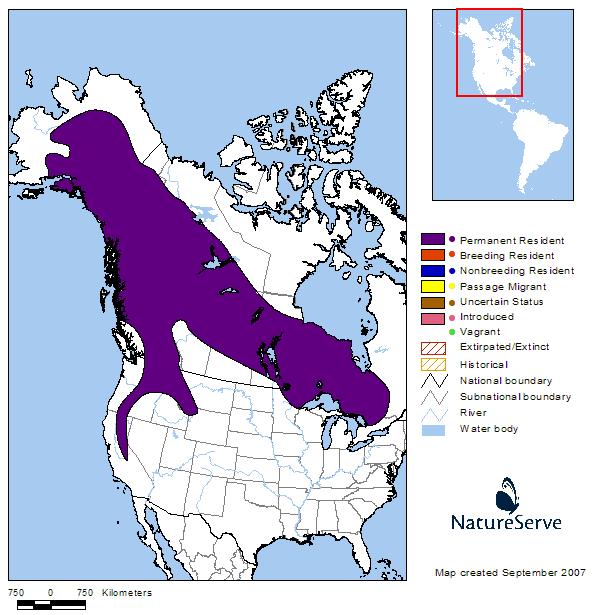
 Year-round
Western Hemisphere Range
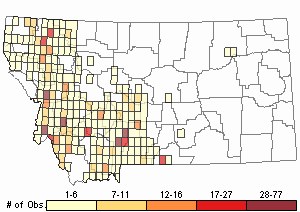
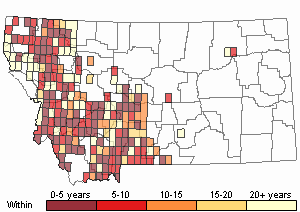
Observations in Montana Natural Heritage Program Database
Number of Observations: 1421
(Click on the following maps and charts to see full sized version)
Map Help and Descriptions
Relative Density
Recency
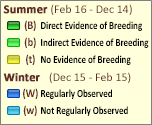
SUMMER (Feb 16 - Dec 14)
Direct Evidence of Breeding
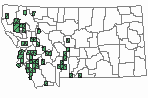
Indirect Evidence of Breeding
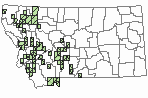
No Evidence of Breeding
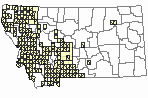
WINTER (Dec 15 - Feb 15)
Regularly Observed
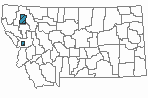
Not Regularly Observed
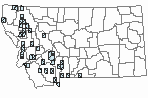
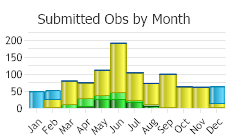
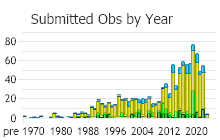
 (Observations spanning multiple months or years are excluded from time charts)
Migration
Very little information regarding migratory patterns exist for Great Gray Owls in the state, as they are a resident species in Montana, both during the breeding season and in winter. The Montana Bird Distribution Committee (2012) has transient Great Gray Owl records for every month of the year. During periods of low prey abundance and/or large snowfalls birds may move from higher to lower altitudes within the state. Also, birds from Canada may move into the state during winter for similar reasons.
Habitat
Little specific habitat information for Montana is currently available, as systematic surveys for Great Gray Owls have not been done. Great Gray Owls are known to use lodgepole pine/Douglas-fir in Montana. Habitat information from other Great Gray Owl sources state that their habitat is dense coniferous and hardwood forest, especially pine, spruce, paper birch, poplar, and second-growth, and especially near water. They forage in wet meadows, boreal forests and spruce-tamarack bogs in the far north, and coniferous forest and meadows in mountainous areas.
Great Gray Owls nest in the tops of large broken-off tree trunks (especially in the south), in old nests of other large birds (e.g., hawk nest) (especially in the north), or in debris platforms from dwarf mistletoe, frequently near bogs or clearings. Nests are frequently reused (Franklin 1988) and the same pair often nests in the same area in successive years.
National Vegetation Classification System Groups Associated with this Species
Forest and Woodland
Deciduous Forest and Woodland
Low Elevation - Xeric Forest and Woodland
Montane - Subalpine Forest and Woodland
Grassland
Montane - Subalpine Grassland
Wetland and Riparian
Alpine Riparian and Wetland
Peatland
Riparian and Wetland Forest
Riparian Shrubland
Wet Meadow and Marsh
Recently Disturbed or Modified
Insect-Killed Forest
Recently Burned
Food Habits
No food habit information is available for Great Gray Owls in Montana. However, information from other areas in the species' range indicates small mammals, especially rodents (i.e. voles), dominate prey over most of the range. Pocket gophers also dominate the diet of Great Gray Owls in North America. They usually forage in open areas where scattered trees or forest margins provide suitable sites for visual searching. They also use sound to locate prey under snow cover.
Ecology
Ecological information for Great Gray Owls in Montana is not available. Information from other areas of the species' range, including Oregon and Canada, indicate that Great Gray Owls loosely congregate, probably in response to abundant prey; groups of up to 15 individuals have been observed in late winter (Hayward and Verner 1994). Some Great Gray Owls may remain on the breeding territory all year. Others move irregularly in search of favorable foraging conditions. The average home range size for breeding adults in Oregon was 4.5 square kilometers and in Wyoming, 2.6 square kilometers. The maximum distance traveled from the nest averages 13.4 kilometers (Hayward and Verner 1994). The maximum distance that juveniles dispersed in their first year ranged from 7.5 to 32 kilometers in Oregon. Adults moved 3 to 43 kilometers during the same period (Johnsgard 1988). Adults and juveniles travel much greater distances in the northern parts of their range, some up to 753 kilometers in Canada (Hayward and Verner 1994). Predation by Great Horned Owls (Bubo virginianus) was the greatest known mortality factor in northern Minnesota and southeastern Manitoba (Duncan 1987).
Reproductive Characteristics
Little information exists regarding Great Gray Owl reproduction in Montana. Systematic surveys have yet to be done in the state. However, information from other areas where Great Gray Owls occur indicates nesting begins in March or April on broken-topped snags or old stick nests of other birds. The average egg dates are late March to May in Alberta, late April to early June in Ontario, and peak mid-April to late May in California. The mean date for the first egg is May 5 in southern Idaho and northwestern Wyoming. Egg-laying may be delayed in years with deep snow (Franklin 1988). Clutch size is 2 to 5 (usually 2 to 3 or 3 to 4). Incubation lasts 28 to 29 days and is completed by the female (male brings food). Young begin to leave the nest at 3 to 4 weeks (4 weeks in Idaho/Wyoming), fly well at 5 to 6 weeks (6 weeks in Idaho/Wyoming), and are independent at about 4 to 5 months (Idaho/Wyoming) (Franklin 1988).
Great Gray Owls usually breed for the first time at 3 to 4 years of age. The pair bond is not maintained outside of the breeding season, but the bond may reform if both birds return to the same breeding territory. Some pairs may not breed in years of low prey abundance.
Management
No known active management is ongoing for Great Gray Owls in the state. However, habitat management must take into account a long-term view of forest succession and consider landscape and regional forest patterns. Because of the owl's large home range, management must be coordinated among administrative units to maintain links between interacting biological units (Hayward and Verner 1994).
Stewardship Responsibility
References
- Literature Cited AboveLegend:
 View Online Publication
 Cramp, S., ed. 1985. Handbook of the birds of Europe, the Middle East, and North Africa. Volume 4, the birds of the western Palearctic. Terns to woodpeckers. Oxford University Press, Oxford, England.
- Duncan, J. R. 1987. Movement strategies, mortality, and behavior of radio-marked great gray owls. In: Nero, R.W., R. J. Clark, R. J. Knapton, and H. Hamre, eds. Biology and conservation of northern forest owls. pp. 101-107. USDA Forest Service General Technical Report RM-142. USDA Forest Service, Rocky Mountain Forest and Range Experiment Station, Fort Collins, CO.
- Franklin, A. B. 1988. Breeding biology of the great gray owl in southeastern Idaho and northwestern Wyoming. Condor 90:689-696.
- Hayward, GD. and J. Verner. 1994. Flammulated, boreal, and great gray owls in the United States: A technical conservation assessment. Rocky Mountain Forest and Range Experiment Station, Fort Collins, Colorado. USDA Forest Service General Technical Report RM-253.
- Johnsgard, P. 1988. North American owls: biology and natural history. Smithsonian Institution Press. 336 pp.
- Marks, J.S., P. Hendricks, and D. Casey. 2016. Birds of Montana. Arrington, VA. Buteo Books. 659 pages.
- Montana Bird Distribution Committee. 2012. P.D. Skaar's Montana bird distribution. 7th Edition. Montana Audubon, Helena, Montana. 208 pp. + foldout map.
- Sibley, D.A. 2000. The Sibley guide to birds. National Audubon Society and Alfred A. Knopf, Inc., New York, NY. 544 pp.
- Additional ReferencesLegend: View Online Publication
Do you know of a citation we're missing?- American Ornithologists’ Union [AOU]. 1998. Check-list of North American birds, 7th edition. American Ornithologists’ Union, Washington, D.C. 829 p.
- Brelsford, M. 1992. Boreal owl (Aegolius funereus) and flammulated owl (Otus flammeolus) survey results for the Bozeman district of the Gallatin National Forest. Unpublished report to the Gallatin National Forest by the Montana Natural Heritage Program, Helena, MT. 20 pp.
- Brelsford, M. 1992. Boreal owl (Aegolius funereus) and flammulated owl (Otus flammeolus) survey results for the Livingston district of the Gallatin National Forest. Unpublished report to the Gallatin National Forest by the Montana Natural Heritage Program, Helena, MT. 22 pp.
- Brunton, D. F., and R. Pittaway, Jr., Oct.-Dec. 1971, Observations of the Great Gray Owl
- Bull, E.L. and J.R. Duncan. 1993. Great Gray Owl (Strix nebulosa). Species Account Number 041. The Birds of North America Online (A. Poole, Ed.). Ithaca, NY: Cornell Laboratory of Ornithology; Retrieved 3/25/2008 from The Birds of North America Online database
- California Department of Fish and Game (CDF&G). 1990. 1989 annual report on the status of California's state listed threatened and endangered plants and animals. 188 pp.
- Carlson, J. 1991. Results of boreal owl surveys on the Jefferson Division of the Lewis & Clark National Forest. Montana Natural Heritage Program, Helena, MT. 33 pp.
- Casey, D. 2000. Partners in Flight Draft Bird Conservation Plan Montana. Version 1.0. 287 pp.
- Dickson, D. C. 1994. Systematic wildlife observations on the Blackfoot-Clearwater Wildlife Management Area. Montana Department of Fish, Wildlife, and Parks. Missoula, Montana. 12 pp. plus appendices.
- Dickson, D.C. 1991. Systematic wildlife observations on the Blackfoot-Clearwater Wildlife Management Area. Montana Department of Fish, Wildlife and Parks. Missoula, MT. 14 pp. plus appendices and photographs.
- Duncan, J.R. 1997. Great Gray Owls (Strix nebulosa nebulosa) and forest management in North America: a review and recommendations. J. Raptor Res. 31(2):160-166.
- Ehrlich, P., D. Dobkin, and D. Wheye. 1988. The birder’s handbook: a field guide to the natural history of North American birds. Simon and Schuster Inc. New York. 785 pp.
- Hand, R.L. 1969. A distributional checklist of the birds of western Montana. Unpublished. Available at Mansfield Library, University of Montana, Missoula.
- Hays, R., R.L. Eng, and C.V. Davis (preparers). 1984. A list of Montana birds. Helena, MT: MT Dept. of Fish, Wildlife & Parks.
- Hejl, S.J., R.L. Hutto, C.R. Preston, and D.M. Finch. 1995. The effects of silvicultural treatments on forest birds in the Rocky Mountains. pp. 220-244 In: T.E. Martin and D.M. Finch (eds). Ecology and Management of Neotropical Migratory Birds. New York, NY: Oxford Univ. Press. 489 p.
- Hendricks, P. 2005. Surveys for animal species of concern in northwestern Montana. Unpublished report to the Montana Department of Fish, Wildlife & Parks, Montana Natural Heritage Program, Helena, Montana, May 2005. 53 p.
- Holt, D. W., and J. M. Hillis. 1987. Current status and habitat associations of forest owls in western Montana. Pages 281-288 in Biology and conservation of northern forest owls: Symposium proceedings (R. W. Nero, R. J. Clark, R. J. Knapton, and R. H. Hamre, Eds.). U.S. Forest Service General Technical Report RM-142, Fort Collins, Colorado.
- Johnsgard, P.A. 1992. Birds of the Rocky Mountains with particular reference to national parks in the northern Rocky Mountain region. Lincoln: University of Nebraska Press. xi + 504 pp.
- Joslin, Gayle, and Heidi B. Youmans. 1999. Effects of recreation on Rocky Mountain wildlife: a review for Montana. [Montana]: Montana Chapter of the Wildlife Society.
- Kirkley, Jack. 2002. Northern Goshawk (Accipiter gentilis) Productivity, Movements and Habitat Selection in Southwestern Montana: Results for 2002. University of Montana - Western. Dillon, MT. 20pp.
- Kirkley, Jack. 2004. Northern Goshawk (Accipiter gentilis) Productivity, Movements and Habitat Selection in Southwestern Montana: Results for 2004. University of Montana - Western. Dillon, MT. 20pp.
- Lenard, S., J. Carlson, J. Ellis, C. Jones, and C. Tilly. 2003. P. D. Skaar's Montana bird distribution, 6th edition. Montana Audubon, Helena, MT. 144 pp.
- MT Fish, Wildlife & Parks. No date. Blackfoot-Clearwater Wildlife Management Area checklist.
- Mullen, P.D. 1990. Status report on boreal owl surveys in southwestern Montana, 1989. Montana Natural Heritage Program, Helena, MT. 16 p. + Appendices
- National Forest Service. 1990. Memo to Montana Natural Heritage Program. Kings Hill Ranger District, White Sulpher Springs, MT.
- Oechsli, L.M. 2000. Ex-urban development in the Rocky Mountain West: consequences for native vegetation, wildlife diversity, and land-use planning in Big Sky, Montana. M.Sc. Thesis. Montana State University, Bozeman. 73 p.
- Ralph, J.C., J.R. Sauer, and S. Droege. 1995. Monitoring bird populations by point counts. Gen. Tech. Rep. PSW-GTR-149. Albany, CA: USDA Pacific Southwest Research Station. 181 p.
- Sibley, D. 2014. The Sibley guide to birds. Alfred A. Knopf, New York, NY. 598 pp.
- Skaar, P. D., D. L. Flath, and L. S. Thompson. 1985. Montana bird distribution. Montana Academy of Sciences Monograph 3(44): ii-69.
- Skaar, P.D. 1969. Birds of the Bozeman latilong: a compilation of data concerning the birds which occur between 45 and 46 N. latitude and 111 and 112 W. longitude, with current lists for Idaho, Montana, Wyoming, impinging Montana counties and Yellowstone National Park. Bozeman, MT. 132 p.
- Sparks, J.R. 1997. Breeding bird communities in mature and old-growth Douglas-fir forests in southwest Montana. M.Sc. Thesis. Bozeman, MT: Montana State University. 68 p.
- Stabins, H. 2004. Forest owl and invertebrate monitoring report for northwestern Montana Plum Creek managed landscapes for 2003 and 2004. Plum Creek.
- Stearns-Roger Inc., 1975, Environmental baseline information of the Mount Vernon Region, Montana. January 31, 1975.
- Taylor, D.M. and C.H. Trost. 1987. The status of historically rare of unrecorded birds in Idaho. Unpublished manuscript. 68 p.
- Thompson, Richard W., Western Resource Dev. Corp., Boulder, CO., 1996, Wildlife baseline report for the Montana [Montanore] Project, Lincoln and Sanders counties, Montana. In Application for a Hard Rock Operating Permit and Proposed Plan of Operation, Montanore Project, Lincoln and Sanders Counties, Montana. Vol. 5. Stroiazzo, John. Noranda Minerals Corp., Libby, MT. Revised September 1996.
- TVX Mineral Hill Mine, Amerikanuak, Inc., Gardiner, MT., 2002, Yearly summary of wildlife observation reports. 1990-2002 Letter reports.
- U.S. Forest Service. 1991. Forest and rangeland birds of the United States: Natural history and habitat use. U.S. Department of Agriculture, Forest Service Agricultural Handbook 688. 625 pages.
- Verner, J. 1994. Current management situation: Great Gray Owls. Pp. 155-158in G.D. Hayward and J. Verner, tech. eds. Flammulated, Boreal, and Great Gray Owls in the United States: A technical conservation assessment. Gen. Tech. Rep. RM-253. U.S.D.A. Forest Service, Rocky Mountain Forest and Range Experiment Station. Fort Collins, CO. 214 pp. 3 maps.
- Waldt, R. 1995. The Pine Butte Swamp Preserve bird list. Choteau, MT: The Nature Conservancy. Updated August 1995.
- Watts, C.R. and L.C. Eichhorn. 1981. Changes in the birds of central Montana. Proceedings of the Montana Academy of Sciences 40:31-40.
- Westmoreland Resources, Inc., Hardin, MT., 1981, Upper Sarpy Basin Wildlife Study. In 1981 Wildlife Report. April 1982.
- Web Search Engines for Articles on "Great Gray Owl"
- Additional Sources of Information Related to "Birds"