View in other NatureServe Network Field Guides
NatureServe
Montana
Utah
Wyoming
Idaho
Wisconsin
British Columbia
South Carolina
Yukon
California
New York
Bonaparte's Gull - Chroicocephalus philadelphia
General Description
Sexes similar in all plumages. Breeding plumaged adult has entirely black head with narrow white eye-crescents, gray mantle, white tail, white underparts, black bill, and orange-red legs. Nonbreeding adult similar except head entirely white with characteristic dark ear spot behind eye, and gray hindneck.
For a comprehensive review of the conservation status, habitat use, and ecology of this and other Montana bird species, please see
Marks et al. 2016, Birds of Montana.Species Range
Montana Range
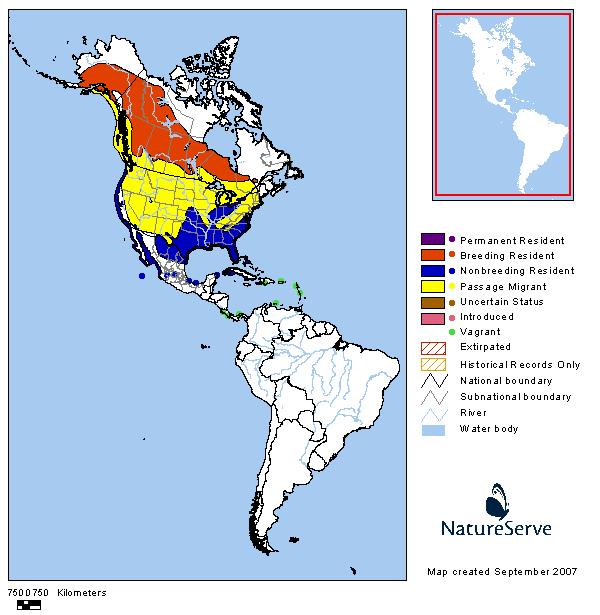
Range Descriptions
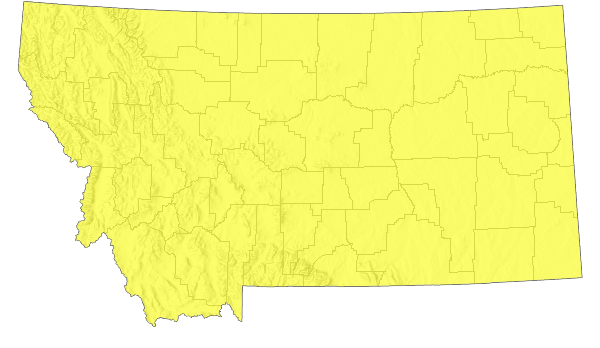
 Migratory
Western Hemisphere Range
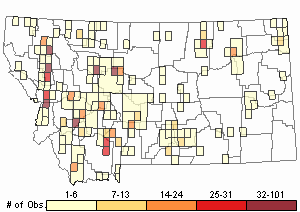
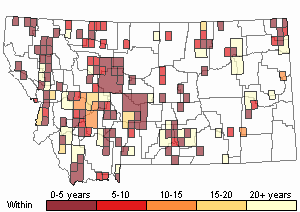
Observations in Montana Natural Heritage Program Database
Number of Observations: 1250
(Click on the following maps and charts to see full sized version)
Map Help and Descriptions
Relative Density
Recency
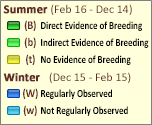
SUMMER (Feb 16 - Dec 14)
Direct Evidence of Breeding
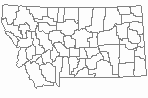
Indirect Evidence of Breeding
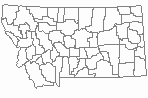
No Evidence of Breeding
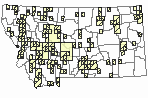
WINTER (Dec 15 - Feb 15)
Regularly Observed
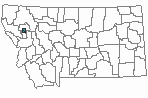
Not Regularly Observed
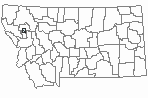
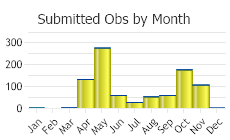
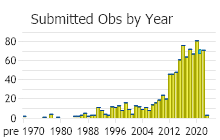
 (Observations spanning multiple months or years are excluded from time charts)
Migration
Most of Montana is in the main migration path. Bozeman migration dates are May 4 to 15, with peaks on May 10. Fall records are mostly for November (Skaar 1969).
Habitat
Bonaparte's Gulls prefer larger lakes, but occur on smaller ponds as well (Skaar 1969).
National Vegetation Classification System Groups Associated with this Species
Wetland and Riparian
Alkaline - Saline Wetlands
Alpine Riparian and Wetland
Peatland
Riparian and Wetland Forest
Riparian Shrubland
Wet Meadow and Marsh
Human Land Use
Agriculture
Food Habits
Diet consists of small fish, euphausids, amphipods, and insects.
Reproductive Characteristics
Single brooded species with three eggs per brood. Incubation period twenty-four days.
Stewardship Responsibility
References
- Literature Cited AboveLegend:
 View Online Publication
- Marks, J.S., P. Hendricks, and D. Casey. 2016. Birds of Montana. Arrington, VA. Buteo Books. 659 pages.
 Skaar, P.D. 1969. Birds of the Bozeman latilong: a compilation of data concerning the birds which occur between 45 and 46 N. latitude and 111 and 112 W. longitude, with current lists for Idaho, Montana, Wyoming, impinging Montana counties and Yellowstone National Park. Bozeman, MT. 132 p.
- Additional ReferencesLegend: View Online Publication
Do you know of a citation we're missing?- American Ornithologists’ Union [AOU]. 1998. Check-list of North American birds, 7th edition. American Ornithologists’ Union, Washington, D.C. 829 p.
- Burger, J., and M. Gochfeld. 2002. Bonaparte’s Gull (Chroicocephalus philadelphia). In The birds of North America, No. 634 (A. Poole and F. Gill, Eds.). Academy of Natural Sciences of Philadelphia and American Ornithologists’ Union.
- Cameron, E. S. 1907. The birds of Custer and Dawson counties, Montana. Auk 24(3): 241-270.
- Dood, A.R. 1980. Terry Badlands nongame survey and inventory final report. Montana Department of Fish, Wildlife, and Parks and Bureau of Land Management, Helena, MT. 70 pp.
- Ehrlich, P., D. Dobkin, and D. Wheye. 1988. The birder’s handbook: a field guide to the natural history of North American birds. Simon and Schuster Inc. New York. 785 pp.
- Hays, R., R.L. Eng, and C.V. Davis (preparers). 1984. A list of Montana birds. Helena, MT: MT Dept. of Fish, Wildlife & Parks.
- Hoffmann, R.S., R.L. Hand, and P.L. Wright. 1959. Recent bird records from western Montana. The Condor 61(2):147-151.
- Johnsgard, P.A. 1992. Birds of the Rocky Mountains with particular reference to national parks in the northern Rocky Mountain region. Lincoln: University of Nebraska Press. xi + 504 pp.
- Joslin, Gayle, and Heidi B. Youmans. 1999. Effects of recreation on Rocky Mountain wildlife: a review for Montana. [Montana]: Montana Chapter of the Wildlife Society.
- Lenard, S., J. Carlson, J. Ellis, C. Jones, and C. Tilly. 2003. P. D. Skaar's Montana bird distribution, 6th edition. Montana Audubon, Helena, MT. 144 pp.
- Montana Bird Distribution Committee. 2012. P.D. Skaar's Montana bird distribution. 7th Edition. Montana Audubon, Helena, Montana. 208 pp. + foldout map.
- Oechsli, L.M. 2000. Ex-urban development in the Rocky Mountain West: consequences for native vegetation, wildlife diversity, and land-use planning in Big Sky, Montana. M.Sc. Thesis. Montana State University, Bozeman. 73 p.
- Saunders, A.A. 1914. The birds of Teton and northern Lewis & Clark counties, Montana. Condor 16:124-144.
- Sibley, D. 2014. The Sibley guide to birds. Alfred A. Knopf, New York, NY. 598 pp.
- Skaar, P. D., D. L. Flath, and L. S. Thompson. 1985. Montana bird distribution. Montana Academy of Sciences Monograph 3(44): ii-69.
- U.S. Forest Service. 1991. Forest and rangeland birds of the United States: Natural history and habitat use. U.S. Department of Agriculture, Forest Service Agricultural Handbook 688. 625 pages.
- Watts, C.R. and L.C. Eichhorn. 1981. Changes in the birds of central Montana. Proceedings of the Montana Academy of Sciences 40:31-40.
- Western Technology and Engineering, Inc. (WESTECH)., 1989, Wildlife Monitoring: Absaloka Mine Area Annual Report, 1989. 12/21/88-12/20/89. Montana SMP 85005 R1. OSMP Montana 0007B. Febr. 15, 1990.
- Web Search Engines for Articles on "Bonaparte's Gull"
- Additional Sources of Information Related to "Birds"