View in other NatureServe Network Field Guides
NatureServe
Montana
Utah
Wyoming
Idaho
Wisconsin
British Columbia
South Carolina
Yukon
California
New York
General Description
Long, black legs with long, decurved bill. Black belly, rufous cap, and bright rufous brown back. Few differences in plummage in sexes. Males have darker bellies and grayer faces, while females are bigger in size.
For a comprehensive review of the conservation status, habitat use, and ecology of this and other Montana bird species, please see
Marks et al. 2016, Birds of Montana.Species Range
Montana Range
Range Descriptions
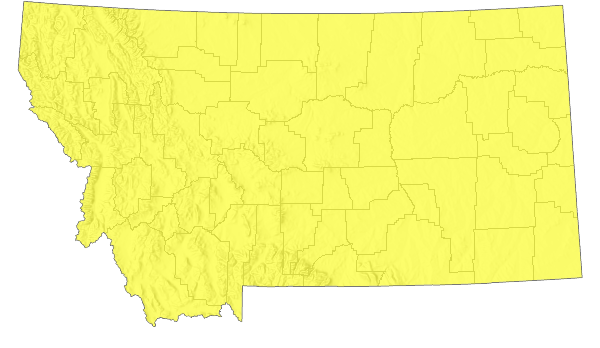
 Migratory
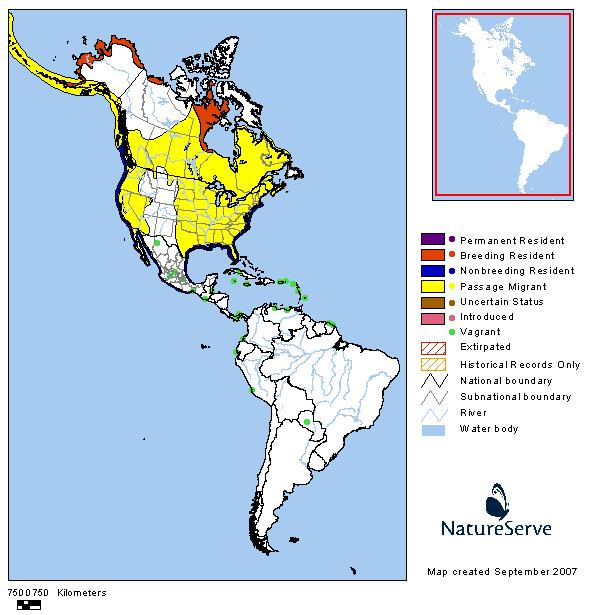
Western Hemisphere Range
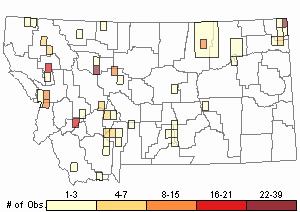
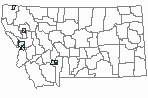
Observations in Montana Natural Heritage Program Database
Number of Observations: 287
(Click on the following maps and charts to see full sized version)
Map Help and Descriptions
Relative Density
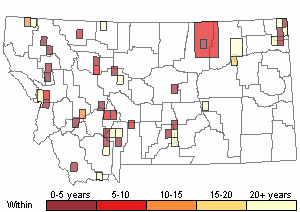
Recency
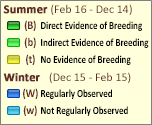
SUMMER (Feb 16 - Dec 14)
Direct Evidence of Breeding
Indirect Evidence of Breeding
No Evidence of Breeding
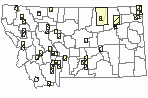
WINTER (Dec 15 - Feb 15)
Regularly Observed
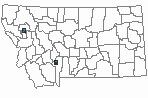
Not Regularly Observed

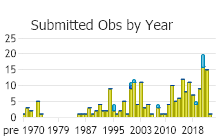
 (Observations spanning multiple months or years are excluded from time charts)
Migration
The species is primarily a coastal migrant in the western U.S.
Habitat
Migrant birds are usually seen on mud flats or sandy beaches (Johnsgard 1986).
National Vegetation Classification System Groups Associated with this Species
Wetland and Riparian
Alkaline - Saline Wetlands
Peatland
Riparian and Wetland Forest
Riparian Shrubland
Wet Meadow and Marsh
Human Land Use
Agriculture
Food Habits
Diet consists of all varieties of invertebrates with the occasional plant material and small fish.
Reproductive Characteristics
Single or double brooded species with four eggs per brood. Incubation period 21 to 22 days. Young able to fly 19 to 21 days after hatch.
Stewardship Responsibility
References
- Literature Cited AboveLegend:
 View Online Publication
- Johnsgard, P.A. 1992. Birds of the Rocky Mountains with particular reference to national parks in the northern Rocky Mountain region. Lincoln: University of Nebraska Press. xi + 504 pp.
- Marks, J.S., P. Hendricks, and D. Casey. 2016. Birds of Montana. Arrington, VA. Buteo Books. 659 pages.
- Additional ReferencesLegend: View Online Publication
Do you know of a citation we're missing?- American Ornithologists’ Union [AOU]. 1998. Check-list of North American birds, 7th edition. American Ornithologists’ Union, Washington, D.C. 829 p.
 Cobell, B. and R. Wagner. 2002. An evaluation of the terrestrial and aquatic resources of Malmstrom Air Force Base. USFWS - Montana Fish and Wildlife Management Assistance Office. 28 pgs + append.
- Ehrlich, P., D. Dobkin, and D. Wheye. 1988. The birder’s handbook: a field guide to the natural history of North American birds. Simon and Schuster Inc. New York. 785 pp.
- Hays, R., R.L. Eng, and C.V. Davis (preparers). 1984. A list of Montana birds. Helena, MT: MT Dept. of Fish, Wildlife & Parks.
- Joslin, Gayle, and Heidi B. Youmans. 1999. Effects of recreation on Rocky Mountain wildlife: a review for Montana. [Montana]: Montana Chapter of the Wildlife Society.
- Lenard, S., J. Carlson, J. Ellis, C. Jones, and C. Tilly. 2003. P. D. Skaar's Montana bird distribution, 6th edition. Montana Audubon, Helena, MT. 144 pp.
- Montana Bird Distribution Committee. 2012. P.D. Skaar's Montana bird distribution. 7th Edition. Montana Audubon, Helena, Montana. 208 pp. + foldout map.
- Mora, M. A. 1995. Residues and trends of organochloride pesticide and polychlorinated biphenyls in birds from Texas, 1965-88. Technical Report 14. Washington, D.C.: U.S.D.I. National Biological Service. 26 p.
- Sibley, D. 2014. The Sibley guide to birds. Alfred A. Knopf, New York, NY. 598 pp.
- Skaar, P. D., D. L. Flath, and L. S. Thompson. 1985. Montana bird distribution. Montana Academy of Sciences Monograph 3(44): ii-69.
- Skaar, P.D. 1969. Birds of the Bozeman latilong: a compilation of data concerning the birds which occur between 45 and 46 N. latitude and 111 and 112 W. longitude, with current lists for Idaho, Montana, Wyoming, impinging Montana counties and Yellowstone National Park. Bozeman, MT. 132 p.
- Taylor, D.M. and C.H. Trost. 1987. The status of historically rare of unrecorded birds in Idaho. Unpublished manuscript. 68 p.
- Warnock, N., and R. E. Gill. 1996. Dunlin (Calidris alpina). In The birds of North America, No. 203 (A. Poole and F. Gill, Eds.). Academy of Natural Sciences of Philadelphia and American Ornithologists’ Union.
- Web Search Engines for Articles on "Dunlin"
- Additional Sources of Information Related to "Birds"