View in other NatureServe Network Field Guides
NatureServe
Montana
Utah
Wyoming
Idaho
Wisconsin
British Columbia
South Carolina
Yukon
California
New York
Barrow's Goldeneye - Bucephala islandica
State Rank Reason (see State Rank above)
Species is uncommon across western Montana. Population trend is uncertain but it may be declining. Threats are poorly documented, but include habitat loss due to warming temperatures.
General Description
Medium-sized diving duck. Total length, early-spring mass: male 48.4 cm, 1,278 g; female 43.2 cm, 818 g. Compact, chunky appearance with short neck and round body, with relatively large rounded head and short gray-black bill. Adult sexes are strongly dimorphic in size and plumage most of the year. Breeding male has striking pattern of iridescent, purplish-black head with bright, white crescent-patch between bill and eye; brilliant white sides, breast, belly and secondaries contrasted against black back, wings, and tail. Female has dark chocolate-brown head; slate-gray back, wings, and tail; and white flanks, belly, and breast. Both sexes have bright amber irides (hence the name "goldeneye"). Wing-beat is rapid with relatively deep arc; produces a distinctive "whistle." (Eadie et al. 2000).
For a comprehensive review of the conservation status, habitat use, and ecology of this and other Montana bird species, please see
Marks et al. 2016, Birds of Montana.Diagnostic Characteristics
See Tobish (1987) for details on identification of Barrow's and Common Goldeneyes in all plumages.
Species Range
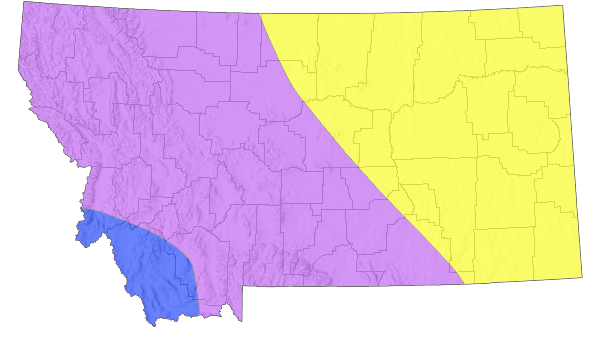
Montana Range
Range Descriptions
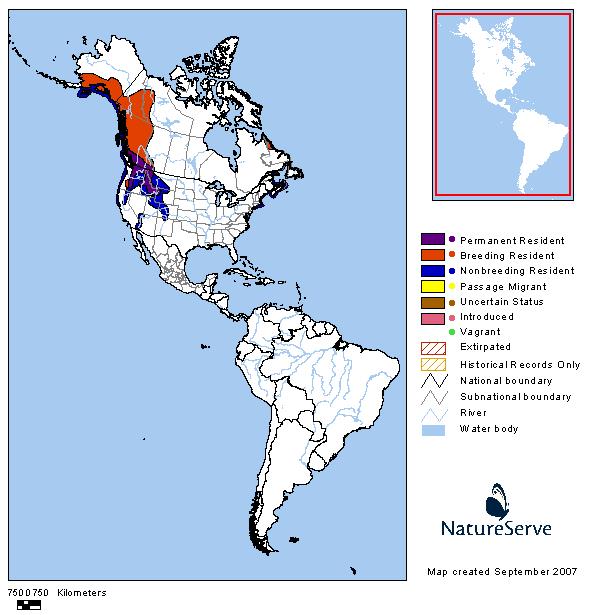
 Western Hemisphere Range
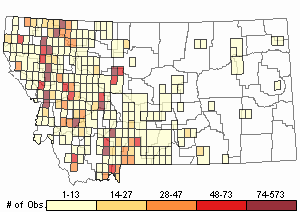
Observations in Montana Natural Heritage Program Database
Number of Observations: 5598
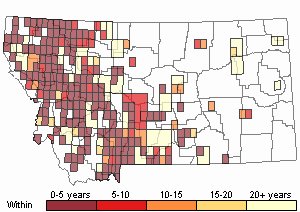
(Click on the following maps and charts to see full sized version)
Map Help and Descriptions
Relative Density
Recency
SUMMER (Feb 16 - Dec 14)
Direct Evidence of Breeding
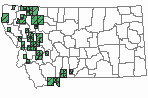
Indirect Evidence of Breeding
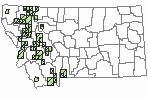
No Evidence of Breeding
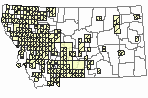
WINTER (Dec 15 - Feb 15)
Regularly Observed
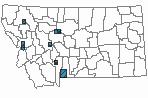
Not Regularly Observed
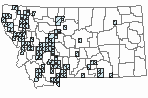

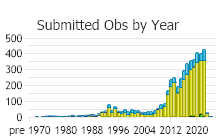
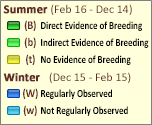 (Observations spanning multiple months or years are excluded from time charts)
Migration
Migration periods are centered around the first week in April in western Montana, and November 20 in the Bozeman area (Bergeron et al. 1992).
Habitat
Chiefly a bird of the western montane region of North America. This species is generally restricted to areas west of the Continental Divide. Prefers alkaline to freshwater lakes in parkland areas; to lesser extent, subalpine and alpine lakes, beaver ponds, and small sloughs (Eadie et al. 2000).
National Vegetation Classification System Groups Associated with this Species
Wetland and Riparian
Alkaline - Saline Wetlands
Alpine Riparian and Wetland
Peatland
Riparian and Wetland Forest
Riparian Shrubland
Wet Meadow and Marsh
Food Habits
Aquatic invertebrates (insects, mollusks, crustaceans) and fish eggs. Seeds and tubers provide a small fraction of the diet (Eadie et al. 2000).
Ecology
The most aggressive of the three Bucephala species; both males and females defend site-specific pair and brood territories, respectively. Pair bonds can be long-term, and males and females exhibit philopatry to breeding and wintering grounds. (Eadie et al. 2000)
Reproductive Characteristics
Cavity nester; live or dead trees, but will infrequently nest in other sites, such as rock crevices or under tree stumps. Females with breeding experience exhibit high fidelity to previous nest sites. Eggs are elliptical to oval in shape. Bluish green to olive green in color. Smooth texture, slightly glossy. Clutch size ranges from 6 to 12 eggs (Eadie et al. 2000). Chicks less than one week old in the Fortine area were seen from May 29 to July 15. Brood size averaged eight.
Management
Timber harvest has reduced the availability of suitable cavity trees for nesting; nest boxes are a useful tool to supplement natural cavities. Recreational activities on breeding lakes can lead to increased disturbance of broods. (Eadie et al. 2000)
Stewardship Responsibility
References
- Literature Cited AboveLegend:
 View Online Publication
 Eadie, J.M., J.P.L. Savard, and M.L. Mallory. 2000. Barrow's Goldeneye (Bucephala islandica). Species Account Number 548. The Birds of North America Online (A. Poole, Ed.). Ithaca, NY: Cornell Laboratory of Ornithology; Retrieved 3/25/2008 from The Birds of North America Online database
- Marks, J.S., P. Hendricks, and D. Casey. 2016. Birds of Montana. Arrington, VA. Buteo Books. 659 pages.
- Tobish, T. 1987. Separation of Barrow's and common goldeneyes in all plumages. Birding 18(1):17-27.
- Additional ReferencesLegend: View Online Publication
Do you know of a citation we're missing?- American Ornithologists’ Union [AOU]. 1998. Check-list of North American birds, 7th edition. American Ornithologists’ Union, Washington, D.C. 829 p.
- Bergeron, D., C. Jones, D.L. Genter, and D. Sullivan. 1992. P. D. Skaar's Montana Bird Distribution, Fourth Edition. Special Publication No. 2. Montana Natural Heritage Program, Helena. 116 pp.
- Casey, D. 2000. Partners in Flight Draft Bird Conservation Plan Montana. Version 1.0. 287 pp.
- Dickson, D.C. 1991. Systematic wildlife observations on the Blackfoot-Clearwater Wildlife Management Area. Montana Department of Fish, Wildlife and Parks. Missoula, MT. 14 pp. plus appendices and photographs.
- Ehrlich, P., D. Dobkin, and D. Wheye. 1988. The birder’s handbook: a field guide to the natural history of North American birds. Simon and Schuster Inc. New York. 785 pp.
- Hays, R., R.L. Eng, and C.V. Davis (preparers). 1984. A list of Montana birds. Helena, MT: MT Dept. of Fish, Wildlife & Parks.
- Hendricks, P. and C.J. Norment. 1986. Additions to the alpine avifauna of the Beartooth Mountains. The Murrelet 67:90-92.
- Hoffmann, R.S., R.L. Hand, and P.L. Wright. 1959. Recent bird records from western Montana. The Condor 61(2):147-151.
- Johnsgard, P.A. 1979. Birds of the Great Plains: breeding species and their distribution. University of Nebraska Press, Lincoln. 539 pp.
- Johnsgard, P.A. 1992. Birds of the Rocky Mountains with particular reference to national parks in the northern Rocky Mountain region. Lincoln: University of Nebraska Press. xi + 504 pp.
- Joslin, Gayle, and Heidi B. Youmans. 1999. Effects of recreation on Rocky Mountain wildlife: a review for Montana. [Montana]: Montana Chapter of the Wildlife Society.
- Lenard, S., J. Carlson, J. Ellis, C. Jones, and C. Tilly. 2003. P. D. Skaar's Montana bird distribution, 6th edition. Montana Audubon, Helena, MT. 144 pp.
- Montana Bird Distribution Committee. 2012. P.D. Skaar's Montana bird distribution. 7th Edition. Montana Audubon, Helena, Montana. 208 pp. + foldout map.
- MT Fish, Wildlife & Parks. No date. Blackfoot-Clearwater Wildlife Management Area checklist.
- Oechsli, L.M. 2000. Ex-urban development in the Rocky Mountain West: consequences for native vegetation, wildlife diversity, and land-use planning in Big Sky, Montana. M.Sc. Thesis. Montana State University, Bozeman. 73 p.
- Palmer, R.S. 1962. Handbook of North American birds. Volume 1. Loons through flamingos. Yale University Press, New Haven. 567 pp.
- Ragnal, Wendy, and Troy Brandt, Wetland Services, Helena, MT., 1998, Tucker Crossing Ranch Wetland Mitigation Project for Montana Dept. of Transportation: Highway 93 - Hamilton to Lolo: 1998 - Year Two Monitoring Report - Addendum. In Tucker Crossing Site WS# Lower Clark Fork, Ravalli County. Fin.Dist.1 Admin. Dist.1
- Rhodes, O.E., Jr., L.M. Smith and M.H. Smith. 1991. Conservation and genetic resources in waterfowl. Trans. N. Amer. Wildl. & Nat. Res. Conf. 56:462-472.
- Sea Duck Joint Venture Management Board. 2001. Sea Duck Joint Venture Strategic Plan: 2001-2006. SDJV Continental Technical Team. Unpubl. report c/o USFWS, Anchorage, AK; CWS, Sackville, New Brunswick. 14 p. plus appendices.
- Sibley, D. 2014. The Sibley guide to birds. Alfred A. Knopf, New York, NY. 598 pp.
- Skaar, P. D., D. L. Flath, and L. S. Thompson. 1985. Montana bird distribution. Montana Academy of Sciences Monograph 3(44): ii-69.
- Skaar, P.D. 1969. Birds of the Bozeman latilong: a compilation of data concerning the birds which occur between 45 and 46 N. latitude and 111 and 112 W. longitude, with current lists for Idaho, Montana, Wyoming, impinging Montana counties and Yellowstone National Park. Bozeman, MT. 132 p.
- Swan River National Wildlife Refuge. 1982. Birds of the Swan River NWR. Kalispell, MT: NW MT Fish and Wildlife Center pamphlet.
- U.S. Forest Service. 1991. Forest and rangeland birds of the United States: Natural history and habitat use. U.S. Department of Agriculture, Forest Service Agricultural Handbook 688. 625 pages.
- USDI Fish and Wildlife Service., 1961, A Detailed report on fish and wildlife resources affected by McNamara Dam and Reservoir, Blackfoot River Project, Montana. June 1961.
- Waldt, R. 1995. The Pine Butte Swamp Preserve bird list. Choteau, MT: The Nature Conservancy. Updated August 1995.
- Watts, C.R. and L.C. Eichhorn. 1981. Changes in the birds of central Montana. Proceedings of the Montana Academy of Sciences 40:31-40.
- Web Search Engines for Articles on "Barrow's Goldeneye"
- Additional Sources of Information Related to "Birds"