View in other NatureServe Network Field Guides
NatureServe
Montana
Utah
Wyoming
Idaho
Wisconsin
British Columbia
South Carolina
Yukon
California
New York
Western Cattle-Egret - Ardea ibis
General Description
A gregarious, white, chicken-sized bird easily recognized by its foraging association with grazing animals. Compared to similar-sized herons and egrets, it is short-legged and thick-necked; throat appears swollen (Telfair 2006).
For a comprehensive review of the conservation status, habitat use, and ecology of this and other Montana bird species, please see
Marks et al. 2016, Birds of Montana.Species Range
Uncommon Migrant
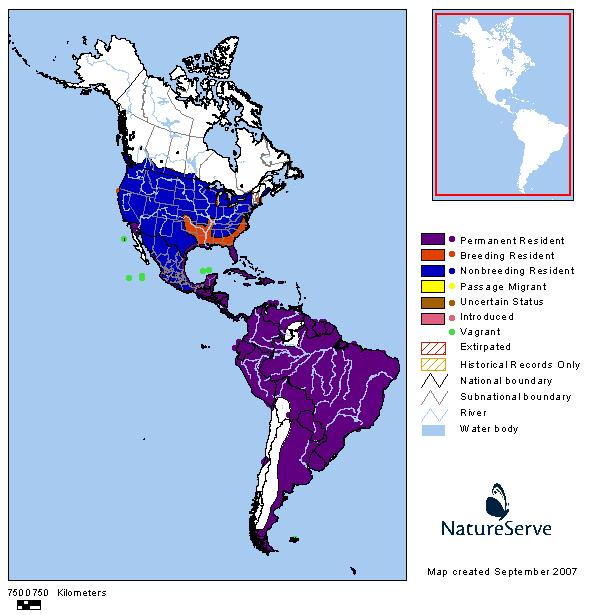
Western Hemisphere Range
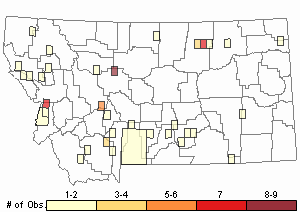
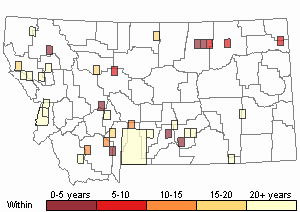
Observations in Montana Natural Heritage Program Database
Number of Observations: 76
(Click on the following maps and charts to see full sized version)
Map Help and Descriptions
Relative Density
Recency
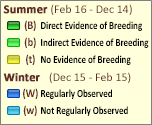
SUMMER (Feb 16 - Dec 14)
Direct Evidence of Breeding
Indirect Evidence of Breeding
No Evidence of Breeding
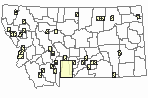
WINTER (Dec 15 - Feb 15)
Regularly Observed
Not Regularly Observed
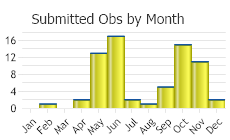
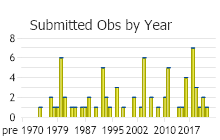
 (Observations spanning multiple months or years are excluded from time charts)
Habitat
The Cattle Egret is the most terrestrial heron; widespread and remarkably adapted to many habitats, both terrestrial and aquatic. Best described as a species adapted to naturally disturbed as well as to highly disrupted, converted landscapes, such as typical cattle and farm land and urban areas (parks, school grounds, sports fields, road edges, lawns, and city dumps and refuse areas) (Telfair 2006).
Food Habits
Diverse diet which varies greatly according to foraging habitat, feeding opportunity, and prey availability. Mostly grasshoppers, crickets, spiders, flies, frogs, and noctuid moths (Telfair 2006).
Reproductive Characteristics
Nests in multi-species colonies established by native herons, egrets, ibises etc. and uses a wide variety of sites and substrates. Nests in live and dead vegetation. Eggs typically subelliptical, light sky blue in color. Clutch size ranges 1 to 9 eggs, averaging 3 to 4. Most first broods occur from early May to early June, depending on weather conditions (Telfair 2006).
Stewardship Responsibility
References
- Literature Cited AboveLegend:
 View Online Publication
- Marks, J.S., P. Hendricks, and D. Casey. 2016. Birds of Montana. Arrington, VA. Buteo Books. 659 pages.
- Telfair, R. C. II. 1994. Cattle Egret (Bubulcus ibis). In The birds of North America, No. 113 (A. Poole and F. Gill, Eds.). Academy of Natural Sciences of Philadelphia and American Ornithologists’ Union. [Revised online 1 May 2006]
- Additional ReferencesLegend: View Online Publication
Do you know of a citation we're missing?- American Ornithologists’ Union [AOU]. 1998. Check-list of North American birds, 7th edition. American Ornithologists’ Union, Washington, D.C. 829 p.
- Ehrlich, P., D. Dobkin, and D. Wheye. 1988. The birder’s handbook: a field guide to the natural history of North American birds. Simon and Schuster Inc. New York. 785 pp.
 Hays, R., R.L. Eng, and C.V. Davis (preparers). 1984. A list of Montana birds. Helena, MT: MT Dept. of Fish, Wildlife & Parks.
- Johnsgard, P.A. 1992. Birds of the Rocky Mountains with particular reference to national parks in the northern Rocky Mountain region. Lincoln: University of Nebraska Press. xi + 504 pp.
- Joslin, Gayle, and Heidi B. Youmans. 1999. Effects of recreation on Rocky Mountain wildlife: a review for Montana. [Montana]: Montana Chapter of the Wildlife Society.
- Lenard, S., J. Carlson, J. Ellis, C. Jones, and C. Tilly. 2003. P. D. Skaar's Montana bird distribution, 6th edition. Montana Audubon, Helena, MT. 144 pp.
- Lokemoen, J.T. 1979. The status of herons, egrets, and ibises in North Dakota. Prairie Nat. 11(4): 97-110.
- Montana Bird Distribution Committee. 2012. P.D. Skaar's Montana bird distribution. 7th Edition. Montana Audubon, Helena, Montana. 208 pp. + foldout map.
- Pavlacky Jr., D.C., et al. 2021. Landscape-scale conservation mitigates the biodiversity loss of grassland birds. Ecological Applications e2548. 17 p.
- Schmidt, R.A. 1980. First breeding record of the White-faced Ibis in North Dakota. Prairie Nat. 12(1): 21-23.
- Sibley, D. 2014. The Sibley guide to birds. Alfred A. Knopf, New York, NY. 598 pp.
- Skaar, P. D., D. L. Flath, and L. S. Thompson. 1985. Montana bird distribution. Montana Academy of Sciences Monograph 3(44): ii-69.
- Skaar, P.D. 1969. Birds of the Bozeman latilong: a compilation of data concerning the birds which occur between 45 and 46 N. latitude and 111 and 112 W. longitude, with current lists for Idaho, Montana, Wyoming, impinging Montana counties and Yellowstone National Park. Bozeman, MT. 132 p.
- Taylor, D.M. and C.H. Trost. 1987. The status of historically rare of unrecorded birds in Idaho. Unpublished manuscript. 68 p.
- U.S. Forest Service. 1991. Forest and rangeland birds of the United States: Natural history and habitat use. U.S. Department of Agriculture, Forest Service Agricultural Handbook 688. 625 pages.
- Wassink, J. 1991. Birds of the Central Rockies. Mountain Press Publishing Co., Missoula, MT.
- Wright, P.L. 1996. Status of rare birds in Montana, with comments on known hybrids. Northwestern Naturalist 77(3):57-85.
- Web Search Engines for Articles on "Western Cattle-Egret"
- Additional Sources of Information Related to "Birds"