View in other NatureServe Network Field Guides
NatureServe
Montana
Utah
Wyoming
Idaho
Wisconsin
British Columbia
South Carolina
Yukon
California
New York
Coeur d'Alene Salamander - Plethodon idahoensis
State Rank Reason (see State Rank above)
Species is widespread across western Montana, but occurs at relatively isolated sites associated with springs, seeps, and waterfall spray zones. It faces threats from impacts of road maintenance and expansion and drought.
General Description
EGGS
Eggs are unlikely to be encountered because they are laid in moist subterranean fractured rock sites (Lynch 1984). Clusters can be up to 13 eggs (Lynch 1984). Eggs are cream colored, around 5 mm (0.2 in) in diameter, and surrounded by two jelly capsules (Larson et al. 1998).
LARVAE
There is no larval stage. Instead juveniles hatch directly from eggs.
JUVENILES AND ADULTS
The legs are relatively long with slightly webbed toes which are shorter than the soles of the feet. A greenish-yellow, orange, or red dorsal stripe may extend from the tip of the snout to the tip of the tail and a yellowish throat patch is present. The stripe usually has scalloped edges, though they may be even. Eyelids are the same color as the dorsal stripe. White flecking is present on the lateral and ventral surfaces over a black base color. There are 14-15 costal grooves present. Snout-vent length (SVL) of 18 to 64 mm (0.71-2.5 in) (Lynch 1984).
Diagnostic Characteristics
Adult Long-toed Salamanders (
Ambystoma macrodactylum) do not have nasolabial grooves, their toes are not webbed, and the fourth toe on their hind feet is longer than the soles of their hind feet. See habitat for Long-toed Salamander for differences in habitat use. Western Tiger Salamander (
A. mavortium) are more heavy-bodied, lack a single dorsal stripe and nasolabial groove. See sections on distribution for geographic areas of possible overlap for Long-toed and Western Tiger Salamanders.
Coeur d'Alene Salamanders have 0.5 to 3.0 intercostal folds between limbs. It has the fewest costal grooves of all western
Plethodon. It also has more vomerine and premaxillary-maxillary teeth and a relatively shorter tail than other western
Plethodon.
Species Range
Montana Range
Range Descriptions
 Native
Western Hemisphere Range
Range Comments
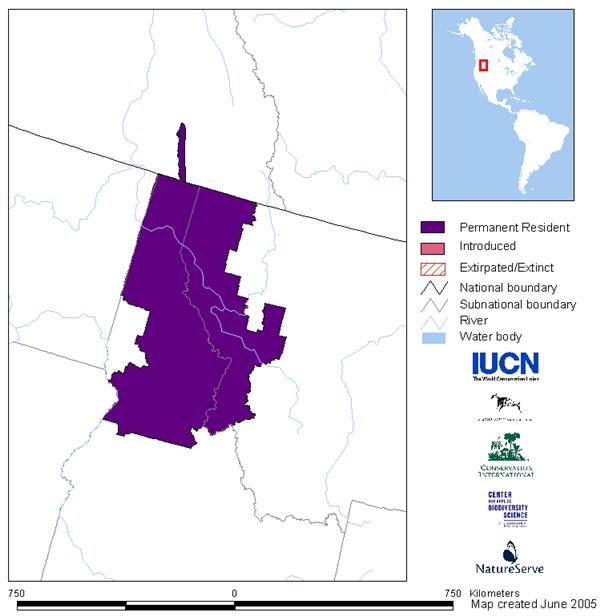
The Coeur d’Alene Salamander is a distinct species inhabiting the northern Rocky Mountains in northern Idaho, northwest Montana, and southeastern British Columbia at elevations up to 1,550 m (5,086 ft) (Howard et al. 1993; Petranka 1998; Wilson et al. 1997; Wilson and Larsen 1998). In Montana they have been documented at isolated localities in a narrow band west of the Bitterroot River, Salish Mountains, and Lake Koocanusa from Sweathouse Creek in the Bitterroot Valley to just north of the town of Yaak near the Canadian border. However, given the paucity of surveys that have been conducted; it is likely that their range extends further south on the west side of the Bitterroot Valley and all the way to the Canadian border.
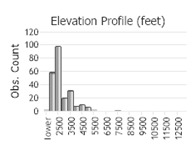
Maximum elevation: 1,585 m (5,200 ft) in Ravalli County (Werner et al. 2004). A biogeographic analysis indicates that they may be found up to 1,800 m (5,906 ft) at the southern end of their range in Montana (Wilson and Larsen 1998). A voucher specimen was collected well above this theoretical maximum elevation at 2,438 m (8,000 ft) in Ravalli County, but because the animal was found dead on the surface it is possible it was carried to the location (Maxell et al. 2003).
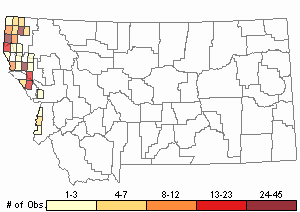
Observations in Montana Natural Heritage Program Database
Number of Observations: 271
(Click on the following maps and charts to see full sized version)
Relative Density
Recency
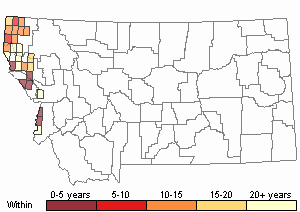

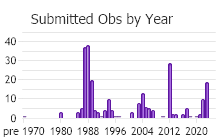
 (Observations spanning multiple months or years are excluded from time charts)
Migration
The species is a non-migrant.
Habitat
The occupied habitat for Coeur d'Alene Salamanders in Montana is like that for the entire global range and includes the three major habitat categories usually with a forest canopy cover: springs and seeps (76%), waterfall spray zones (6%), and damp streambanks (17%). Additionally, in Montana, two sites occurred in abandoned mines. (Wilson and Larsen 1988; Werner and Reichel 1994; Wilson et al. 1997; Boundy 2001; Maxell 2002).
Primary habitats are seepages and streamside talus; they also inhabit talus far from free water (deep talus mixed with moist soil on well-shaded north-facing slopes). However, the relative number of locations in each type is likely biased by differences in survey efficiency and probably does not reflect the importance of the different habitats. The abundance of seep locations is at least partly due to the relative ease of surveying roadside seeps. Streams and waterfalls are often less accessible, particularly at night. Coeur d'Alene Salamanders are most difficult to find in streamside habitat, where they are usually observed underneath moist rocks on the banks adjacent to the water. Searches of 30 minutes to find a Coeur d'Alene Salamander at a stream site during daylight are not uncommon (Groves 1988).
Coeur d'Alene Salamander occurrences are generally located in coniferous forests but are not restricted to a specific overstory species or aspect. Populations have been found in areas with Ponderosa Pine (
Pinus ponderosa), Douglas-fir (
Pseudotsuga menziesii), Western Larch (
Larix occidentalis), Western Redcedar (
Thuja plicata) and Western Hemlock (
Tsuga heterophylla) overstories (Groves 1988; Groves et al. 1996) at all aspects.
Of the 99 known occurrences in Idaho, 90% of sites with data collected on habitats were in areas of greater than 25% canopy cover and only two (both seeps) were in an area with 10% cover or less. Forest cover may be more important near stream sites than seep sites. Average cover at seven streamside sites (83% + or - 15%) was significantly greater than at seep locations (57% ± 5%), (Cassirer et al. 1994). Minimum canopy cover measured at stream sites was 42%. Terrain at sites was typically steep, with average slopes of 62% (range 10-90%) (Groves 1988; Wilson 1991).
Known populations occur in association with sharply fractured rock formations (used for underground refugia) from 488 m to 1,524 m (1601-5000 ft) in elevation. This fractured rock is often found in the Belt Rock formation but can also occur in talus and in other geologic types (Wilson and Simon 1987; Groves and Cassirer 1989). The species is found in conjunction with both persistent and intermittent surface water. Thus, it is possible to locate Coeur d'Alene Salamanders at a wet site in the spring yet be unable to find any animals at the same site later in the summer when the site is dry on the surface.
National Vegetation Classification System Groups Associated with this Species
Forest and Woodland
Montane - Subalpine Forest and Woodland
Sparse and Barren
Sparse and Barren
Wetland and Riparian
Riparian and Wetland Forest
Open Water
Streams and Rivers (Lotic) - Northern Great Plains
Food Habits
This species is an invertivore. When above ground, Coeur d'Alene Salamanders feed primarily on insects (11 orders documented) and other invertebrates, including millipedes, mites, spiders, harvestmen, snails, and segmented worms (Wilson and Larsen 1988; Lindeman 1993). They appear to be opportunistic feeders and generally restrict foraging activities to moist spray zones, seeps, or streamside rocks and vegetation. They may venture beyond these areas during rainy periods. The diet is most like other salamanders that occupy semi-aquatic habitats.
Ecology
Coeur d’Alene Salamanders are lungless. They respire through their skin and lose water to the environment through evaporation (Spotila 1972; Feder 1983). This results in restricting their movement to cool and damp environments. Because Coeur d'Alene Salamanders may live in the harshest climate of any northwestern plethodontid (Nussbaum et al. 1983), they are highly dependent on the thermal and hydrologic stability provided by wet habitats in otherwise inhospitable surroundings. For this reason, Coeur d'Alene Salamanders are closely tied to water and are considered among the most aquatic plethodontids (Brodie and Storm 1970).
The Coeur d'Alene Salamander is most often nocturnal when surface-active. Although it has been seen in daytime during rain, heavy overcast, and clear sky conditions; surface activity is most prevalent during spring and fall (Wilson and Larsen 1988). In wet weather and when temperatures are greater than 7 °C (44.6 °F), Coeur d’Alene Salamanders are active at night and can be found in leaf litter or under bark and logs in coniferous forests (Wilson and Larsen 1988). Surface activity is negatively correlated with high daytime temperatures and days since last rain (Wilson and Larsen 1988). The wet microclimate it occupies buffers this species from climatic extremes and may explain its persistence in a region lacking other species of plethodontid salamanders. Altogether, Coeur d’Alene Salamanders may spend up to seven months underground (Nussbaum et al. 1983, Cassirer et al. 1994, Groves et al. 1996).
Population sizes are difficult to measure, and no estimates are available. Predators include birds, gartersnakes, and possibly small mammals or ground beetles (Wilson and Simon 1985, Staub 1995, Wilson and Wilson 1996). Other sources of mortality include trampling (Werner and Reichel 1994). Evidence exists for snake predation upon the species: on July 24, 1986 in the Kootenai River Gorge, Lincoln County, Wilson and Wilson (1996) retrieved a 2.5 cm (1 in) Coeur d’Alene Salamander tail tip from a fresh road-killed Common Gartersnake, (
Thamnophis sirtalis) (39.5 cm (15.6 in) SVL), and on June 8, 1987, they palped a neonate
P. idahoensis (1.8 cm (0.7 in) SVL) from an immature Common Gartersnake (18.9 cm (7.4 in) SVL) above the west shore of Lake Koocanusa, Lincoln County, Montana.
Reproductive Characteristics
Adults breed terrestrially in late summer to fall (August to October), and, to a lesser extent, in the spring (April and May) (Lynch 1984; Lynch and Wallace 1987). Males are sexually mature at 3.5 years of age (44 mm (1.7 in) SVL); females at 4.5 years (48 to 49 mm (1.9 in) SVL), but some individuals may delay breeding. Coeur d’Alene Salamanders typically lay their first clutch during their 5th spring (Lynch 1984). Males mate every year, whereas females mate in alternate years (Lynch 1984).
After a courtship ritual of an hour or more, the male deposits a spermatophore, which is picked up by the female with her cloaca (Lynch and Wallace 1987). Females store sperm up to nine months before fertilizing eggs. Females deposit an average of six eggs in April or May, presumably in underground rock crevices, although no nest sites have been found in the wild (Lynch 1984). Little information exists regarding Coeur d'Alene Salamander reproduction in Montana. An egg mass was laid by a captive female in early June. The egg mass was 21 mm (0.83 in) maximum dimension and contained a clutch of seven eggs (Larson et al. 1998). Juveniles emerge directly from the eggs in mid-September (Lynch 1984). Neonates apparently grow more slowly than other Plethodon species. Growth probably occurs in spurts associated with wet weather in the spring and fall.
Management
The following was taken from the Status and Conservation section for the Coeur d’Alene Salamander account in
Maxell et al. 2009 Coeur d’Alene Salamanders have only been documented at approximately 50 localities in Montana, with virtually all populations isolated by miles of unsuitable habitat that cannot be crossed. Populations that have been documented appear to remain healthy if the microhabitats they require are not disturbed. Risk factors relevant to the viability of populations of this species are likely to include timber harvest, fire and fire management activities, road and trail development and maintenance, on-road vehicle use, development of water impoundments, and the isolation of individual populations as described above. Individual studies that specifically identify risk factors or other issues relevant to the conservation of Coeur d’Alene Salamanders include the following. (1) (Wallace 1986) found that populations separated by 60 mi (96.6 km) had little if any gene flow and concluded that current gene flow was not sufficient to maintain interpopulation similarity. In other words, individual populations that are separated from others by several miles may be on separate evolutionary trajectories because there is no gene flow given the dry intervening habitats which do not allow individuals to disperse. (2) Cassirer et al. (1994) and Groves et al. (1996) both thoroughly review potential risk factors relevant to the viability of Coeur d’Alene Salamander populations and give details on how these potential risk factors can be mitigated through management actions. Both manuscripts should be consulted closely. (3) In a conservation assessment completed for and partially sponsored by the Region 1 USFS office Cassirer et al. (1994) gave details for inventorying for and monitoring Coeur d’Alene Salamander populations in all Region 1 National Forests in which they have been documented. However, their inventory and monitoring suggestions were never initiated.
Stewardship Responsibility
References
- Literature Cited AboveLegend:
 View Online Publication
 Boundy, J. 2001. Herpetofaunal surveys in the Clark Fork Valley region, Montana. Herpetological Natural History 8: 15-26.
- Brodie, E.D. and R.M. Storm. 1970. Plethodon vandykei. Catalogue of American Amphibians and Reptiles: 91.1-91.2.
- Cassirer, E.F., C.R. Groves, and D. Genter. 1994. Coeur d'Alene salamander conservation assessment; report to U.S.D.A. Forest Service Region 1. Idaho Department of Fish and Game, Boise, and Montana Natural Heritage Program, Helena, MT. 55 p.
- Feder, M.E. 1983. Integrating the ecology and physiology of plethodontid salamanders. Herpetologica 39(3): 291-310.
- Groves, C. and F. Cassirer. 1989. A survey of the Katka-Boulder and Horizon Analysis areas, Idaho Panhandle National Forest, for the Coeur d’Alene salamander (Plethodon vandykei idahoensis). Idaho Department of Fish and Game. 15 p.
- Groves, C. R. 1988. Status and distribution of the Coeur d' Alene salamander (Plethodon vandykei idahoensis) in Idaho. Idaho Department of Fish and Game, Boise, Idaho. 39 p.
- Groves, C.R., E.F. Cassirer, D.L. Genter and J.D. Reichel. 1996. Element stewardship abstract for the Coeur d'Alene salamander (Plethodon idahoensis). Natural Areas Journal 16: 238-247.
- Howard, J.H., L.W. Seeb, and R. Wallace. 1993. Genetic variation and population divergence in the Plethodon vandykei species group. Herpetologica 49: 238-247.
- Larson, M.D., A.G. Wilson, Jr., and J.H. Larsen, Jr. 1998. Plethodon idahoensis (Cour d' Alene salamander). Egg mass. Herpetological Review 29: 163.
- Lindeman, P.V. 1993. Food of the Coeur d'Alene salamander (Plethodon idahoensis) at Elk Creek Falls, Idaho. Northwestern Naturalist 74: 58-59.
- Lynch, J.E. 1984. Reproductive ecology of Plethodon idahoensis. M.S. thesis. University of Idaho, Moscow, ID. 59 p.
- Lynch, J.E., Jr. and R.L. Wallace. 1987. Field observations of courtship behavior in Rocky Mountain populations of Van Dyke's salamander, Plethodon vandykei, with a description of its spermatophore. Journal of Herpetology 21: 337-340.
- Maxell, B.A. 2002. Geographic Distribution. Plethodon idahoensis. Herpetological Review 33(2): 144.
- Maxell, B.A., J.K. Werner, P. Hendricks, and D.L. Flath. 2003. Herpetology in Montana: a history, status summary, checklists, dichotomous keys, accounts for native, potentially native, and exotic species, and indexed bibliography. Society for Northwestern Vertebrate Biology, Northwest Fauna Number 5. Olympia, WA. 135 p.
- Maxell, B.A., P. Hendricks, M.T. Gates, and S. Lenard. 2009. Montana amphibian and reptile status assessment, literature review, and conservation plan, June 2009. Montana Natural Heritage Program. Helena, MT. 643 p.
- Nussbaum, R.A., E.D. Brodie, Jr. and R.M. Storm. 1983. Amphibians and reptiles of the Pacific Northwest. University of Idaho Press. Moscow, ID. 332 pp.
- Petranka, J.W. 1998. Salamanders of the United States and Canada. Smithsonian Institution Press, Washington D.C. 587 pp.
- Spotila, J.R. 1972. Role of temperature and water in the ecology of lungless salamanders. Ecological Monographs 42: 95-125.
- Staub, N.L. 1995. Caudata: Plethodon idahoensis (Coeur de'Alene salamander). Predation. Herpetological Review 26(4):199.
- Werner, J.K. and J.D. Reichel. 1994. Amphibian and reptile survey of the Kootenai National Forest: 1994. Montana Natural Heritage Program. Helena, MT. 104 p.
- Werner, J.K., B.A. Maxell, P. Hendricks and D.L. Flath. 2004. Amphibians and Reptiles of Montana. Mountain Press Publishing Company: Missoula, MT. 262 pp.
- Wilson, A.G. Jr. 1991. A survey of the Avery Ranger District, Idaho Panhandle National Forests, for the Coeur d' Alene salamander (Plethodon idahoensis). Idaho Department of Fish and Game, Nongame and Endangered Wildlife Program, Boise. 44 p.
- Wilson, A.G. Jr. and E.M. Simon. 1985. Plethodon vandykei idahoensis (Coeur d' Alene salamander). Predation. Herpetological Review 16: 111.
- Wilson, A.G. Jr. and E.M. Simon. 1987. Status of the Coeur d' Alene salamander (Plethodon vandykei idahoensis) in Montana. Montana Natural Heritage Program, Helena. 134 p.
- Wilson, A.G. Jr. and E.M. Wilson. 1996. Plethodon idahoensis (Coeur d' Alene salamander). Snake predation. Herpetological Review 27: 138.
- Wilson, A.G. Jr. and J.H. Larsen Jr. 1988. Activity and diet in seepage-dwelling Coeur d'Alene salamanders (Plethodon vandykei idahoensis). Northwest Science 62(5): 211-217.
- Wilson, A.G. Jr. and J.H. Larsen, Jr. 1998. Biogeographic analysis of the Coure d' Alene salamander (Plethodon idahoensis). Northwest Science 72: 111-115.
- Wilson, A.G. Jr., E.M. Wilson, C.R. Groves, and R.L. Wallace. 1997. U.S. distribution of the Coeur d'Alene Salamander (Plethodon idahoensis Slater and Slipp). Great Basin Nat. 57(4): 359-362.
- Additional ReferencesLegend: View Online Publication
Do you know of a citation we're missing?- [USDAFS] USDA Forest Service. 1999. Update of U.S. Forest Service Northern Region Sensitive Species List. 12 March, 1999. Region 1 U.S. Forest Service Supervisors Office, Missoula, Mt. 20 P.
- Aubry, K.B., L.L.C. Jones and P.A. Hall. 1988. Use of woody debris by plethodontid salamanders in Douglas-fir forests in Washington. Pages 32-37 in R.C. Szaro, K.E. Severson, and D.R. Patton, technical coordinators. Management of amphibians, reptiles, and small mammals in North America. General Technical Report RM-166. U.S. Forest Service, Rocky Mountain Forest and Range Experiment Station, Fort Collins, Colorado.
- Belt, G. H., J. O'Laughlin and T. Merrill. 1992. Design of forest riparian buffer strips for the protection of water quality: analysis of scientific literature. Report No. 8. Id. For. Wildl. and Policy Analysis Group, Id. For., Wildl. and Range Exp. Sta., University of Idaho, Moscow, Idaho. 34 pp.
- Black, J.H. and R. Timken. 1976. Endangered and threatened amphibians and reptiles in Montana. p 36–37. In R.E. Ashton, Jr. (chair). Endangered and threatened amphibians and reptiles in the United States. Society for the Study of Amphibians and Reptiles Herpetological Circular 5: 1-65.
- Blaustein, A.R., J.J. Beatty, H. Deanna, and R.M. Storm. 1995. The biology of amphibians and reptiles in old-growth forests in the Pacific Northwest. General Technical Report PNW-GTR-337. Portland, OR: U.S. Department of Agriculture, Forest Service, Pacific Northwest Research Station. 98 p.
- Brodie, E.D., Jr. 1970. Western salamanders of the genus Plethodon: systematics and geographic variation. Herpetologica 26: 468-516.
- Brown, G.W. and J.T. Krygier. 1970. Effects of clear-cutting on stream temperature. Water Resources Research 6(4): 1131-1139.
- Brunson, R.B. 1955. Check list of the amphibians and reptiles of Montana. Proceedings of the Montana Academy of Sciences 15: 27-29.
- Carlson, J. (Coordinator, Montana Animal Species of Concern Committee). 2003. Montana Animal Species of Concern January 2003. Helena, MT: Montana Natural Heritage Program and Montana Fish, Wildlife, and Parks. In Press. 12p.
- Charland, M.B. 1992. A survey of the distribution and biology of the Coeur d'Alene salamander (Plethodon vandykei idahoensis) in British Columbia. Wildlife Branch, Ministry of the Environment, Lands, and Parks, Victoria, B.C. Draft Report. 32 pp.
- Corn, P.S. and R.B. Bury. 1989. Logging in western Oregon: responses of headwater habitats and stream amphibians. For. Ecol. and Manage. 29:39-57.
- Crother, B.I. (ed.) 2008. Scientific and standard English names of amphibians and reptiles of North America north of Mexico. SSAR Herpetological Circular No. 37:1-84.
- Diller, L. and R. Wallace. 1985. Report on the survey of the Selway-Bitterroot wilderness for the Coeur d'Alene salamander, Plethodon vandykei. USDA Forest Service, Moose Creek District. 5 pp.
- DuBois, K. 2017. Coeur d'Alene Salamander (Plethodon idahoensis) survey, Montana Fish, Wildlife, and Parks Region 2. Missoula, MT: Montana Fish, Wildlife, and Parks. 19 p.
- Dumas, P.C. 1957b. Range extension of the salamander Plethodon vandykei idahoensis. Copeia 1957(2): 147-148.
- Flath, D.L. 1979. Nongame species of special interest or concern: Mammals, birds, reptiles, amphibians, fishes. Wildlife Division, Montana Department of Fish and Game. Helena, MT.
- Flath, D.L. 1998. Species of special interest or concern. Montana Department of Fish, Widlife and Parks, Helena, MT. March, 1998. 7 p.
- Franz, R. 1970c. Additional notes on the Coeur d' Alene salamander, Plethodon vandykei idahoensis, in Montana. Bulletin of the Maryland Herpetological Society 6: 53-55.
- Franz, R. 1971. Notes on the distribution and ecology of the herpetofauna of northwestern Montana. Bulletin of the Maryland Herpetological Society 7: 1-10.
- Genter, D. 1990. The Coeur d' Alene salamander, Montana's cliff-hanger. Montana Outdoors 21(5): 15-17.
- Genter, D.L. 1989. Mitigation of the Kootenai Falls population of the Coeur d' Alene salamander. Report to Montana Department of Highways and USDA Forest Service. Montana Natural Heritage Program, Helena, MT. 11 pp.
- Genter, D.L., A.G. Wilson, and E. Simon. 1987. Status report on Coeur d' Alene salamander in Montana. Montana Natural Heritage Program, Helena. 101 p.
- Genter, D.L., R. Summerfield, and M. Hunnicutt. 1991. Results of population monitoring for the Coeur d'Alene salamander (Plethodon idahoensis) in northwestern Montana. Montana Natural Heritage Program, Helena, MT. ? pp.
- Groves, C.R. 1988. Status and distribution of the Coeur d' Alene salamander (Plethodon vandykei idahoensis) in Idaho. Idaho Department of Fish and Game, Boise, Idaho. 39 pp.
- Groves, C.R. 1989. Status and distribution of the Coeur d' Alene salamander (Plethodon vandykei idahoensis) in Idaho. Part II. Idaho Department of Fish and Game, Boise, Idaho. 18 pp.
- Groves, C.R. 1994. Candidate and sensitive species programs. Lessons for cost-effective conservation. In: Clark, T.W., R.P. Reading, and A.L. Clarke, (Eds.) Endangered species recovery: finding the lessons, improving the process. Island Press, Washingto
- Groves, C.R., E.F. Cassirer, D.L. Genter, and J.D. Reichel. 1996. Couer d' Alene salamander (Plethodon idahoensis). Natural Areas Journal 16: 238-247.
- Hammer, K. and S. Paulsen. 1989. Coeur d' Alene salamander update. Wild Rockies Review Earth First 2(2): 17-18.
- Hendricks, P. 2005. Surveys for animal species of concern in northwestern Montana. Unpublished report to the Montana Department of Fish, Wildlife & Parks, Montana Natural Heritage Program, Helena, Montana, May 2005. 53 p.
- Hendricks, P. and J.D. Reichel. 1996a. Amphibian and reptile survey of the Bitterroot National Forest: 1995. Montana Natural Heritage Program. Helena, MT. 95 p.
- Henry, J.L. and A.G. Wilson, Jr. 2003. Plethodon idahoensis (Coeur d'Alene Salamander). Coloration. Herpetological Review 34(2):134.
- Highton, R. 1962. Revision of the North American salamanders of the genus Plethodon. Bulletin of the Florida State Museum 6(3): 235-367.
- Highton, R. and A. Larson. 1979. The genetic relationships of the salamanders of the genus Plethodon. Systematic Zoology 28: 579-599.
- Hunnicutt, M. 1990. 1990 monitoring report for Plethodon idahoensis sites on the Kootenai National Forest. 6 pp.
- Jones, L.L.C. 1989. Plethodon vandykei (Van Dyke’s Salamander). Reproduction. Herpetological Review 20(2): 48.
- Jones, Lawrence L. C., W. P. Leonard and D. H. Olson, eds. 2005. Amphibians of the Pacific Northwest. Seattle Audubon Society: Seattle, WA, 227 pp.
- Joslin, Gayle, and Heidi B. Youmans. 1999. Effects of recreation on Rocky Mountain wildlife: a review for Montana. [Montana]: Montana Chapter of the Wildlife Society.
- Kerr, R, 1989 Summary of 1989 monitoring of the Coeur d' Alene salamander (Plethodon idahoensis) in western Montana. Unpublished report for Montana Natural Heritage Program. 7 pp.
- Larson, C. L., and E. R. Kalmbach, 1950, Progress Reports on Studies of Botulism in Waterfowl
- Larson, K.S. and R.J. Larson. 1990. Lure of the locks: showiest ladies-tresses orchids, Spiranthes romanzoffiana, affect bumblebee, Bombus Spp., foraging behavior. Canadian Field Naturalist 104:519-525.
- Larson, M.M., and G.H. Schubert. 1970. Cone crops of Ponderosa Pine in central Arizona including the influence of Abert Squirrels.
- Maxell, B. A. 2000. Management of Montana's amphibians: a review of factors that may present a risk to population viability and accounts on the identification, distribution, taxonomy, habitat use, natural history, and the status and conservation of individual species. Report to USFS Region 1, Order Number 43-0343-0-0224. University of Montana, Wildlife Biology Program. Missoula, MT. 161 p.
- Maxell, B.A. 2002. Geographic Distribution. Plethodon idahoensis. Herpetological Review 33(2): 144.
- Maxell, B.A. 2002. Plethodon idahoensis (Coeur d'Alene salamander). Herpetological Review 33(2):144.
- Nicholson, K.E. ed. 2025. Scientific and standard English names of amphibians and reptiles of North America north of Mexico, with comments regarding confidence in our understanding. Ninth Edition. Society for the Study of Amphibians and Reptiles. 87 p.
- Orchard, S.A. 1990. Provincial status report for the Coeur d' Alene salamander (Plethodon idahoensis). Wildlife Branch, Ministry of Environment, Lands, and Parks, Victoria, B.C., Canada. 12 p.
- Peterson, S.M., A.G. Wilson, Jr., and E.M. Wilson. 1999. Plethodon idahoensis (Cour d' Alene salamander). Skeletal abnormality. Herpetological Review 30: 222.
- Peterson, S.M., A.G. Wilson, Jr., and E.M. Wilson. 1999. Plethodon idahoensis. Skeletal abnormality. Herpetological Review 30(4): 222.
- Reel, S. 1989. Vest-pocket preserves. Montana Outdoors 20(2): 27-29.
- Reel, S., L. Schassberger and W. Ruediger. 1989. Caring for Our Natural Community: Region 1 - Theatened, Endangered and Sensitive Species Program. USDA, Forest Service Northern Region Wildlife and Fisheries.
- Reichel, J. and D. Flath. 1995. Identification of Montana's amphibians and reptiles. Montana Outdoors 26(3):15-34.
- Slater and Slipp. 1941. The distributions of amphibians and reptiles in Idaho. Occassional Papers, Department of Biology, College of Puget Sound. No. 14, pp. 78-109.
- Slater, J.R., and J.W. Slipp. 1940. A new species of Plethodon from northern Idaho. Occassional Papers Department of Biology College of Puget Sound 1940(8): 38-43.
- Stebbins, R. C. 2003. A field guide to western reptiles and amphibians. 3rd Edition. Houghton Mifflin Company, Boston and New York. 533 p.
- Stebbins, R.C. 1985. A field guide to western reptiles and amphibians. Houghton Mifflin Company, Boston. 336 pp.
- Teberg, E.K. 1964. An extension into Montana of the known range of Plethodon vandykei idahoensis. Herpetologica 19: 287.
- Teberg, E.K. 1965. Range extensions of the salamander Plethodon vandykei idahoensis. Copeia 1965: 244.
- Thompson, L.S. 1984a. Biogeography of Montana: preliminary observations on major faunal and floristic distribution patterns. Abstract. Proceedings of the Montana Academy of Sciences 43: 40-41.
- Wallace, R.L. 1986. A biochemical genetic study of the Plethodon vandykei complex. Final report. Idaho fish and Game Non-Game Program, Boise, ID. 30 p.
- Werner, J.K. and J.D. Reichel. 1996. Amphibian and reptile monitoring/survey of the Kootenai National Forest: 1995. Montana Natural Heritage Program. Helena, MT. 115 pp.
- Werner, J.K., T. Plummer, and J. Weaslehead. 1998a. Amphibians and reptiles of the Flathead Indian Reservation. Intermountain Journal of Sciences 4(1-2): 33-49.
- Wilson Ornithological Soc., 1963, Annual Report of the Conservation Committee
- Wilson, A. G., Jr., and J. H. Larsen, Jr. 1999. Morphometric analysis of salamanders of the Plethodon vandykei species group. American Midland Naturalist 141:266-276.
- Wilson, A.G. 1990. A survey of the Nez Perce National Forest for the Coeur d’alene salamander (Plethodon idahoensis). Idaho Department of Fish and Game. 33p.
- Wilson, A.G. and E. Simon.1987. Status report on the Coeur d'Alene salamander (Plethodon idahoensis) in Montana. [Unpublished report]. 98 pp. USDA Forest Service Region 1, Kootenai and Lolo Forests.
- Wilson, A.G. and E.M. Simon. 1988. Supplementary report on the status of the Coeur d'Alene salamander (Plethodon idahoensis) in Montana. Report to the Montana Natural Heritage Program, Helena.
- Wilson, A.G. Jr. and P. Ohanjanian. Plethodon idahoensis. Catalogue of American Amphibians and Reptiles 741.1-741.4.
- Wilson, A.G. Jr., E.M. Simon, and J.H. Larsen, Jr. 1989. Range extension for the Coeur d'Alene salamander, Plethodon vandykei idahoensis, to the Canada-United States border. Canadian Field Naturalist 103:93-94.
- Wilson, A.G., Jr. 1993. Biogeographic and morphometric analyses of the Plethodon vandykei species group. Ph.D. Dissertation. Washington State University, Pullman, WA. 127 p.
- Wilson, A.G., Jr., and P. Ohanjanian. 2002. Plethodon idahoensis. Catalogue of American Amphibians and Reptiles 741.1-741.4.
- Web Search Engines for Articles on "Coeur d'Alene Salamander"
- Additional Sources of Information Related to "Amphibians"