View in other NatureServe Network Field Guides
NatureServe
Montana
Utah
Wyoming
Idaho
Wisconsin
British Columbia
South Carolina
Yukon
California
New York
Northern Bog Clubmoss - Lycopodium inundatum
Other Names:
Lycopodiella inundata
State Rank Reason (see State Rank above)
DRAFT: Requesting feedback on the 2026 revised rank, factors, and State Rank Reason outlined below and in the Conservation Status Rank Report.
Lycopodium inundatum is very rare in Montana, being known from only 5 fens stretching from the southern end of Glacier National Park to several wetlands in the Seeley-Swan Valley. Populations appear to be relatively small. Trends are generally unknown, though there is no indication of major changes in the recent past. Two of the occupied fens occur adjacent to forest roads with one of these on private land, which now contains a house and outbuildings adjacent to the fen. The proximity of the roads and development increase the risk of negative impacts.
Monitoring of the occupied fens and known populations are needed to determine potential population trends and to determine if any negative impacts are occurring.
General Description
Northern Bog Clubmoss resembles a large moss. It has prostrate or arching stems that root at irregular intervals and give rise to erect branches that are up to 10 cm high. The narrow, pointed leaves are 4-8 mm long and clothe the stems and branches in 8-10 ranks. Each spore is subtended by a bract, or sporophyll, that is similar to the leaves and borne in dense spikes at the top of erect branches. It is difficult to distinguish the fertile and sterile portions of the branches.
Phenology
Producing spores June-July.
Diagnostic Characteristics
Lycopodium annotinum is similar, but the sporophylls are half the length of the vegetative leaves. Lycopodium clavatum has well-differentiated cones of sporophylls, and L. selago has bands of sporophylls that alternate with vegetative leaves. Lycopodium inundatum is the only species occurring in standing water of peatlands.
Species Range
Montana Range
Range Descriptions
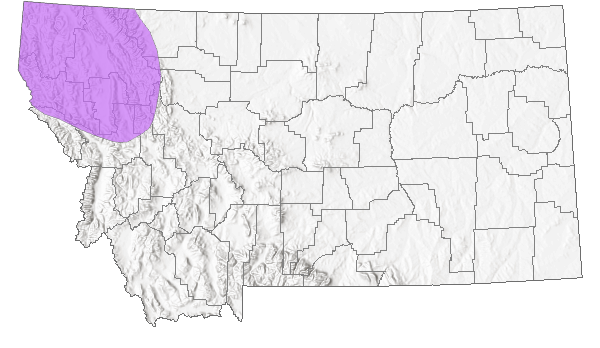
 Native
Range Comments
In MT known from Flathead and Missoula counties; BC to CA, MT and NL to OH and WV (Lesica et al. 2012. Manual of Montana Vascular Plants. BRIT Press. Fort Worth, TX).
Observations in Montana Natural Heritage Program Database
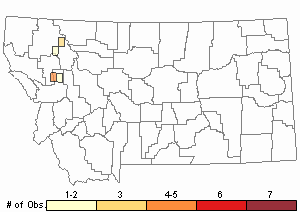
Number of Observations: 15
(Click on the following maps and charts to see full sized version)
Map Help and Descriptions
Relative Density
Recency
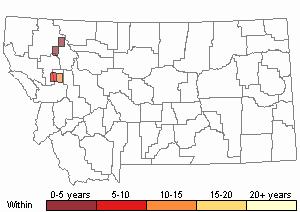
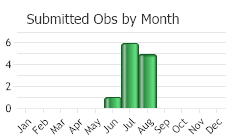
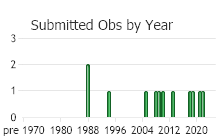
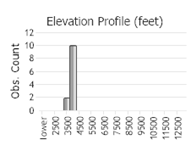 (Observations spanning multiple months or years are excluded from time charts)
Habitat
Wet, organic soil of nutrient-poor fens in the valley and lower montane zones.
National Vegetation Classification System Groups Associated with this Species
Wetland and Riparian
Peatland
Stewardship Responsibility
References
- Literature Cited AboveLegend:
 View Online Publication
- Lesica, P., M.T. Lavin, and P.F. Stickney. 2012. Manual of Montana Vascular Plants. Fort Worth, TX: BRIT Press. viii + 771 p.
- Additional ReferencesLegend: View Online Publication
Do you know of a citation we're missing? Bowles, M. L., M. M. DeMauro, N. Pavlovic, and R. D. Hiebert. 1990. Effects of anthropogenic disturbances on endangered and threatened plants at the Indiana Dunes National Lakeshore. Natural Areas Journal. 10(4): 187-200.
- Bursik, R. J., and R. K. Moseley. 1992. Forty-year changes in Hager Lake Fen, Bonner County, Idaho. Cooperative Challenge Cost-share Project, Idaho Panhandle National Forests and Idaho Conservation Data Center, Idaho Department of Fish and Game, Boise. 31 pp.
- Caicco, S. L. 1987. Field investigations of selected sensitive plant species on the Idaho Panhandle National Forest. Idaho Natural Heritage Program, Idaho Department of Fish and Game, Boise, Idaho. 44 pp.
- Gillespie, J.P. 1962. A theory of relationships in the Lycopodium inundatum complex. American Fern Journal. 52: 19-26.
- Lellinger, D.B. 1985. A Field Manual of the Ferns and Fern-Allies of the United States and Canada. Smithsonian Inst. Press. Washington, D.C. B85LEL01PAUS
- Lesica, P., M.T. Lavin, and P.F. Stickney. 2022. Manual of Montana Vascular Plants, Second Edition. Fort Worth, TX: BRIT Press. viii + 779 p.
- Moseley, R. K., R. J. Bursik, and M. Manusco. 1991. Floristic inventory of wetlands in Fremont and Teton counties, Idaho. Unpublished report on file IDCDC Department of Fish & Game, Boise, ID. 60 pp.
- Rumely, J. H. 1956. Plant ecology of a bog in northern Idaho. Unpublished dissertation, Washington State University, Pullman. 85 pp.
- Shelly, J. S. and M. Mantas. 1993. Noteworthy collections, Montana. Madrono 40:271-273.
- Web Search Engines for Articles on "Northern Bog Clubmoss"