View in other NatureServe Network Field Guides
NatureServe
Montana
Utah
Wyoming
Idaho
Wisconsin
British Columbia
South Carolina
Yukon
California
New York
Ice Grass - Phippsia algida
State Rank Reason (see State Rank above)
DRAFT: Requesting feedback on the 2026 revised rank, factors, and State Rank Reason outlined below and in the Conservation Status Rank Report.
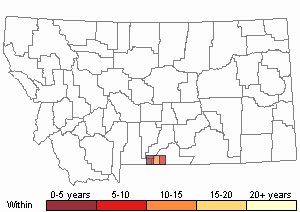
Phippsia algida is rare in Montana, being known only from wet, alpine areas of the Beartooth Plateau. Occurrences are in remote areas with most of the known populations occurring within designated wilderness areas. The remote habitat limits the potential for negative impacts, and no significant and widespread threats to the species are known besides potential impacts associated with climate change. Population levels are poorly documented, and trends are unknown though populations have likely been relatively stable in the recent past or experienced only minor declines. All but four of the observations are more than three decades old, leading to additional uncertainty about the status of the populations.
Climate change may negatively affect this species over the next several decades. However, the timing and magnitude of potential impacts are largely unknown. Although climate change is listed as a potential threat to the species, it does not affect the overall threat rank or scoring, or the final subnational rank.
Survey and monitoring data are needed to be able to more precisely determine population levels, assess condition and for assessing population trends. Surveys in potentially suitable habitat are likely to document additional occurrences.
General Description
Ice Grass is a glabrous perennial with fibrous roots and densely tufted stems that are up to 7 cm high. The narrow leaves have a boat-shaped tip. The 1-flowered spikelets are borne in a narrow, terminal inflorescence that is ca. 1/3 the length of the stem. Each spikelet has 2 small glumes. The thin, 3-nerved lemma is ca. 1.5 mm long and is blunt with a short point. The palea is slightly smaller and has a shallowly-toothed margin.
Phenology
Flowering and fruiting in August.
Diagnostic Characteristics
Members of the genus Poa have boat-shaped leaf tips, but have many-flowered spikelets. Species of Agrostis have 1-flowered spikelets, but the glumes are longer than the lemma. A hand lens will be required to inspect this plant.
Species Range
Montana Range
Range Descriptions
 Native
Range Comments
Circumpolar; south to BC, AB and QC, south in the Rocky Mountains through MT, WY and CO (Kartesz in prep. 2012).
Observations in Montana Natural Heritage Program Database
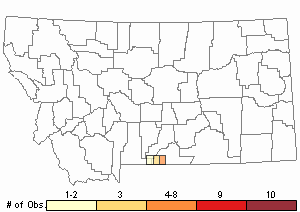
Number of Observations: 12
(Click on the following maps and charts to see full sized version)
Relative Density
Recency
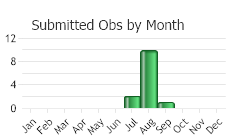

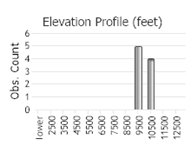 (Observations spanning multiple months or years are excluded from time charts)
Habitat
Wet, gravelly soil of seeps and along streams in the alpine zone.
National Vegetation Classification System Groups Associated with this Species
Alpine
Alpine - Vegetated
Wetland and Riparian
Alpine Riparian and Wetland
Stewardship Responsibility
Threats or Limiting Factors
STATE THREAT SCORE REASON
Threat impact not assigned because threats are not known (MTNHP Threat Assessment 2021).
References
- Literature Cited AboveLegend:
 View Online Publication
 MTNHP Threat Assessment. 2021. State Threat Score Assignment and Assessment of Reported Threats from 2006 to 2021 for State-listed Vascular Plants. Botany Program, Montana Natural Heritage Program, Helena, Montana.
- Additional ReferencesLegend: View Online Publication
Do you know of a citation we're missing?- Clark, T.W., H.A. Harvey, R.D. Dorn, D.L. Genter, and C. Groves (eds). 1989. Rare, sensitive, and threatened species of the greater Yellowstone ecosystem. Northern Rockies Conservation Cooperative, Montana Natural Heritage Program, The Nature Conservancy, and Mountain West Environmental Services. 153 p.
- Fertig, W. and M. Bynum. 1994. Biological report on the proposed Twin Lakes Research Natural Area. Unpublished report to the Shoshone National Forest. Wyoming Natural Diversity Database, Laramie, Wyoming. 33 pp. plus appendices.
- Grulke, N. E. and L. C. Bliss. 1983. A note on winter seed rain in the High Arctic. Arctic and Alpine Research 15(2):261-265.
- Grulke, N. E. and L. C. Bliss. 1988. Comparative life history characteristics of two high Arctic grasses, Northwest Territories. Ecology 69(2):484-496.
- Grulke, N.E. 1995. Distribution of Phippsia algida and autosuccession in the polar semidesert, Canadian High Arctic. Arctic and Alpine Research 27(2):172-179.
- Lesica, P. 1993. Vegetation and flora of the Line Creek Plateau area, Carbon County, Montana. Unpublished report to USDA Forest Service, Intermountain Research Station. Montana Natural Heritage Program, Helena, Montana. 30 pp.
- Lesica, P., M.T. Lavin, and P.F. Stickney. 2012. Manual of Montana Vascular Plants. Fort Worth, TX: BRIT Press. viii + 771 p.
- Lesica, P., M.T. Lavin, and P.F. Stickney. 2022. Manual of Montana Vascular Plants, Second Edition. Fort Worth, TX: BRIT Press. viii + 779 p.
- Web Search Engines for Articles on "Ice Grass"