View in other NatureServe Network Field Guides
NatureServe
Montana
Utah
Wyoming
Idaho
Wisconsin
British Columbia
South Carolina
Yukon
California
New York
Hudson's Bay Bulrush - Trichophorum alpinum
Other Names:
Scirpus hudsonianus, Eriophorum alpinum
State Rank Reason (see State Rank above)
DRAFT: Requesting feedback on the 2026 revised rank, factors, and State Rank Reason outlined below and in the Conservation Status Rank Report.
Trichophorum alpinum is rare in Montana, where it is known from several montane to lower alpine habitats in northwest Montana, mostly within Glacier National Park. Several populations are in remote areas, which limits the potential for negative impacts. No significant and widespread threats to the species are known except for potential impacts at one population that is adjacent to a trail, which makes it susceptible to trampling and trail maintenance activities. Climate change may also have negative impacts on some populations. Population levels are imprecisely known, and trends are unknown though populations have likely been relatively stable in the recent past or experienced only minor declines. One population is known only from a historical collection.
Climate change may negatively affect this species over the next several decades. However, the timing and magnitude of potential impacts are largely unknown. Although climate change is listed as a potential threat to the species, it does not affect the overall threat rank or scoring, or the final subnational rank.
Survey and monitoring data are needed to be able to more precisely determine population levels, assess condition and for assessing population trends. Surveys in potentially suitable habitat may document additional occurrences.
General Description
Stems 3-angled, 10–40 cm, loosely clustered on short rhizomes. Leaf blades ca. 0.5 mm wide. Spikelet 5–7 mm long, many-flowered; awn of lowest bract inconspicuous, shorter than the spikelet. Scales 4–5 mm long, glabrous, brown with a pale midstripe; tips acute. Flowers: bristles 6, white, greatly exceeding the spikelet. Achene ca. 1.5 mm long (
Lesica et al. 2012. Manual of Montana Vascular Plants. BRIT Press. Fort Worth, TX).
Phenology
Mature fruit in July-August.
Diagnostic Characteristics
The solitary spikelet and tuft of long bristles make this species resemble a slender Eriophorum; however, species of true cottongrass have at least 10 bristles per achene. It differs from the other species of Scirpus with solitary infloresences in having bristles that are longer than the scale, and a 3-sided stem.
Species Range
Montana Range
Range Descriptions
 Native
Range Comments
Circumboreal south to BC, MT. Known from Flathead and Glacier counties (Lesica et al. 2012. Manual of Montana Vascular Plants. BRIT Press. Fort Worth, TX).
Observations in Montana Natural Heritage Program Database
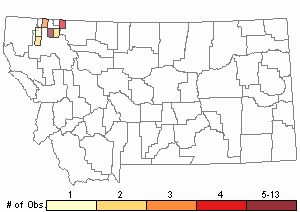
Number of Observations: 26
(Click on the following maps and charts to see full sized version)
Relative Density
Recency
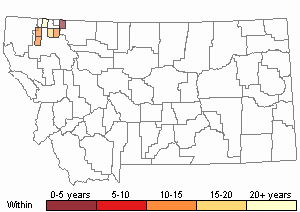
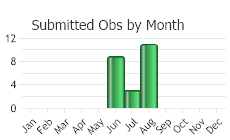
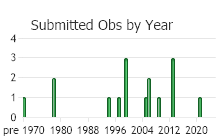
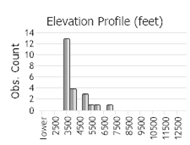 (Observations spanning multiple months or years are excluded from time charts)
Habitat
Wet, cold organic soil of fens and slopes in the montane and subalpine zones.
National Vegetation Classification System Groups Associated with this Species
Alpine
Alpine - Vegetated
Shrubland
Sagebrush Shrubland
Wetland and Riparian
Alpine Riparian and Wetland
Peatland
Wet Meadow and Marsh
Stewardship Responsibility
Threats or Limiting Factors
STATE THREAT SCORE REASON
Reported threats to Montana's populations of Hudson’s Bay Bulrush refer to trampling by hikers and potential trail maintenance. All known populations are clustered in Glacier National Park, and some of these are crossed by a popular hiking trail. Minor negative impacts from annual hiking traffic are likely. Trail maintenance or expansion of trail system could have damaging impacts if the security of populations is not considered (MTNHP Threat Assessment 2021).
References
- Literature Cited AboveLegend:
 View Online Publication
- Lesica, P., M.T. Lavin, and P.F. Stickney. 2012. Manual of Montana Vascular Plants. Fort Worth, TX: BRIT Press. viii + 771 p.
 MTNHP Threat Assessment. 2021. State Threat Score Assignment and Assessment of Reported Threats from 2006 to 2021 for State-listed Vascular Plants. Botany Program, Montana Natural Heritage Program, Helena, Montana.
- Additional ReferencesLegend: View Online Publication
Do you know of a citation we're missing?- Bursik, R. J. 1992. Field investigations of sensitive plant taxa occurring on the Priest Lake Ranger District, Kanisku National Forest, Idaho Panhandle National Forests. Idaho Department of Fish and Game, Conservation Data Center, Boise. 141 pp. plus appendices.
- Fassett, N. C. 1985. (3rd ed.) A Manual of Aquatic Plants, with Revision Appendix by E. C. Ogden. University of Wisconsin Press, Madison. 405 pp.
- Lesica, P., M.T. Lavin, and P.F. Stickney. 2022. Manual of Montana Vascular Plants, Second Edition. Fort Worth, TX: BRIT Press. viii + 779 p.
- Maguire, B. 1939. Distrubution notes concerning plants of Glacier National Park, Montana-II. Rhodora 41:504-508.
- Web Search Engines for Articles on "Hudson's Bay Bulrush"