View in other NatureServe Network Field Guides
NatureServe
Montana
Utah
Wyoming
Idaho
Wisconsin
British Columbia
South Carolina
Yukon
California
New York
Bloom Peak Douglasia - Douglasia conservatorum
Other Names:
Androsace conservatorum
State Rank Reason (see State Rank above)
DRAFT: Requesting feedback on the 2026 revised rank, factors, and State Rank Reason outlined below and in the Conservation Status Rank Report.
Douglasia conservatorum was described as a new species in 2010 of open, subalpine habitat along the Montana-Idaho border. It is a local endemic with only one known population. Population levels are relatively small and were estimated at approximately 500 plants in 2008. Its extreme rarity makes it highly susceptible to negative impacts and to extirpation in the state. Surveys of potentially suitable habitat in parts of western Montana are needed to see if other populations can be located. Monitoring is needed to determine if the population and its habitat are stable.
General Description
Mat-forming. Scapes solitary, 12–30 mm long, stellate-pubescent. Leaves papillose, linear to linear-elliptic, 7–17 mm long. Inflorescence a bracteate umbel with 2 to 10 flowers. Flowers on pedicels 3-8 mm long, bractless; calyx pubescent; corolla 10-12 mm long, the 5 lobes 5–6 mm long. Capsule 2–3 mm long (
Lesica et al. 2012. Manual of Montana Vascular Plants. BRIT Press. Fort Worth, TX).
Phenology
Flowering during June.
Diagnostic Characteristics
Douglasia conservatorum can be distinguished from Montana's only other Douglasia species (D. montana) by its longer flowering stems (12-30 mm long vs. 5-20 mm) and the greater number of flowers on each stem (usually 3 or more vs. 1 to 2 in D. montana).
Species Range
Montana Range
Range Descriptions
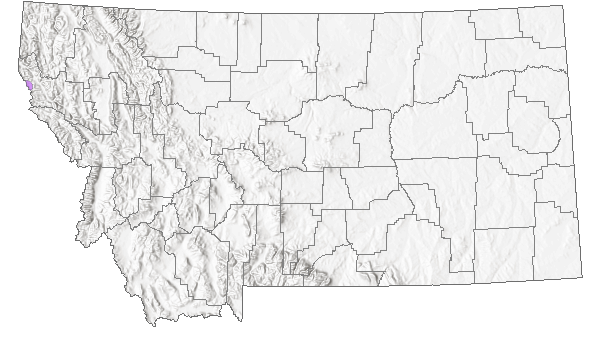
 Native
Range Comments
Currently thought to be restricted to a single location along the Idaho/Montana border.
Observations in Montana Natural Heritage Program Database
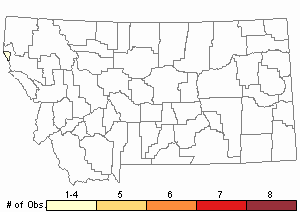
Number of Observations: 4
(Click on the following maps and charts to see full sized version)
Map Help and Descriptions
Relative Density
Recency
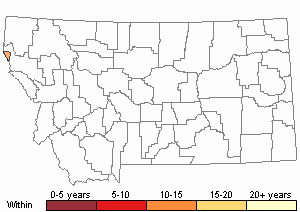
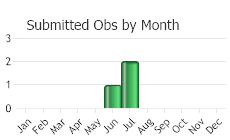
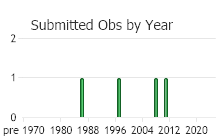
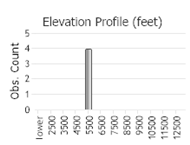 (Observations spanning multiple months or years are excluded from time charts)
Habitat
Open, subalpine ridges and slopes with shallow, gravelly soils (Bjork 2010).
National Vegetation Classification System Groups Associated with this Species
Grassland
Montane - Subalpine Grassland
Stewardship Responsibility
Threats or Limiting Factors
STATE THREAT SCORE REASON
Threat impact not assigned because threats are not known (MTNHP Threat Assessment 2021).
References
- Literature Cited AboveLegend:
 View Online Publication
- Lesica, P., M.T. Lavin, and P.F. Stickney. 2012. Manual of Montana Vascular Plants. Fort Worth, TX: BRIT Press. viii + 771 p.
 MTNHP Threat Assessment. 2021. State Threat Score Assignment and Assessment of Reported Threats from 2006 to 2021 for State-listed Vascular Plants. Botany Program, Montana Natural Heritage Program, Helena, Montana.
- Additional ReferencesLegend: View Online Publication
Do you know of a citation we're missing?- Bjork, C. R. 2010. Douglasia conservatorum (Primulaceae), a New Species from Idaho and Montana, U.S.A. NOVON 20:9-12.
- Lesica, P., M.T. Lavin, and P.F. Stickney. 2022. Manual of Montana Vascular Plants, Second Edition. Fort Worth, TX: BRIT Press. viii + 779 p.
- Web Search Engines for Articles on "Bloom Peak Douglasia"