View in other NatureServe Network Field Guides
NatureServe
Montana
Utah
Wyoming
Idaho
Wisconsin
British Columbia
South Carolina
Yukon
California
New York
Smooth Goosefoot - Chenopodium subglabrum
Other Names:
Chenopodium leptophyllum var. subglabrum
State Rank Reason (see State Rank above)
Chenopodium subglabrum is rare in Montana, where it is known from several widely scattered sites in central and eastern Montana. However, many sites have not been surveyed since the 1990's. Population counts are not well-documented, though based on available data they appear to be relatively small, perhaps numbering a few thousand plants. Since the plant is an annual species, populations may fluctuate widely from year to year. Chenopodium subglabrum may be negatively impacted by a lack of disturbance, such as from fire or flooding, which could help create or maintain its habitat. However, it is unclear as to if and to what extent habitat or populations have been reduced due to a lack of these disturbances and by subsequent vegetation succession.
Surveys that revisit known sites of Chenopodium subglabrum are greatly needed to document presence, population counts, distributions, and habitat conditions. Additional surveys of potential habitat are needed. Monitoring at a subset of sites to evaluate population trends and assess threats are also essential information that currently is lacking in Montana.
General Description
Smooth Goosefoot is an annual with erect, simple, or highly stems 2-3 (8) dm high. The alternate leaves are linear with entire margins, single veined, glabrous, up to 3 cm long. The small, green flowers are grouped in remote clusters in simple or branched spikes. Each flower lacks petals but has 5 glabrous sepals and 5 stamens. The 1-seeded fruit is compressed hemispheric and is relatively large; 1-2 mm across, exposing a jet-black fruit at maturity that readily separates from the pericarp (fruit wall).
Phenology
Fruiting occurs in late June-July.
Diagnostic Characteristics
Chenopodium fremontii also has narrow, entire-margined leaves, but they are larger and have three veins rather than just one. Chenopodium leptophyllum is similar but its leaves are grayish-mealy rather than nearly glabrous. Hitchcock et al. (1964, Vascular Plants of the Pacific Northwest Vol. 2) treats Chenopodium leptophyllum and C. subglabrum as conspecific.
Species Range
Montana Range
Range Descriptions
 Native
Range Comments
In MT known from Cascade, Fergus, Garfield, Sheridan and Carter counties; elsewhere WA east to AB and MB, south to NV, CO, NE and IA (Lesica et al. 2012. Manual of Montana Vascular Plants. BRIT Press. Fort Worth, TX).
Observations in Montana Natural Heritage Program Database
Number of Observations: 23
(Click on the following maps and charts to see full sized version)
Relative Density

Recency
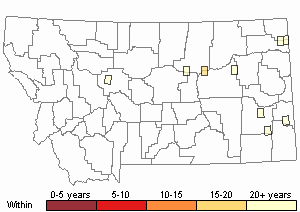
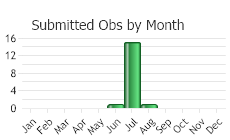
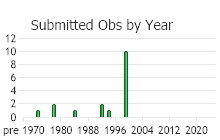
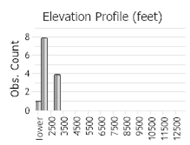 (Observations spanning multiple months or years are excluded from time charts)
Habitat
Smooth goosefoot grows in extremely loose, sandy soils and tends to occupy early successional, sparsely vegetated habitats. The unconsolidated sandy substrate is nutrient poor and droughty. In Montana, it inhabits sand dunes and occasional river sandbars or sandy terraces. In Alberta, Saskatchewan and Manitoba, the species is generally found on south- or west-facing, actively eroding slopes at the edge of stabilizing sand, and sometimes in dune slacks (Smith and Bradley 1990). Associates at a site in Harding County, South Dakota include Sporobolus cryptandrus, Chenopodium ambrosioides, Ambrosia acanthicarpa, Oryzopsis hymenoides, and Rumex venosus. (Legumes were noted to be absent.)
National Vegetation Classification System Groups Associated with this Species
Grassland
Lowland - Prairie Grassland
Wetland and Riparian
Riparian and Wetland Forest
Ecology
Smooth goosefoot is an annual that grows in habitats with loose sand deposited by wind or water. Populations are small, and are likely to migrate in position over time (Heidel 1990). The largest populations are in areas of finer and more compacted sand, and it rarely grows in highly unstable sand. It may occur in stabilized sand, however, populations in these habitats are always small. It cannot survive where succession leads to a continuous vegetation cover, and is vulnerable to competition from weedy exotics such as Melilotus officinalis and Euphorbia esula.
Like most members of the Goosefoot Family, this species is tolerant of both xeric and alkali-impregnated conditions (Smith and Bradley 1990). Like other species of the genus, it is wind-pollinated and is likely to have seeds that can survive one or more years until they germinate. It produces relatively few seeds per plant, so seedling establishment is presumed critical in its life history. Smooth goosefoot is an annual; populations develop from seed each year, and therefore population size is likely to fluctuate widely between years.
Management
Populations of the species are dependent on areas of active, drifting sand, most of which are now under cultivation. Stabilization of the remaining sand dune habitat is also a problem. Wallis and Wershler have suggested lack of fire as a major factor in stabilization of southern Alberta sand dunes (Smith and Bradley 1990; see also Lesica and Cooper 1998). Grazing is also thought to be important in maintaining a portion of unstabilized sandy habitats within these areas. A combination of fire and grazing during appropriate seasons is most effective in keeping blowouts active (Smith and Bradley 1990). Several sites in Alberta are leased for grazing, and include the largest provincial populations of the species.
In Alberta, one of the principal threats to this species is the invasion of non-native plants - particularly crested wheatgrass and sweet clovers - along oil and gas access roads and well-sites (Smith and Bradley 1990). Noxious weeds like Euphorbia esula (leafy spurge) can take over this species' habitat and already pose a threat elsewhere in its range (Smith and Bradley 1990). Tamarix chinensis (tamarisk), which has major impacts on river sandbar habitats, is invading the Powder River basin, where smooth goosefoot was first collected in Montana, in 1973.
Stewardship Responsibility
Threats or Limiting Factors
STATE THREAT SCORE REASON
Reported threats to Montana's populations of Smooth Goosefoot (Chenopodium subglabrum) are currently assigned as unknown. Discussions within the Montana Native Plant Society Threat Ranking Subcommittee indicated there are likely significant threats to Smooth Goosefoot; however, specific threat information needs to be brought forth (MTNHP Threat Assessment 2021).
References
- Literature Cited AboveLegend:
 View Online Publication
- Lesica, P., M.T. Lavin, and P.F. Stickney. 2012. Manual of Montana Vascular Plants. Fort Worth, TX: BRIT Press. viii + 771 p.
 MTNHP Threat Assessment. 2021. State Threat Score Assignment and Assessment of Reported Threats from 2006 to 2021 for State-listed Vascular Plants. Botany Program, Montana Natural Heritage Program, Helena, Montana.
- Additional ReferencesLegend: View Online Publication
Do you know of a citation we're missing?- Heidel, B. 1990. Inventory of rare plant species in Theodore Roosevelt National Park, Billings and McKenzie counties, North Dakota. Report to the National Park Service. North Dakota Natural Heritage Inventory, Bismarck, North Dakota. 112 pp.
- Heidel, B.L. and K.H. Dueholm. 1995. Sensitive plant survey in the Sioux District, Custer National Forest, 1994, Carter County, Montana and Harding County, South Dakota. Unpublished report to the Custer National Forest. Montana Natural Heritage Program, Helena, Montana. 95 pp. plus appendices.
- Heidel, B.L., S.V. Cooper and C. Jean. 2000. Plant species of special concern and plant associations of Sheridan County, Montana. Report to U.S. Fish and Wildlife Service. Montana Natural Heritage Program, Helena, Montana. 96 p.
- Hitchcock, C. L., A. Cronquist, M. Ownbey, and J. W. Thompson. 1964. Vascular Plants of the Pacific Northwest. Part 2: Salicaceae to Saxifragaceae. University of Washington Press, Seattle. 597 pp.
- Lesica, P. & S. V. Cooper. 1998. Succession and disturbance in sandhills vegetation: constructing models for managing biological diversity. Conservation Biology 13:293-302.
- Lesica, P., M.T. Lavin, and P.F. Stickney. 2022. Manual of Montana Vascular Plants, Second Edition. Fort Worth, TX: BRIT Press. viii + 779 p.
- Seipel, T.F. 2006. Plant species diversity in the sagebrush steppe of Montana. M.Sc. Thesis. Bozeman, MT: Montana State University. 87 p.
- Smith, B. and C. Bradley. 1990. Status report on smooth goosefoot (Chenopodium subglabrum (S. Wats.) (A. Nels.) a threatened species in Canada. Unpublished report. Committee on the Status of Endangered Wildlife in Canada, Calgary, AB 52 pp.
- Vanderhorst, J.P., S.V. Cooper, and B.L. Heidel. 1998. Botanical and vegetation survey of Carter County, Montana. Unpublished report prepared for the Bureau of Land Management. Montana Natural Heritage Program, Helena. 116 pp. + app.
- Web Search Engines for Articles on "Smooth Goosefoot"