View in other NatureServe Network Field Guides
NatureServe
Montana
Utah
Wyoming
Idaho
Wisconsin
British Columbia
South Carolina
Yukon
California
New York
Beautiful Bladderpod - Physaria pulchella
Other Names:
Lesquerella pulchella, Physaria carinata ssp. pulchella
State Rank Reason (see State Rank above)
Physaria pulchella is regoinal endemic where it occurs primarily in southwest Montana with some potential locations in adjacent Idaho. In Montana, plants are known from at least 20 occurrences that support a state population of more than 10,000 individuals. Population trends are unknown, but in the earlier 2000's were found to be relatively stable. Reported potential threats include invasive plant species and proximity to roads, but impact data is unavailable and assumed to be relatively minor and mostly limited in scope. Climate change may also pose a potential risk to the state's populations.
Continued revisits to known occurrences, at specified intervals, to collect data on population parameters, habitat conditions, and potential threats are necessary to maintain an accurate and timely state conservation status rank. Monitoring at a subset of populations is necessary to track population trends and assign a timely and accurate state conservation status rank. Additional surveys on lands modelled as predicted suitable habitat are also necessary to better understand the species distribution in the state.
General Description
Beautiful Bladderpod is an herbaceous perennial with unbranched, prostrate to ascending stems arising from a branched rootcrown and taproot. The basal leaves have short petioles and elliptic, entire-margined blades. The alternate stem leaves are smaller and lack petioles. The foliage is covered with branched hairs. Yellow, stalked flowers are borne at the tops of the stems in a narrow inflorescence that elongates as the fruit matures. Each flower has 4 separate petals, 4 separate sepals, and 4 long and 2 short stamens. The flattened capsules (siliques) are round to broadly elliptic with a keel on each face.
Phenology
Flowering occurs in June at lower elevations, and from mid-July through early August at higher elevations.
Diagnostic Characteristics
This species can be distinguished by the flattened, nearly circular fruits with a low ridge on each face, continuous with the style. Fruits of the similar L. carinata and L. paysonii are longer than broad.
Species Range
Montana Range
Range Descriptions
 Native
Range Comments
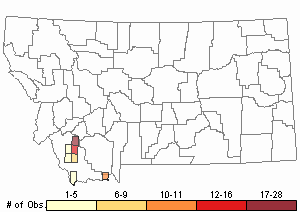
In Montana it is restricted to Beaverhead County in the Pioneer Mtns., the Grasshopper Creek drainage, and the Centennial Mtns. (Rollins 1995). Also collected from Lemhi County, Idaho (MONT 80967).
Observations in Montana Natural Heritage Program Database
Number of Observations: 83
(Click on the following maps and charts to see full sized version)
Relative Density
Recency
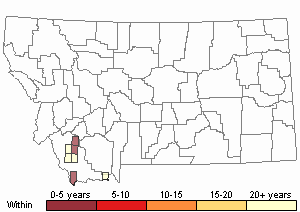
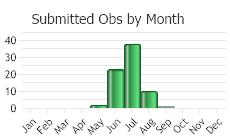
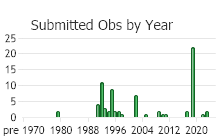
 (Observations spanning multiple months or years are excluded from time charts)
Habitat
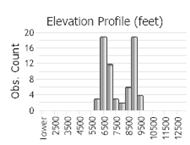
In Montana, this species has been found on gravelly, calcareous soils of sparsely vegetated foothill slopes at elevations ranging from 6200 to 7600 feet. It also occurs in poorly developed, stony soils of subalpine slopes and ridges in the Pioneer and Centennial mountain ranges at 8600-9200 feet. At lower elevations it inhabits openings in mountain mahogany or limber pine woodlands. It also is found in sparse grassland or cushion plant communities at all elevations. This plant is usually associated with calcareous parent material, although it is found on both limestone and associated quartzite in the Centennial Mountains.
National Vegetation Classification System Groups Associated with this Species
Alpine
Alpine - Sparse and Barren
Alpine - Vegetated
Forest and Woodland
Low Elevation - Xeric Forest and Woodland
Montane - Subalpine Forest and Woodland
Shrubland
Foothills - Montane Shrubland
Grassland
Montane - Subalpine Grassland
Ecology
This species is a short-lived perennial calciphile that occupies severe, sparsely vegetated habitats with low competition. It can also enter recently disturbed areas, as in Beaverhead County where small numbers of plants had colonized an open stream bed and an abandoned two-track. The species' natural habitat is subject to frost heave, and rodent burrowing has also been noted (Heidel and Vanderhorst 1996).
Management
Beautiful bladderpod occurs in areas with a history of human and natural disturbances. It appears to tolerate and may benefit from disturbances that reduce competition. Invasive weeds may become a threat; the closely related Lesquerella carinata var. languida is being threatened by spotted knapweed (Vanderhorst 1995). Several known populations occur in areas of historic mining activity.
Stewardship Responsibility
Threats or Limiting Factors
Threats to Montana's populations of Beautiful Bladderpod include invasive plant species and their proximity to roads at some occurrences. Impact data from these reported threats is not available.
Climate change may also pose a potential risk to the state's populations. The MTNHP conducted a species-level assessment using the Climate Change Vulnerability Index (CCVI) in 2021, which resulted in a Moderately Vulnerable rating to climate change. Climate change including increased ambient temperatures, decreased snowpacks, and increased frequencies and severities of drought could have negative impacts on this species; however, field-based data on the timing and magnitude are not available.
References
- Additional ReferencesLegend:
 View Online Publication
Do you know of a citation we're missing?- Al-Shehbaz, I. A. and S. L. O'Kane. 2002. Lesquerella is united with Physaria (Brassicaceae). Novon 12:319-329.
- Heidel, B.L. 1993. Status review of Lesquerella sp. novum, Butte District Bureau of Land Management, Montana. Unpublished report to the Bureau of Land Management. Montana Natural Heritage Program, Helena, Montana. 40 pp.
- Heidel, B.L. and J. Vanderhorst. 1996. Sensitive plant species surveys in the Butte District, Beaverhead and Madison Counties. Unpublished report to the Bureau of Land Management. Montana Natural Heritage Program, Helena, Montana.
- Lesica, P., M.T. Lavin, and P.F. Stickney. 2012. Manual of Montana Vascular Plants. Fort Worth, TX: BRIT Press. viii + 771 p.
- Lesica, P., M.T. Lavin, and P.F. Stickney. 2022. Manual of Montana Vascular Plants, Second Edition. Fort Worth, TX: BRIT Press. viii + 779 p.
- Rollins, R.C. 1995. Two Lesquerellas (Cruciferae) of south central and western Montana. Novon 5(1): 71-75.
- Vanderhorst, J.P. 1995. Report on the conservation status of Lesquerella carinata var. languida, a candidate threatened species. Unpublished report to the Bureau of Land Management and the U.S. Fish and Wildlife Service. Montana Natural Heritage Program, Helena, Montana 56 pp.
- Vanderhorst, J.P. 1995. Survey of Bannack State Park and vicinity for Montana plant species of special concern. Unpublished report to Bannack State Park, Montana Department of Fish, Wildlife, and Parks. Montana Natural Heritage Program, Helena, MT. 43 pp.
- Web Search Engines for Articles on "Beautiful Bladderpod"