View in other NatureServe Network Field Guides
NatureServe
Montana
Utah
Wyoming
Idaho
Wisconsin
British Columbia
South Carolina
Yukon
California
New York
Whitestem Goldenbush - Ericameria discoidea var. discoidea
Other Names:
Haplopappus macronema var. macronema
State Rank Reason (see State Rank above)
Ericameria discoidea variety discoidea is extremely rare in Montana where is it is known from one or two imprecisely mapped occurrences. Population counts are small, and data is over 30 years old. Plants occur in remote, rocky habitats near treeline which limits the potential for negative impacts and no significant or probable threats have been identified. Population trends are unknown.
Surveys that bring forth current data on the extent of known populations, number of plants, habitat conditions, and threats are greatly needed. Additional surveys of suitable habitat are also needed to determine if other populations occur in Montana.
General Description
Discoid Goldenweed is a low, rounded shrub with leafy stems that are 15-40 cm tall. Leaves are lance-shaped, widest above the middle, 1-3 cm long, and wavy-margined. The leaves and the inflorescence are glandular, the while stem is densely white-hairy. Flowering heads are borne in clusters of 1-3 at the ends of the branches. The glandular-hairy involucral bracts are 8-15 mm long, and the outer are broader and more leafy than the inner. Ray flowers are lacking. The 10-25 disk flowers are yellow and 8-11 mm long. The achenes have numerous, fine bristles on top.
Phenology
Flowering occurs in late July-August.
Diagnostic Characteristics
Few other Montana shrubs in the Aster family have stems that are covered with white, felt-like hair. Chrysothamnus parryi and C. nauseosus (rabbitbrush) usually have fewer than 12 flowers per head and the involucral bracts are arranged in well-defined vertical rows instead of overlapping like shingles as in Haplopappus. The other variety of this species in Montana, Haplopappus macronema var. linearis, has narrower leaves that are 8-20 times as long as wide and lack wavy margins.
Species Range
Montana Range
Range Descriptions
 Native
Range Comments
The range of this variety is from se. OR to sw. MT, south to CA and UT. The range of this species as a whole is c. ID, sw MT, south to CA, UT, and CO. Peripheral.
Observations in Montana Natural Heritage Program Database
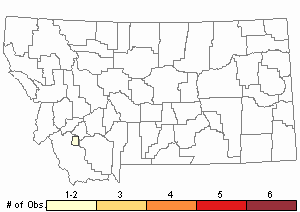
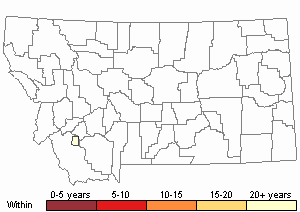
Number of Observations: 2
(Click on the following maps and charts to see full sized version)
Relative Density
Recency

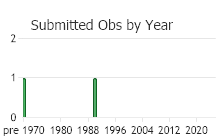
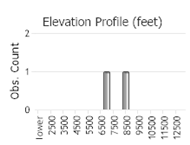 (Observations spanning multiple months or years are excluded from time charts)
Habitat
Haplopappus macronema var. macronema grows in rocky, open, sparsely wooded slopes or coarse talus near or above treeline. In the Pioneer Mountains, it grows at about 7600 feet on a south-facing talus slope with scattered whitebark pine, sagebrush, delphinium and gooseberry.
National Vegetation Classification System Groups Associated with this Species
Alpine
Alpine - Sparse and Barren
Alpine - Vegetated
Forest and Woodland
Montane - Subalpine Forest and Woodland
Shrubland
Sagebrush Shrubland
Sparse and Barren
Sparse and Barren
Ecology
Plants of discoid goldenweed grow in partial shade but are usually associated with sparse vegetation. Seedlings may not be able to establish in dense vegetation.
POLLINATORS The following animal species have been reported as pollinators of this plant species or its genus where their geographic ranges overlap:
Bombus bifarius,
Bombus centralis,
Bombus huntii, and
Bombus melanopygus (Williams et al. 2014).
Management
There are no documented threats to the population in the Pioneer Mountains.
Stewardship Responsibility
Threats or Limiting Factors
Reported threats to Whitestem Goldenbush have not been identified.
References
- Literature Cited AboveLegend:
 View Online Publication
 MTNHP Threat Assessment. 2021. State Threat Score Assignment and Assessment of Reported Threats from 2006 to 2021 for State-listed Vascular Plants. Botany Program, Montana Natural Heritage Program, Helena, Montana.
- Williams, P., R. Thorp, L. Richardson, and S. Colla. 2014. Bumble Bees of North America. Princeton, NJ: Princeton University Press. 208 p.
- Additional ReferencesLegend: View Online Publication
Do you know of a citation we're missing?- Hall, H.M. 1928. The genus Haplopappus, a phylogenetic study in the compositae. Carnegie Institution of Washington Publication No. 389, Washington D.C. 391 pp.
- Lesica, P. 1992. Vascular plant and sensitive plant species inventory for the Highland Mountains, Deerlodge National Forest. Unpublished report prepared for the Deerlodge National Forest. Montana Natural Heritage Program, Helena, MT. 21 pp. plus appendices, photographs.
- Lesica, P. 1994. Sensitive plant survey of BLM lands along the Big Hole River and in the Whitehall Valley. Montana Natural Heritage Program, Helena, MT. 13 pp.
- Lesica, P., M.T. Lavin, and P.F. Stickney. 2012. Manual of Montana Vascular Plants. Fort Worth, TX: BRIT Press. viii + 771 p.
- Lesica, P., M.T. Lavin, and P.F. Stickney. 2022. Manual of Montana Vascular Plants, Second Edition. Fort Worth, TX: BRIT Press. viii + 779 p.
- Schassberger, L.A. 1991. Rare plant inventory of the East Pioneer Mountains. Prepared for the USDA Forest Service, Region 1, Beaverhead National Forest. Montana Natural Heritage Program, Helena, MT. 55 pp.
- Vanderhorst, J.P. and P. Lesica. 1995a. Sensitive plant survey of the Tendoy Mountains in the Beaverhead National Forest, Beaverhead County, Montana. Unpublished report to the Bureau of Land Management, Butte District. Montana Natural Heritage Program, Helena, MT. 59 pp. plus appendices.
- Web Search Engines for Articles on "Whitestem Goldenbush"