View in other NatureServe Network Field Guides
NatureServe
Montana
Utah
Wyoming
Idaho
Wisconsin
British Columbia
South Carolina
Yukon
California
New York
Poison Hemlock - Conium maculatum
Other Names:
Poison-hemlock, Devil's Bread, Carrot Fern, Devil's Porridge, Poison Parsley, Spotted Corobane, Spotted Hemlock
Non-native Species
Global Rank:
G5
State Rank:
SNA
(see State Rank Reason below)
C-value:
0
Agency Status
USFWS:
USFS:
BLM:
State Rank Reason (see State Rank above)
Conium maculatum is native to Eurasia. Plants were brought to North America in the 1800s for ornamental purposes where they escaped from cultivated settings (Pokorny et al. 2018). Conium maculatum forms dense stands that outcompete native and desirable vegetation in numerous types of habitats, and are toxic to livestock and humans. A conservation status rank is not applicable (SNA) because the plant is exotic (non-native) to Montana and is not a suitable target for conservation activities.
General Description
PLANTS: A tall, biennial forb that grows 3 to 8 feet from a fleshy, white taproot. Stems are extensively branched, stout, hollow (between nodes), and purple-spotted. Plants lack hairs (glabrous). Base of stems are not, or are barely, swollen. Foliage has a strong musty odor while the roots smell of carrots or parsnips, however all portions of the plant are very poisonous. Sources: Lesica et al. 2022; Pokorny et al. 2018
LEAVES: Arranged as a basal rosette and alternately on the stem. Leaf stems (petioles) are present, with blades that are triangular in outline, 15-30 cm long. Blades are shiny, and 3 times divided (tripinnate) into lobed leaflets; the ultimate segments less than 1 mm long. Veins in the leaf terminate at the tips of serrations (teeth). Sources: Lesica et al. 2022; Pokorny et al. 2018
INFLORESCENCE: A compound umbel of tiny, white flowers that arise from the tip and nodes of the stem. Involucral and involucel bracts are present, lanceolate to ovate in shape. Involucral bracts are green with white margins. Fruit: A schizocarp of two, 1-seeded mericarps joined together on their inner faces (commissure). Mericarps: ovate, slightly compressed parallel to the commissure, and hairless (glabrous) with prominent raised ribs but barely winged, 2-3 mm long. Sources: Lesica et al. 2022; Pokorny et al. 2018
Phenology
Flowering occurs from July to August (Pokorny et al. 2018)
Diagnostic Characteristics
Whether by name or look, several members of the Apiaceae (Carrot or Parsley) Family can be look-a-likes. These plants are not ones to mis-identify because some are toxic or poisonous. Be conscious of your safety when examining plants. Keep in mind that other species - not listed below - may also be perceived as look-alikes!
Poison Hemlock -
Conium maculatum, non-native
* Plants: Highly poisonous. Hairs absent (glabrous).
* Stems: Lower portion is purple-spotted. Base is little, to not, swollen.
* Leaves: Glabrous and tri-pinnately divided into small ultimate segments; fern-like. Veins meet with tip of the leaf's tooth. No bulbs in leaf axils.
* Flowers: White. Sepals absent.
* Mericarps: Glabrous, prominent ribs raised, but barely winged and often wavy.
* Roots: Stout taproot.
* Habitats: Moist, disturbed places, such as along streams, ditches, and cool open slopes.
Queen Anne's Lace or Wild Carrot -
Daucus carota, non-native
* Plants: Hairs sparse (glabrate) to long and stiff (hirsute).
* Stems: Lower portion not purple-spotted. Base is not swollen.
* Leaves: Glabrous and bi-pinnately divided with leaflets being deeply divided. No bulbs in leaf axils.
* Flowers: White with the central flower of the central umbel often purple. Sepals minute.
* Mericarps: Ribs with barbed prickles (not glabrous).
* Roots: Stout taproot.
* Habitats: Along roads, trails, and in fields – often in areas with some disturbance.
Western Water-hemlock -
Cicuta douglasii, native
* Plants: Highly poisonous. Hairs absent (glabrous).
* Stems: Often branched. Lower portion not purple-spotted. Base is swollen.
* Leaves: Glabrous. Bi- to tri-pinnately divided. Tertiary venation twice as long as wide and enclosing sections of the leaflets. Primary lateral veins terminate in the sinuses between the serrations (teeth). No bulbs in leaf axils.
* Flowers: white or greenish.
* Mericarps: Glabrous. Prominent ribs are corky (at least as wide as the darkened intervals), but not winged.
* Roots: Thickened or tuberous. Internally are horizontally divided with cross partitions.
* Habitats: Moist meadows, streambanks, and wetlands.
Spotted Water-hemlock -
Cicuta maculata, native
* Plants: Highly poisonous. Hairs absent (glabrous).
* Stems: Often branched. Lower portion not purple-spotted. Base is swollen.
* Leaves: Glabrous and bi- to tri-pinnately divided. Tertiary venation of the leaflet is as long as wide. Primary lateral veins terminate in the sinuses between the serrations (teeth). No bulbs in leaf axils.
* Flowers: White or greenish.
* Mericarps: Glabrous. Prominent ribs are corky (at least as wide as the darkened intervals), but not winged.
* Roots: Thickened or tuberous. Internally are horizontally divided with cross partitions.
* Habitats: Moist meadows, woodlands, streambanks, and wetlands.
Bulb-bearing Water-hemlock -
Cicuta bulbifera, native
* Plants: Highly poisonous. Hairs absent (glabrous).
* Stems: Usually solitary. Lower portion not purple-spotted. Base is swollen.
* Leaves: Glabrous. Upper leaves are simple or once-pinnate with bulblets in the axils.
* Flowers: White. Often sterile.
* Mericarps: Ribs thick and raised, wider than the intervals.
* Roots: Thickened or tuberous.
* Habitats: Fens.
Hemlock Water-parsnip -
Sium suave, native
* Plants: Hairs absent (glabrous).
* Stems: Solitary. Lower portion not purple-spotted. Base is not swollen.
* Leaves: Glabrous. Emergent leaves are once-pinnate with lance-linear leaflets. Submerged leaves are bi- to tri-pinnately divided with narrower leaflets. Primary lateral veins sometimes terminate in the tips of the serrations (teeth). No bulbs in leaf axils.
* Flowers: White or greenish. Sepals minute.
* Mericarps: Glabrous and elliptical. Ribs corky, but not winged.
* Roots: Fibrous. Internally are horizontally divided with cross partitions.
* Habitats: In shallow fresh water and banks of streams, ponds, and wetlands.
Cow-Parsnip -
Heracleum lanatum, native
* Plants: Hairs present.
* Stems: Single, hollow, with short, soft hairs (pubescent). Lower portion not purple-spotted. Base is not swollen.
* Leaves: Veins pubescent. Leaves once-palmately divided into 3 leaflets. Leaflets broad, 3-7 lobed, and coarsely toothed. Petioles are basally dilated. No bulbs in leaf axils.
* Flowers: White and sweet-smelling. Sepals minute.
* Mericarps: Glabrous. Obovate. Dorsal ribs narrow. Marginal (lateral) ribs broadly winged.
* Roots: Stout taproot.
* Habitats: Moist places, such as avalanche slopes, thickets, open forests, woodlands, along streams, and drier wetlands.
Hemlock Parsley -
Conioselinum scopulorum, origin and presence unknown
* Plants: Sparsely hairy (glabrate).
* Stems: Single but sparingly branched and hollow. Lower portion not purple-spotted. Petioles are basally dilated. Base is not swollen.
* Leaves: Glabrate, bi- to tri-pinnately divided. Ultimate leaf lobes with one main vein. No bulbs in leaf axils.
* Flowers: White. Sepals absent.
* Mericarps: Glabrous. Elliptical. Dorsal ribs narrowly winged, low and corky. Marginal (lateral) ribs winged.
* Roots: Tuberous and fibrous.
* Habitats: Moist meadows, woodlands, streambanks, and wetlands.
Species Range
Montana Range
Range Descriptions
 Non-native
Range Comments
In Montana, the earliest documented herbarium specimen of Poison Hemlock was found in 1918 in Gallatin County (CPNWH 2026). Since 1934 the herbarium record demonstrates the spread of Poison Hemlock into other counties in south- and north-central, western, and northeastern Montana (Consortium of Pacific Northwest Herbaria 2026; Consortium of Great Plains Herbaria 2026).
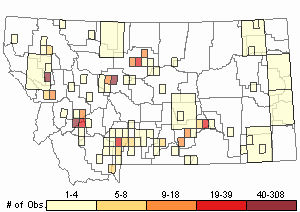
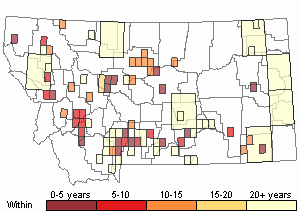
Observations in Montana Natural Heritage Program Database
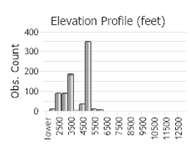
Number of Observations: 974
(Click on the following maps and charts to see full sized version)
Relative Density
Recency
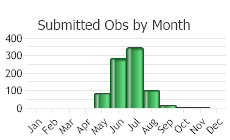
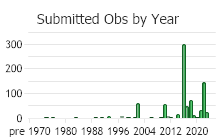
 (Observations spanning multiple months or years are excluded from time charts)
Habitat
Poison Hemlock occurs in moist, disturbed soil along streams, ditches, and cool open slopes within the plains and valleys zones in Montana (Lesica et al. 2022). It grows at lower elevations and can invade perennial croplands (Pokorny et al. 2018).
Ecology
TOXICITY FOR ANIMALS
Ingesting Poison Hemlock is usually fatal (USDA-ARS) 2018). For sheep, 100-500 grams, and for cattle, 200-500 grams, of eating green leaves can cause poisoning. Signs of poisoning usually appear within an hour of ingesting. Animals die from respiratory paralysis within 3 hours. Common signs of poisoning include: nervous trembling; loss of muscular control (ataxia), especially of the lower or hind limbs; salivation; lack of coordination; dilated pupils; rapid and weak pulse; coma; and death. Pregnant animals that eat Poison Hemlock will develop a deformed fetus. Toxins are also passed into the milk, which becomes contaminated. Refer also to the Management/Grazing section.
PLANT-INVERTEBRATE HABITAT
At the end of each growing season, the hollow stems become dry. When broken, the dried hollow stems serve as over-wintering or nesting sites for many bees and other invertebrates.
PLANT COLONIZATION & COMPETITION
Poison Hemlock commonly invades riparian corridors, especially where there is disturbance. After colonization, plant populations generally move downstream and then move outside the corridor to drier upland sites (Pokorny et al. 2018).
Poison Hemlock can invade perennial cropland, such as alfalfa fields (Pokorny et al. 2018). It poses a significant problem in the first cutting of the alfalfa. However, subsequent re-growth of alfalfa typically suppresses Poison Hemlock.
Biology
PLANT PHYSIOLOGY & CHEMISTRY
All parts of the Poison Hemlock plant are poisonous to humans, livestock (cattle, horses, goats, etc.), and wildlife. Plants contain 8 different alkaloids. Coniine and gamma-coniceine alkaloids affect the reproductive and central nervous systems. Coniine is found in the mature plant and the seed. Gamma-coniceine accounts for 98% of the alkaloids found in the early vegetative stages of growth.
Reproductive Characteristics
Poison Hemlock reproduces by seed.
FLOWERS
In summary: radial symmetry, 5-merous, perfect (stamens/ovary present), inferior ovary.
Sepals: absent. Petals: 5, separate (distinct), and white. Stamens: 5. Pistal: 2-fused and reflexed styles; 2-chambered (carpel), inferior (epigynous) ovary. Stylopodium (an enlargement borne between the base of the styles and top of the ovary): present, low-conic.
FRUITS
A schizocarp of two 1-seeded mericarps joined together on their inner faces (commissure). Mericarps (Seeds): ovate, slightly compressed parallel to the commissure, and hairless (glabrous), with prominent raised ribs but barely winged and often wavy, light brown, 2-3 mm long. Many oil tubes in the intervals between ribs.
LIFE CYCLE [Adapted from Pokorney et al. 2018]
Plants live for two years. When environmental conditions are conducive, 85% of the produced seeds (mericarps) will germinate. Seeds that don't germinate remain dormant for up to three-years, which is considered to be short-lived. Dormancy is broken by light, temperature, and moisture of favorable conditions. Upon germination, a large, basal rosette forms and usually remains present through the growing season. In its second year of life, a stem emerges from the rosette, grows tall, flowers, seeds, and dies. The minute wings of the seeds does not promote dispersal by wind. Rather, seeds either land near the parent plant or rely on birds and small mammals for dispersal. Clumps of dried stems often persist through the winter.
Management
COUNTY & STATE DESIGNATIONSAs of 2024, Poison Hemlock is listed as
County Noxious in 14 counties: Big Horn, Carter, Chouteau, Fallon, Gallatin, Golden Valley, Lincoln, Meagher, Musselshell, Powder River, Rosebud, Stillwater, Sweet Grass, and Yellowstone.
INTEGRATED VEGETATION MANAGEMENTAn integrated vegetative management approach provides the best long-term control, and requires that land-use objectives and a desired plant community be identified (Shelly et al.
in Sheley and Petroff 1999). Once identified, an integrated weed management strategy can be developed to promote a weed-resistant plant community and serve other land-use objectives such as with livestock forage, wildlife habitat, or recreation.
Poison Hemlock is an invasive, non-native (exotic) plant. Its establishment, spread, and growth are associated with disturbed soils, especially where moist or with higher nitrogen levels.
PREVENTION [Adapted from Pokorny et al. 2018]
Focus on preventing establishment, spread, and seed production, using a variety of practices:
* Learn to identify Poison Hemlock at various stages of development.
* If found, map and monitor populations and survey for additional plants.
* Avoid driving vehicles and other equipment through areas that have Poison Hemlock.
* Report new infestations to the landowner, land manager, or weed district.
GRAZING [Adapted from Pokorny et al. 2018; USDA-ARS 2018]
* Livestock grazing is NOT an option because plants are poisonous - containing 8 toxic alkaloids.
* Livestock that ingest Poison Hemlock can be treated, if caught in time (USDA-ARS 2018). Avoid stressing animals that are not recumbent. For recumbent livestock, support respiration and treat with activated charcoals and a saline cathartic. Parasympathetic symptoms can be treated with gastric lavage and atropine therapy. Animals that recover seldom show aftereffects. Pregnant animals that recover often give birth to deformed offspring.
* A livestock grazing management plant that does not excessively graze the rangeland creates resiliency to help prevent Poison Hemlock from establishing.
PHYSICAL and CULTURAL CONTROLS [Adapted from Pokorny et al. 2018]
Hand-pulling is effective for isolated or small infestations where the taproot is also removed. Pull before seed-set. Wear gloves and protective clothing to prevent skin irritations. Plants are tough, with thick stems and roots. Therefore, pull plants when soils are moist, and when plants are younger / smaller. Pulling and digging may require several consecutive years of effort where a seed bank has accumulated. Dispose of plants into a sealed plastic bag, tie, and let bake in the sun for at least two weeks before moving to the landfill.
Burning is not recommended because there is usually not adequate dry plant material available in the spring. Burning in the fall will not prevent seed production.
Mowing can removed bolting plants, which will deplete carbohydrate energy reserves in the taproot, prevent seed production, and reduce the plant's competitive advantage.
Tilling that is repeated can prevent Poison Hemlock from establishing - especially where crops are planted.
CHEMICAL [Adapted from Pokorny et al. 2018]
Herbicides can be effective, especially when properly integrated with intensive pasture management. The herbicide type and concentration, application time and method, environmental constraints, land use practices, local regulations, and other factors will determine its effectiveness and impact to non-target species. Strict adherence to application requirements defined on the herbicide label will reduce risks to human and environmental health. Consult your County Extension Agent and/or Weed District for information on herbicidal control. Chemical information is also available at
Greenbook.
Repeated herbicide applications are likely necessary to delete the seed bank. Once Poison Hemlock populations are under control, it is necessary to implement proper grazing, fertilizer application, and irrigation management to promote the growth of desired vegetation and reduce the risk of re-infestation.
Chlorsulfuron (Telar®) and
Metsulfuron (Escort®) herbicides provide excellent pre- and post-emergent control of Poison Hemlock. Their application is often every two to four years.
Phenoxy (2,4-D; MCPA) and
Glyphosate (Roundup®; Rodeo®) herbicides provide good control if applied in early spring after the rosettes emerge. Glyphosate herbicides will kill both grasses and forbs. Glyphosate and 2,4-D herbicides are usually applied annually. For details on application rates and timing see Pokorny et al. (2026) or talk with your local weed district.
BIOLOGICAL CONTROL [Adapted from Pokorny et al. 2018]
Poison Hemlock Moth (
Agonopterix alstroemeriana) was accidentally introduced into the USA, but has been permitted by the USDA-APHIS for redistribution to control Poison Hemlock plants. However, the moth's limited impact on stands makes it a low priority for redistribution in the USA. As of 2016, Poison Hemlock Moth is not approved for release in Canada to control Poison Hemlock plants.
Useful Links:Central and Eastern Montana Invasive Species TeamMontana Invasive Species websiteMontana Biological Weed Control Coordination ProjectMontana Department of Agriculture - Noxious WeedsMontana Weed Control AssociationMontana Weed Control Association Contacts WebpageMontana Fish, Wildlife, and Parks - Noxious WeedsMontana State University Integrated Pest Management ExtensionWeed Publications at Montana State University Extension - MontGuides
Stewardship Responsibility
Threats or Limiting Factors
Poison Hemlock is an aggressive non-native plant that forms dense stands and can outcompete native plant species and invade rangelands and perennial crop lands, like alfalfa fields. As a result, plants reduce forage availability or wildlife and livestock animals. The seeds can also contaminate harvested grain seed.
Poison Hemlock is toxic to humans and all types of livestock. Significant livestock losses occur when animals graze on fresh Poison Hemlock plants or when the plants contaminate harvested seed, silage, and hay. Animals that eat Poison Hemlock pass the toxins into their milk, or if pregnant to their offspring which can cause skeletal deformities or cleft palates. Palate and skeletal deformities in calves are indistinguishable from the lupine-induced crooked calf disease.
References
- Literature Cited AboveLegend:
 View Online Publication
- Lesica, P., M.T. Lavin, and P.F. Stickney. 2022. Manual of Montana Vascular Plants, Second Edition. Fort Worth, TX: BRIT Press. viii + 779 p.
- Pokorny, Monica, Stacy Davis, and Jane Mangold. 2018. Poison Hemlock, Conium maculatum. Montguide MT200013AG. Revised January 2018. Montana State University Extension, Bozeman, Montana.
 Sheley, Roger, and Janet Petroff. 1999. Biology and Management of Noxious Rangeland Weeds. Oregon State University Press, Corvallis, Oregon.
- U.S. Department of Agriculture-Agricultural Research Service. 2018. Poison Hemlock (Conium maculatum). Modified June 26th. Poisonous Plant Research. Logan, Utah.
- Additional ReferencesLegend: View Online Publication
Do you know of a citation we're missing?- Eggers, M.J.S. 2005. Riparian vegetation of the Montana Yellowstone and cattle grazing impacts thereon. M.Sc. Thesis. Montana State University, Bozeman, MT. 125 p.
- Hendrick, U. P., ed. 1972. Sturtevant's edible plants of the world. Dover Pub., New York. 188 pp.
- Hodgson, J.R. 1970. Ecological distribution of Microtus montanus and Microtus pennsylvanicus in an area of geographic sympatry in southwestern Montana. Ph.D. Dissertation. Bozeman, Montana: Montana State University. 65 p.
- James, W. R. 1973. Know your poisonous plants. Naturegraph Publishers, Healdsburg, Ca. 99pp.
- Lesica, P., M.T. Lavin, and P.F. Stickney. 2012. Manual of Montana Vascular Plants. Fort Worth, TX: BRIT Press. viii + 771 p.
- Munz, P.A., and D.D. Keck. 1973. A California flora and supplement. Univ. California Press, Berkeley, CA.
- Robbins, W. W., M. K. Bellue, and W. S. Ball. 1970. Weeds of California. State of California, Department of Agriculture.
- Web Search Engines for Articles on "Poison Hemlock"