View in other NatureServe Network Field Guides
NatureServe
Montana
Utah
Wyoming
Idaho
Wisconsin
British Columbia
South Carolina
Yukon
California
New York
Meltwater Lednian Stonefly - Lednia tumana
Other Names:
Mist Forestfly
State Rank Reason (see State Rank above)
This stonefly is currently listed as an "S1" Species of Concern in MT due to extremely limited number of populations, range and/or habitat, making them highly vulnerable to extirpation in the state or even global extinction. They are only known from a few locations in Glacier National Park, mostly from larval collections. Currently at risk of becoming extinct due to the melting of the glaciers in Glacier National Park, which they depend on for their alpine glacier stream habitat. The stonefly was listed as Threatened under the Endangered Species Act in 2019.
General Description
The Meltwater Lednian Stonefly is a small, dark species of extremely cold glacier-fed streams at high elevations in Glacier Park south through the Mission and Swan Ranges of northwestern Montana. Little else is known about its habits or ecology, except that the adults emerge in mid-summer (July-August) and mate during this time.
Phenology
Lednia tumana lives most of their lives (~1 years) in the water as nymphs (wingless, immature insects) and emerge as winged adults usually in July or August to find a mate and reproduce. Adult Lednia tumana are short lived (probably a week or less), making them difficult to collect at this life stage. They likely have poor dispersal as most stonefly adults are weak fliers.
Diagnostic Characteristics
Adults are 4.5-7.0 mm in length and dark brown with wings nearly as long or longer than the body (Baumann and Stewart 1980, Baumann and Kondratieff 2010). Adults fold their wings over their back and have antenna much longer than their head. Nymphs are a similar length (4.5-6.5 mm) but lack wings and live in streams. Lednia tumana nymphs lack gills and late instar nymphs are darkly colored. Lednia tumana can be separated from Zapada species by the lack of cervical gills.
Species Range
Montana Range
Range Descriptions
 Native
Range Comments
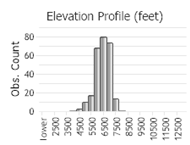
Known only from the Northern Rocky Mountains in Banff National Park, Alberta, South through Glacier National Park into the Mission and Swan Mountains. It is present on both sides of the Continental Divide in Flathead and Glacier counties at 1610 m to at least 2332 m elevation (Baumann and Kondratieff 2010, and Muhlfeld et al. 2011). Populations in Glacier National Park appear to be experiencing local population fragmentation and range contractions, possibly linked to a warming climate (Muhlfeld et al. 2011, Jordan et al. 2016, and Muhlfeld et al. 2020).
Observations in Montana Natural Heritage Program Database
Number of Observations: 275
(Click on the following maps and charts to see full sized version)
Relative Density
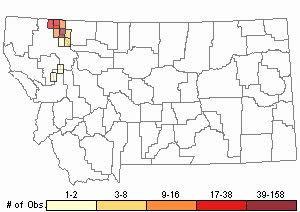
Recency
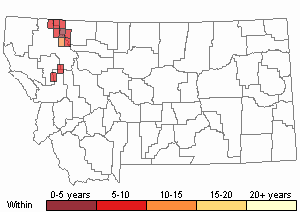
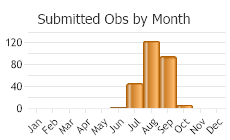
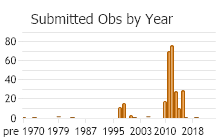
 (Observations spanning multiple months or years are excluded from time charts)
Migration
No migration is noted for this species, they are restricted in range and dispersal.
Habitat
The larvae are found in first-order small alpine, mountain streams (Newell and Minshall 1976, and Muhlfeld et al. 2011), but only those closely linked to glacial run-off (Giersch 2002). A closely related species, Lednia tetonica, lives in streams with cold water temperatures (<8.5°C) that originate from glaciers. These stoneflies live in streams with meltwater from both surface glaciers and subterranean ice (e.g., rock glaciers). Streams tend to be stable (i.e., low variation in flow, not flashy) with cobble substrate in the alpine zone of mountains (i.e., usually above treeline). One study suggested they can persist in areas after glaciers have melted (Muhlfeld et al. 2020); however, rock glaciers are very common and cryptic features on the landscape that are the source of streams with very cold, and stable conditions (Brighenti et al. 2021).
Food Habits
Stable isotope were used to investigate the diet of a closely related species in the Teton Range, Lednia tetonica. These stoneflies primarily ate biofilm (mixture of bacteria, fungi and algae growing on rocks) and the golden algae, Hydrurus (Jorgenson 2022). The proportion of food items consumed depended on their availability and the type of streams that the stonefly lived in (e.g., surface glacier or rock glacier). These stoneflies ate little coarse particulate organic matter (e.g., leaves; 9% on average) and some animal matter (e.g., predator).
Ecology
The Lednian meltwater stonefly spends most of their life in the aquatic egg and nymph forms and may complete their life cycles in a single year or in 2 to 3 years. Adults are short-lived and emerge from the water to mate on vegetation along the stream by July or August. Ecologically this species is a cold-water stenotherm that is unable to tolerate warm water temperatures (mean temperture exceeding 10 degrees Celsius, maximum temperture exceeding 18 degrees Celsius) and is generally collected within a few hundred meters of the base of glaciers or snow melt derived streams (Muhlfeld et al. 2011).
Reproductive Characteristics
Adults are present and presumably mating takes place in July and August (Baumann et al. 1977, Giersch personal communication).
Management
On October 4, 2016 the U.S. Fish and Wildlife Service proposed listing the Meltwater Lednian stonefly under the Endangered Species Act due to primarily to threats to the habitat and range of this species including climate change, loss of glaciers and permanent snowfields, and changes in stream flow and water temperature. On November 21, 2019 a notice was published in the Federal Register that the species' status was determined to be Threatened. Further information on status can be found on the U.S. Fish and Wildlife Service's
Species AccountStewardship Responsibility
Threats or Limiting Factors
Lednia tumana lives in streams originating from subterranean ice (e.g., rock glaciers) and surface glaciers. Physiological studies of the stoneflies have shown that they can survive high temperatures (e.g., 25°C) for short time periods (Hotaling et al. 2020) and that their supercooling point is below 0°C (Hotaling et al. 2021). This stonefly was reared at five temperatures (1, 4, 7, 13 and 21°C) over a 31-day period. Results suggest that their ideal temperature lies between 1 and 13°C (Shah et al. 2023).
References
- Literature Cited AboveLegend:
 View Online Publication
- Baumann, R. W. and K. W. Stewart. 1980. The nymph of Lednia tumana (Ricker) (Plecoptera:Nemouridae). Proceedings of the Entomological Society of Washington 82(4):655-659.
 Baumann, R.W. and B.C. Kondratieff. 2010. The stonefly genus Lednia in North America (Plecoptera: Nemouridae). Illiesia. 6:315-327.
- Brighenti, S., S. Hotaling, D.S. Finn, A.G. Fountain, M. Hayashi, D. Herbst, J.E. Saros, L.M. Tronstad, C.I. Millar. 2021. Rock glaciers and related cold rocky landforms: overlooked climate refugia for mountain biodiversity. Global Change Biol. 27:1504-1517. DOI: 10.1111/gcb.15510
- Giersch, J. J. 2002. Revision and phylogenetic analysis of the verrula and alberta species group of Rhyacophila pictet 1834 with description of a new species (Trichoptera: Rhyacophilidae). Master's of Science Thesis. Montana State University, Bozeman, MT. 206 pp.
- Green M.D., L.M. Tronstad, J.J. Giersch, A.A. Shah, C.E. Fallon, E. Blevins, T.R. Kai, C.C. Muhlfeld, D.S. Finn, and S. Hotaling. 2022. Stoneflies in the genus Lednia (Plecoptera: Nemouridae): sentinels of climate change impacts on mountain stream biodiversity. Biodiversity and Conservation. 31: 353-377.
- Hotaling, S., A.A. Shah, K.L. McGowan, L.M. Tronstad, J.J. Giersch, D.S. Finn, H.A. Woods, M.E. Dillon, J.L. Kelley. 2020. Mountain stoneflies may tolerate warming streams: evidence from organismal physiology and gene expression. Global Change Biology, 26:5524-5538.
- Hotaling, S., A.A. Shah, M.E. Dillon, J.J. Giersch, L.M. Tronstad, D.S. Finn, H.A. Woods, and J.L. Kelley. 2021. Cold tolerance of mountain stoneflies (Plecoptera: Nemouridae) from the high Rocky Mountains. Western North American Naturalist 81(1):54-62.
- Jordan, S., J.J. Giersch, C.H. Muhlfeld, S. Hotaling, L. Fanning, T.H. Tappenbeck, and G. Luikart. 2016. Loss of genetic diversity and increased subdivision in an endemic alpine stonefly threatened by climate change. PLoS ONE 11(6): e0157386. doi:10.1371/journal.pone.0157386.
- Jorgenson, K.L. 2022. Hydrologic source and trophic flexibility structure alpine stream food webs in the Teton Range, Wyoming. M.Sc. Thesis. Laramie, WY: University of Wyoming.
- Muhlfeld, C.C., J.J. Giersch, F.R. Hauer, G.T. Pederson, G. Luikart, D.P. Peterson, C.C. Downs and D.B. Fagre. 2011. Climate change links fate of glaciers and an endemic alpine invertebrate. Climatic Change 106:337-345.
- Muhlfeld, C.C., T.J. Cline, J.J. Giersch, E. Peitzsch, C. Florentine, D. Jacobsen, and S. Hotaling. 2020. Specialized meltwater biodiversity persists despite widespread deglaciation. Proceedings of the National Academy of Sciences May 2020, 202001697; DOI: 10.1073/pnas.2001697117
- Newell, R.L and G.W. Minshall. 1976. An annotated list of the aquatic insects of Southeastern Idaho. Part I. Plecoptera. The Great Basin Naturalist 36(4): 501-504.
- Shah, A.A., S. Hotaling, A.B. Lapsansky, R.L. Malison, J.H. Birrell, T. Keeley, J.J. Giersch, L.M. Tronstad, H.A. Woods. 2023. Warming undermines emergence success in a threatened alpine stonefly: a multi-trait perspective on vulnerability to climate change. Functional Ecology 37:1033-1043. DOI: 10.1111/1365-2435.14284
- U.S. Fish and Wildlife Service. ECOS Environmental Conservation Online System. Last updated 2022. Meltwater lednian stonefly (Lednia tumana) species account. Accessed 15 November 2023. https://ecos.fws.gov/ecp/species/8276
- Additional ReferencesLegend: View Online Publication
Do you know of a citation we're missing?- Baumann, R.W, A.R. Gaufin, and R.F. Surdick. 1977. The stoneflies (Plecoptera) of the Rocky Mountains. American Entomological Society, Philadelphia.
- Donald, D.B. and R.S. Anderson. 1977. Distribution of stoneflies (Plecotpera) of the Waterton River drainage, Alberta, Canada. Syesis 10:111-120
- Giersch, J.J., S. Hotaling, R.P. Kovach, L.A. Jones, and C.C. Muhlfeld. 2016. Climate-induced glacier and snow loss imperils alpine stream insects. Global Change Biology. 13 p. plus Supporting Information. doi: 10.1111/gcb.13565
- Hotaling, S., J.J. Giersch, D.S. Finn, L.M. Tronstad, S. Jordan, L.E. Serpa, R.G. Call, C.C. Muhlfeld, and D.W. Weisrock. 2019. Congruent population genetic structure but differing depths of divergence for three alpine stoneflies with similar ecology and geographic distributions. Freshwater Biology. 64:335-347
- Kondratieff, B.C. and R.A. Lechleitner. 2002. Stoneflies (Plecoptera) of Mount Rainer National Park, Washington. Western North American Naturalist 62(4):385-404.
- Merritt, R.W. and K.W. Cummins. 1996. An introduction to the aquatic insects of North America. 3rd Edition. Kendall/Hunt Publishing Company. Dubuque, Iowa. 862 pp.
- Stewart, K.W. and D.D. Zeigler. 1984. The use of larval morphology and drumming in Plecoptera systematics, and further studies of drumming behavior. Annales De Limnologie 20(1-2):105-114.
- Treanor, H.B., J.J. Giersch, K.M. Kappenman, C.C. Muhlfeld and M.A.H. Webb. 2013. Thermal tolerance of meltwater stonefly Lednia tumana nymphs from an alpine stream in Waterton-Glacier International Peace Park, Montana, USA. Freshwater Science 32(2): 597-605.
- Tronstad, L.M., S. Hotaling, J.J. Giersch, O.J. Wilmot, and D.S. Finn. 2020. Headwaters fed by subterranean ice: potential climate refugia for mountain stream communities? Western North American Naturalist 80(3):395-407.
- Web Search Engines for Articles on "Meltwater Lednian Stonefly"
- Additional Sources of Information Related to "Insects"