View in other NatureServe Network Field Guides
NatureServe
Montana
Utah
Wyoming
Idaho
Wisconsin
British Columbia
South Carolina
Yukon
California
New York
- Home - Return Home
- Kingdom - Animals - Animalia
- Phylum - Spiders, Insects, and Crustaceans - Arthropoda
- Class - Insects - Insecta
- Order - Dragonflies / Damselflies - Odonata
- Family - Clubtail Dragonflies - Gomphidae
- Species - Brimstone Clubtail - Stylurus intricatus
Brimstone Clubtail - Stylurus intricatus
State Rank Reason (see State Rank above)
This dragonfly is currently listed as an "S1" Species of Concern in MT due to extremely limited and/or rapidly declining population numbers, range and/or habitat, making it highly vulnerable to extirpation in the state. Currently only known from a few locations, mostly from larval collections and require shifting prairie river sandbars, this habitat is lost when damming a large river occurs.
General Description
The Brimstone Clubtail is a rare dragonfly found in the sandy-bottomed prairie rivers of the arid west. It probably reaches the northern distribution in Alberta and in Montana only inhabits the Powder River and lower Yellowstone and Missouri. This is a very pale clubtail with pale shins. The thorax is more pale than dark and mostly yellow-green.
Phenology
Main flying times occur from June through September.
Diagnostic Characteristics
Eyes spaced apart like most clubtails, moderate club and paler in color than most other clubtails in Montana.
Species Range
Montana Range
Range Descriptions
 Native
Range Comments
Distributed in spotty patches across the arid west from Southern California through N Mexico, north to Alberta and Montana's prairie rivers and east to the great plains rivers of Iowa and Nebraska.
Observations in Montana Natural Heritage Program Database
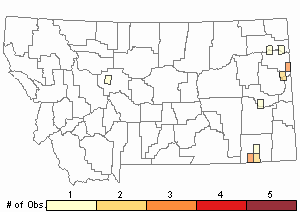
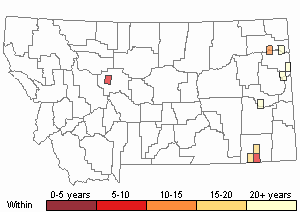
Number of Observations: 18
(Click on the following maps and charts to see full sized version)
Relative Density
Recency

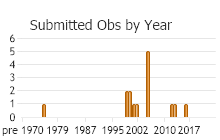
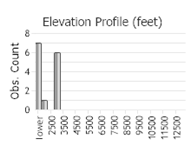 (Observations spanning multiple months or years are excluded from time charts)
Migration
Not known to migrate any distance.
Habitat
The habitat of the Brimstone Clubtail includes slow-moving, sand-bottomed, warm muddy rivers in open country and occasionally irrigation canals as well (Dunkle 2000, Paulson 2009).
National Vegetation Classification System Groups Associated with this Species
Wetland and Riparian
Riparian and Wetland Forest
Riparian Shrubland
Food Habits
Larvae feed on a wide variety of aquatic insects, such as mosquito larvae, other aquatic fly larvae, mayfly larvae, and freshwater shrimp. They will also eat very small fish and tadpoles. Adult dragonflies will eat almost any soft-bodied flying insect including mosquitoes, flies, small moths, mayflies, and flying ants or termites.
Reproductive Characteristics
Male Brimstone Clubtails fly wide-ranging patrols rapidly back and forth over the water, often hovering and perching. Females oviposit in rapid flight by tapping the water with their abdomens at regular intervals (Dunkle 2000, Paulson 2009). They land on grass leafs or limber weed stems and chose one that bends downward to put them in a "hanging" position.
Stewardship Responsibility
References
- Additional ReferencesLegend:
 View Online Publication
Do you know of a citation we're missing?- Dunkle, S.W. 2000. Dragonflies through binoculars: A field guide to dragonflies of North America. New York, NY. Oxford University Press. 266 pp.
- Hendricks, P., S. Lenard, D.M. Stagliano, and B.A. Maxell. 2013. Baseline nongame wildlife surveys on the Fort Peck Indian Reservation. Report to the Assiniboine and Sioux Tribes of the Fort Peck Indian Reservation. Montana Natural Heritage Program, Helena, MT. 83 p.
- Paulson, D.R. 2009. Dragonflies and Damselflies of the West. Princeton University Press, Princeton. 535 pp.
- Web Search Engines for Articles on "Brimstone Clubtail"
- Additional Sources of Information Related to "Insects"