View in other NatureServe Network Field Guides
NatureServe
Montana
Utah
Wyoming
Idaho
Wisconsin
British Columbia
South Carolina
Yukon
California
New York
Eastern Forktail - Ischnura verticalis
General Description
We do not yet have descriptive information on this species. Please try the buttons above to search for information from other sources.
Species Range
Montana Range
Range Descriptions
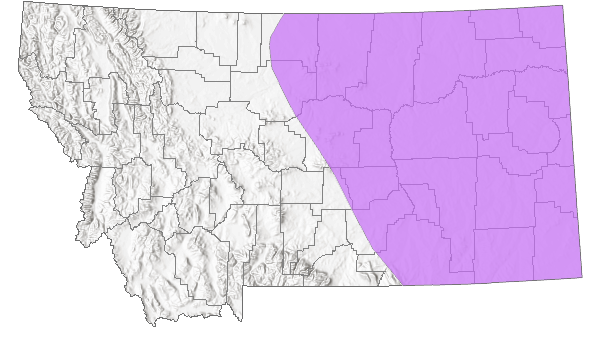
 Native
Range Comments
Common species of eastern Montana ponds and streams (Miller and Gustafson 1996).
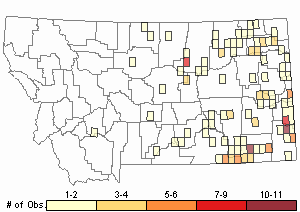
Observations in Montana Natural Heritage Program Database
Number of Observations: 192
(Click on the following maps and charts to see full sized version)
Map Help and Descriptions
Relative Density
Recency
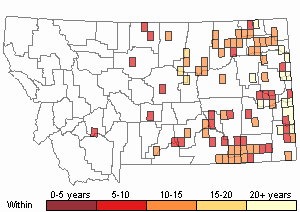
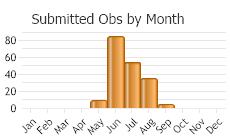
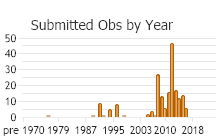
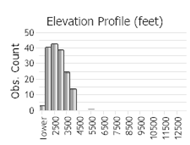 (Observations spanning multiple months or years are excluded from time charts)
Habitat
The Eastern Forktail chooses a variety of lentic habitats including ponds, lakes, and marshes, as well as slow streams and backwaters. This species avoids acidic water conditions and is not so restricted to mud-bottomed substrates, unlike other Ischnura species (Westfall and May 1996, Nikula et al. 2002, Acorn 2004, Paulson 2009).
National Vegetation Classification System Groups Associated with this Species
Wetland and Riparian
Alkaline - Saline Wetlands
Peatland
Riparian and Wetland Forest
Riparian Shrubland
Wet Meadow and Marsh
Food Habits
Eastern Forktails are quite aggressive predators. They will chase off other damselflies and have been reported eating damselflies as big as spreadwings. Although both sexes will do so, female Eastern Forktails are much more likely than males to eat other damselflies (Acorn 2004, Paulson 2009).
Reproductive Characteristics
Male Eastern Forktails are common at breeding sites and perch in and patrol through dense vegetation searching for females. They are rarely found our over open water. Females are also common at water as well as in nearby vegetation. Copulation is lengthy and females only mate a single time, using the male's sperm to fertilize all her eggs. They oviposit alone on floating or emergent stems of grasses or sedges (Nikula et al. 2002, Paulson 2009).
Stewardship Responsibility
References
- Literature Cited AboveLegend:
 View Online Publication
- Acorn, J. 2004. Damselflies of Alberta: flying neon toothpicks in grass. Edmonton, Alberta: University of Alberta Press. 156 pp.
 Miller, K.B. and D.L. Gustafson. 1996. Distribution records of the Odonata of Montana. Bulletin of American Odonatology 3(4):75-88.
- Nikula, B., J. Sones, D.W. Stokes, and L.Q. Stokes. 2002. Stokes beginner's guide to dragonflies and damselflies. Boston: Little, Brown. 159 pp.
- Paulson, D.R. 2009. Dragonflies and Damselflies of the West. Princeton University Press, Princeton. 535 pp.
- Westfall, M.J., Jr. and M.L. May. 1996. Damselflies of North America. Scientific Publishers, Gainesville, Florida. 649 pp.
- Additional ReferencesLegend: View Online Publication
Do you know of a citation we're missing?- Dunkle, S.W. 2000. Dragonflies through binoculars: A field guide to dragonflies of North America. New York, NY. Oxford University Press. 266 pp.
- Hendricks, P., S. Lenard, D.M. Stagliano, and B.A. Maxell. 2013. Baseline nongame wildlife surveys on the Fort Peck Indian Reservation. Report to the Assiniboine and Sioux Tribes of the Fort Peck Indian Reservation. Montana Natural Heritage Program, Helena, MT. 83 p.
- Web Search Engines for Articles on "Eastern Forktail"
- Additional Sources of Information Related to "Insects"