View in other NatureServe Network Field Guides
NatureServe
Montana
Utah
Wyoming
Idaho
Wisconsin
British Columbia
South Carolina
Yukon
California
New York
- Home - Return Home
- Kingdom - Animals - Animalia
- Phylum - Spiders, Insects, and Crustaceans - Arthropoda
- Class - Insects - Insecta
- Order - Dragonflies / Damselflies - Odonata
- Family - Spread-winged Damselflies - Lestidae
- Species - Northern Spreadwing - Lestes disjunctus
Northern Spreadwing - Lestes disjunctus
General Description
This is a relatively large damselfly 1 ¼ to 1 ¾ inches (30 to 41 mm) long. The build is slender with short wings in proportion to the length of the abdomen. The thorax is bronze-black with a yellow stripe down the center on the upper surface.
Species Range
Montana Range
Range Descriptions
 Native
Range Comments
Until recently, the Northern Spreadwing was known as the Common Spreadwing with two distinct subspecies, (L. d. disjunctus - northern race and L. d. australis - southern race). These subspecies have been separated into two separate species, Northern Spreadwing and (L. australis) Southern Spreadwing.
The Northern Spreadwing has an extensive range. It is found from Alaska across northern Canada to Labrador, and south to Florida and California. In Montana it is found throughout the state, especially in wetland and lake areas - Red Rocks, Seeley-Swan, Prairie Potholes.
Observations in Montana Natural Heritage Program Database
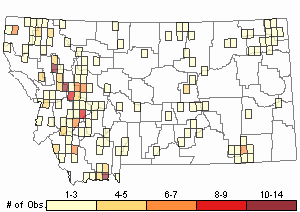
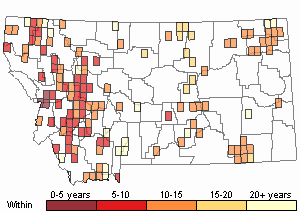
Number of Observations: 321
(Click on the following maps and charts to see full sized version)
Relative Density
Recency
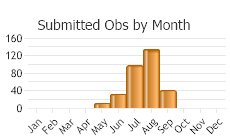
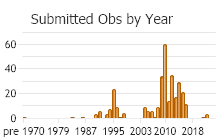
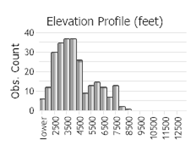 (Observations spanning multiple months or years are excluded from time charts)
Habitat
Northern Spreadwings prefer still-water and well-vegetated habitats of lakes and ponds, some of which can be temporary, as well as marshes, swamps, pools and bogs, and even slow, sluggish streams. (Westfall and May 1996, Nikula et al. 2002, Acorn 2004, Paulson 2009).
Ecological Communities Associated with this Species
Wetland and Riparian
Alkaline - Saline Wetlands
Alpine Riparian and Wetland
Peatland
Riparian and Wetland Forest
Riparian Shrubland
Wet Meadow and Marsh
Food Habits
Larvae feed on a wide variety of aquatic insects, such as mosquito larvae, other aquatic fly larvae, mayfly larvae, and freshwater shrimp.
Adult- This damselfly will eat almost any soft-bodied flying insect including mosquitoes, flies, small moths, mayflies, and flying ants or termites.
Ecology
At the large marsh in Red Rock NWR this species swarms in late summer, together with the Spotted Spreadwing (L. congener), and the Emerald Spreadwing (L. dryas). The larvae (naiads) are very active, rapacious hunters, which makes them vulnerable to predation by fish. As a result, they are often found in shallow marshes and ponds areas that may dry up in summer, and thus lack fish. However, this species does occur in permanent bodies of water as well. The naiads have from the time the pond fills up in the spring to when it dries up in the summer to mature and emerge.
Reproductive Characteristics
Male Northern Spreadwings spend a predominant amount of their time perched on emergent vegetation with only short flight periods. Females arrive at breeding sites ready to mate and copulation commences quickly. Tandem pairs complete oviposition with the female slicing the stems of bulrushes or sedges open with her ovipositer. Northern Spreadwings are also known to submerge entirely in tandem during oviposition - an unusual behavior for spreadwings - occasionally returning to the surface for air (Nikula et al. 2002, Paulson 2009).
The Northern Spreadwing is another Lestes species (Emerald and Lyre-tipped Spreadwings) where the deposited eggs halt their development and overwinter before restarting again after the wetland fills with water or unfreezes in the spring (Acorn 2004).
Stewardship Responsibility
References
- Literature Cited AboveLegend:
 View Online Publication
- Acorn, J. 2004. Damselflies of Alberta: flying neon toothpicks in grass. Edmonton, Alberta: University of Alberta Press. 156 pp.
 Nikula, B., J. Sones, D.W. Stokes, and L.Q. Stokes. 2002. Stokes beginner's guide to dragonflies and damselflies. Boston: Little, Brown. 159 pp.
- Paulson, D.R. 2009. Dragonflies and Damselflies of the West. Princeton University Press, Princeton. 535 pp.
- Westfall, M.J., Jr. and M.L. May. 1996. Damselflies of North America. Scientific Publishers, Gainesville, Florida. 649 pp.
- Additional ReferencesLegend: View Online Publication
Do you know of a citation we're missing?- Dunkle, S.W. 2000. Dragonflies through binoculars: A field guide to dragonflies of North America. New York, NY. Oxford University Press. 266 pp.
- Hendricks, P., S. Lenard, D.M. Stagliano, and B.A. Maxell. 2013. Baseline nongame wildlife surveys on the Fort Peck Indian Reservation. Report to the Assiniboine and Sioux Tribes of the Fort Peck Indian Reservation. Montana Natural Heritage Program, Helena, MT. 83 p.
- Sater, S. 2022. The insects of Sevenmile Creek, a pictorial guide to their diversity and ecology. Undergraduate Thesis. Helena, MT: Carroll College. 242 p.
- Web Search Engines for Articles on "Northern Spreadwing"
- Additional Sources of Information Related to "Insects"