View in other NatureServe Network Field Guides
NatureServe
Montana
Utah
Wyoming
Idaho
Wisconsin
British Columbia
South Carolina
Yukon
California
New York
Band-winged Meadowhawk - Sympetrum semicinctum
General Description
We do not yet have descriptive information on this species. Please try the buttons above to search for information from other sources.
Species Range
Montana Range
Range Descriptions
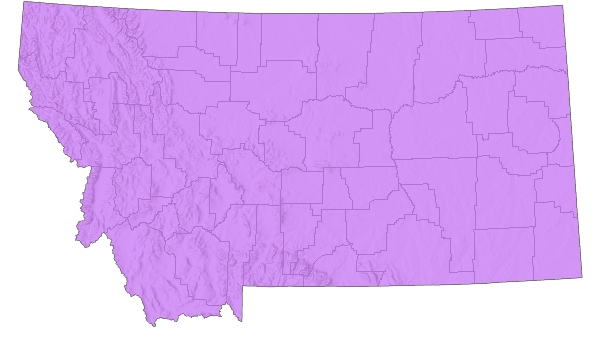
 Native
Range Comments
Formerly recognized as Western Meadowhawk (Sympetrum occidentale) and S. fasciatum (Paulson 2007). Statewide; S. semicinctum occidentale occurs in northwestern Montana, and S. semicinctum fasciatum occurs throughout the rest of the state (Miller and Gustafson 1996, Paulson 2007).
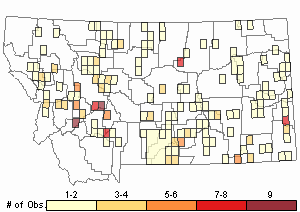
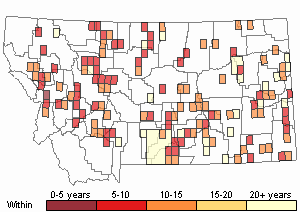
Observations in Montana Natural Heritage Program Database
Number of Observations: 333
(Click on the following maps and charts to see full sized version)
Map Help and Descriptions
Relative Density
Recency
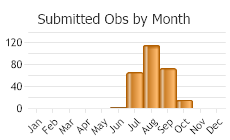
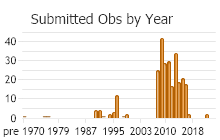
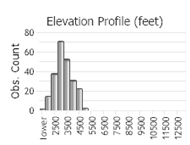 (Observations spanning multiple months or years are excluded from time charts)
Habitat
The Band-winged Meadowhawk prefers open, shallow ponds and marshes, as well as bogs and fens with some water flow from spring-fed seepages, especially at stream overflows (Dunkle 2000, Nikula et al. 2002, Paulson 2009).
National Vegetation Classification System Groups Associated with this Species
Wetland and Riparian
Alkaline - Saline Wetlands
Alpine Riparian and Wetland
Peatland
Riparian and Wetland Forest
Wet Meadow and Marsh
Food Habits
Larvae feed on a wide variety of aquatic insects, such as mosquito larvae, other aquatic fly larvae, mayfly larvae, and freshwater shrimp. They will also eat very small fish and tadpoles.
Adult- The dragonfly will eat almost any soft-bodied flying insect including mosquitoes, flies, small moths, mayflies, and flying ants or termites.
Reproductive Characteristics
Male Band-winged Meadowhawks make short patrols over the water and perch high in nearby vegetation. Females are usually in tandem with males during ovipisition which is completed in flight by dipping to the water among emergent plants (Dunkle 2000, Nikula et al. 2002, Paulson 2009).
Stewardship Responsibility
References
- Literature Cited AboveLegend:
 View Online Publication
- Dunkle, S.W. 2000. Dragonflies through binoculars: A field guide to dragonflies of North America. New York, NY. Oxford University Press. 266 pp.
 Nikula, B., J. Sones, D.W. Stokes, and L.Q. Stokes. 2002. Stokes beginner's guide to dragonflies and damselflies. Boston: Little, Brown. 159 pp.
- Paulson, D.R. 2009. Dragonflies and Damselflies of the West. Princeton University Press, Princeton. 535 pp.
- Paulson, D.R., 2007. 'The importance of forests to neotropical dragonflies.' Pp. 79-101 in Forests and Dragonflies, Fourth WDA International Symposium of Odonatology, Pontevedra (Spain), July 2005, A. Cordero Rivera ed.
- Additional ReferencesLegend: View Online Publication
Do you know of a citation we're missing?- Acorn, J. 2004. Damselflies of Alberta: flying neon toothpicks in grass. Edmonton, Alberta: University of Alberta Press. 156 pp.
- Nelson, Howard E. 1953. The summer dragonflies of Flathead Valley, Montana. M.A. Thesis. University of Montana. Missoula, MT.
- Sater, S. 2022. The insects of Sevenmile Creek, a pictorial guide to their diversity and ecology. Undergraduate Thesis. Helena, MT: Carroll College. 242 p.
- Web Search Engines for Articles on "Band-winged Meadowhawk"
- Additional Sources of Information Related to "Insects"