View in other NatureServe Network Field Guides
NatureServe
Montana
Utah
Wyoming
Idaho
Wisconsin
British Columbia
South Carolina
Yukon
California
New York
Plains Emerald - Somatochlora ensigera
General Description
A conspicuously marked species, easily known by its almost entirely yellow face, the peculiar shape of the anal appendages of the male, and the very short anal appendages of the female, together with a long projecting vulvar lamina (Walker and Corbett, 1975). Length 48-51 mm.; abdomen 35-38; hind wing 33-35. An inland species of medium size and well-defined markings. Orange labrum with black front border and median basal spot. Frons has a broad cap of metallic blue green; its side spots of yellow narrow forward to meet or nearly meet on middle line in front. Occiput shining brown. Thorax scantily hairy. Side stripes of thorax and of abdominal segment 2 bright yellow, bordered by black. Thorax dark reddish brown in front, with yellow carina; it becomes bluish toward crest and between yellow stripes on sides. Wings hyaline, touched with amber yellow at extreme base. Costa ochre yellow; stigma blackish; veins brown. Abdomen brown, much swollen on segment 2; two large antero-lateral spots, in male a smaller postero-lateral spot runs down and half covers genital lobe. Of two usual elongate lateral triangles on segment 3, lower one is much longer. Remainder of abdomen and caudal appendages black. This species nearly like linearis but smaller and more brightly marked with yellow. Caudal appendages of male more slender and more nearly parallel in their apical third. Ovipositor of female longer, straighter, more slender (Needham and Westfall, 1955).
Species Range
Montana Range
Range Descriptions
 Native
Range Comments
Montana is the type locality for this species.
Observations in Montana Natural Heritage Program Database
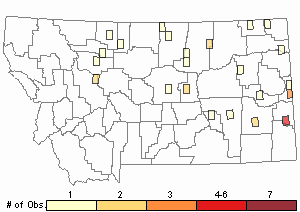
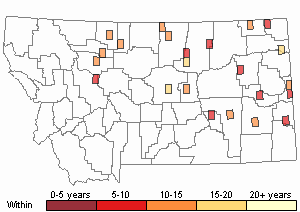
Number of Observations: 36
(Click on the following maps and charts to see full sized version)
Relative Density
Recency
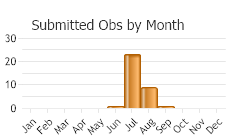
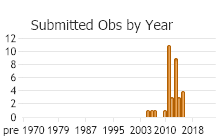
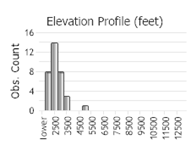 (Observations spanning multiple months or years are excluded from time charts)
Habitat
The Plains Emerald prefers habitats of streams, small rivers,and ditches with pools and riffles in open areas (Dunkle 2000, Paulson 2009).
National Vegetation Classification System Groups Associated with this Species
Wetland and Riparian
Riparian and Wetland Forest
Riparian Shrubland
Food Habits
Larvae feed on a wide variety of aquatic insects, such as mosquito larvae, other aquatic fly larvae, mayfly larvae, and freshwater shrimp. They will also eat very small fish and tadpoles.
Adult- The dragonfly will eat almost any soft-bodied flying insect including mosquitoes, flies, small moths, mayflies, and flying ants or termites.
Reproductive Characteristics
Male Plains Emeralds are territorial and patrol up and down streams slowly with periodic hovering. Females oviposit into muddy or gravelly shores above the waterline or directly into the water (Dunkle 2000, Paulson 2009).
Stewardship Responsibility
References
- Literature Cited AboveLegend:
 View Online Publication
- Dunkle, S.W. 2000. Dragonflies through binoculars: A field guide to dragonflies of North America. New York, NY. Oxford University Press. 266 pp.
 Needham, J.G. and M.J. Westfall, Jr. 1954. A manual of the dragonflies of North America (Anisoptera). University of California Press, Berkeley. 615 pp.
- Paulson, D.R. 2009. Dragonflies and Damselflies of the West. Princeton University Press, Princeton. 535 pp.
- Walker, E.M. and P.S. Corbet. 1975. The Odonata of Canada and Alaska. Vol. 3, Part III: The Anisoptera--Three Families. Univ. Toronto Press, Canada.
- Web Search Engines for Articles on "Plains Emerald"
- Additional Sources of Information Related to "Insects"