View in other NatureServe Network Field Guides
NatureServe
Montana
Utah
Wyoming
Idaho
Wisconsin
British Columbia
South Carolina
Yukon
California
New York
Common Green Darner - Anax junius
General Description
The Green Darner is a common and widespread member of the family Aeshnidae. Darners are among the largest and fastest-flying North American dragonflies, 2 1/4-4 3/4" (57-120 mm) long. Green Darners are found state-wide from the mountians to the prairies with a subspecies in the east and in the western part of the state. Due to the Common Green Darner's highly migratory nature, they can also be seen in a wide variety of non-wetland habitats as well. Green Darners inhabit a variety of well-vegetated lakes, ponds, marshes, and vernal pools, some temporary or even brackish, as well as small streams. This species prefers habitats that lack fish (Nikula et al. 2002, Paulson 2009, Dunkle 2000). Of the darners in Montana, the only one with a fully green thorax and a blue striped abdomen. Associated Wetland Ecological Systems: Western Emergent Marsh, Northern Rocky Mountain Wooded Vernal Pool, Great Plains Open Freshwater Depressional Wetland, Perennial Praire Streams.
Species Range
Montana Range
Range Descriptions
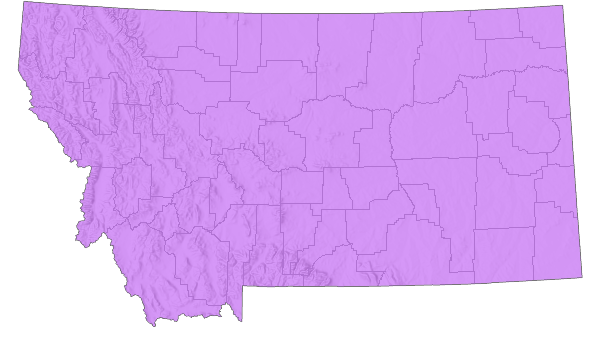
 Native
Range Comments
Common Green Darners, although a native North American species, are also a wide ranging migrant dragonfly. They occur as far south as Honduras, the West Indies, and Hawaii. They are vagrants to Alaska, eastern Asia, Britain, and France (Dunkle 2000, Paulson 2009).
Observations in Montana Natural Heritage Program Database
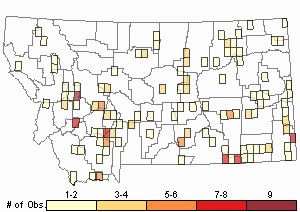
Number of Observations: 237
(Click on the following maps and charts to see full sized version)
Map Help and Descriptions
Relative Density
Recency
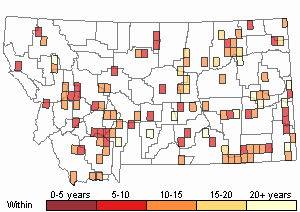
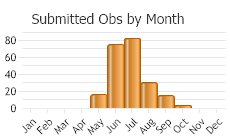
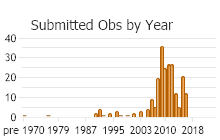
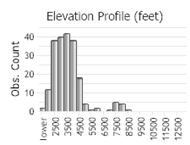 (Observations spanning multiple months or years are excluded from time charts)
Migration
Common Green Darners are both migratory and breeders in Montana. Mature adults move north early in spring, long before other resident have emerged. These migratory individuals then breed in appropriate wetlands and the larvae develop, emerge late in summer, and migrate out of the state in the early fall (Paulson 2009).
Habitat
Common Green Darners inhabit a variety of well-vegetated lakes, ponds, marshes, and vernal pools, some temporary or even brackish, as well as small streams. This species prefers habitats that lack fish. Due to the Common Green Darner's highly migratory nature, they can also be seen in a wide variety of non-wetland habitats as well (Dunkle 2000, Nikula et al. 2002, Paulson 2009).
National Vegetation Classification System Groups Associated with this Species
Wetland and Riparian
Alkaline - Saline Wetlands
Peatland
Riparian and Wetland Forest
Riparian Shrubland
Wet Meadow and Marsh
Food Habits
Larvae feed on a wide variety of aquatic insects, such as mosquito larvae, other aquatic fly larvae, mayfly larvae, and freshwater shrimp. They will also eat very small fish and tadpoles.
Adult- The dragonfly will eat almost any soft-bodied flying insect including mosquitoes, flies, small moths, mayflies, and flying ants or termites.
Reproductive Characteristics
Male Common Green Darners patrol irregular territories along open water and shorelines often clashing with other males and searching for females. Copulation is completed away from breeding sites, probably to avoid harassment by other males. Oviposition usually in tandem (unique for darners) on floating or submerged stems and leaves as well as woody branches. Single males often try to dislodge males from tandem pairs (Dunkle 2000, Nikula et al. 2002, Paulson 2009).
Stewardship Responsibility
References
- Literature Cited AboveLegend:
 View Online Publication
- Dunkle, S.W. 2000. Dragonflies through binoculars: A field guide to dragonflies of North America. New York, NY. Oxford University Press. 266 pp.
 Nikula, B., J. Sones, D.W. Stokes, and L.Q. Stokes. 2002. Stokes beginner's guide to dragonflies and damselflies. Boston: Little, Brown. 159 pp.
- Paulson, D.R. 2009. Dragonflies and Damselflies of the West. Princeton University Press, Princeton. 535 pp.
- Additional ReferencesLegend: View Online Publication
Do you know of a citation we're missing?- Hendricks, P., S. Lenard, D.M. Stagliano, and B.A. Maxell. 2013. Baseline nongame wildlife surveys on the Fort Peck Indian Reservation. Report to the Assiniboine and Sioux Tribes of the Fort Peck Indian Reservation. Montana Natural Heritage Program, Helena, MT. 83 p.
- Nelson, Howard E. 1953. The summer dragonflies of Flathead Valley, Montana. M.A. Thesis. University of Montana. Missoula, MT.
- Wells, E.A. 1986. Alpine limnology of selected water bodies on the Beartooth Plateau, Montana, with emphasis on benthos. Ph.D. Dissertation. Bozeman, MT: Montana State University. 401 p.
- Web Search Engines for Articles on "Common Green Darner"
- Additional Sources of Information Related to "Insects"